Ochem Only Reactions + Questions that Ask Stability
 Call Kai
 Learn
 Practice Test
 Spaced Repetition
 Match
 Flashcards
 Knowt Play
1/32

Earn XP
Description and Tags
Know your definitions of isomers first!
33 Terms
Heterolytic vs homolytic formation
Hint: Is it an equal relationship or an abusive relationship?
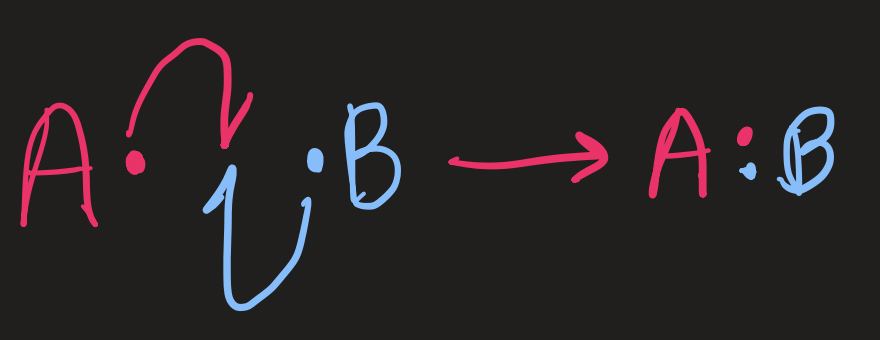
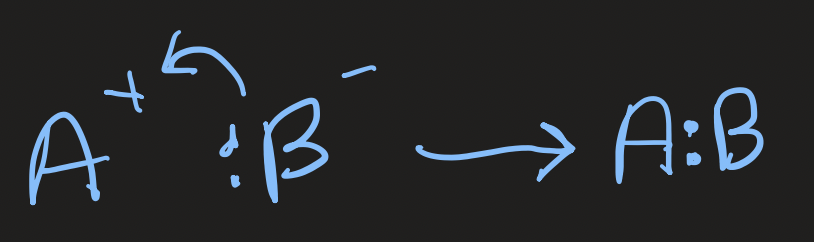
Homo = equal exchange = they both had to have radical e-
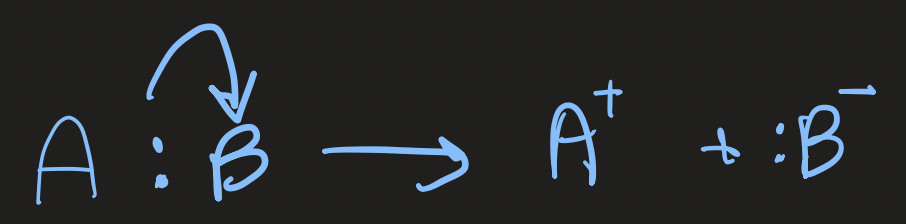
Heterolytic vs homolytic breakage
Hint: Is it an equal breakup or an abusive breakup?

Radical substitution rxn

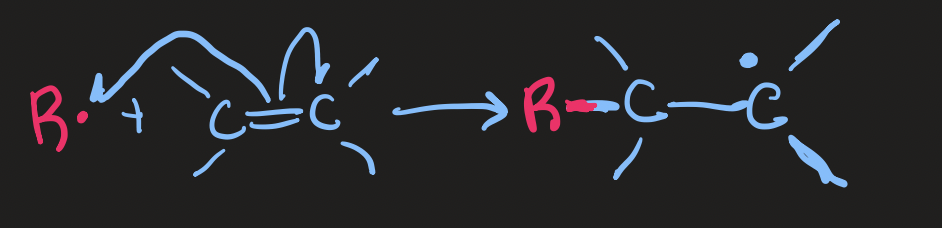
Radical addition rxn
Degree of Unsaturation formula (NOT on formula sheet)

where N is # of Nitrogens, X is # of Halogens btw
The alternative Degree of Unsaturation formula (NOT on formula sheet)
DoU = # of rings + # of π bonds in structure
(HARD) Stability of Alkene depends on… also include the reasons why…
Degree of Substitution (The more NON-hydrogen groups beside a C=C bond, the better stable)
Steric strain (The farther apart bulky groups are, the better stable)
Why?
Hyperconjugation (having substituted groups “stabilizes the C=C antibonding molecular orbital, π*”)
Bond strengths (sp2-sp3 bonds are better than sp3-sp3 bonds, so C=C likes to be in the centre of compound)
Again, Steric strain
Explain thoroughly Markovnikov’s Rule (why Br prefers to go to the more substituted carbon)
Highly substituted carbocations are more stable than less substituted ones (the thermodynamic argument).
It requires less energy to create the transition state for the rxn with the highly subbed carbocat, so the rxn proceeds faster than other rxns (the kinetic argument).
Derek Jackson’s Goat Rule Law
Achiral reactants will give “overall” achiral products.
You have done something wrong if you end up with a single, chiral product. Maybe you missed an enantiomer, which would create a racemic mixture (overall achiral).
Which carbocation is more stable?

The right one is more stable. Although both have the same degree of substitution, the right one can make resonance structures.

Stability of a Carbocation depends on… also include the reasons why…
Degree of Substitution (the # of NON-hydrogen groups specifically on the Carbon with + charge)
Charge delocalization (How many resonances can you make where the + charge moves?)
Why?
Hyperconjugation (having substituted groups “stabilizes the p orbital, not molecular orbital”)
Resonance structures = good
Rank stability of these Alkenes (from LEAST to MOST stable):
Tetrasubstituted alkene, monosubstituted alkene, trans-Disubstituted, cis-disubstituted.
Monosubstituted
cis-disubstituted
trans-disubstituted (because of less steric strain)
tetrasubstituted

Will this reaction be stereoselective and/or regioselective?
It is regioiselective but NOT stereoselective. Both stereoisomers are made but not the other regioisomer.

The red product is minor per the Degree of Substitution Rule
When would carbocation rearrangements (the shifts) occur?
If the + charge can travel to a more substituted carbon, or if the carbocation can become a benzylic or allylic carbocation.

The explanation is that a charge close to a benzene or double bond can engage in ⚡ RESONANCE ⚡
1,2-alkyl shift
When a C-C bond breaks to move the carbocat’s charge to a more substituted spot.
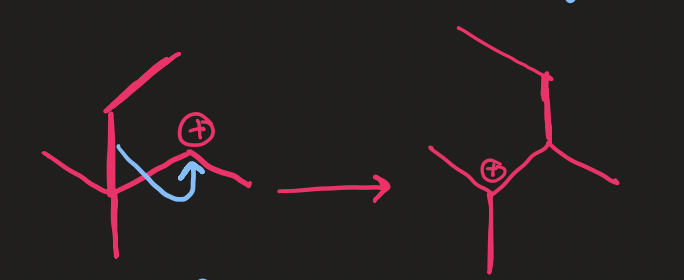
Remember the + charge can only jump one carbon away.
1,2-hydride shift
When a C-H bond breaks to move the carbocat’s charge to a more substituted spot.

Know why we wouldn’t do a 1,2-alkyl shift instead. Remember the + charge can only jump one carbon away.
Draw the mechanism that turns THIS:
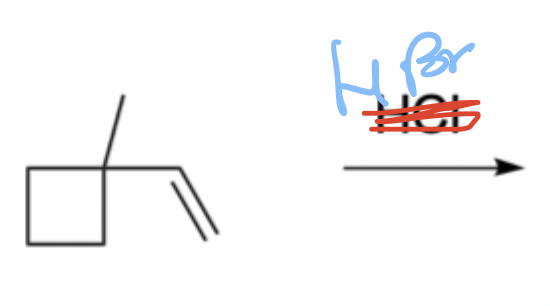
into THIS:


An 1,2-alkyl shift happened to move the + charge. See how it doesn’t need to be a methyl that moves, but an ENTIRE ring?
Dehydroxyhalogenation (An elimination rxn)
Produces an alkene by removing hydrogen halide

Dehydration (An elimination rxn)
Produces an alkene by removing water

Draw the mechanism and explain if it is stereoselective, regiospecific, etc.

Addition of Hydrogen Halide (HX)
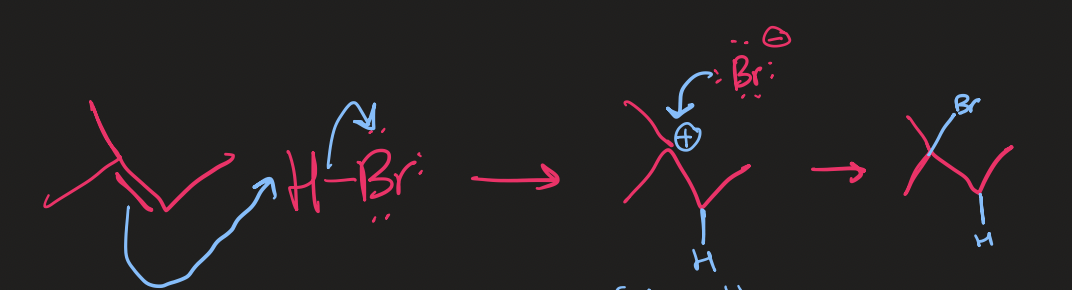
Regioselective for this major product, because it prefers more substituted carbocation.
Draw the mechanism and explain if it is stereoselective, regiospecific, etc.

Halogenation / Addition of Dihalogen (X2)
Intermediate known as Halonium / Bromonium ion

Stereospecific for trans isomers (specific becuz impossible to create cis).

As a skeleton, what are the products of adding Halogen, Br2, to an alkene? (Is it stereospecific? stereoselective? regioselective?)
Product is a dibromoalkane.
Always stereospecific due to anti-addition. Note it is not always trans, could be (S,S), (R,R), or even meso compound.
Never regioselective because you are adding Br to both sides, how are you gonna make smth different?
Draw the mechanism and explain if it is stereoselective, regiospecific, etc.

Addition of halogen (X2) in the presence of H2O
Wow three elementary steps. Final product called halohydrin btw.

Stereospecific because of anti-addition, OH and Br must be different sides.
Also, regioselective because H2O prefers to go to the more substituted carbon. Reason: More substituted = more stable partial positive charge
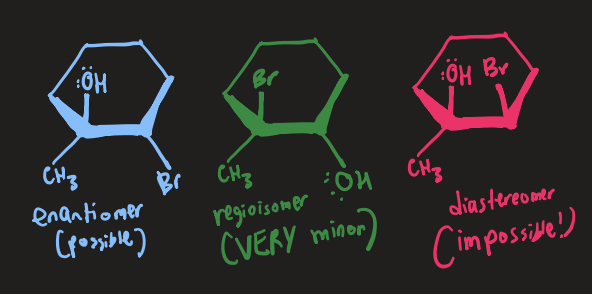
As a skeleton, what are the products of adding Br2 to an alkene IN THE PRESENCE of? (Is it stereospecific? stereoselective? regioselective?)
Product is a halohydrin.
Always stereospecific due to anti-addition.
Sometimes regioselective because OH prefers being on the more substituted carbon. Wouldn’t be selective if both carbons were equally substituted.
Draw the mechanism and explain if it is stereoselective, regiospecific, etc.
Markovnikov Hydration of Alkene
As a skeleton, what are the products of hydrating an alkene the Markovnikov style? (Is it stereospecific? stereoselective? regioselective?)
Draw the mechanism and explain if it is stereoselective, regiospecific, etc.
Anti-Markovnikov Hydration of Alkene
As a skeleton, what are the products of hydrating an alkene the ANTI-Markovnikov style? (Is it stereospecific? stereoselective? regioselective?)
Draw the mechanism and explain if it is stereoselective, regiospecific, etc.
Hydrogenation of Alkene (you actually can’t draw this)
As a skeleton, what are the products of adding H2 to an alkene? (Is it stereospecific? stereoselective? regioselective?)
Draw the mechanism and explain if it is stereoselective, regiospecific, etc.
Dihydroxylation of alkene (hehe yes i test this before epoxide)
As a skeleton, what are the products of adding H3O+ to an epoxide? (Is it stereospecific? stereoselective? regioselective?)
Epoxide synthesis (mechanism currently unneeded)