Skin & Soft Tissue Infections
 Call Kai
 Learn
 Practice Test
 Spaced Repetition
 Match
 Flashcards
 Knowt Play
1/60

There's no tags or description
Looks like no tags are added yet.
61 Terms
4 ways skin forms a barrier to infection
Tough
Constantly desquamating
Dry
Acidic
Name 4 SSTIs limited to skin and hair follicles
Impetigo
Folliculitis
Furuncle
Carbuncle
Name 4 SSTIs involving subcutaneous tissues
Erysipelas
Cellulitis
Lymphangitis
Necrotising fasciitis
Name 2 main pathogens of SSTIs
Staphylococcus aureus
Streptococcus pyogenes
What type of organism is Streptococcus pyogenes
Group A beta-haemolytic streptococcus
What 2 types of bacteria would be found in abdominal wound infections
Gram-negative bacilli
Anaerobes
What species of bacteria would be found in whirlpool folliculitis
Pseudomonas species
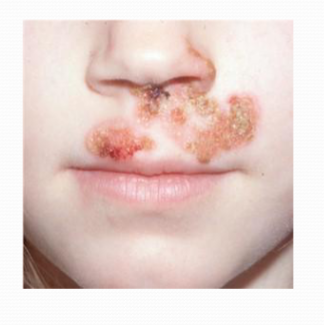
What is this
Impetigo
In what layers is Impetigo seen
Superficial, intraepidermal bacterial skin infection
Infection confined to epidermis, doesn’t ulcerate
What is the significance of Impetigo infections staying confined to epidermis
It heals without scarring
Most common cause of Impetigo & 1 other possible cause
S.aureus
Could also be S.pyogenes
Describe appearance of Impetigo
Typical golden crusts
Impetigo is seen most in what age group
Children
Treatment for mild, very localised impetigo (≤ 3 lesions)
Topical anti-bacterial therapy e.g. fusidic acid
Treatment for widespread impetigo
Systemic anti-bacterial therapy
Flucloxacillin
Early cephalosporin e.g. Cefalexin
Clarithromycin
True/False Flucloxacillin can be inactivated by Beta lactamases
False - flucloxacillin is resistant to the penicillinase (β-lactamase) enzyme produced by S. aureus
What is Folliculitis
Superficial bacterial infection occurring within hair follicles
Where is Folliculitis seen most (on body)
Commonest in beard area
Also axillae or buttocks
Most common bacteria in Folliculitis
S.aureus
If folliculitis is seen on the trunk, what organism might have caused this? & from where?
Pseudomonas infection associated with inadequately chlorinated whirlpools/hot tubs
Treatment for mild/superficial Folliculitis
Mild/superficial lesions may respond well to simple local antiseptic measures
Treatment for widespread or more severe lesions of folliculitis
Oral anti-staphylococcal antibiotics
Flucloxacillin
Early cephalosporin e.g. Cefalexin
Macrolid e.g. Clarithromycin
What is a Furuncle
A boil - Deeper infection in hair follicle associated with an abscess (collection of pus) in the hair follicle
Describe a Furuncle
Firm, tender, red (erythematous) nodule
What happens with most Furuncles
Most drain spontaneously
What can help furuncle drainage
Moist heat applied may accelerate localisation and drainage
What can a Furuncle develop into
Later becomes fluctuant and painful and commonly ruptures spontaneously with drainage of pus and resolution
Most common organism causing of Furuncle
S.aureus
How do you treat large, painful non resolving furuncles
May require incision and drainage and an antistaphylococcal antibiotic (as before)
Which is more important for abscesses - drainage/antibiotics
Most important aspect of management is incision and drainage.
Antibiotics are supportive
A number of adjacent furuncles may coalesce to form a more extensive lesion called a
Carbuncle
Do carbuncles ever spontaneously drain
Yes - they may spontaneously drain and discharge pus to the surface along hair follicles
What happens if carbuncles don’t drain spontaneously
Larger carbuncles require incision and drainage of pus with adjunctive administration of an antistaphylococcal antibiotic ( as before)
What 3 locations are carbuncles seen most
Commonest on nape of neck, back and thighs
Organism responsible for carbuncles
S.aureus
What skin layers do cellulitis and erysipelas infect
Cellulitis and erysipelas are bacterial infections of the skin extending to involve the subcutaneous tissues
Differentiate between cellulitis and erysipelas
Erysipelas is a clinically distinctive form of cellulitis which is usually more superficial
Erysipelas lesions have characteristic well-defined, raised borders, which are sharply demarcated from adjacent non-infected skin
Cellulitis has advancing margins which are flat and less well demarcated
Most common cause of Erysipelas (organism)
S.pyogenes
Treatment for mild Erysipelas (1 main & 2 alternatives)
Oral amoxicillin
cefalexin or a macrolide
Treatment for more severe cases of Erysipelas
IV penicillin (benzylpenicillin)
Difference in location between cellulitis & Erysipelas
Cellulitis is also a spreading bacterial infection of the skin & subcutaneous tissues but it is deeper than erysipelas
Symptoms of cellulitis
Hot, red, swollen, painful skin
Fever, pain, erythema, swelling, discharge
3 lab findings of Cellulitis
High white cell count
High c reactive protein(crp)
High ESR
What leads to the development of cellulitis
Often recognised antecedent skin lesion e.g traumatic wound, ulcer, or other area of damaged skin (e.g. interdigital athlete’s foot) providing portal for bacterial entry
Organism responsible for Cellulitis & 1 other possibility
S. pyogenes
S. aureus
2 treatments based on organism causing cellulitis
Flucloxacillin(for S. aureus)
Benzylpenicillin (for S. pyogenes)
(You usually don’t know when starting treatment if S. aureus or S. pyogenes. Flucloxacillin at sufficient doses will treat both organisms - Empiric Therapy. If clinical sample results of culture show that infection is caused by S.pyogenes alone, treatment can be modified to Benzylpenicillin - Targeted Therapy)
What is an alternative cellulitis treatment in non-severe penicillin allergy
Cefalexin
How & why does treatment for cellulitis change when it is on the face
Infection near the eyes or nose, may involve additional pathogens such as S.pneumoniae, H. influenzae or anaerobic bacteria
Treatment: Co-amoxiclav Or Cefalexin + metronidazole
Difference between development of staph / strep infection
S. aureus SSTI → Tendency to abscess formation
S. pyogenes SSTI → Tendency to spread rapidly
(Staph tends to burrow
Strep tends to spread)
What is iGAS & what is its significance
Invasive Group A streptococcus
A notifiable disease
What is Lymphangitis
Spreading bacterial infection in the lymphatics
Symptoms of Lymphangitis
Rapidly advancing erythema, pain and swelling along lymphatic channels
Characteristic linear, spreading erythematous lesion with associated painful swelling of ipsilateral regional lymph nodes
Frequently associated systemic features, fever, malaise, chills
Main cause of lymphangitis
S. pyogenes
Treatment for lymphangitis
Treatment with penicillin (amoxicillin po or if more severe, benzypenicillin iv)
What is Necrotising fasciitis
Rapidly progressive, life threatening infection of skin, subcutaneous tissues to the level of and involving subepidermal fascia and may extend to involve deeper muscle layers
Treatment for Necrotising fasciitis
Surgical emergency
Urgent surgical debridement and adjunctive high dose IV antibiotic therapy is required
(Send some tissue to micro & do not put it in formalin)
Name 3 antibiotics used for Necrotising fasciitis
Benzylpenicillin & flucloxacillin & clindamycin
Major clinical sign of Necrotising fasciitis
Apparently disproportionate pain
Main agent causing Necrotising fasciitis
S. Pyogenes
Main organism causing Surgical Site Infection
S. aureus
What does a post-op S. aureus infection lead to
Cellulitis