RADT 113: Test 6 Skull
 Call Kai
 Learn
 Practice Test
 Spaced Repetition
 Match
 Flashcards
 Knowt Play
1/207

There's no tags or description
Looks like no tags are added yet.
208 Terms
How many bones of the skull are there?
22
Bones of the Skull:
is it the cranium bones or facial bones the part of the skull that encloses and protects the brain?
cranium bones
Bones of the Skull:
is it the cranium bones or facial bones that protect the eyes, nasal passages, and mouth?
facial bones
Bones of the Skull:
how many cranial bones are there?
8
Bones of the Skull:
How many facial bones are there?
14
Bones of the Skull:
are the following bones cranial or facial bones?
frontal
parietal
occipital
temporal
sphenoid
ethmoid
cranial bones
Bones of the Skull:
are the following bones cranial or facial bones?
maxillae
zygomatic
nasal
lacrimal
palatine
inferior nasal conchae
vomer
mandible
facial bones
Bones of the Skull - Cranium:
How many frontal bone(s) are there?
1
Bones of the Skull - Cranium:
How many parietal bone(s) are there?
2
Bones of the Skull - Cranium:
How many occipital bone(s) are there?
1
Bones of the Skull - Cranium:
How many temporal bone(s) are there?
2
Bones of the Skull - Cranium:
How many sphenoid bone(s) are there?
1
Bones of the Skull - Cranium:
How many ethmoid bone(s) are there?
1
Bones of the Skull - Facial:
How many maxillae bone(s) are there?
2
Bones of the Skull - Facial:
How many zygomatic bone(s) are there?
2
Bones of the Skull - Facial:
How many nasal bone(s) are there?
2
Bones of the Skull - Facial:
How many lacrimal bone(s) are there?
2
Bones of the Skull - Facial:
How many palatine bone(s) are there?
2
Bones of the Skull - Facial:
How many inferior nasal conchae bone(s) are there?
2
Bones of the Skull - Facial:
How many vomer bone(s) are there?
1
Bones of the Skull - Facial:
How many mandible bone(s) are there?
1
Joints of the skull:
__________ ______- between the frontal and 2 parietal bones
coronal suture
Joints of the skull:
__________ _______- between the 2 parietal bones
sagittal suture
Joints of the skull:
____________ ________- between the occipital and parietal bones
lambdoid suture
Joints of the skull:
____________ ______- 2, R &L, between the parietal and temporal bones on each side
squamosal suture
Joints of the skull:
what suture can only be seen from the lateral view?
HINT: is between the parietal and temporal bones on each side
Squamosal suture
Aspects, Surfaces, or Regions of the Skull
Frontal/________– the part visible when viewed from the front
anterior
Aspects, Surfaces, or Regions of the Skull
_______ ______- L or R surface visible when the skull is viewed from the side
Lateral aspect
Aspects, Surfaces, or Regions of the Skull
Posterior/_____ _____- posterior surface of the skull viewed from the rear
occipital aspect
Aspects, Surfaces, or Regions of the Skull
______ ______- top/crown of the skull visible from above
Vertical aspect
Aspects, Surfaces, or Regions of the Skull
_______ ______ – inferior surface- part visible from below
Basal aspect
Skull Basic Terms
_____________ – the 2 cone shaped cavities for the eyeballs
orbits
Skull Basic Terms
___________ ________- ( external canthus)- the point at the outer margin of the eye where the upper and lower eyelid
lateral canthus
Skull Basic Terms
what is the lateral canthus also known as?
external canthus
Skull Basic Terms
____ ______- the 2 chambers of the nose- R & L
Nasal cavities
Skull Basic Terms
__________ _______- the partition between the 2 nasal cavities
HINT: also has a piercing term named after this
nasal septum
Skull Basic Terms
______ ______- cavities within some of the cranial bones.
4 pairs.
Located close to nasal cavities.
Each open into one of the nasal cavities and each contain air
Paranasal sinuses
Skull Basic Terms
how many pairs of paranasal sinuses are there?
4
Skull Basic Terms
the paranasal sinuses are close to the _______ cavities
nasal
Skull Basic Terms
______- the expanded cavity at the upper end of the digestive tract.
It opens behind into the oral pharynx ( throat)
Mouth
Skull Basic Terms
________- the chin- the prominence on the anterior part of the mandible at the midline
mentum
Skull Basic Terms
what is the chin also known as?
mentum
Skull Basic Terms
______ ______ _____- the passage leading into the ear and ear drum
External acoustic meatus
Skull Basic Terms
______ _____ _____- the opening leading into the ear and eardrum
External acoustic opening
Skull Basic Terms
_________ – processes of the facial bones are named from the bone with which the process forms a joint
ex) frontal process of maxilla articulates with the frontal bone
Processes
Skull Basic Terms
_____________- ( gaps)- unossified area at the junctions where three bones of the skull meet in an infant ( soft spots)
Fontanelles
Skull Basic Terms
___________- point on the vertex of the skull where the sagittal suture meets the coronal suture
Bregma
Skull Basic Terms
does the anterior or posterior fontanelle becomes the bregma?
anterior fontanelle
Skull Basic Terms
___________– the point at the posterior end of the sagittal suture where the occipital bone and 2 parietals, are in contact here
lambda
Skull Basic Terms
does the anterior or posterior fontanelle becomes the lambda?
posterior fontanelle
Skull Basic Terms
______ ______- 3 depressions on the inner surface of the floor of the skull.
The anterior, the middle, and posterior cranial fossae.
Each extends from one lateral wall of the cranium to the other lateral wall.
Cranial fossae
Skull Basic Terms
how many cranial fossae are there?
3
Skull Basic Terms
_______ ______- openings in the floor/base of the skull through which nerves and veins leave the cranial cavities- arteries enter it
Basal foramina

The _____ ______
Single bone, forms the front of the cranium above the orbits
Convex external surface
A
Frontal Bone
The frontal bone:
convex or concave?
convex

The Frontal Bone
_______ _______- 2 rounded prominences on the frontal bone, one on each side of the midline, visible on the forehead
H
frontal eminence

The Frontal Bone
_______ _______- R & L, ridges of bone that form the superior borders of the circular opening into each orbit.
Covered by the eyebrows
G
Supraorbital margins

The Frontal Bone
_______ _______- a small notch, or sometimes a foramen, located towards the medial end of the supraorbital margin.
A nerve to the face is transmitted through this
C
Supraorbital notch

The Frontal Bone
8
Supraorbital Notch

The Frontal Bone
E
Nasal spine

The Frontal Bone
B
Zygomatic process

The Frontal Bone
______________- a smooth flat area between the medial ends of the supraorbital margins
above the upper ends of the nasal bones ( between eyebrows)
F
Glabella

The Frontal Bone
The ______ ______/Plates consists of 2 flat plates of bone
form the roofs of the orbits and the floor of the anterior cranial fossa
extend posteriorly from the supraorbital margins and join the sphenoid bone
3
Orbital Part
The Frontal Bone
do the orbital part/plates extend posteriorly or anteriorly from the supraorbital margins?
posteriorly
The Frontal Bone
What bone does the orbital part/plates joint with?
sphenoid bone

The Frontal Bone
_______ ______- a definite gap between the medial borders of the 2 orbital plates.
The cribriform plate of the ethmoid bone fits into this space.
9
Ethmoid Notch
The Frontal Bone
What from the ethmoid bone fits into the ethmoid notch?
cribriform plate
The Frontal Bone
The _____ _____- extends down in the midline between the supraorbital margins.
This extension articulates with the nasal and lacrimal bones and frontal processes of the maxilla
Nasal Part

The Frontal Bone
_____ _____- a pointed process that forms a small part of the nasal septum
1
Nasal Spine

The Frontal Bone
________ _______- lateral end of the supraorbital margin that articulates with the zygomatic bone
5
Zygomatic Process

The ________ ______:
2, L& R, form part of the lateral walls and vertex of the skull
The 2 meet at the midline of the vertex to form the sagittal suture
B
Parietal Bone
The Parietal Bone:
The _________ ____________ is a rounded prominence on the lateral surface of each parietal bone
parietal eminence
The Parietal Bone:
the distances between the parietal eminence is the greatest transverse or horizontal diameter of the skull?
transverse

The _______ ______:
A single bone that forms the posterior wall, and the posterior upper part of the base of the cranium
The upper margin on each side joins a parietal bone to form the lambdoidal suture
J
Occipital Bone
The Occipital Bone:
The _______ _______ _______ is a definite rounded bony prominence
located at the midline of the external surface begins to curve forwards
easily palpable
external occipital protuberance
The Occipital Bone:
The ______ ________ ________ is a similar prominence on the internal surface, opposite of the external protuberance
internal occipital protuberance
The Occipital Bone:
The two ________ ________: R&L are oval shaped prominences located on the inferior surfaces of each lateral part
They have smooth surfaces that articulate with the superior articular processes of the atlas
occipital condyles
The Occipital Bone:
The ____________ ___________ is a large opening in the inferior part of the occipital bone through which the medulla oblongata of the brain joins the spinal cord.
It is formed entirely by the occipital bone
foramen magnum
The Occipital Bone:
What two things unite in the foramen magnum of the occipital bone?
brain
spinal cord
The Occipital Bone:
What bone does the foramen magnum unite with anteriorly to form the base of the skull?
sphenoid bone

The ________ ______:
2, R & L, form a part of each lateral wall and part of the base of the skull
D
Temporal Bone

The Temporal Bone:
The ________ ______- a depression on the temporal bone in front of the opening into the ear and below the origin of the zygomatic process.
The condyle(head) of the mandible fits into it to form the temporomandibular joint.
C
mandibular fossa
The Temporal Bone:
the head (condyle) of the mandible fits into the mandibular fossa to form the ________________ _______
temporomandibular joint

The Temporal Bone:
The _________ ________ - a slender bony process that extends horizontally forward from the opening of the ear.
AKA zygoma
It meets a similar process that extends back from the zygomatic bone to form the zygomatic arch
B
zygomatic process

The Temporal Bone:
The _______ _______is a large bony prominence that extends down from the temporal bone posterior to the ear.
It contains mastoid air cells.
It is palpable.
G
mastoid process
The Temporal Bone:
what does the mastoid process contain?
mastoid air cells

The Temporal Bone:
The ______ ______ is a long slender silver-like process that extends down from each temporal bone
it is NOT palpable
F
styloid process
The Temporal Bone:
Is the mastoid process or the styloid process palpable?
mastoid process
The Temporal Bone:
____: the passage leading into the ear and ear drum
EAM
Middle Ear:
What does MIS an acronym for?
Malleus
Incus
Stapes
Middle Ear:
Which part of the middle ear is described to be “hammer shaped”?
Malleus
Middle Ear:
Which part of the middle ear is described to be “anvil shaped”?
Incus
Middle Ear:
Which part of the middle ear is described to be “stirrup shaped”?
Stapes
The _________ ______:
A single bone that helps to form a small part of the lateral wall on each side, as well as part of the base of the skull
It has a body, a pair of greater wings, a pair of lesser wings, and 2 pterygoid processes
Sphenoid Bone

The Sphenoid Bone:
Is the anterior or superior aspect of the sphenoid bone covered by the facial bones?
anterior aspect
The Sphenoid Bone:
what bone’s orbital plate(s) are anterior to the sphenoid bone?
facial bone
The Sphenoid Bone:
what bone’s orbital plate(s) are posterior to the sphenoid bone?
temporal bone
The Sphenoid Bone:
the basal part of the _______ bone joints the sphenoid bone from behind
occipital

The Sphenoid Bones:
The _______ _______- a saddle-like bony depression on the upper surface of the body of the sphenoid.
Its deep central cavity contains the pituitary gland
12
Sella turcica
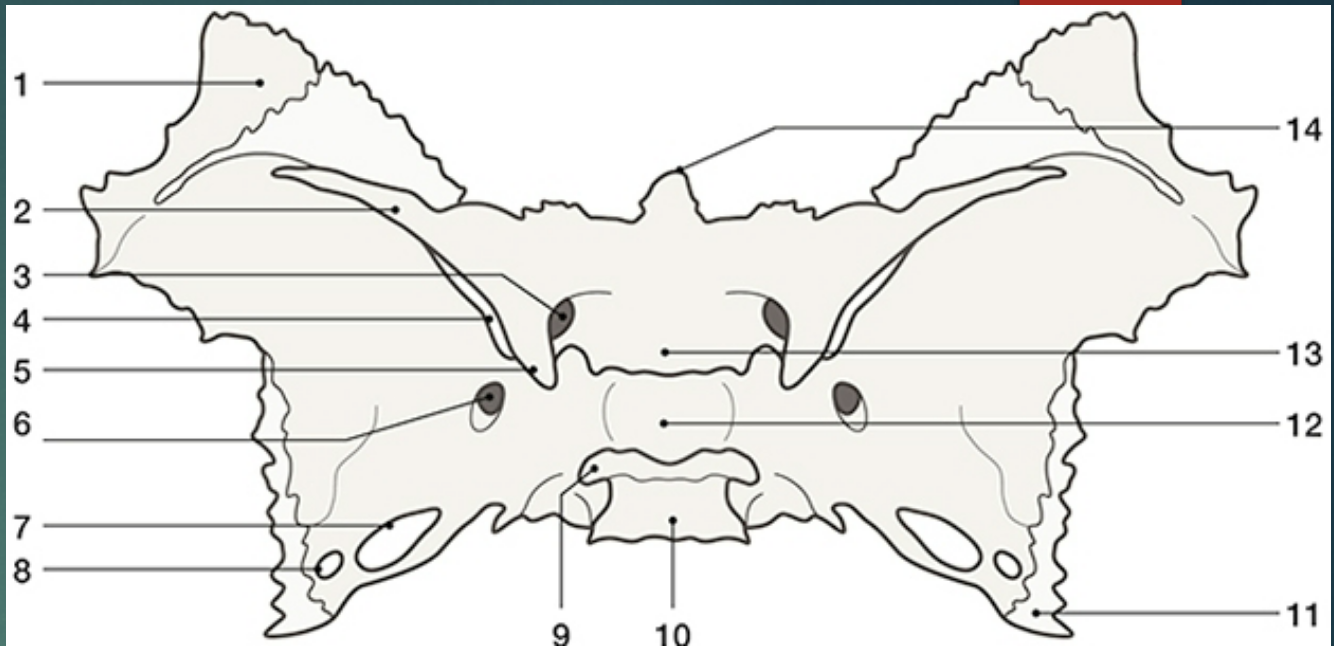
The Sphenoid Bones:
The _______ _______ is the posterior wall of the Sella turcica.
It curves upwards similar to the back of a saddle. (pituitary gland sits in here)
10
dorsum sella