DT - Basic Dental Morphology/ Terms
 Call Kai
 Learn
Learn Practice Test
 Spaced Repetition
 Match
Match Flashcards
 Knowt Play
1/39

There's no tags or description
Looks like no tags are added yet.
Name | Mastery | Learn | Test | Matching | Spaced | Call with Kai | Chat |
|---|
No analytics yet
Send a link to your students to track their progress
40 Terms
Anatomical Crown
The portion of the tooth that is covered by enamel, extending from the CEJ to the incisal/occlusal surface.

Clinical crown
The portion of the tooth visible in the mouth above the gingival margin. Its size can change depending on the position of the gingiva.

Enamel
The hard, highly mineralized outer layer that covers the anatomical crown of the tooth and protects the underlying dentin. It is the hardest substance in the human body.

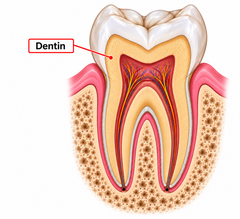
Dentin
The hard, calcified tissue that makes up the majority of the tooth and lies beneath the enamel and cementum, surrounding the pulp.
Pulp Chamber
The enlarged portion of the pulp cavity located in the crown of the tooth that contains pulp tissue, nerves, and blood vessels.

Pulp Canal
The narrow portion of the pulp cavity located within the root of the tooth that contains pulp tissue, nerves, and blood vessels and extends toward the apical foramen.

Cementum
A thin layer of calcified tissue that covers the root of the tooth and provides attachment for the periodontal ligament fibers.
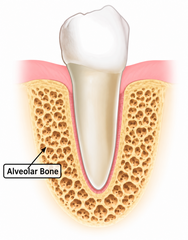
Alveolar Bone
The part of the maxilla and mandible that surrounds and supports the roots of the teeth and forms the tooth sockets (alveoli).
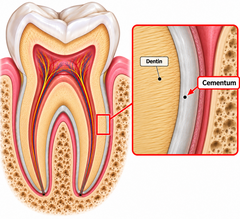
Cementodentinal Junction (CDJ)
The boundary where the cementum covering the root meets the underlying dentin.

Cementoenamel Junction (CEJ)
The line where the enamel of the crown meets the cementum covering the root. Also called the cervical line.

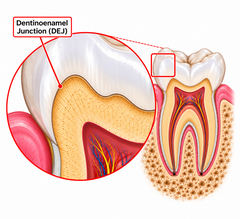
Dentinoenamel Junction (DEJ)
The boundary where the enamel meets the underlying dentin in the crown of the tooth.
Periodontal Ligament (PDL)
The fibrous connective tissue between the cementum and alveolar bone that attaches and supports the tooth in its socket.

Gingiva
The soft tissue (gums) that surrounds the teeth and covers the alveolar bone, providing a protective barrier around the teeth and supporting structures.

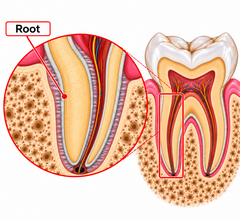
Root
The portion of the tooth that is below the CEJ and normally embedded in the alveolar bone, anchoring the tooth within its socket.
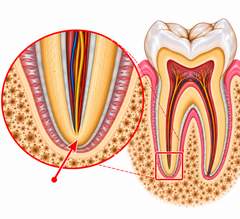
Apical Foramen
The small opening at the tip (apex) of a tooth root where nerves and blood vessels enter and exit the pulp.

Root Apex
The tip or terminal end of the root of a tooth.
Periodontium
The gingiva, periodontal ligament (PDL), cementum, and alveolar bone the tissues that surround, support, and attach the teeth.

The tooth structures

Arch
The curved arrangement of teeth within the maxilla or mandible. The two dental arches are the maxillary arch (upper) and mandibular arch (lower).

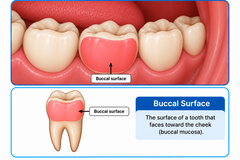
Buccal Surface
The surface of a posterior tooth (premolars and molars) that faces the cheek.
Distal Surface
The surface of a tooth that faces away from the midline of the dental arch.

Facial Surface
General term for the tooth surface that faces the lips or cheeks. It can describe any tooth.

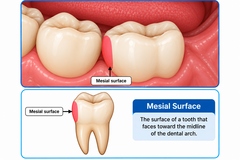
Mesial Surface
The surface of a tooth that faces toward the midline of the dental arch.
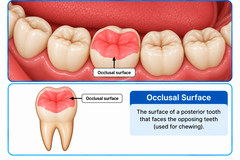
Occlusal Surface
The chewing surface of a posterior tooth (premolar or molar) that contacts the opposing teeth.
Labial Surface
Specifically the facial surface of anterior teeth (incisors and canines) that faces the lips.

Lingual Surface
The surface of a tooth that faces toward the tongue.

Line Angle
The junction where two surfaces of a tooth meet.
Point Angle
The junction where three surfaces of a tooth meet.
Cingulum
A rounded, raised area on the cervical third of the lingual surface of an anterior tooth (incisor or canine).

Contact Area
The area on the mesial or distal surface of a tooth that touches the adjacent tooth.
Developmental Groove
A shallow groove or line on a tooth that marks where the developmental lobes joined together during tooth formation.
Fossa
A shallow depression or concavity on the surface of a tooth.
Height of Contour
The greatest outward curvature of a tooth surface, located in the cervical 1/3 on the facial surfaces of all teeth and the lingual surfaces of anterior teeth, and in the middle 1/3 on the lingual surfaces of posterior teeth.
Incisal Ridge
The raised cutting edge of a newly erupted anterior tooth, formed where the labial and lingual surfaces meet.
Marignal ridge
A raised border of enamel that forms the mesial and distal edges of a tooth, found on the lingual surface of anterior teeth and the occlusal surface of posterior teeth.
Lobe
One of the main developmental sections of a tooth that forms during tooth development and joins with other lobes to create the crown.
Mamelon
One of the three small, rounded bumps found on the incisal edge of newly erupted permanent incisors, which usually wear away over time with normal biting and chewing.
Pit
A small, pinpoint depression on the surface of a tooth, usually found where developmental grooves meet or end.
Proximal
The surface of a tooth that faces an adjacent tooth in the same dental arch. The mesial and distal surfaces are the two proximal surfaces.
Pulp Horn
A pointed extension of the pulp chamber that extends toward a cusp or incisal lobe of the tooth.