Chapter 11 Autonomic NS
 Call Kai
 Learn
Learn Practice Test
 Spaced Repetition
 Match
Match Flashcards
 Knowt Play
1/82

There's no tags or description
Looks like no tags are added yet.
Name | Mastery | Learn | Test | Matching | Spaced | Call with Kai | Chat |
|---|
No analytics yet
Send a link to your students to track their progress
83 Terms
What is the primary function of the autonomic nervous system
regulate organs to maintain homeostasis or involuntary functions
The two branches of the autonomic nervous system are
sympathetic and parasympathetic
the “fight or flight” part of the autonomic nervous system:
sympathetic
the “rest and digest” side of the autonomic nervous system:
parasympathetic
Parasympathetic and sympathetic activities tend to be __________ and _____________
antagonistic; dually innervated
Sympathetic branch neurons originates from the:
spinal cord
Parasympathetic branch neurons originates in the:
brainstem and sacral spinal cord
what does dual innervation of the autonomic NS mean
both branches of the autonomic nervous system communicate with all the organs and have influence over their function
If one branch causes an organ to become more active, the other branch causes it to become ____________. This means they are _________
less active; antagonistic
what does antagonistic relationship mean in terms of the branches of the autonomic NS
the branches compete with each other and are opposites

A typical efferent autonomic signal originates from the
central nervous system
The cell bodies that can be found in the central nervous system are
preganglionic and postganglionic neurons

Preganglionic neurons send signals down the axon into the:
peripheral nervous system

In the PNS after preganglionic neurons are sent they arrive in a grouping of more autonomic neurons called the
postganglionic neurons

The structure where the postganglionic neurons live in is called an:
autonomic ganglion
Postganglionic neurons go to
effector organs
Examples of effector organs are:
cardiac muscle, smooth muscle, glands, adipose tissue, skeletal muscle
there is a __________ between the preganglionic neuron and postganglionic neuron
chemical synapse
there is a ___________ between the postganglionic neuron and the effector organs
chemical synapse

The sympathetic part of the ANS has ___________ that are short and ___________ that are long
preganglionic neurons; postganglionic neurons
preganglionic neurons originate in the:
thoracolumbar spinal cord
aside from preganglionic and postganglionic neurons there are also _______________ in the sympathetic NS, which can be found further away
collateral ganglia

what ganglia is this
preganglionic neurons
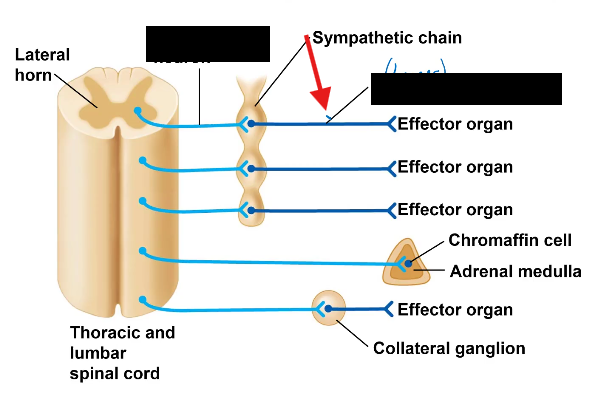
what ganglia is this
postganglionic neuron

In the parasympathetic NS there can found long _____________ and sho
preganglionic neurons; postganglionic neurons

The autonomic ganglia are located ____ to their effector organs or ______ the effector organ
near; within
organs are dually innervated which means
each organ receives input from efferent branches of both sympathetic and parasympathetic
when parasympathetic NS is activated it creates a state of
rest and digest
when the sympathetic NS is activated causes an increase in
excitation
both parasympathetic and sympathetic branches are always active but:
as one decreases the other increases
this autonomic branch is associated with:
quiet, relaxed states
rest and digest
heart rate is reduced
SLUDD
vasodilation to some organs
parasympathetic
what does SUDD include
salivation, lacrimation or tear production, urination, digestion, defecation
What does vasodilation to organs mean
increased blood flow to digestive urinary organs
this autonomic branch is associated with:
fight or flight response
prepares for emergence, stress, exercise
increases heart rate & blood pressure
dilates pupils
energy is mobilized
decreases digestion and urination
dilation of blood vessels to skeletal muscles = more blood flow
tunnel vision, selective hearing
sympathetic
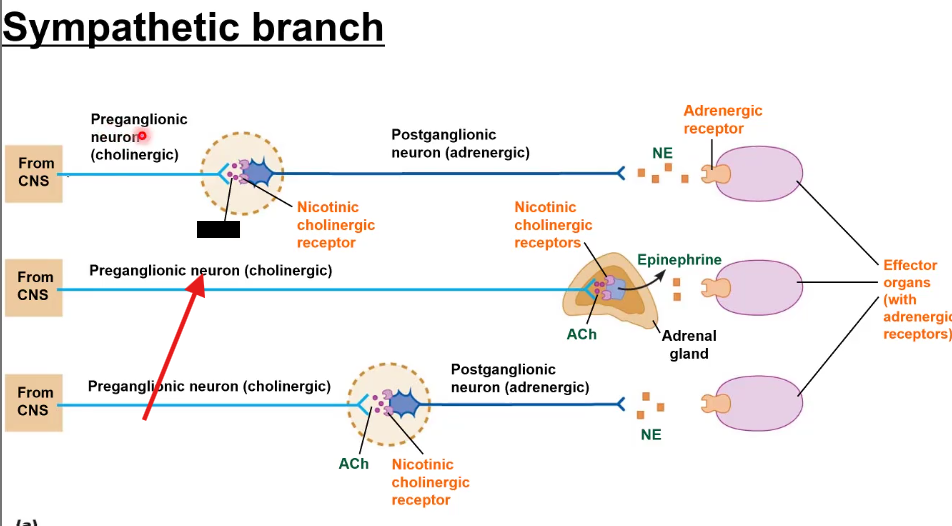
Preganglionic neurons release a neurotransmitter called
acetylcholine

the preganglionic neurons that release acetylcholine are called
cholinergic

the postganglionic neurons that release norepinephrine are called
adrenergic

the receptors on the postganglionic neurons are called
nicotinic cholinergic receptors

the nicotinic cholinergic receptors on the postganglionic neuron are
ionotropic

the postganglionic neuron releases a neurotransmitter called
norepinephrine

the target effectors that receive signals from the postganglionic neurons have receptors called
adrenergic receptors

the postganglionic neurons in the parasympathetic branch also release
acetylcholine

the target effectors of the parasympathetic branch have what type of receptors
muscarinic cholinergic receptors
the receptors for the target effectors of the parasympathetic branch are what type of receptors
metabotropic
metabotropic receptors use
G coupled receptors


types of cholinergic receptors
nicotinic ACh receptors, muscarinic ACh receptors
this type of ACh receptors are
ionotropic
cause cation channel to open
channel opening cause depolarization
nicotinic ACh receptors
this type of ACh receptors are
G protein coupled
effect depends on receptor subtype
muscarinic ACh receptors
type of adrenergic receptors
there are two main classes
each has subclasses
all are metabotropic
alpha and beta
Subclasses of alpha receptors
alpha 1 and alpha 2
subclasses of beta receptors are
beta 1, beta 2, beta 3
these type of adrenergic receptors are
located in effector organs of sympathetic NS
MOST COMMON ADRENERGIC RECEPTOR
almost always excitatory
alpha receptors
these type of adrenergic receptors are
all activate adenylate cyclase
amplifying enzyme to make cAMP
affinities for norepinephrine and epinephrine
beta receptors
this subclass of beta receptors are
located in cardiac muscle (heart) and kidneys
usually excitatory
beta 1
this subclass of beta receptors are:
located in some blood vessels and smooth muscle (digestive tract)
usually inhibitory
causes smooth muscle to relax
beta 2
this subclass of beta receptors are:
located in adipose tissue
usually excitatory
beta 3
the parasympathetic branch does not have any
adrenergic receptors

phospholipase C is
an amplifying enzyme
beta receptors _____ production of cAMP
increases


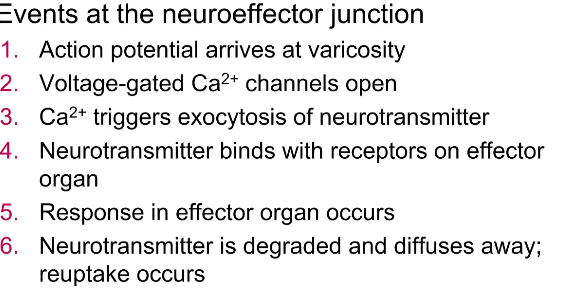
Neuroeffector junction
synapse between postganglionic neuron and effector organ

where neurotransmitter is released
varicosities
Neurotransmitter is released through
exocytosis
events at the neuroeffector junction
sends commands directly or indirectly to the preganglionic neurons, thus controlling signal output
hypothalamus
hypothalamus is
integration and command center of all auto functions
communicates with CNS and gets inputs from everywhere
influenced by emotions
controls all ANS
Brainstem is
in charge of breathing and bp, heart rate
spinal cord controls
reflexes for defecation and urination
definition of a reflex
a patterned response because of a stimulus and doesn’t require higher brain processing
autonomic reflexes are
aka visceral reflexes
no cortex involved
control all involuntary activities
endocrine organs that are apart of endo system
secrete hormones
In the endo system __________ is primary control center
hypothalamus
organ that
receives commands from hypothalamus and directs other endo glands
pituitary gland
primary or secondary gland of endo system
main function is hormone secretion
like thyroid gland, and pineal gland
primary
primary or secondary gland of endo system
hormone secretion as secondary function
heart
secondary
target cells of endo system have
hormone receptors
main purpose of endo system is
maintain homeostasis
homeostasis is
stable internal environment to changes in external and internal
homeostasis cycle
stimulus activates a receptor
receptor sends info the afferent signaling