Module 9 - Planning and Implementation in Teaching
 Call Kai
 Learn
 Practice Test
 Spaced Repetition
 Match
 Flashcards
 Knowt Play
1/28

There's no tags or description
Looks like no tags are added yet.
29 Terms
Goals vs Objectives
Goals
Global
Broad
Long-term
Multi-dimensional
Objectives
Specific
Singular
Short-term
Uni-dimensional
Types of Objectives
Educational Objectives
Assess the intended outcomes of the educational process.
Instructional Objectives
The teaching activities and resources utilized to facilitate learning.
Behavioural (Learning) Objectives
Describe what the learner will aim to do following a learning situation.
Blending
When the professional (nurse teacher) and client (learner) collaborate and mutually decide on objectives.
Writing Behavioural Objectives
A - Audience (Who?)
B - Behaviour (What?)
C - Condition (Under which circumstances?)
D - Degree (How well? Within what time frame?)
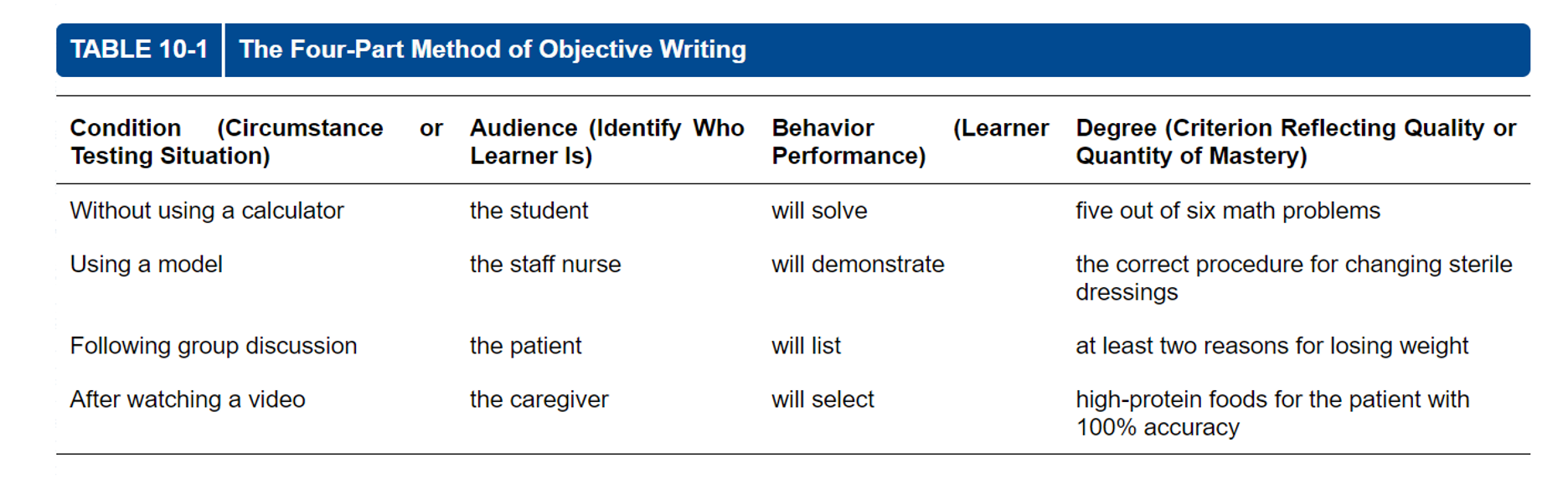
Condition
Describes the condition under which behaviour will occur.
Under what conditions should the learner be able to do it?
Performance
What is the learner expected to be able to do to demonstrate that the objectives have been achieved?
What should the learner be able to do?
Criterion
Time frame and level of competence that the learner will strive to achieve.
How well must the learner be able to do it?
Bloom’s Taxonomy
Categorizes learning objectives according to the hierarchy of behaviours.
Promotes higher forms of thinking in education rather than just remembering facts.
Orders behaviours based on complexity.

Cognitive Learning Domain
“Thinking” domain.
Involves acquiring information and helping develop the learners’ intellect, understanding, and thinking.
Knowledge
Memorization, recall, defining, recognizing.
Comprehension
Demonstrating understanding, summarizing information.
Application
Using ideas, principles, and theories in certain situations.
Analysis
Recognizing and structuring information by breaking it down and identifying relationships.
Synthesis
Putting parts together to create a whole.
Evaluation
Judging the value of something by applying certain criteria.
Affective Learning Domain
“Feeling” domain.
Involves internalization/commitment to feelings in the form of emotions, beliefs, and values.
Receiving
Showing awareness of an idea or situation.
Responding
When someone will respond to an experience (denial à acceptance).
Valuing
Accepting the worth of an idea/event, and showing commitment, willingness, and desire to act further on that value.
Organization
Organizing, classifying, prioritizing values, viewing some values as dominant.
Characterization
Adherence to a worldview and commitment to a value system.
Psychomotor Learning Domain
“Skilks” domain.
Involves acquiring fine and gross motor skills.
Perception
Showing sensory awareness of objects/cues associated with a task.
Set
Demonstrating readiness to take action
Guided Response
Exerting effort/actions (under guidance), imitating.
Mechanism
Repeatedly performing steps/actions, developing confidence.
Complex Overt Response
Performing complex motor actions, independent/with minimum guidance.
Adaptation
Adapting/modifying motor processes to different situations.
Origination
Creating new motor actions based on developed skills.
Teaching Plan
A blueprint that outlines how the goals and objectives will be achieved.
Includes:
Goal, objectives, and subobjectives
Purpose
Content outline
Methods of teaching
Time allotment
Resources/tools
Method of evaluation

Learning Contracts
Written or verbal agreement between the educator and the learner to lay out specific teaching and learning activities that will occur in a specific time frame.
Teaching Method
The way information is taught
Brings the learner into contact with what is to be learned
Includes:
Lecture
Group discussion
Role-playing
One-on-one discussion
Instructional Material
Objectives or tools used to transmit information
Supplement the art of teaching
Includes:
Books
Written material
Videos
Podcasts
Lecture
Oldest and most used teaching method.
Highly criticized.
Can be effective if well organized and delivered effectively.
Group Discussion
A method of teaching whereby learners get together to actively exchange information, ideas, feelings, and opinions with one another and with the educator.
Effective in patient and family education.
Leads to longer retention.
Cooperative Learning
Uses group work activities.
Highly effective with students and healthcare professionals.
Less useful with patients.
One-to-One Instruction
Face-to-face sharing of information.
Designed to meet the needs of the specific learner.
Useful in all 3 domains of learning.
Demonstration and Return Demonstration
Educator performs a skill then the learner attempts to perform the demonstrated skill with minimal cueing.
Primarily useful in psychomotor learning but can enhance cognitive and affective learning.
Gaming
Competitive activity with rules.
Usually includes rewards.
Primarily effective for cognitive learning.
Simulation
Trial and error teaching method.
Learners engage in activities that reflect real life scenarios.
Role-Playing
Learners participate in unrehearsed dramatization.
Supports learning in the affective domain.
Self-Directed Learning
Learner assumes responsibility for learning.
Educator provides outloine that guides the learner.
Incorporates a variety of activities.
Remote Learning
Maxinizes resoursces by delivering information across time and space.
Most used for cognitive learning, can be used for affective and psychomotor learning.
Patient Education Materials
Advantages
Cheap and convenient
Widely acceptable
Easily alterable
Disadvantages
Most abstract form of reality
Proper reading level required
Considerations
Purpose of the instructions
Choose only needed and relevant information
Organize information into topics
PEM KISS
Patient Education Materials - Keep It Simple Smart
Use an active voice
Write directly to the reader
Use a positive tone
Short sentences/bullet points
Use graphics
Highlight key information
Readability Formulas
Estimate how difficult the written material is to read.
Identify text that may be too complex.
Improve understanding and retention of information.
Considerations:
Formulas measure only word and sentence length.
Lowering a readability score does not necessarily improve comprehension.
May penalize effective strategies such as bulleted lists and white space.
Ex: Fog Index = (Average sentence length + % of complex words) * 0.4
PEMAT
Designed to help healthcare professionals to evaluate the understandability and actionability of patient education materials.
Assess Understandability
Determines whether people of varying health literacy levels can process and comprehend the material.
Looks at factors like word choice, sentence structure, layout, and use of visuals.
Assess Actionability
Evaluates whether the material clearly explains what actions the reader should take.
Focuses on providing concrete steps, examples, and tools that enable the user to act on the information.
Standardize Evaluation
Provides a structured, evidence-based method for scoring materials, ensuring consistency across different evaluators.
Improve Quality of Materials
Helps organizations identify gaps and revise materials to make them more user-friendly and effective for patient education.