6. Sensory Perception, Preference and Eating ehavior in the context of Obesity and Older Consumer
 Call Kai
 Learn
 Practice Test
 Spaced Repetition
 Match
 Flashcards
 Knowt Play
1/20

There's no tags or description
Looks like no tags are added yet.
21 Terms
What drives food intake; Homeostatic vs. Hedonic influences
We eat to fulfill a physiological need to maintain body weight (set-point)
Brain-based homeostatic and hedonic eating motives overlap but are nonetheless dissociable
An increasing proportion of human food consumption appears to be driven by pleasure, not just by the need for calories
Three components of ‘Power of food’ scale

Correlation with power food and BMI
Higher power food score = linked to higher BMI
Factors to identify the different food perceptions

Is there a correlation between sensory preferences and increasing body weight?
No indication of different sensory preferences and discrimination abilities with increasing body weight
Relation fat preference and weight gain
Positive correlation was found between overall fat preference and percent body fat.
Traditional vs Sensory epidemiology
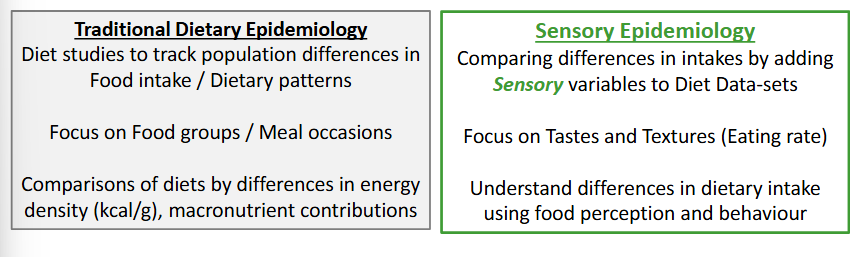
Which ‘Taste’ contributes most to higher daily energy intake?
More savoury fatty foods = higher energy intake
Links between oral processing and BMI
Chicken or egg situation: do you eat fast to keep up high BMI or do you eat fast and that causes high BMI

Life expectancy and chronic disease
Life expectancy has gone up, but the age of chronic disease onset has not increased to the same extent
Implication: people will live longer but will have a longer period of disability/ill health
A longer “sick-span” = poor quality of life, health care costs etc. Prevention orientated lifecycle approaches add not only to life-span but ‘health-span’ (delay and compress morbidity)
Nutrition has a major role in preventing the onset of chronic disease
Three levels of prevention of chronic disease
Primary prevention: e.g. folic acid supplementation to prevent neural tube defects
Keeping as many people as possible free from disease risk
Secondary prevention: e.g. osteoporosis
Keeping those already at risk at the lowest risk possible, and delaying disease onset
Tertiary prevention: e.g. mediterranean diet reduces issues in those with heart disease
Treating those already diseased to mitigate disease progression
what do we mean by malnutrition
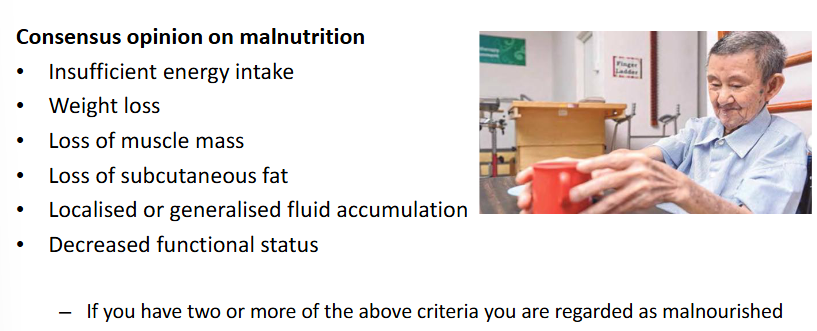
why does food intake decrease?
changes in sensory perception, eating pleasure and appetite
changes in dental satus and oral health
what are the current approaches to boost nutrition in older consumers
Smell reduction with age
decreases significantly with age

Gustation and age

Changes in appetite with age
Decreases in all components of energy expenditure
Basal metabolic rate
Reduced physical activity, which stimulates appetite
Decreased adaptive ability to shifts in energy intake
Poorer componesation for energy deficit in older age
Motivation to eat
Metabolic; decreased hormonal and metabolic signals
Food related: decreased food enjoyment, decreased sensory, decreased oral health
Psychological; loneliness, depression, isolation
Medications and disease states/illness suppress appetite
Impact of tooth loss in elderly
Impairment:
periodontal disease
Caries
Losing a body part
Disability:
Reduced ability to undertake daily tasks (eating, speaking)
Broader psycho-social impact (avoiding social interaction, life less satisfying)
Impact of tooth loss on nutrition
Edentate patients have one-sixth chewing power of dentate patients
This has a significant impact on food choice and intake
Edentulous patients tend to have:
Higher cholesterol levels
lower serum ascorbic acid and beta carotene
lower intake of vitamins and folic acid
Food first approaches - to enhance consumption in malnourished elderly
Flavor enhancement
Added tastes
Added flavors/spices
modified textures
combinations
Increasing intake through increased variety
Food + oral nutritional supplements
Oral nutritional supplements for malnourished elderly
23-60% in acute care settings
Prescribed by doctor or dietician and used to support a food first approach but boost energy, nutrients and compliance
Varying reports on compliance and wastage:
37-78% compliance rates
wastage estimates: 24-63%
Reasons for non-compliance with oral nutritional supplements
