Public Policy Study Guide
 Call Kai
 Learn
Learn Practice Test
 Spaced Repetition
 Match
Match Flashcards
 Knowt Play
1/23

There's no tags or description
Looks like no tags are added yet.
Name | Mastery | Learn | Test | Matching | Spaced | Call with Kai | Chat |
|---|
No analytics yet
Send a link to your students to track their progress
24 Terms
Politics
The study of political institutions and political processes, including “who gets what, when, and how.” It involves political processes, conflicts, interests, power, and decision-making.
Key idea: The process and conflict surrounding government decisions.
Policy
A course of action or non-action taken by a government or legislature regarding a particular issue. It includes laws, regulations, programs, strategies, and funding priorities.
Key idea: What government does or chooses not to do.
Polity
Refers to the institutions and structures of a political system, such as legislatures, executives, courts, and other governmental institutions.
Key idea: Structure
Politics Determines Public Policy
Along with changes in public policy, Policy design may reflect the different power resources of social groups. Public policy therefore cannot be understood without reference to politics.
Key idea: Political power and competing interests help shape which policies are adopted and changed.
Public Policy Studies
Examines the processes and decisions that define the policy outputs of a political system and the effects resulting from those decisions.
Key idea: It asks how policies originate, why they vary or change, and what effects they produce.
Policymaking
The process by which governments, organizations, or institutions develop and implement strategies, rules, and guidelines to address problems or achieve goals.
Key idea: Identify issues → formulate solutions → choose → implement → evaluate.
Policy Variation
Studies differences in policy outputs across policy sectors and across countries.
Key idea: Question: Why do policies differ?
Policy Change
Studies the degree to which public policies change or remain stable over time. Policies tend to be stable, with change often being slow and incremental.
Key idea: Question: Why does it happen—or fail to happen?
Rational Approach to Policymaking
Views policymaking as a structured process designed to achieve the optimal solution. It involves collecting information, identifying alternatives, choosing a policy, implementing it, and evaluating it.
Key idea: Rational = optimality.
Incremental Approach to Policymaking
Argues that policymakers make decisions with limited information, limited time, cognitive limitations, and political disagreement. They make small adjustments to existing policies rather than seeking a theoretically optimal solution.
Key idea: Incremental = satisfactory solution / satisficing.
Stages of the Policy Process
The traditional policy cycle contains four major stages:
• Problem definition & agenda setting — Which problems receive government attention?
• Policy formulation & adoption — What solutions are developed and which policy is selected?
• Implementation — How is the adopted policy carried out?
• Evaluation & change — What effects did it have, and should it be changed or terminated?
• Important: The stages can overlap, be skipped, or occur simultaneously; the cycle is an analytical tool, not always a literal sequence.
Key idea: Problem definition & agenda setting → Policy formulation & adoption → Implementation → Evaluation & change.
Elmendorf's Recommendations for “Good” Policymaking
Evidence is necessary but not sufficient. Experts can help determine what is likely to happen if a policy is adopted, but society must decide what it values.
• Use evidence honestly and acknowledge uncertainty.
• Be transparent about benefits, drawbacks, and weaknesses.
• Avoid claiming that a policy will solve every problem.
• Communicate research so non-experts can understand it.
• Include different perspectives and experiences.
• Pay attention to implementation, not just policy design.
Key idea: Effective policy should be technically appropriate, administratively feasible, and politically sustainable.
Lowi's Policy Typology
Classifies public policies according to their characteristics and political implications. His four major types are distributive, redistributive, regulatory, and constituent.
• Distributive — Gives government resources/benefits to particular recipients. Examples: farm subsidies, higher-education grants, roads, bridges.
• Redistributive — Transfers or reallocates costs and benefits between societal groups. Examples: welfare, Medicaid, Social Security, progressive taxation.
• Regulatory — Specifies conditions and constraints on individual or collective behavior, using sanctions or incentives. Examples: environmental and consumer regulations.
• Constituent — Creates or changes government institutions and the framework/division of governmental powers. Example: creating the Department of Homeland Security.
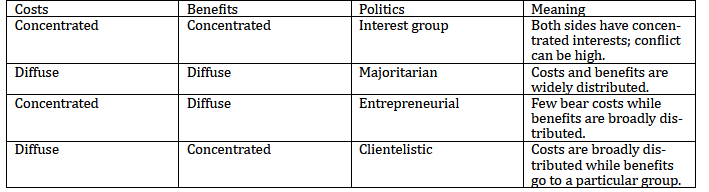
Wilson's Policy Typology
Classifies policies according to whether costs and benefits are concentrated or diffuse.
Key idea: Concentrated/diffuse costs and benefits determine the likely type of politics.
Nudge
Policy instrument used to influence behavior without coercion. In the NATO framework, listed under Nodality, which uses information.
Key idea: Influence behavior without direct coercion.
Regulated Self-Regulation
Is an approach in which the government requires or oversees an industry or organization to create and enforce rules for its own behavior.
Key idea: Government oversight + industry-developed rules
Economic regulation
Involves government rules governing economic activities, particularly prices, competition, market entry, or business practices.
Examples can include:
Regulating prices charged by certain industries
Controlling entry into a regulated market
Establishing rules for competition
Key idea: Focuses primarily on how markets and economic activity operate.
Social Regulation
Involves government rules designed to protect public health, safety, the environment, or other social interests.
Examples of regulatory policy include:
Environmental regulations
Regulations concerning vaping products
Consumer protections
Key idea: Focuses on regulating behavior to achieve broader social goals rather than primarily regulating prices or market competition.
Regulatory Capture
Occurs when a regulatory agency becomes overly influenced by the industry or groups that it is supposed to regulate. Which is considered to be a weakness of Authority in the NATO framework.
Why it matters:
A regulatory agency may begin making decisions that favor the interests of the regulated industry rather than the broader public interest.
Grants
Treasure instrument in Hood's NATO framework because government uses money to influence behavior. The document also identifies higher-education grants as an example of a distributive policy.
Key idea: Government-provided financial resources.
Tax subsidies
Tax provisions that reduce the amount of taxes an individual or organization would otherwise pay in order to encourage a particular activity or provide a particular benefit.
They can take forms such as:
Tax credits
Tax deductions
Tax exemptions
Falls under Treasure because they use financial resources/economic incentives to influence behavior.
Privatization
Is the process of transferring the ownership or provision of a government-owned service or activity to private organizations.
Basic distinction:
Government provides/owns service → Public provision
Private organization provides/owns service → Privatization
The document's NATO framework is useful here because Organization refers to the government directly providing services.
Publicly owned companies
Are companies owned by the government rather than private individuals or private corporations.
They are an example of government using Organization as a policy instrument because the government directly owns and/or operates an organization to provide goods or services.
Non-Pharmacological Interventions (NPIs) in Ghana's Response to COVID-19
Provides a case study of how governments can use public policy tools to respond to a crisis.
During COVID-19, the Ghanaian government urgently introduced non-pharmacological interventions (NPIs) to:
Contain the spread of the virus and cushion the population from its impacts.