2 Upper GI disorders - Mouth and Oesophagus
 Call Kai
 Learn
Learn Practice Test
 Spaced Repetition
 Match
Match Flashcards
 Knowt Play
1/23

There's no tags or description
Looks like no tags are added yet.
Name | Mastery | Learn | Test | Matching | Spaced | Call with Kai | Chat |
|---|
No analytics yet
Send a link to your students to track their progress
24 Terms
Structure of the GI system
key sites for therapeutic intervention incude :
mouth
oesophagus
stomach
pancreas
small intestine
large intestine
liver

Gastrointestinal Disorders
GORD
oral cavity ulceration and stomatitis
peptic ulcer disease
duodenal ulcer
Dysfunctional physiology of the mouth
oral ulceration - break in oral epithelium - exposes nerve endings in underlying connective tissue
Stomatitis - inflammation of the lining of the mouth caused by poor oral hygiene, heat burns
Leukoplakia - painless white patches on side of tongue or cheeks
Dysphagia - difficulty swallowing
Oesophagus structure
UOS - prevents air entering oesophagus and oesophagopharyngeal reflux
LOS prevents gastroesophageal reflux
high intraluminal pressure keeps it closed until food needs to be dumped into the stomach

Dysfunctional physiologies and diseases of the oesophagus
GORD
Hiatal Hernia
Motility Disorders - problems with sphincters and uncoordinated contraction
Achalasia caused by inadequate LOS relaxation
GORD causes
Transient LOS relaxation in the absence of swallowing
acid escaping - oesophageal epithelium damage
3 Types of GORD
non erosive reflux disease - heartburn
Erosive oesophagitis - acute inflammatory disease
Barrett’s oesophagus - metaplasia (transformation) of the mucosa - cancer risk
Mechanism of Acid Secretion
Gastric Anatomy - stomach
OXYNTIC gland area :
mucous cells
chief cells (pepsinogen)
ECL cells (histamine)
Parietal cells (HCl, intrinsic factor)
PYLORIC gland area :
mucous cells
G cells (gastrin- hormone that stimulates acid secretion)
D cells (somatostatin)
NO parietal cells
Cells key to acid secretion in the body (oxyntic gland) of the stomach

Cells key to acid secretion in the pyloric region of the stomach
include the purpose the cells*

Gastric or Oxyntic Gland - mechanism of parietal cells
translaocation of the H+/K+ ATPase proton pump to the apical membrane
at rest they are in cytoplasmic vesicles
when stimulated they are membrane fused
increased surface area and membrane pumps
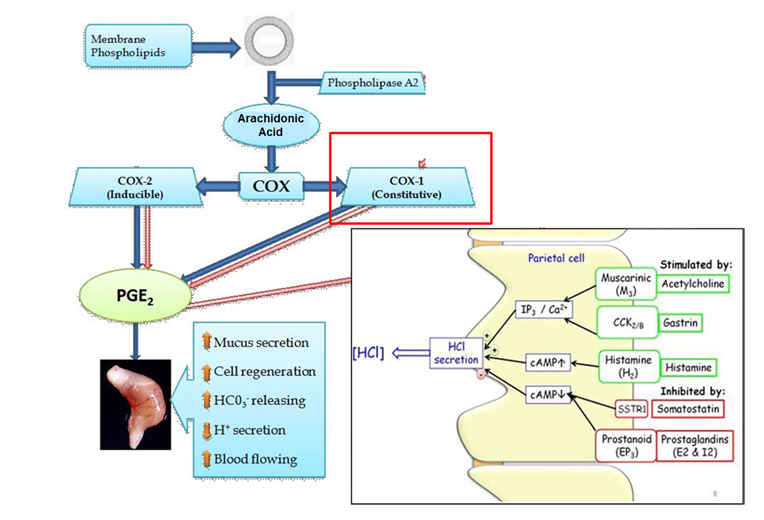
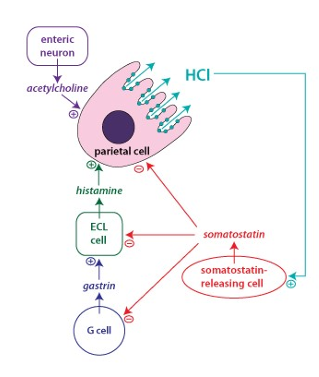
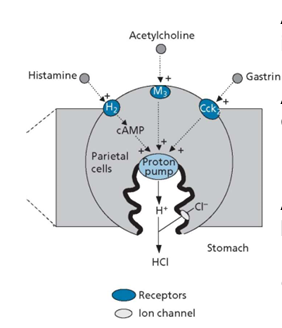
Stimuli for Acid secretion - up regulation
Acetylcholine - enteric neurons
Histamine - ECL cells
Gastrin - G cells
Stimuli for Acid Secretion - down regulation
Somatostatin- D cells - directly inhibits parietal cell secretion - inhibits gastrin and histamine release
Acid secretion Pathways
ACH - Ca activated
Gastrin - Ca activated
Histamine - PKA activated - more powerful and fastest
Phases of Acid Secretion
Cephalic Phase - sight, smell, thought
Gastric Phase - food neutralises ph - G cell stimulation, food prevents D cell activity
Intestinal Phase - chyme enters duodenum - duodenal stimulation of hormones, less food and lower pH stimulate D cell activity
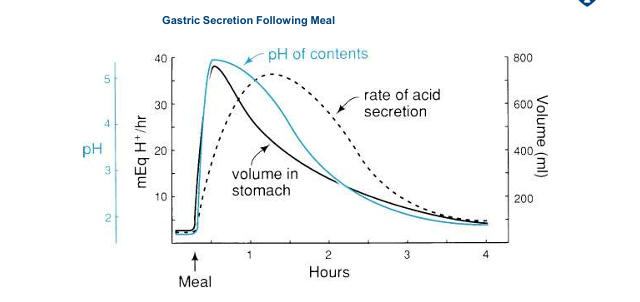
gastric secretion following a meal
food buffers stomach acid and raises pH
suppresses somatostatin from D cells causing gastrin and HCl release
digestion trigger huge secretion volume and HCl
As food leaves stomach, acid increases and pH falls - D cell stimulation, less HCl produced as somatostatin
HCl secretion control
vagovagal reflex - increases parietal cell acid production and stomach distention :
direct stimulation of ECL cell to release histamine
direct stimulation of G cells to release gastrin via GRP ( gastrin releasing peptide)
Mechanism of HCl secretion
CO2 diffuses into parietal cell from plasma
hydrated to carbonic acid by carbonic anhydrase
carbonic acid dissociates to H+ and H2CO3-
proton pump actively transports H+ and K+ in
Na+ actively reabsorbed
K+ recycles to gastric lumen via K+ channel
Cl- exists passively from cell via Cl- channel
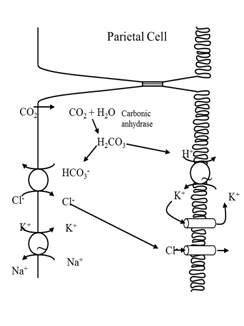
How is the Na+ and K+ gradient maintained on the absolute real side of the stomach’s membrane ?
proton pump
exchanger promotes HCO3- exit and Cl uptalke, maintains cellular pH
slight rise blood pH = alkaline tide
negative gastric artero-venous carbon dioxide gradient
Regulation of HCl secretion

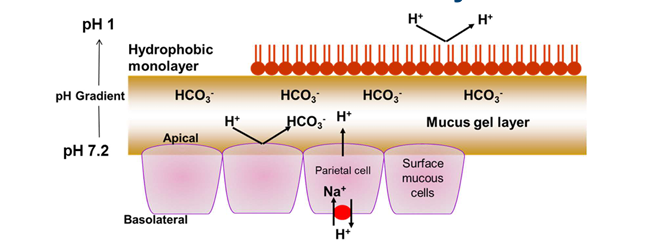
How’s does mucus protect the stomach’s lining ?
vagal stimulation and irritation stimulate gastric mucous cells to secrete mucin ( a glycoprotein that is part of the mucosal barrier)
gastric surface epithelial cells secrete HCO3- when stimulated by ACh, HCl and PGs
HCO3- accumulates near cell surface
mucus protects by trapping HCO3- rich fluid near apical border of epithelia
How and Why is mucus layer continually produced ?
prostaglandin Acid regulation - how do they do this ?