Bio Med 2 Lab | Exp 10 - Muscle Nerve Physiology
 Call Kai
 Learn
 Practice Test
 Spaced Repetition
 Match
 Flashcards
 Knowt Play
1/41

There's no tags or description
Looks like no tags are added yet.
42 Terms
Motor Unit 1/2
The basic functional unit of muscle contraction
Motor Unit 2/2
It consists of a motor neuron and all the muscle fibers it innervates
Motor Neuron
Nerve cells located in the spinal cord or brain that transmit signals to muscles, causing them to contract
Motor Unit - Axons
Passes Signals
Motor Unit - Dendrites
Collects Signals
Motor Unit - Recruitment 1/2
Also known as motor unit activation, is the process by which the nervous system activates and controls motor units in muscles to generate varying degrees of muscle force and contraction
Motor Unit - Recruitment 2/2
A highly coordinated process that helps the body adapt to the demands of different movements and tasks
Muscle Twitch 1/2
A brief and involuntary contraction of a muscle fiber or a small group of muscle fibers
Muscle Twitch 2/2
It is the smallest and most basic unit of muscle contraction and is typically initiated by a single action potential (electrical impulse) in a motor neuron
Muscle Twitch - Latent Phase (phase 1/3)
The brief period that occurs immediately after the stimulation of a muscle fiber by a motor neuron. During the latent phase, there is no visible muscle contraction, but the excitation-contraction coupling process is initiated. This includes the release of calcium ions from the sarcoplasmic reticulum within the muscle cell.
Muscle Twitch - Contraction Phase (phase 2/3)
Following the latent phase, the muscle fiber contracts in response to the increased intracellular calcium levels. The muscle fibers generate force and shorten. This phase is where the actual muscle contraction occurs.
Muscle Twitch - Relaxation Phase (phase 3/3)
After the muscle contracts, it enters the relaxation phase. During this phase, the muscle fiber returns to its resting state. Calcium ions are actively transported back into the sarcoplasmic reticulum, and the muscle fiber lengthens. The muscle returns to its non-contracted state.
Action Potential 1/2
A fundamental electrical event that plays a crucial role in the functioning of both nerve cells (neurons) and muscle cells (muscle fibers)
Action Potential 2/2
Responsible for transmitting signals, initiating muscle contractions, and enabling communication in the nervous system

Action Potential - Graph
Threshold

Action Potential - Graph
Stimulus

Action Potential - Graph
Depolarization: Na+ channel open, Na+ influx (ions in)
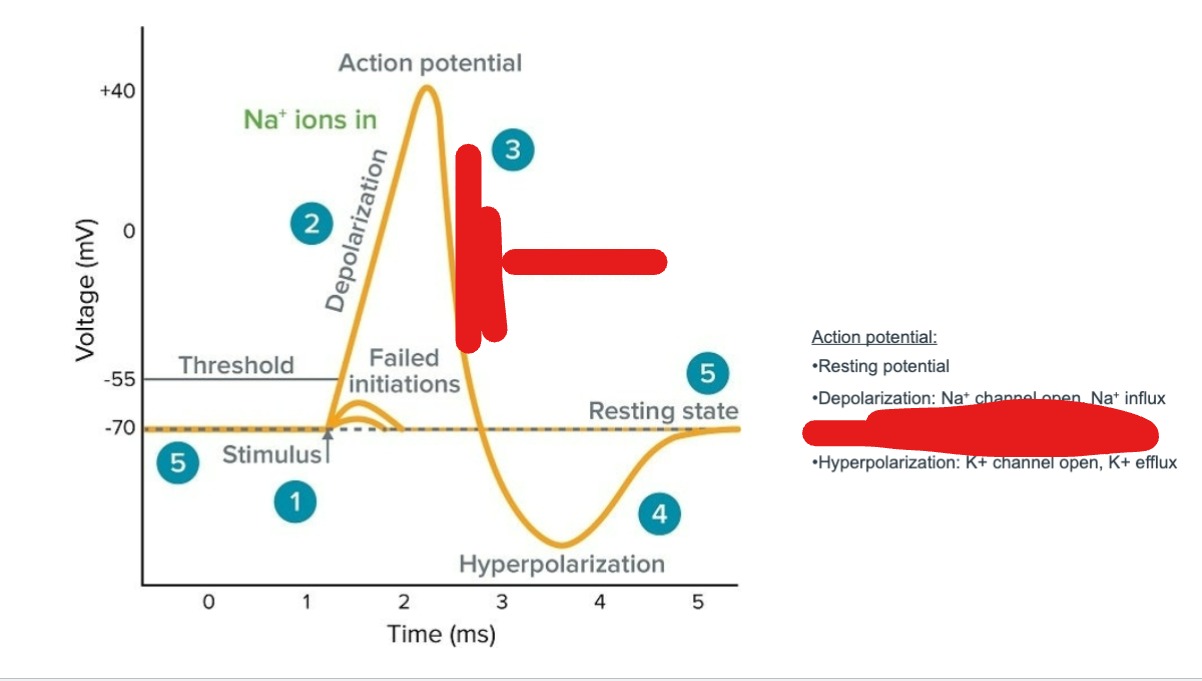
Action Potential - Graph
Repolarization: K+ channel open, K+ efflux (ions out)

Action Potential - Graph
Hyperpolarization: K+ channel open, K+ efflux (ions out)

Action Potential - Graph
Resting State
Threshold Voltage 1/2
To initiate an action potential in a neuron, the cell membrane must reach a specific ____ potential. This
____ is typically around -55 to -50 mV
Threshold Voltage 2/2
If the membrane potential reaches or exceeds this ____, it triggers the opening of voltage-gated sodium channels.
Treppe 1/2
Also known as the "staircase effect", is a phenomenon in muscle physiology where successive muscle contractions become stronger when a muscle is stimulated with the same frequency and intensity
Treppe 2/2
It is characterized by a series of incremental increases in muscle force or tension with each successive contraction
Wave Summation 1/2
Also known as temporal summation, is a phenomenon in muscle physiology in which successive muscle contractions are combined, or "summed," to produce a sustained, more forceful contraction
Wave Summation 2/2
It occurs when a new muscle contraction begins before the previous one has completely relaxed. _____ is a fundamental mechanism for increasing muscle force output.

Treppe (in Tetanus)

Wave Summation

Incomplete Tetanus

Complete Tetanus
Single Stimulus Contraction
When a ____ (action potential) is applied to a muscle, it generates a single muscle contraction. This contraction has a specific force output, typically lower than the maximum force the muscle can produce.
Temporal Summation
If a second stimulus is applied to the muscle shortly after the first contraction (before it fully relaxes), it results in another contraction that combines with the first. This second contraction "rides" on top of the first, and their force outputs add together.
Repeat Stimuli
The process can be repeated multiple times, with each new stimulus causing a muscle contraction that adds to the force generated by the previous contractions. These contractions occur in rapid succession.
Increase in Force Output
The summation of contractions leads to a continuous increase in muscle ____. This is because the muscle does not have sufficient time to return to its resting state between contractions, and the force generated in each contraction adds up.
Tetanus
If the stimulation frequency is high enough and the contractions are so closely spaced that the muscle does not have time to relax at all, it can lead to a state called tetanus, where the muscle remains in a sustained contraction. This is known as complete or fused _____.
What is muscle twitch? What are the three phases of muscle twitch?
A brief, involuntary contraction of a muscle fiber or small group of fibers, initiated by a single action potential. It is the smallest and most basic unit of muscle contraction. The 3 phases are: Latent phase, Contraction phase, and Relaxation phase
What is Motor Unit Recruitment?
The process by which the nervous system activates and controls motor units to generate varying degrees of muscle force.
Under fixed stimulus frequency, how does increasing stimulus voltage affect muscle contraction force (g)?
increasing stimulus voltage recruits more motor units (larger motor units), which increases the muscle contraction force.
What is Treppe?
Also known as the "staircase effect." It is when successive muscle contractions become stronger when the muscle is stimulated with the same frequency and intensity, producing incremental increases in force with each contraction.
What is Wave Summation?
Also known as temporal summation. It occurs when a new muscle contraction begins before the previous one has completely relaxed, so the contractions combine ("sum") to produce a sustained, more forceful contraction.
What is incomplete (unfused) tetany and complete (fused) tetany?
- Rapid stimulation where the muscle does not fully relax between contractions, producing a wavy, sustained contraction with partial relaxation.
- Very high stimulation frequency where the muscle has no time to relax at all, resulting in a smooth, sustained contraction (maximum tension).
Under fixed stimulus voltage, how does increasing stimulus frequency affect muscle contraction?
Increasing stimulus frequency leads to: single twitch → wave summation (temporal summation) → incomplete tetany → complete tetany. The force output increases and becomes more sustained until it reaches maximum tension (complete/fused tetanus)