biochem maxxing
 Call Kai
 Learn
 Practice Test
 Spaced Repetition
 Match
 Flashcards
 Knowt Play
1/120

There's no tags or description
Looks like no tags are added yet.
121 Terms
BIOCHEMISTRY
Chemistry of LIFE; chemical composition of organisms
BIOLOGICAL MOLECULES & how they interact to cause the processes within and between cells
ESSENTIAL ELEMENTS
CHNOPS; CARBON HYDROGEN NITROGEN OXYGEN PHOSPHATE SULFUR
25 / 92 naturally occurring elements are found in organisms
• CHNO account for 96% of living matter
• PS account for most of the remaining 4%
What’s a molecule?
Compounds comprised of ONLY nonmetals held together by COVALENT bonds
COVALENT BONDS
electrons SHARED by 2 nonmetals
this is the bond of life & strongest bond in H20
requires more energy to break
INTRAMOLECULAR force hold the atoms WITHIN MOLECULES together hold individual molecules together.
covalency is a CATEGORY of bonds
varying bonds strengths
POLAR COVALENT BONDS
electrons shared UNEQUALLY between two nonmetals
result of two nonmetals with a LARGE difference in electronegativities
NONPOLAR COVALENT BONDS
electrons shared EQUALLY between the two nonmetals
result of two nonmetals with SIMILAR electronegativities

ELECTRONEGATIVITY
Electronegativity
• tendency of an atom to attract electrons to itself when it is bonded to
another atom
• Trend:
• INCREASES across a period
• DECREASES down a group
• Remember noble gases do NOT form bonds so their
electronegativity = 0

Most Common POLAR COVALENT bonds in molecules
FRIENDS OF NORTHSIDE FON
bond formed between Hydrogen atom and either oxygen, nitrogen, or fluorine
WEAK BONDS
• INTERMOLECULAR forces; btwn DIFFERENT molecules
• SHORT TERM ATTACHMENT btwn DIFFERENT MOLECULES
• MOST important HYDROGEN bond***
HYDROGEN BONDS
• STRONGEST weak bonds; INTERMOLECULAR force; formed btwn POLAR MOLECULES
• forms btwn H of ONE polar molecule & the F, O, or N of a SECOND polar molecule
MOLECULES OF LIFE
1. Water (cells & organisms composed mostly of) most ABUNDANT; most cells surrounded by h2o & composed of 70-90% H2O unique properties of water —> its STRUCTURE
2. Carbohydrates
3. Proteins
4. Lipids
5. Nucleic Acids
WATER MOLECULE STRUCTURE
POLAR COVALENT
• oxygen’s HIGH electroneg & Hydrogen LOWEST electroneg amongst the nonmetals —>
LARGE diff in electronegativities → electrons from the hydrogen atoms spend most of their time orbiting the oxygen atom → leads to a partial POSITIVE charge at each of the HYDROGENS and TWO partial NEGATIVE charges on the OXYGEN
Water’s H Bonding
H-BONDS form btwn positively charged H atoms of one polar molecule and negatively charged O atoms of neighboring H20 molecules
EXTENSIVE H-bonding between h2o molecules —> basis of water's unique properties that are essential to the perpetuation of life on Earth
UNIQUE WATER PROPERTIES
COHESION & ADHESION —> leads to CAPILLARY
MEDIUM OF LIFE
MODERATES TEMPERATURE
a result of its SPECIFIC HEAT, HEAT of VAPORIZATION
ICE LESS DENSE THAN LIQUID WATER
SURFACE TENSION
COHESION
when two of the SAME polar molecules form H-bonds with each other
• because of cohesion H20 molecules H-bond to each other → resist being pulled apart
ADHESION
two DIFFERENT polar molecules H-bond w e/o
H2O molecules H-bond to other polar molecules or charged particles → resist being pulled apart
CAPILLIARY ACTION
cohesion + adhesion creates a continuous water column from the roots to leaves which allows for CAPILLARY ACTION
moves H2O against gravity trom the soil towards the leaves of a plant for PHOTOSYNTHESIS
H2O enters the roots → enters the microscopic veins that start at a root and travel up the stem ending at the leaf
H2O molecules evaporate off the surface of a leaf (via TRANSPIRATION) pulling all the H2O molecules below in the vein column UPWARD
MEDIUM OF LIFE; facilitates the chemical processes of cells
H2O; SOLVENT OF LIFE; most important molecules in cells are polar and therefore H2O soluble
H2O dissolved materials allows easy access by cells; like hydrolysis breaks down polymers into monomers which are then permeable to cell membranes
H2O facilitates movement of materials across cell membranes; allows for DIFFUSION and OSMOSIS
serves to BUFFER the chemical reactions of cells; allows cells to resist changes in pH
WATER MODERATES TEMPERATURE
H2O can RESIST changes in temp bc high SPECIFIC HEAT & HEAT of VAPORIZATION
• COHESION between water molecules → high SPECIFIC HEAT; H2O absorbs a lot of heat E without significant increase in temp bc most of the E absorbed is used to disrupt H-bonds between H2O molecules
• COHESION between water molecules → high HEAT of VAPORIZATION; H2O molecules must absorb lots of heat E to change from liquid to gas state bc most E absorbed must first be used to break the H-bonds between the water molecules
• helps regulate Earth temp because most of the solar E absorbed is utilized to heat large bodies of water which moderates climates
• organisms are composed mostly of H2O; therefore theyre able to moderate their own temperatures through evaporative cooling
EVAPORATIVE COOLING
evaporation of water to cool organisms, ex: sweating in humans,
urohydrosis in birds;
• Storks poop on their legs and feet → poop slowly evaporates in the heat → cooling the stork + liquid droppings evaporate → white chalky residue left behind coating bird's legs → provides additional sun protection
licking by kangaroos
• Kangaroos lack natural sweat glands but have a special network of blood vessels in their forearms; they lick their forearms until the fur is soaking wet → saliva evaporates → quickly cools down body temps

ICE IS LESS DENSE THAN LIQUID H2O
frozen water molecules spread apart into a lattice → creates air spaces in the solid ice → H2O expands as it solidifies = ice less dense than water → ice FLOATS
ice on the surface of water melts every spring
ice on the surface of water provides insulation for the life below
SURFACE TENSION
COHESION —> surface of liquid water exposed to air is hard to puncture
***SLOWS evaporation of water from large bodies of water —> allows for the continued presence of large bodies of water on Earth
allows water to bead up on waxy surfaces of leaves & organisms with waterproof coatings
PROTEINS
true polymers; exhibit all 3 polymer properties
C, H, O, N & sometimes S
• MOST structurally sophisticated molecules & instrumental in ALL LIFE PROCESSES
PROTEIN FUNCTIONS
structure, transport
• communication (hormones & receptors)
• gene regulation
• immunity
• catalysts ENZYMES
PROTEIN MONOMERS;
amino acids
only 20 diff naturally occuring 1s
AMINO ACID STRUCTURE
C2 molecule
AMINO GROUP ATTACHED TO ONE CARBON
CARBOXYL ATTACHED TO SECOND PART OF CARBON
R GROUP (only distinction between 20 diff amino acids) attached to same carbon; variable side chain attachment
R GROUPS
1) NONPOLAR HYDROPHOBIC
2) POLAR; hydrophilic
3) ACIDIC HYDROPHILIC (neg charge)
4) BASIC HYDROPHILIC (POS charge)
interactions btwn r groups dictate structure n function of that region of the protein
PEPTIDE BOND
covalent bond btwn 2 amino acids via dehydration synthesis
carboxyl end of an amino acid + amino group of a 2nd amino acid
PROTEIN STRUCTURE
most structurally sophisticated molecules
chains of amino acids must FOLD to create unique 3d structure for FUNCTION
PRIMARY STRUCTURE
unique amino acid sequence
structure held tg by peptide bonds (covalent)
result of dehyd synthesis
POLYPEPTIDE
SECONDARY STRUCTURE
alpha helix or beta sheet
weak (H)bonds btwn CARBOXYL and amino groups
a single protein will have portions in both alpha helix or beta sheet
TERTIARY STRUCTURE
single POLYPEPTIDE chain forms a fiberous or globular shape
result of weakbonds bwtn diff R groups
***minimum level of folding to be functional
WEAK BONDS IN TERTIARY STRUCTURE
HYDROGEN BONDS - polar R groups
HYDROPHOBIC - nonpolar R groups
ionic - between basic and acidic
disulfide bonds; covalent btwn 2 cysteine amino acids (contain sulfhydrl grp attachments)
WHERE R GROUPS END UP
POLAR & CHARGED groups are hydrophilic; OUTER SURFACE facing towards aqueous cytoplasm or extracellular fluid
NONPOLAR & HYDROPHOBIC R GROUPS; proteins inner core packed together; away from water, helps to stabilize overall protein structure
CYSTEINE AMINO ACIDS; contains sulfhydryl groups; positioned close to e/o to form disulfide bonds; helps to stabilize overall structure
QUATERNARY STRUCTURE
ex. hemoglobin & DNA POLYAMERASE
combo 2 or more polypeptide chains to form 1 funcitonal protein
caused by weak bonds btwn the polypeptide chains
not found in all proteins
PROTEIN DENATURATION
MOST of protein shape is determined by WEAK BONDS → heavily influenced by environmental conditions
pH changes, high salt concentration or HIGH temperatures —→ DENATURATION can occur
• denatured protein = protein unraveled, lost shape → biologically inactive
• denaturation breaks ONLY weak bonds; when a protein denatures it loses 4°, 3° or 2°
structure
CHAPERONES
proteins that help other proteins fold into their functional 3° globular shape
can be used after denaturation OR when a protein is newly synthesized
• NOT available for all proteins
NUCLEIC ACIDS
CHNOP; TRUE POLYMER
store & transmit hereditary information & high E molecules
NUCLEIC ACID MONOMER
NUCLEOTIDES
5-carbon SUGAR
phosphate group
nitrogenous base
NUCLEOTIDE STRUCTURE
5CARBON SUGAR; either deoxyribose or ribose
phosphate group at 5’ C
Nitrogenous base at 1’ C
NITROGENOUS BASE CATEGORIES
nitrogenous base is only distinction btwn nucleotides —> name of N base used to refer to entire nucleotide
PURINES; 2 fused carbon rings that contain N atoms
Adenine (A) & Guanine (G)
PYRIMIDINES; ONE CARBON RING; CONTAINS N ATOMS
(C)Cytosine, (T)Thymine, Uracil (U)
PHOSPHODIESTER BOND
covalent bond btwn 2 nucleotides — DEHYD SYNTHESIS
formed btwn 3’ C of one nucleotide and phosphate (5’C) of a second nucletoide
DNA (DEOXYRIBONUCLEIC ACID)
• true polymer; stores genetic information by coding for the primary structure of PROTEINS
• 5-carbon sugar DEOXYRIBOSE and the nitrogenous bases; A (adenine) G (guanine) T (thymine) C (cytosine)
• DOUBLE stranded helix; each strand has a sugar-phosphate backbone held together by PHOSPHODIESTER bonds
• strands are ANTIPARALLEL; backbones run in opposite directions; one strand runs 5' → 3' & other 3' → 5'
• strands held tg by H-BONDs btwn nitrogenous bases; purine to pyrimidine pairs!
specific purine to pyrimidine pairs called COMPLEMENTARY BASE PAIRING
COMPLEMENTARY BASE PAIRING
A = T where adenine pairs with thymine; purine to pyrimidine pairing; held together by TWO hydrogen bonds
G=C where guanine pairs with cytosine; purine to pyrimidine pairing; held together by THREE hydrogen bonds
RNA (RIBONUCLEIC ACID)
• true polymer; transmits genetic info —> involved in protein synthesis
• SINGLE strand held tg by PHOSPHODIESTER bonds
• RNA nucleotides contain the 5-carbon sugar RIBOSE & nitrogenous bases
• A (adenine) G (guanine) C (cytosine) U (uracil) (AGCU)
ATP (ADENOSINE TRIPHOSPHATE)
MODIFIED RNA adenine nucleotide
5-C sugar ribose; nitrogen base adenine
3 phosphate groups; contains TWO phosphate - phosphate bonds which are HIGH E bonds
• E molecule of life; powers all cellular activity
• NOT created by dehydration synthesis; created by CELLULAR RESPIRATION
ENZYMES (-ase)
are proteins & biological catalysts
speed up rxns by lowering EA
true of all catalysts
not consumed by rxns; RECYCLED
INDUCED FIT
Enzymes catalyse rxns by induced fit
can only act on specific reactants called substrates —> enzymes have 1 or 2 but usually its enzyme specific
specificity; enzyme shape
enzyme-substrate —> complementary; must collide in randomly in proper orientation
ENZYME ACTIVE SITE
substrate attaches to active site (active site must be complementary to substrate) via weak (H)bonds
ENZYME SUBSTRATE COMPLEX
substrate bonds to active site —> forms an enzyme substrate complex —> signals enzyme to undergo induced fit
INDUCED FIT
substrate attaching to active site causes enzyme to slightly change shape, creating induced fit.
induced fit stresses bonds in the substrate which makes the substrate easier to break (or force to form a bond)
after rxn, substrate changes shape, no longer complementary to active site; enzyme detaches and returns to og shape and thus can be recycled
ENZYMES SUMMARY 1-7
1) Random collision
2) attachment at active site
3) ENZYME SUBSTRATE COMPLEX FORMED
4) UNDERGO INDUCED FIT
5) Reaction occurs; products formed
6) Detachment
7) Enzyme og shape restored
COFACTORS
molecules/atoms that attach to active site to help enzyme bind the substrate; not req by all enzymes
are broken down; ex. iron and vitamins
COENZYMES
organic molecules that serve as cofactors; most vitamins r coenzymes
also serve as temporary electron acceptors during oxidation-reduction reactions in cells during cellular respiration and photosynthesis.
ex. NAD+, FAD, NADP+
ENZYME DENATURATION;
enzymes r proteins! proteins rely on weak bonds for their structure, —> dependent on environmental factors
factors that can impact;
substrate concentration
salinity
pH
temperature
ENZYME CONCENTRATION
theory: increasing enzyme concentration = increasing enzyme activity
cuz more enzymes more collisions ykwim
REALITY; amt of enzyme in a cell is CONSTANT
there is a max amt of activity can be achieved
SUBSTRATE CONCENTRATION
increasing substrate concentration = increasing enzyme activity cuz more collisions = more activity
TEMPERATUREEE
increasing temp = increasing enzyme activity
more temp = more E = more collisions = more activity
enzymes have optimal temp; temp too high = denaturing
low temps dont denature; reduce collision rate —> insanely slow
pH
any significant change in PH causes denaturation
each enzyme has optimal PH; any above or below causes denaturing
SALINITY; salt concentration
high salt concentrations = protein denaturation
METABOLIC PATHWAYS controlled by ENZYME REGULATION
competitive & noncompetitive inhibition, allosteric regulation
COMPETITIVE INHIBITION
competitive inhibitors are INHIBITOR molecules that compete w substrate for active site; are complementary to active site —> block substrate from entering —> slows down rxns
NONCOMPETITIVE INHIBITION;
noncomp inhibitors bond to allosteric site on enzyme; the inhibitor binding there causes enzyme to lose its shape —> rendering active site unreceptive to substrate
ALLOSTERIC REGULATION;
inhibitors dont stop rxn; slow it down so much its considered metabolically inactive
inhibitor categories
IRREVERSIBLE; attach to enzyme via covalent bonds; irreversible inhibition
REVERSIBLE; attach to enzyme via H bonds/ weak = reversible
inhib attaches temporarily & then detaches; eventually broken down = reversible inhib
both types of inhibs found in both comp and non comp INHIBITION
ALLOSTERIC SITE (only some)
allosteric enzymes have an additional binding site diff from active site called ALLOSTERIC site or regulatory site
regulatory molecules (either activators or inhibs) attach to this ALLOSTERIC SITE & alter shape of active site
activators allow substrate to attach to the active site, inhibs prevent attach
noncompetitive inhibitionnnn
FEEDBACK INHIBITION;
high concentration of end product slows down its own synthesis (metabolic pathway)
end product acts as an allosteric inhib on one of the steps of the pathway
high concentration of end product increases likelihood of collisions btwn end product(inhib) and the first enzymes
low concentration of end product turns on metabolic pathway —> low concentration prevents end product from actubg as an inhibitor on one of the first steps of the pathway cuz it decreases likelihood of collision btwn end product and first step
CELLULAR WORK;
3 types of energy-driven processes that cells must carry out to survive, grow, and function
chemical, transport, mechanical
WORK REQUIRES ENERGY
Chemical work
synthesis of monomers and polymers
TRANSPORT WORK
movement of molecules across the membranes via protein pump
MECHANICAL WORK;
contraction of muscle cells, chromosomes movement during cell division, movement of cilia & flagella
LAWS OF THERMODYNAMICS
1) Law of Conservation of Energy;
total amt of energy in the universe is constant; energy cannot be created nor destroyed
2) Law of Entropy;
entropy (disorder) in this universe is increasing
process will be spontaneous when it results in an increase of total entropy
Important of LAWS OF THERMODYNAMICS
death occurs as a loss of energy or loss of order
Cells use chemical energy
stored in covalent bonds specifically (C-C) or (P-P)
bonds are broken = E released
bonds are formed = E stored
METABOLIC RXNS
cells use chemical energy to carry out cellular work via chemical reactions;
ENDERGONIC & EXERGONIC
EXERGONIC RXN
COVALENT BONDS broken —> net release of E
increase entropy because you are releasing energy spontaneously
ex. Hydrolysis; break bonds by ADDING water
(delta = final - initial)
ENDERGONIC RXN
chemical bonds created; E absorbed —> net absorption of E
ex. DEHYDRATION SYNTHESIS; cuz create bonds by removing water
METABOLIC PATHWAYS;
processes of life occur in a series of metabolic rxns called pathways;
products of the first rxn become reactants in the second rxn anf so forth, but each rxn is regulated by enzymes
CARBOHYDRATES (-OSE)
• true polymers; CHO in a 1:2:1 ratio
• commonly called SUGARS and STARCHES
• major biochemical functions
IMMEDIATE source of E
cell identification
glucose storage
cell structure
CARBOHYDRATE MONOMERS
monomer = MONOSACCHARIDE
• glucose, fructose, galactose, ribose, deoxyribose
C5 or C6 organic rings
• most common = glucose (C6H12O6)
GLYCOSIDIC LINKAGE
special covalent bond formed between 2 monosaccharides via dehydration synthesis

DISACCHARIDES
• TWO monosaccharides joined by a glycosidic linkage created by dehydration synthesis
• IMMEDIATE E source for cells
• Ex: sucrose, maltose, lactose

OLIGOSACCHARIDES
• 3 -10 monosaccharides in a chain joined by glycosidic linkages created by dehydration synthesis
• play important roles in CELL IDENTIFICATION; (cell-to-cell recognition)
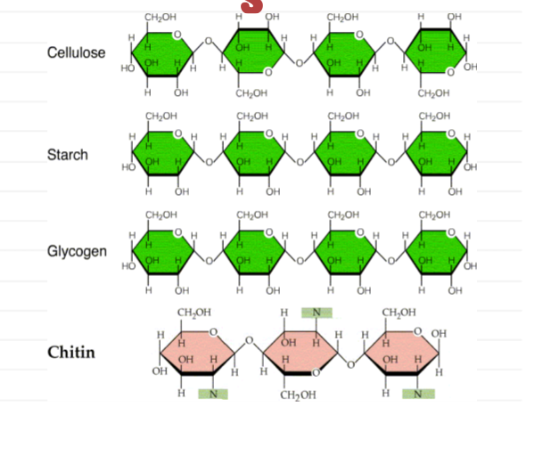
POLYSACCHARIDE
• HUNDREDS of monosaccharides joined by glycosidic linkages created by dehydration synthesis
function in GLUCOSE STORAGE or CELL STRUCTURE
ex.
Cellulose; STRUCTURAL plant cell walls
Chitin; STRUCTURAL strengthens exoskeletons in insects and fungal cell walls
Starch; plant GLUCOSE STORAGE potatoes and grains
Glycogen; animal GLUCOSE STORAGE stored in liver and muscle cells
LIPIDS
• mainly C, H & O (in no particular ratio) sometimes P
• DIVERSE group of molecules: NOT all considered true polymers + NO true monomer
• "sort of" monomers = FATTY ACIDS + GLYCEROL
• ONLY found in 2 out of the 3 lipid families
UNIFYING LIPID PROPERTY
• all lipids are HYDROPHOBIC & "H2O fearing"
• extremely NONPOLAR: entirely nonpolar covalent bonds
mainly chains or rings of HYDROCARBON

GLYCEROL
• lipid monomer
• 3-carbon chain that contains 3 hydroxyl groups

FATTY ACIDS
• lipid monomer
• long HYDROCARBON CHAIN with a CARBOXYL group
• fatty acids that contain ONLY single bonds between C atoms are SATURATED
• fatty acids that contain double bonds between C atoms are UNSATURATED
UNSATURATED FATTY ACIDS
• contain at LEAST one DOUBLE bond between the C in the hydrocarbon chain
• create a "kink" at every double bond

ESTER LINKAGE (BOND)
• covalent bond created via dehydration synthesis between the glycerol
molecule and a fatty acid
• formed between one of the glycerol hydroxyl groups and the fatty acid carboxyl group

TRIGLYCERIDES
• true polymer
• created by dehydration synthesis using 3 fatty acids and 1 glycerol
• major functions - LONG TERM E STORAGE and INSULATION
• held together by 3 ESTER LINKAGES
• created by dehydration synthesis
• 3 fatty acids + 1 glycerol
• removes 3 H,O molecules

TRIGLYCERIDE FATS & OILS
FAT;
triglycerides in animals
• solid at room temperature contain only saturated fatty acids
• fatty acids stack close together
OIL
• triglycerides in plants
liquid at room temperature
contain unsaturated fatty acids
• "kinks" prevent fatty acids stacking close together
PHOSPHOLIPIDS
• major component of ALL biological membranes
• modified polymer; only partially created by dehydration synthesis
• 1 glycerol molecule attached to 2 fatty acids & a PHOSPHATE group
PHOSPHOLIPIDS HYDROPHILIC/PHOBIC
HYDROPHILIC head; "water-liking"
polar because of negatively charged phosphate group
head comprised of the glycerol + phosphate
HYDROPHOBIC tails; "water-fearing"
nonpolar because of fatty acid hydrocarbon chains
tails comprised of the fatty acids
STEROIDS
• not a polymer —> not created by dehydration synthesis
functions:
• animal cell membrane structure
• cell communication as hormones
• C-skeleton of 4 fused rings
CHOLESTEROL
• most ABUNDANT steroid in humans
• ONLY steroid utilized in animal cell membranes
BIOMOLECULES
water, carbohydrates, proteins, lipids, nucleic acids
all organic molecules —> *these molecules are not only organic but they are specifically POLYMERS
COMPOSED MAINLY OF CHNOPS
CARBON accounts for the LARGEST diversity of biological molecules
IMPORTANCE OF CARBON
important to life becausw; versatile bonding behavior; ONLY true NONMETAL w 4 valence electrons → can have a MAXIMUM of 4 COVALENT BONDS around it
ORGANIC MOLECULES
molecules that contain at LEAST one carbon-carbon (C-C) bond
• carbons covalently bonded to each other
• can be polar or nonpolar
DIVERSITY OF CARBON MOLECULES
• carbon has a tendency to bond to ITSELF in long chains that form the SKELETONS of organic molecules
carbon chains can vary in length; may be straight, branched or arranged in rings; can have multiple bonds (double & triple) that vary in number & location
• carbon skeletons can be assembled and remodeled into a variety of organic compounds