Legal Unit 3 AOS1A
 Call Kai
 Learn
 Practice Test
 Spaced Repetition
 Match
 Flashcards
 Knowt Play
1/82

There's no tags or description
Looks like no tags are added yet.
83 Terms
Types of Criminal Offences:
Two categories of criminal offences:
Summary Offences
Indictable offences
Summary Offences:
A minor crime that is “generally” heard in the Magistrates' Court by Magistrate - less serious
Eg: minor road offences, petty theft, minor assaults.
The final hearing ‘HEARING’ - not trial.
No right to a jury trial for summary offences.
Most summary offences are in the Summary Offences Act 1966 (Vic)
(many listed in other Vic. statutes and regulations)
Most crimes are summary offences - in Vic. 95%
Indictable Offences:
An indictable offence is a serious crime.
Eg: Homicide, sexual offences, some theft, drug trafficking.
Offences in the Crimes Act 1958 (Vic) are indictable → unless the offence is stated in the Act to be a summary offence.
Indictable offences are heard in the County or Supreme Court of Victoria (Trial Division)
Final hearing is known as a trial. ‘TRIAL’ - not hearing
A jury is used to determine guilt if the accused pleads not guilty (12-15).
Judge ensures strict evidence + procedure rules are followed, determine sanction (if guilty).
Committal Procceeding:
Primary purpose: to determine if there is enough evidence to support a conviction for the offence charged for an INDICTABLE OFFENCE!
Committal proceedings take place in the Magistrates Court and involve several stages, including a final stage, called the committal hearing.
Committal HEARING is where a magistrate decides whether there is evidence of sufficient weight to support a conviction at trial - test the strength of the evidence
Act as a filter - screens cases before moving to the couty/supreme court
Committal Hearing final outcomes:
Does find there is sufficient evidence: Accused is committed to stand trial and the case is then transferred to the higher court that will hear the case.
Does not find there is sufficient evidence: Accused is discharged, allowed to go free.
If further evidence is found in future, the accused can be brought before the court again (committal proceeding is not a trial, and no guilt has been decided).
Purposes of a Committal Proceeding:
Ensuring that cases where there is inadequate evidence do not go to trial
Finding out whether the accused plans to plead guilty or not guilty
Ensuring a fair trial by making sure the prosecution's case is disclosed to the accused
Giving accused the opportunity to put forward a case at an early stage and possibly cross-examine witnesses.
Indictable Offences Heard and Determined Summarily:
Indictable offences that can be heard in Magistrates' Court as if they were summary offences
If an indictable offence can be dealt with as a summary offence is determined by statute.
Schedule 2 of the Criminal Procedure Act 2009 (Vic) lists many indictable offences that can be heard summarily.
Eg: Theft if property alleged to have been stolen is a motor vehicle.
Capped at indictable offences which carry a max. penalty of 10 years
Heard by a Magistrate, no jury.
Why choose an indictable offence to be heard summarily?
It is quicker and cheaper to have a case heard in the Magistrates Court.
Maximum penalty that can be granted is less than if it were heard as an indictable offence.
The Magistrates Court AS A WHOLE can only impose a max. of two years' imprisonment for a single offence, and a max. of five years imprisonment for multiple offences.
The court and the accused must agree that the offence is appropriate to be heard summarily
The Burden of Proof:
Refers to which party has the responsibility to prove the facts of the case.
Lies with the person or party who is ‘bringing the case’ - for a criminal case, the prosecution/crown (prosecution must prove the accused is guilty).
Rationale: If the prosecution is accusing a person of having committed a crime, then the responsibility should be on the prosecution to establish the facts.
When can the burden of proof be reversed?
The burden of proof can be reversed
If the accused is pleading a defence - eg: mental impairment
Section 5 of the Drugs, Poisons and Controlled Substances Act 1981 (Vic) → A person is presumed to possess a substance if the substance is on their property (owned, rented, occupied), and the person cannot satisfy the court otherwise.
The onus (responsibility) is on accused - prove the drug was not in their possession.
Burden of Proof and the Accused:
The accused should not bear any part of the burden – they should NOT need to prove:
That they are innocent
An alternative version of events if disagree with version put forward by prosecution.
Accused does not need to prove they are not guilty - only that the prosecution has not proven guilt, done by:
Cross-examining prosecution’s witnesses, Bringing defence witnesses
Submitting to the court that the prosecution has not brought enough evidence.
The Standard of Proof:
Refers to the level of certainty or strength of evidence required to prove the case.
In a criminal case, the prosecution must prove case beyond reasonable doubt.
Means that no reasonable doubt is possible from the evidence presented.
The magistrate /jury can still think of fanciful, imaginary or unreasonable doubts (not realistic or based on the evidence), but these do not count.
To prove guilt - must be no other reasonable conclusion can be reached.
Indictable offences, - jury given instructions = must be satisfied of guilt BRD. Summary offences, the magistrate (not a jury) will decide on guilt.
If the BOP on the accused, the standard of proof is on the balance of probabilities.
The Presumption of Innocence:
Guarantees if a person is accused of crime, considered innocent until proven otherwise.
Old common law right + in Charter of Human Rights and Responsibilities Act 2006 (Vic).
The presumption of innocence is upheld is by:
Imposing a high standard on prosecution to prove case (beyond reasonable doubt)
Imposing the burden of proof on the prosecution
Accused persons do not have to prove they are innocent.
Features of the Criminal Justice System Upholding the Presumption of Innocence: (6)
Accused has the right to silence, don’t need to answer question/ give evidence. Silence is not to be taken as a sign of guilt
Indictable offences, prosecution must prove there is enough evidence to support a conviction before trial - Committal Proceeding.
The right to appeal wrongful conviction
The right to apply for bail; unless there are reasonable grounds for denying bail
Police must reasonably believe a person has committed a crime before arrest
Eg: Deny bail if accused is a threat to the safety of the community
Person's prior convictions cannot be revealed until sentencing (after found guilty).
SCAB PC
Protection of Rights:
In Vic. many rights are protected by statute - eg: Charter of Human Rights and Responsibilities Act 2006 (Vic) - Human Rights Charter
Purpose: To protect and promote human rights.
Ensures that statutes passed in Vic. Parliament is compatible with human rights in Charter.
The rights in the Charter are based on the International Covenant on Civil and Political Rights (1966) - An international treaty to which Australia is a signatory.
Sections 23-27 of Charter contains rights available to an accused in criminal proceedings.
Main Rights Available to an Accused:
The right to be tried without unreasonable delay
The right to silence
The right to trial by Jury
Accused Rights: The Right to be tried without unreasonable delay:
The Human Rights Charter states - person charged with criminal offence is entitled to a guarantee they will be tried without unreasonable delay.
Accused is entitled to have charges heard in a timely manner, delays only reasonable.
Every accused person is entitled to this right regardless of prior convictions/characteristics.
Unreasonable delay is not defined, the reasonableness of a delay depends on many factors such as the complexity of the case and the legal issues involved.
Eg: prosecution needing more time to prepare for a case involving multiple crime scenes, crimes and multiple accused people.
Specific Scenarios of Accused Right: The Right to be tried without unreasonable delay:
Detained Awaiting Trial:
Section 21(5) of the Human Rights Charter - a person, arrested/detained criminal charge, has the right to be brought to trial without unreasonable delay.
People have right to liberty, should not be held for an unreasonable time awaiting trial.
Children Awaiting Trial:
Charter states that an accused child must be brought to trial as quickly as possible.
Having a trial ‘as quickly as possible’ for an accused child, rather than a trial ‘without unreasonable delay’’ is justified because of the impact a trial might have on a child
Accused Rights: The Right to Silence:
Protections given to an accused person to not have to say or do anything including:
A right to refuse to answer any questions, does not have to give any info. as part of the investigation of a crime
Cannot be forced to give evidence in a criminal trial or answer any questions, file any defence, or call a particular witness as part of a trial.
Ensures the presumption of innocence is upheld as an accused person’s choice to not speak during questioning/court cannot be viewed as a sign of guilt.
Accused’s Rights: Exercising the Right to Silence:
An accused’s right to silence can be exercised prior and during a trial, including when:
Being confronted by law enforcement during arrest / when being accused of committing an offence.
In court , accused can choose to remain silent instead of defending themselves against the prosecution or answering their questions.
Accused relies on a defence that was not raised earlier, no conclusions should be drawn that the new defence is a new invention or is suspicious when just raised.
Where the accused has chosen to answer some questions but not others (selective silence), this cannot be used to conclude guilt.
Statute Law Protecting the right to silence:
Section 89 of the Evidence Act 2008 (Vic) - negative conclusions cannot be drawn because person has failed to answer questions/respond to matter in an investigation.
Judge directions to a jury - direct that the accused has a right to remain silent, jury should not conclude that the accused is guilty because they remained silent.
The Jury Directions Act 2015 (Vic) - accused’s lawyer to request judge tells jury:
failure of an accused to give evidence cannot be considered an admission of guilt
failure of an accused to call witnesses cannot be used as evidence against them.
Exceptions to the Right to Silence:
If police believe that person has committed /about to commit crime /may be able to assist in the investigation of an indictable offence → person MUST give name and address if asked.
Criminal Procedure Act 2009 (Vic) sets out that an individual pulled over whilst driving must provide their driver’s licence, or their name and address, if asked by police.
Accused Rights: The Right to Trial by Jury:
A trial by jury - where a person's peers within the community decide the outcome of the case, for a criminal case, decide the guilt of the accused.
Juries provide the opportunity for community participation in the legal process.
Not protected by the Human Rights Charter, but protected by statute law in Vic. (State indictable), and in the Constitution (Commonwealth indictable).
Right applies to people accused of indictable offences, who plead not guilty, according to the Criminal Procedure Act 2009 (Vic).
Trial by Jury: Role of Jury + components
Criminal jury is made up of 12 jurors, the court can order the empanelment of up to three additional jurors, considering factors such as the length and nature of the trial
Only 12 jurors will ultimately deliberate on the accused's guilt.
Helps to avoid any disruptions in the trial eg: one or more of the jurors gets sick.
Jury will hear the case and will need to reach a verdict on deciding guilt of the accused
The jurors must make this decision beyond reasonable doubt.
State Indictable Offences: Trial By Jury
Victorian indictable criminal offences, the Juries Act 2000 (Vic) requires 12 members of jury.
The Criminal Procedure Act 2009 (Vic) and the Juries Act also contain provisions about processes in relation to jury empanelment and directions to be given to juries.
There is no right to trial by jury for summary offences.
Commonwealth Indictable Offences: Trial By Jury
Section 80 of the Australian Constitution states that any person who is charged with a Commonwealth indictable offence is entitled to a trial by jury.
The High Court has interpreted this as a right that cannot be refused by an accused
An accused cannot choose to be tried by judge alone if they have been charged with a Commonwealth indictable offence.
Commonwealth indictable offences - serious offences set out in Commonwealth law. Include:
Organ trafficking, terrorism and importation of illegal substances.
Section 80 of the Aus. Constitution provides a limited right to trial by jury because most indictable offences are crimes under state law - this section only applies to Commonwealth
The Commonwealth Parliament can determine by statute which offences are 'indictable'
Define Victim:
Victim: A person who has suffered directly or indirectly as a result of a crime.
Not a party in a criminal case, should be recognised, treated with respect + dignity as participants during the case.
Recognised in several statutes including the Victims Charter Act 2006 (Vic) - Victims Charter
Victims Charter Act 2006 (Vic) - Some objectives of the Victims Charter:
Recognise the impact of crime on victims
Recognise victims should be offered certain info. during investigation + prosecution process
Help reduce likelihood of secondary victimisation - experienced by the victim as a result of interaction with the criminal justice system.
Vitcims Charter definition of Victims:
Depending on the crime, a victim can include (defined broadly):
A person who has suffered injury as a direct result of a criminal offence (‘primary victim’)
A family member of a person who has died as a direct result of a criminal offence
A family member of a person who is under 18 or incapable of managing their own affairs due to mental impairment - that person has suffered injury as a direct result of a criminal offence
A child under 16 years who has been groomed for sexual conduct + child’s family.
There are many rights afforded to victims in a criminal case - but the main 3 are:
The right to give evidence using alternative arrangements (only in certain cases)
The right to be informed about the proceedings
The right to be informed of the likely release date of the offender (only if imprisoned)
Victims Rights 1. The right to give evidence using alternative arrangements:
Alternative arrangements: different ways in which a witness can give evidence
Section 360 of the Criminal Procedure Act (2009) allows for alternative arrangements
Purpose: Ensure witnesses feel safe giving evidence, reducing secondary victimisation - involvement in criminal proceedings can again be traumatic for victims
Arrangements can be made at any stage of proceeding (including appeal/ rehearing.
Victims Rights: Cases which alternative arrangements can be made:
Sexual offences (court directs that it is always given - always use of tv)
Family violence offence (court directs that it is always given - always use of tv)
Offence for obscene, indecent, threatening language or behaviour in public
Offence for sexual exposure in a public place.
**Always given
**Have to ask for it
Victims Rights: Cases which alternative arrangements are ALWAYS GIVEN:
Sexual offences (court directs that it is always given - always use of tv)
Family violence offence (court directs that it is always given - always use of tv)
**Always given unless:
Prosecution applies for complainant to give evidence in the courtroom
Complainant is able and wishes to do so
Complainant is aware of right to give evidence in another place.
Victims Rights: Cases which alternative arrangements are SOMETIMES GIVEN:
Offence for obscene, indecent, threatening language or behaviour in public
Offence for sexual exposure in a public place.
Victims Rights: Types of alternative arrangements: (6)
Witness gives evidence from a place other than the courtroom: by means of closed- circuit tv (or other facilities) - enables communication to courtroom. The evidence will be recorded.
Screens used to remove the accused from the direct line of vision of the witness.
A support person may be chosen by the witness to be beside them while giving evidence
Providing emotional support - must be approved by court
Only certain persons (specified by court) allowed in court when witness is giving evidence.
Legal practitioners may be required to not formally dress in robes.
Legal practitioners may be required to be seated while asking witness questions.
Victims Rights: The right to be informed about proceedings:
Charter recognises that people adversely affected by crime should get certain info. about the proceeding + criminal justice system.
Charter requires investigatory agencies, prosecuting agencies and victims’ services agencies (police, DPP, Victims of Crime Commissioner) to provide:
Clear, timely and consistent information about support services
Possible compensation entitlements
Legal assistance available to persons adversely affected by crime.
Inform a victim about the progress of the investigation.
Info. does not need to be given if it may put the investigation at risk, or if the victim chooses not to receive it.
Victims Rights: The right to be informed about proceedings: Informed About
Once prosecution has started, Charter requires the prosecution to give victim the following info:
Details of the offences charged against the person
If no offence is charged, the reason why
How the victim can find out the date, time and place of the hearing of the charges
The outcome of the criminal proceeding, including any sentence imposed
Details of any appeal.
The victim must also be told that they are entitled to attend any court hearings.
Rationale for Victims Rights: The right to be informed about proceedings + release date:
Important for victims as they may want to observe the provision of justice and understand the accused is held accountable for their actions.
Eliminates uncertainty, minimising the risk of the victim suffering secondary victimisation
Victims of violent offences want to know the offender is imprisoned (may still fear for their safety if offender is released) = can provide comfort.
The right to be informed of this information can remove the uncertainty.
Victims can take precautions, to prevent the offender from contacting them.
Victims on Register have the right to submit how the offender’s release may affect them - considered when the decision to grant parole is made.
Victims Rights: 3. The right to be informed of the likely release date of the offender:
Victims of criminal acts of violence may apply to be included on the Victims Register.
Section 17 of the Victims Charter - a person can be placed on the Victims Register if they, or their family member, are a victim of a criminal act of violence.
Once on Register, receive information about:
An offender who has been imprisoned
If offender applies for parole, parole conditions and notification of release of the prisoner on parole ( ≥14 days before), if parole is cancelled.
The length of the offender’s sentence + any changes its length
The earliest possible release date + if the offender escapes from prison
Offenders death
Criminal Acts of Violence definition
***Criminal acts of violence - defined in s 30A(1) of the Corrections Act 1986 (Vic).
Sexual offences, aggravated burglary, stalking, kidnapping, culpable driving causing death, assault/injury (punishable by imprisonment, murder/manslaughter) etc…
Fairness: (the process, from the processing to the courtroom)
‘All people can participate in the justice system, and its processes should be impartial and open.’
Components of fairness: Impartial processes, open processes, participation.
Fairness is designed to ensure that:
Innocent people are not found guilty of a crime that they did not commit
Public confidence is maintained in our criminal justice system through features such as open and public hearings.
Each accused person is entitled to receive just processes + impartial hearing, victims are entitled to participate in the system + assurance that justice is achieved.
Fairness: Impartial Processes:
Courts and court personnel (judges, magistrates, jury) are independent and impartial.
Should not show bias towards or against either party, the case must be decided based on facts and law, not on prejudices.
Impartiality also extends beyond the courtroom.
Fairness: Open Processes:
Helps ensure institutions + people administering justice can be scrutinised by public + held accountable for actions, decisions and practices.
Includes police, courts, government departments and bodies
Occasionally, courts may need to be closed to the public/ media, or details of a case may need to be unavailable to the public.
Fairness: Participation:
People participate in justice system - accused.
Opportunity to know case put against them
Opportunity to prepare a defence
Use of a lawyer
Use of an interpreter
Tried without unreasonable delay
Participation extends to victims:
allowing some victims to give evidence using alternative arrangements
the use of victim impact statements
providing an opportunity to give their views
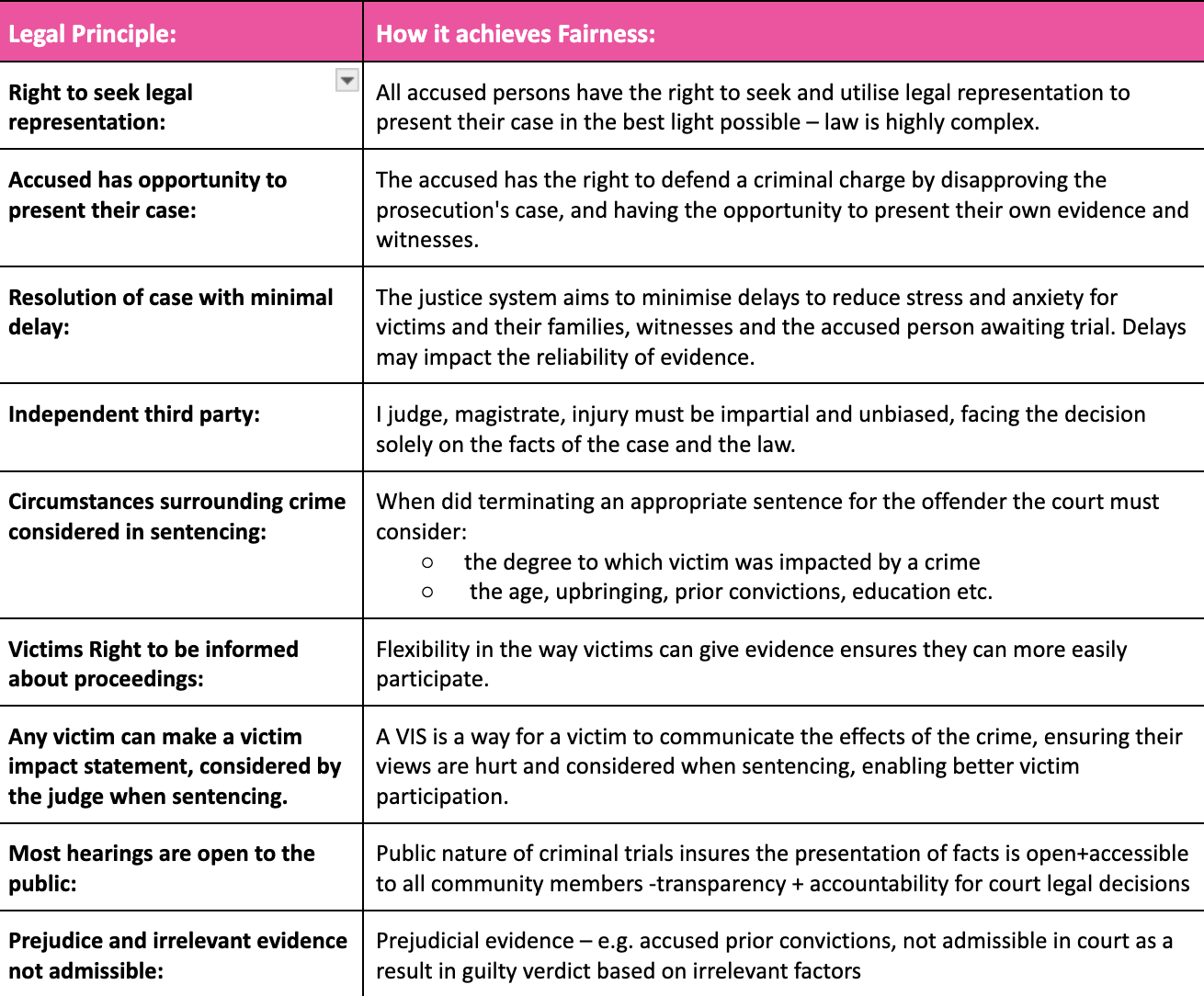
How is fairness Achieved: (9)
Right to seek legal representation
Accused has opportunity to present their case
Resolution of case with minimal delay
Independent third-party
Circumstances surrounding crime considered in sentencing
Victims rights to be informed without proceeding
Any victim can make a victim impact statement considered by the judge in sentencing
Most hearings are open to the public
Prejudice and irrelevant evidence, not admissible.
Equality: (the people, the individual)
‘All people engaging with the justice system and its processes should be treated in the same way. If the same treatment creates disparity or disadvantage, adequate measures should be implemented to allow everyone to.’
Emphasises the importance of focusing on equal results rather than equal treatment.
Prevent discrimination for disadvantaged = essential to establish mechanisms that accommodate the inherent differences among people.
Mechanisms ensure the law treats all individuals fairly, regardless of circumstances
Protected in the Human rights Charter, stating everyone is equal before the law, entitled to protection of the law and protection against discrimination.
Components of Equality: Same treatment and Different treatment.
Equality: Same Treatment:
People must be treated in the same way and given the same level of support regardless of personal differences for characteristics (race, gender, age) - 'Formal equality’
The same processes will apply in every case, for every party.
No changes to way cases are run - everyone given the same opportunities + level of support.
Equality: Dirrerent Treatment:
If treating people in the same way could in fact cause disparity/disadvantage, then measures should be put in place to allow people to participate in the justice system without it.
‘Substantive equality’ - the one size fits all approach' does not work, and special measures are needed so that people do not suffer disadvantage simply because of who they are. Egs:
Interpreters
Providing information in a different way
Changes to court processes
Different form of oath or affirmation
Changes for the purposes of cultural differences
Breaks and adjournments
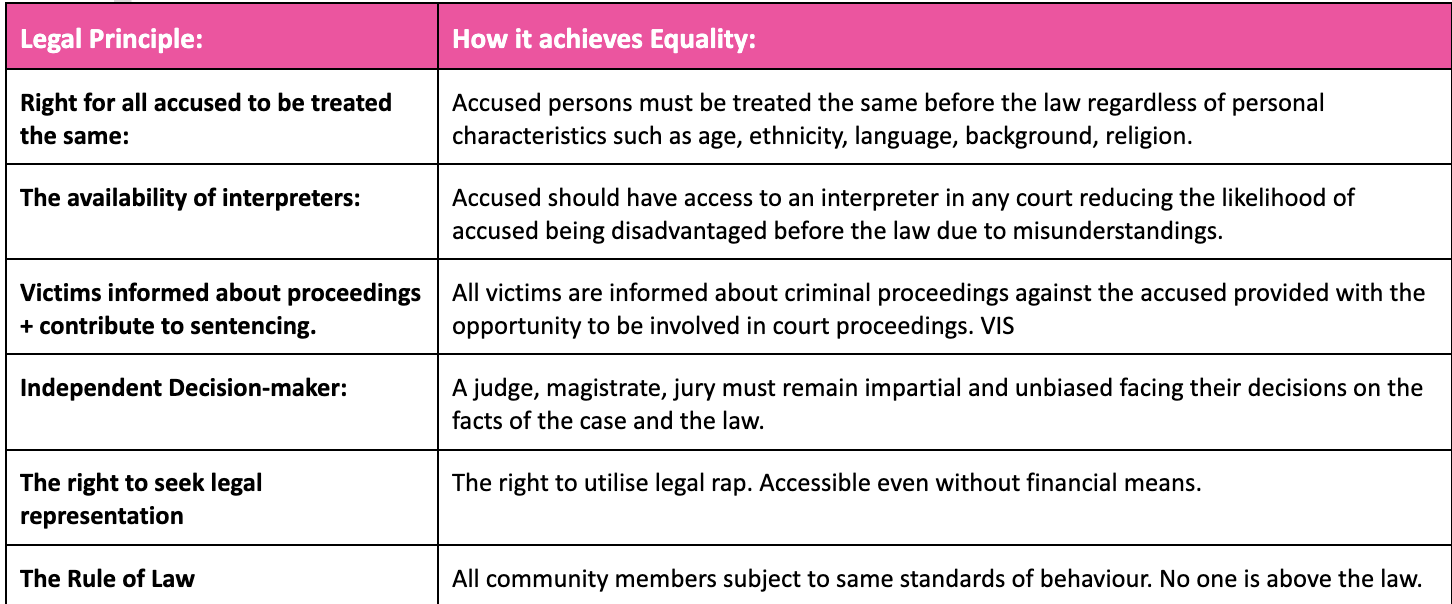
How is equality achieved:
Right for all accused to be treated the same
The availability of interpreters
Victims informed about proceedings and contribute to sentencing
Independent decision maker
The right to seek legal representation
The rule of law
Access: (facilities, services)
‘All people should be able to engage with the justice system and its processes on an informed basis.’
Promotes an accused’s ability to understand their legal rights + processes involved in case.
Allows people to have the opportunity to use the processes and institutions within the criminal justice system - these are not beyond their reach.
Right to access only applies to accused persons, but victims, families and the general public.
Components of Access: Engagement (in the legal process), Informed basis
Access: Engagement:
People need the means + ability to be able to use + participate in the system. This includes:
Physical access
Technological access
Financial access
No delays
Access: Informed Basis:
People should be able to engage on an informed basis. They should be able to:
Understand their legal rights and the processes involved in their case
Obtain/ be provided with enough information to make reasoned and sensible decisions (e.g. a decision about what to plea).
This can be more difficult for: non-English speakers, First Nations peoples, young children, people with disabilities, people from different cultural and linguistic backgrounds
The following may help a person be more informed:
Education, Information
Legal and support services
Legal representation
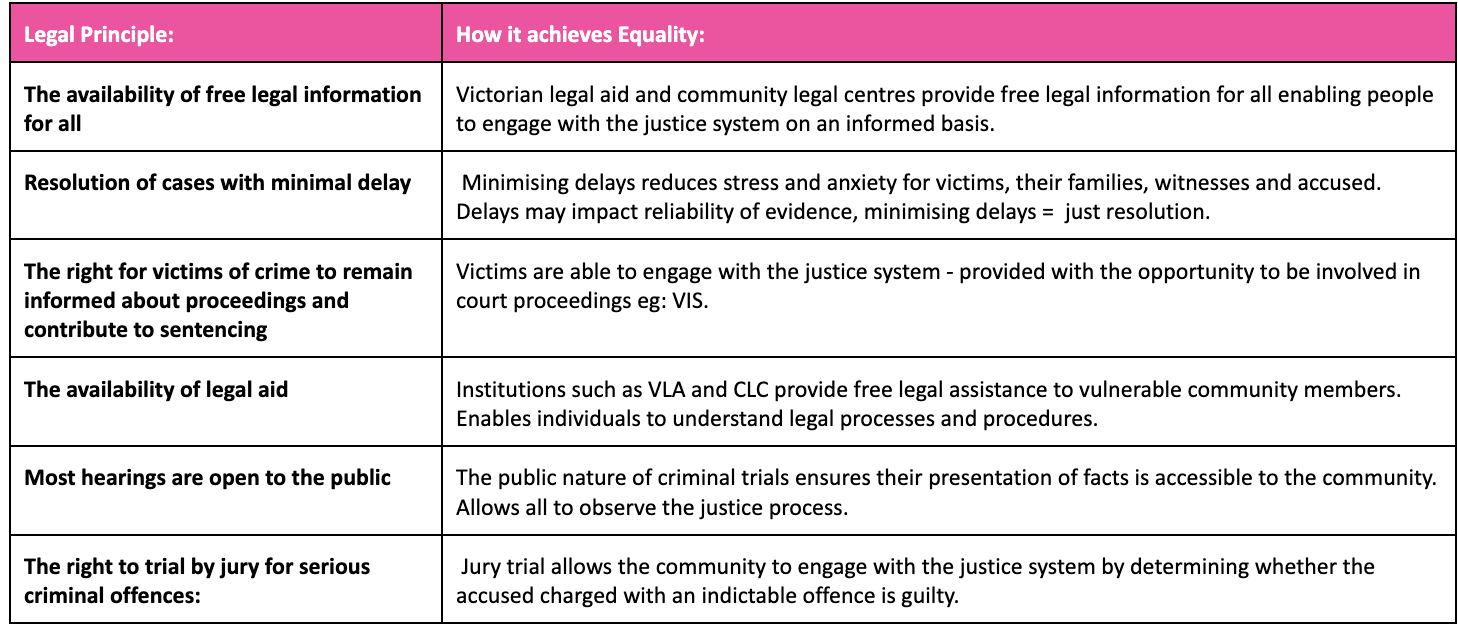
How is access achieved:
The availability of free legal information
Resolution of cases with minimal delay
The right for victims of crime to remain informed about proceedings and contribute to sentencing
The availability of legal aid
Most hearings are open to the public
The right to trial by jury for serious criminal offences
What is Victorian Legal Aid (VLA)?
Victoria Legal Aid (VLA) is a government funded statutory authority assisting people in Victoria access the legal system.
Primary role:
To ensure access to justice, particularly for those who cannot afford a lawyer (regardless of their financial situation)
To uphold the principles of the criminal justice system, including fairness and equality before the law.
The Role of VLA:
Victoria Legal Aid plays a key role in supporting the rights of an accused by:
Helping accused people understand the law and legal processes
Providing access to legal advice and representation
Promoting fairness and equality before the law
Reducing disadvantage for vulnerable or financially disadvantaged accused persons
Supporting the operation of the adversary system - ensuring both sides are legally represented - fair trial requires both sides to be represented
Types of Assistance provided by VLA: (In order of extent of assistance - 4 being most)
Free Legal Information
Free Legal Advice
Duty Lawyer Services
Legal Representation (Grants of Legal Assistance)
VLA: Support for Vulnerable Accused Persons:
VLA recognises vulnerable individuals may face additional barriers.
Assistance may be prioritised for accused persons who:
Have a mental illness or cognitive impairment
Children
Face family violence issues
Homeless or socially disadvantaged
In custody
Ensures personal circumstances don’t prevent meaningful participation in the legal process - Fairness
VLA: 1. Free Legal Information:
Info. about the law + legal processes to public. Assistance regardless of income, aims to help individuals understand rights, criminal process, and options
Available through VLA website, over-the-phone help, community legal education.
VLA: 1. Free Legal Information: HOW IT ASSISTS ACCUSED + PURPOSE
Helps accused understand rights, charges, court procedures
Enables accused to make informed decisions
Improves access to justice, even if no further legal help is received.
—-
To ensure that every person can access legal knowledge and understand how to navigate the criminal justice system.
VLA: 2. Free Legal Advice:
Provides free/low-cost legal advice to people who meet certain eligibility criteria.
Personalised legal advice about an individual’s specific legal issue.
Provided in person at VLA offices (appointments), community legal centres partnered with VLA, via phone.
VLA: Free Legal Advice: HOW IT ASSISTS ACCUSED + PURPOSE
May receive advice about:
Charges laid against them
- Rights during investigation
- Possible defences,
- Likely outcomes + penalties
- How to prepare for court
Assistance:
-Assists deciding plea
- Helps accused understand strengths + weaknesses of case
Purpose:
To promote fairness - ensure the accused understands their legal position and can make
informed decisions.
VLA: 3. Duty Lawyer Services:
A lawyer provided by VLA who is available at many Magistrates’ Courts and Children’s Courts.
A free, on-the-day legal assistance provided at court.
Funded by Victoria Legal Aid.
Assist accused people who:
• In custody
• Meet VLA’s disadvantage criteria
• Would be at clear disadvantage without representation
VLA: 3. Duty Lawyer Services: HOW IT ASSISTS ACCUSED + PURPOSE
Assistance Includes:
- Provide on-spot legal advice in court
- Explaining the court process
- Negotiating w. prosecution - plea neg.
- Representing the accused for the day.
- Help accused understand outcomes
How it assists an accused:
- Represents accused - don’t have lawyer
- Provides advice before appearance
-Ensures the accused is not unrepresented in important court stages
—-
To ensure that accused who needs immediate representation at court (no lawyer) is still able to participate fairly in proceedings.
VLA: 4. Legal Rep. (Grants of Legal Assistance)
For more complex or serious matters, VLA may provide accused with ongoing legal rep. through a grant of legal assistance.
This funding covers:
• Preparing the case
• Filing applications
• Negotiations with prosecution
• Court representation at trial or contested hearings.
VLA: 4. Legal Rep. (Grants of Legal Assistance): HOW IT ASSISTS ACCUSED + PURPOSE
How it assists an accused:
• Allows access to professional legal rep.
• Supports preparation of a defence
• Improves ability to present case effectively
• Helps ensure a fair trial
-
Purpose:
To promote access to justice, ensuring that individuals who cannot afford a lawyer can still have
representation in serious or complex criminal matters.
VLA: 3. Duty Lawyer Services Additional Requirements - INCOME TEST:
Duty lawyers-only available to accused who satisfy income test + face straightforward charge.
People in custody are given priority and do not need to satisfy the income test.
Legal representation at a hearing is only available to accused people who satisfy the income test, and either face a significant charge or belong to a category of people the VLA prioritises
Those in custody; with disability, acquired brain injury, mental health issue; people experiencing homelessness, cannot speak, read/write, First Nations people
VLA: Duty Lawyers - How To Meet an Income Test:
Present Centrelink benefit card/pensioner concession card to the duty lawyer.
Can sign a declaration that shows they have limited income (e.g. primary income = welfare
VLA: 3. Duty lawyers are especially important for accused persons who are:
Financially disadvantaged
Facing court unexpectedly
At risk of unfair outcomes without legal help
VLA: 4. Legal Representation - Grants of Legal Assistance Eligibility
Means test (financial eligibility - income, assets and expenses): Assesses if accused has financial resources to pay for own lawyer.
Merits test (reasonable prospects of success): Assesses if the case has legal merit + if rep. is likely to benefit accused.
Reasonableness test: Ensures public funds are used appropriately - rep. must be justified.
VLA: 4. Grants are commonly provided for: + rep.
Serious criminal charges
Cases with potential imprisonment
Vulnerable accused persons
Representation can come from:
VLA in-house lawyers
Private lawyers who take VLA-funded cases (“private practitioner panel”)
Victoria Legal Aid (VLA) assisting Victims:
VLA recognises that victims may have vulnerabilities that limit their ability to navigate the justice system. Assistance is prioritised for victims who:
Experiencing family violence, Are children or young people
Have a disability, mental illness, or cognitive impairment
Are from culturally or linguistically diverse backgrounds
Are homeless or socially disadvantage
VLA Prioritized providing Victims the means to:
Navigating the Criminal Justice System:
Explain how the criminal justice system works eg: processes, sentencing.
Informing victims about their rights at different stages of a criminal matter
Providing information about support services available during criminal proceedings.
Protection Orders
Providing info. about Family Violence + Personal Safety Intervention Orders.
Explaining who can apply for a protection order + steps involved in applying.
Assisting victims to understand conditions of P.Os + how they are enforced
Financial assistance and compensation
Criminal case compensation and resolution orders can be made by a court.
Victims take civil action and sue the offender
Victims of Crime Financial Assistance Scheme → VLA can help victims with the Victims of Crime Financial Assistance Scheme (FAS)
FAS - Victims of Crime Financial Assistance Scheme (FAS)
*FAS: Vic. gov. Scheme, financial assistance to V.o.V.C - help them recover from harm they suffered.
FAS. is available to:
Primary victims (directly injured),
Secondary victims (family members, witnesses) + Related victims (family of person who died)
Types of Assistance available to Victims of Crime by VLA:
Free Legal Information:
Legal Advice to Victims:
Family Violence Legal Assistance
Duty Lawyer Services for Victims
VLA VICTIMS: Free Legal Information:
VLA. provides free legal info. to victims= help them understand the law, the legal system and the options available to them. This general information, available before victims take legal action.
VLA VICTIMS: Free Legal Information: HOW
•Publishing plain-language legal info. on website about victim rights, criminal procedures, support services.
• Explain how the C.J.S operates
• Providing info. about intervention orders, (who can apply, how, conditions)
•Provide info. about financial assistance available (eligibility, limits,covered expenses) under FAS.
• Deliver community legal education sessions and resources
• Referring victims to appropriate support services alongside legal info.
VLA VICTIMS: Legal Advice to Victims:
VLA provides free legal advice to victims = help them understand rights, legal options.
Advice delivered through accessible
early-intervention services.
VLA VICTIMS: Legal Advice to Victims: HOW
• Telephone services - victims speak directly to lawyer about situation.
• In-person appointments (offices/legal centres) more detailed advice.
• Providing tailored legal advice about issues such as: Rights, intervention orders, financial assistance (FAS)
• Helping victims prepare application + gathering documents
• Explain the application process - reducing stress and confusion.
• Assisting victims through grants of legal assistance, allowing ongoing legal representation.
VLA VICTIMS: Family Violence Legal Assistance
VLA often prioritises victims of family violence because they are typically at high risk and urgently
need legal protection.
VLA VICTIMS: Family Violence Legal Assistance: HOW
• Legal advice on Intervention Order (IVO) applications
• Court rep. at the Magistrates’ Court (including duty lawyer services)
• Support through VLA-funded family violence programs
• Assistance w. related issues - parenting arrangements, safety plans, child protection matters
VLA VICTIMS: Duty Lawyer Services for Victims
VLA provides duty lawyer services to assist victims - particularly when need immediate legal help at court.
These services are usually provided at the Mag. Court + focus on protection and safety matters.
VLA VICTIMS: Duty Lawyer Services for Victims: HOW
Assistance with Intervention Orders (IVO)
• Helping victims apply for Family Violence (FVIOs) or Personal Safety IVO. (PSIOs). Explain purpose, conditions, length
On-the-day Legal Advice
• Provide free, immediate legal advice on court day, no appointment.
• Explaining court procedures, advise victims about rights
Court Representation
• Rep. victims during IVO hearings
• Requesting appropriate conditions to protect the victim’s safety.
Support During Court Proceedings
• Help victims feel supported, Refer victims to support services
Grants of Legal Assistance
Can make a grant of legal assistance if apply for (FVIOs)/(PSIOs)
VLA VICTIMS: **Duty Lawyer Services for Victims - Eligibility depends on:
Financial circumstances (means test)
Safety a merit test (reasonable prospects of success or need)
Priority categories, which often include family violence victims