AP World History Unit 1 & 2 Exam Study Guide
 Call Kai
 Learn
 Practice Test
 Spaced Repetition
 Match
 Flashcards
 Knowt Play
1/79

There's no tags or description
Looks like no tags are added yet.
80 Terms
Confucius (2)
Founder of Confucianism. Chinese philosopher and teacher; his beliefs, known as Confucianism greatly influenced Chinese life.
Shi Huangdi (2)
Founder of the short-lived Qin dynasty and creator of the Chinese Empire (r. 221-210 BCE) He is remembered for his ruthless conquests of rival states and standardization (163), unified China, ruled Qin dynasty, built many roads, started Great Wall of China, divided kingdoms into districts, the first emperor of China.
Wu Ti (2)
(140-87 BCE), most famous Han ruler; promoted peace; supported Confucianism.
Ban Zhou (2)
Chinese woman that wrote "lessons for women" in the first century. It illuminates the unresolved tensions in Han society's attitude towards women. She also pleas for education of girls and for men to not beat their wives.
Chandragupta Maurya (3)
He founded India's first empire (Mauryan). He was an Indian prince who conquered a large area in the Ganges River valley soon after Alexander invaded western Indian.
Ashoka (3)
Third ruler of the Mauryan Empire in India (r. 270-232 BCE) He converted to Buddhism and broadcast his precepts on inscribed stones and pillars, the earliest surviving Indian writing.
Buddha (3)
Creator of Buddhism. Born around 600 BCE.
Philip II of Macedonia (4)
Ruled Macedonia from 359 to 336 BC; founder of centralization kingdom. Later conquered the rest of the rest of Greece, which was subjected to Macedonia authority. Father of Alexander the Great.
Alexander the Great (4)
Led the invasion on Persia in 334 BCE, using less but better trained warriors that ended the Achaemenid Empire in 331 BCE. He burned Persepolis.
Pericles (4)
Athenian political leader during 5th century BC. Guided development of Athenian Empire. Died during the early stages of Peloponnesian War.
Augustus Caesar (4)
The first emperor of Rome whose leadership brought about a long period of Pax Romana (Roman Peace)
Constantine (4)
Emperor of Rome who adopted the Christian faith and stopped the persecution of Christians (280-337)
Mesopotamia (1)
North Balkan Peninsula Kingdom to the north of Greece. Invasions led by Alexander the Great.
Tigris and Euphrates (1)
Tigris- Mesopotamian river above Euphrates.
Euphrates- Mesopotamian river below Tigris.
Egypt (1)
Split in to two regions, Upper Egypt and Lower Egypt
- Upper Egypt: Southern half of Egypt, connects Egypt to Nubia.
- Lower Egypt: Northern half of Egypt, connects Egypt to the Mediterranean Sea and Sinni Peninsula.
Nile river flows north toward the Mediterranean Sea.
Indus River Valley [Harappa, Mohenjo Daro] (1)
Northern Indian river that enabled agricultural societies to arise.
Harappans- Earliest urban society in the Indus River Valley -centered around Harappan & Mohenjo Daro.
Huang He River Valley (1)
Also known as the Yellow River Valley. Located in N. China.
Athens (4)
Powerful city in Ancient Greece that was a leader in arts, sciences, philosophy, democracy, and architect.
Sparta (4)
Greek city-state that was ruled by an oligarchy focused on military, used slaves for agriculture, discouraged the arts.
Constantinople (5)
Capital of the Byzantine Empire. Constructed on the site of Byzantium, an old Greek city on the Bosporus.
hunting and gathering (1)
The killing of wild animals animals and fish as well as the gathering of fruits, roots, nuts, and other plants for sustenance.
agriculture (1)
The deliberate effort to modify a portion of Earth's surface through the cultivation of crops and the raising of livestock for sustenance or economic gain.
civilization (1)
Any group of people sharing a set of cultural traits.
Hammurabi's Code (1)
Extensive law code est. by Babylonian King Hammurabi.
ziggurats (1)
A massive pyramidal stepped tower made of mudbricks, its is associated with religious complexes in ancient Mesopotamia cities, but its function is unknown.

bureaucracy (2/3)
A system of managing government through departments run by appointed officials (not elected)
mandate of heaven (2)
Chinese belief: heavenly powers' approval chooses emperor.
dynastic cycle (2)
The historical pattern of the rise, decline, and replacement of dynasties.
Confucianism (2)
Chinese ethical and philosophical teachings of Confucius which emphasized education, family, peace, and justice.
Confucian relationships (2)
Five Relationships
- Ruler :: Subject
- Parent :: Child
- Elderly :: Youth
- Husband :: Wife
- Friend :: Friend
Legalism (2)
Chinese philosophy developed by Hanfeizi; taught that humans are naturally evil and therefore need to be ruled by harsh laws.
Daoism/Taoism (2)
Chinese religion from 500s BCE that emphasized following the mystical and indescribable "way." It celebrated the chaos and contradictions of reality as well as the harmony of nature. The Yin and Yang symbolizes many aspects of this religion.
feudalism (2)
Basic concept refers to the political and social order of medieval Europe. Based on a hierarchy of lords and vassals who controlled political and military affairs.
Buddhism (3)
A world religion or philosophy based on the teaching of the Buddha and holding that a state of enlightenment can be attained by suppressing worldly desire.
Hinduism (3)
A religion and philosophy developed in ancient India, characterized by a belief in reincarnation and a supreme being who takes many forms.
caste system (3)
Rigid system of social classification introduced by the Aryans. Plays a very big part in the religion of Hinduism and in India.
Pax Romana (4)
The roman golden age. Caused by Augustus Caesar and lasted 2 and 1/2 centuries.
Roman architecture (4)
Some of the most important characteristics of Roman architecture include arches, columns and the use of marble and limestone. Roman architects were heavily influenced by early Greek architects, particularly in their use of Doric, Corinthian and Ionic columns.

Hellenistic (4)
Period when the Greek language and Greek ideas spread to the non-Greek peoples of southwest Asia.
barbarians (4)
a member of a community or tribe not belonging to one of the great civilizations (Greek, Roman, Christian).
democracy (4)
System of government in which all "citizens" (however defined) have equal political and legal rights, privileges, and protections as in the Greek city-state of Athens in the fifth and fourth centuries BCE.
oligarchy (4)
A government ruled by a few powerful people.
Roman Senate (4)
A council whose members were the heads of wealthy, landowning families. Originally an advisory body to the early kings, in the era of the Roman Republic the Senate effectively governed the Roman state and the growing empire.
Christianity (5)
Religion emerging from Middle East in the first century CE holding Jesus to be the son of God who sacrificed himself on behalf on mankind.
animism (1/5)
A type of religious belief that focuses on on the roles of the various gods and spirits in the natural world and in the human events. Animist religions are polytheistic and have been practiced in almost every part of the world.
Indian Ocean Trade (5)
Connected Southeast Asia and China to Africa, the Middle East, and South Asia.

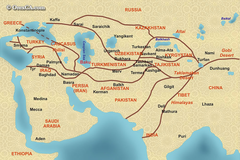
Silk Road Trade (5)
Trade routes stretching from China to the Mediterranean, which allowed for the exchange of goods and ideas from China to the Roman Empire.
Trans-Saharan Trade (5)
Caravan routes across the Sahara connected trading centers in West Africa, North Africa, and East Africa.

Paleolithic Age (1)
"Old Stone Age" long period of human development before agriculture.
Neolithic Age (1)
"New Stone Age" discovery and cultivation of agriculture.
Neolithic Revolution (1)
Early stages of agriculture society.
Peloponnesian War (4)
A war in which Athens and its allies were defeated by the league centered on Sparta.
Punic Wars (4)
One of the three wars between Carthage and Rome that resulted in the destruction of Carthage and its annexation by Rome.
Persian War (4)
Conflicts between the Greek city-states and the Persian Empire, ranging from the Ionian Revolts (499-494 BCE) through Darius's punitive expedition that failed at Marathon. Chronicled by Herodotus. (131)
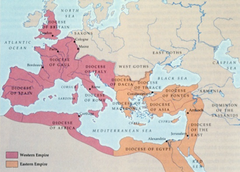
Split/Collapse of Roman Empire (5)
Split when Roman ruler Constantine created a second capital in modern day Turkey. Capital originally called Byzantium, later changed to Constantinople, now is modern day Istanbul. Unsure of how to split, first into 3 regions and then into 4, and finally 2.
Nomads (1/2/3/4)
People who wander from place to place.
Sumerians (1)
The people who dominated southern Mesopotamia through the end of the third millennium BCE, they were responsible for the creation of many fundamental elements of Mesopotamia culture-such as irrigation technology, cuneiform, and religious conceptions-taken over by their Semitic successors.
Babylonians (1)
Native group of people to Mesopotamia.
Jews (1)
Hebrew descendants who inhabited Judah.
Shang China (1)
(1766 BCE- 1027 BCE) First organised river society, introduced writing on oracles bones, local trade, ancestor worship, bronze age. Located on the Huang He River.
Zhou China (2)
(1122 BCE- 256 BCE) Overthrew Shang and established the 2nd Chinese dynasty. Created the "mandate of heaven" to justify their rule.
Qin China (2)
(221 BCE- 206 BCE) The dynasty that replaced the Zhou dynasty and employed Legalism ideas in order to control warring states and unify the country.
Han China (2)
(202 BC-220 AD) dynasty started by Lui Bang; a great and long-lasting rule, it discarded the harsh policies of the Qin dynasty and adopted Confucian principles; Han rulers chose officials who passed the civil exams rather than birth; it was a time of prosperity.
Mauryan India (3)
(322-185 BCE) The first state to unify most of the Indian subcontinent. Founded by Chandragupta Muarya in 322 and survived until BCE. From its capital at Pataliputra in the Ganges Valley it grew wealthy and taxes.
Gupta India (3)
Powerful Indian state based, like its Mauryan predecessor, in the Ganges Valley. It controlled most of the Indian subcontinent through a combination of military force and its prestige as a center of sophisticated culture. Golden Age.
Persian Empire (4)
A vast empire of southwest Asia founded by Cyrus II after 546 BC and brought to the height of its power and glory by Darius I and his son Xerxes.
Roman Republic/Roman Empire (4)
Roman Republic- The period from 507 to 31 B.C.E., during which Rome was largely governed by the aristocratic Roman Senate.
Roman Empire- The period from 507 to 31 B.C.E., during which Rome was largely governed by the aristocratic Roman Senate.
Maya (5)
People who established a series of independent states and city-states in Mesoamerica.
Huns (5)
Nomadic invaders from central India; disrupted Gupta administration (overthrew Gupta)
How do the three classical empires integrate various peoples into their empires?
China- Empire wide language, Mandarin.
India- Used Hinduism and the caste system to expand.
Roman Empire- allowed to express any religion and culture as long as they pay taxes and follow the roles.
How do the three classical empires administrate their empires?
China- Zhou, used feudalism (didn't work) Qin, used Legalism and Centralization. (meh) Han, used Centralization and didn't not use Legalism.
India- Decentralization, regions too diverse to use centralism.
Roman Empire- Centralism.
What causes the three classical empires to collapse?
China- Collapsed due to the invading Huns, heavy taxes, poor harvest, and weak leaders.
India- Collapsed due to White Huns and decentralization.
Roman Empire- Golden Age ends. Empire Splits into West and East. West collapses first.
6000 BCE
Beginnings of agriculture.
3000 BCE
Beginnings of early River Valley civilizations.
6th c. BCE
Creation of Buddhism, Confucianism, Daoism/Taoism
5th c. BCE
Greek Golden Age
323 BCE
Death of Alexander the Great
32 CE
Death of Jesus Christ/beginning of Christianity
220 CE
End of Han Dynasty
476 CE
Fall of Western Roman Empire