Bone Pathology
 Call Kai
 Learn
 Practice Test
 Spaced Repetition
 Match
 Flashcards
 Knowt Play
1/33

Earn XP
Description and Tags
M.8R, W.2, L.10
34 Terms
List the structure that connects osteocytes and osteoblasts
long cytoplasmic processes
When do changes in bone tissue fluid flow occur?
when there are:
changes in stress/strain on bone or microcracks
What detects changes in BTF flow and what happens when they do detect this change?
Osteocytes detect change → signal osteoblasts → initiate bone formation or resorption

what can osteoclasts NOT bind to?
unmineralized bone
Describe osteoblasts (what they retract, secrete, produce and what this can lead to, and their overall function w/ bone resorption)
Retract and secrete collagenases → osteoclasts have access to bone
secrete RANKL → activates resorption process
Produce osteoprotegerin → inhibition of formation of osteoclasts
Osteoblasts upregulate and downregulate osteoclastic bone resorption
What is organic matrix made up of?
Organic Matrix
Type I collagen
GS
non-collagenous proteins, proteoglycans, lipids
Mineral
hyroxyapartite; contains minerals including calcium and phosphate
List function of hydroxyapatite
gives bone its hardness
List the type of development for flat bones and long bones
Flat bones
intramembranous ossification
Long bones
endochondral ossification
List how bones grow length wise and width wise
Length
metaphyseal growth plates via endochondral ossification
Width
osteogenic layer of periosteum
Define (re-)modelling of bone
change of shape or contour of bone in response to normal growth, changed mechanical use or disease
List what a bone can do in reaction to injury
Change of size and shape
Change of density
Disruption of endochondral ossification → change to metaphyseal trabeculae
Rapidly deposited bone is woven
Injured periosteum → forms bone
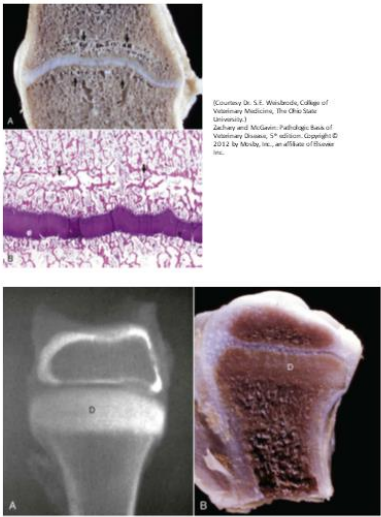
List the two types of causes of bone fractures and define them
Traumatic
force put on bone exceeded the design; too much force for normal bone
Pathological
abnormal bone broken by minimal trauma or normal weight bearing
Stable
unstable
Rigid
Critical Factors:
Correct alignment - Lack of movement - Asepsis - Adequate blood supply
External
formed by periosteum
Internal
between ends of fragments and in medullary cavity
Function:
should bridge gap
encircle fracture site
stabilize area
List the 3 stages of callus formation
Inflammation
Proliferation
Maturation
List advantages of healing by callus
Natural process
Minimal intervention - minimal risk
Minimal intervention - lowest cost option
List disadvantages of healing by callus
Callus may not be able to stabilise fracture
Callus takes time to stabilise a fracture
Large callus may interfere with function of joints or tendons
List complications of fracture healing
Inadequate blood supply/02 cartilage formation; if anoxía necrosis
Instability (movement and high tension) -> development of fibrous tissue -> no bone formation -> nonunion, false joint/pseudoarthrosis
Infection -> osteomyelitis, sequestra
Malnutrition, age
Tissue between fracture ends delayed or non-union
Too large metallic implants -> lack of mechanical force to bone → atrophy
Intramedullary implants may damage blood supply
Premature closure of growth plates deformed limbs
List and define terminology for inflammation of the bone
Osteitis
inflammation of bone
Periostitis
inflammation of periosteum
Osteomyelitis
involves medullary cavity
Define Sequestrum
fragment of necrotic bone
List infectious agents of bone that cause inflammation
Bacteria (most common)
Trueperella pyogenes
Staphylococcus spp.
Streptococcus spp.
Salmonella E.coli
Fungi
Viruses
protozoa
How do they get there?
hematogenous
direct extension
List two ways Direct extension can cause infectious inflammation of the bone and give two examples
Trauma
Extension from direct inflammation
Ex:
Actinomyces bovis (“lumpy jaw”)
Pyogranulomatous osteomyelitis
List two ways Indirect extension can cause infectious inflammation of the bone and give two examples
Bacterial (usually) —> suppurative inflammation
List consequences of infectious inflammation of bone and possible sequela
Thrombosis, infarction, inflammation —> bone resorption
Possible Sequela
Extension into joint and periosteum
Formation of sequestra
Formation of sinus tracts
Spread to other bones and soft tissues
Pathological fractures
List and define types of fractures of cortical bone
Closed
skin unbroken
Open/compound
skin broken
Simple
clean break into two parts
Comminuted
bone shattered into fragments
Greenstick
cortex on one side broken, on other side only bent (-> no displacement of fracture site)
Transverse/spiral (depending on fracture line)
List the two types of growth plate fractures
Type I and II: few or no complications
Type III-V: may have growth abnormalities as growth plate involved
Define an infarction
Fracture of trabeculae without involvement of cortex
Metabolic Bone Disease (dx, define and causes)
Osteoporosis
less bone
malnutrition, immobilization, low dietary Ca, estrogen/androgen deficiency
List two more types of metabolic bone disease
Rickets / Osteomalacia
Fibrous osteodystrophy
replacement of bone by fibro-osseous tissue (makes bone softer; mostly have collagen, no bone)
List Primary Neoplasms of bone
Fibroma
Fibrosarcoma
Chondroma
Chondrosarcoma
Osteoma
Osteosarcoma
Liposarcoma
Hemangiosarcoma
Multilobular tumor of bone
malignant neoplastic cells from osteoid
List sites where primary and secondary neoplasms of bone can show up in canines
Common Primary Site
mammary gland
lung
liver
prostate gland
Secondary
rib shafts
vertebral bodies
humoral
femoral metaphyses
List where secondary neoplasms of bone can show up in felines
rare
mets to appendicular skeleton
lung carcinoma to digits