BIO 400 Chapter 7
 Call Kai
 Learn
 Practice Test
 Spaced Repetition
 Match
 Flashcards
 Knowt Play
1/36

There's no tags or description
Looks like no tags are added yet.
37 Terms
Apoenzyme
inactive enzyme, protein enzyme
essential ions
mostly metal ions
coenzymes
organic compounds
holoenzyme
active, protein and cofactor
Cosubstrates
altered during the reaction and regenerated by another enzyme
Prosthetic groups
remain bound to the enzyme during the reaction, and may be covalently or tightly bound to enzyme
amount of energy released by ATP
30.5 kJ/mol
gamma phosphate
phosphoryl group
gamma and beta phosphates
pyrophosphoryl group
adenylyl group
AMP
S-adenosylmethionine
sourced from ATP; donates methyl groups in many
biosynthesis reactions
Cosubstrate
UDP-Glucose
sugar coenzyme formed from UTP and glucose-1-phosphate
Nucleotide-sugar coenzymes
involved in carbohydrate metabolism
Uridine diphosphate glucose
Metabolic role: Transfer of glycosyl groups
Mechanistic role: Cosubstrate
Adenosine triphosphate (ATP)
Metabolic role: Transfer of phosphoryl or nucleotidyl groups
Mechanistic role: Cosubstrate
NAD and NADP
Vitamin source: Niacin (B3)
Metabolic role: Oxidation-reduction reactions, involves two electrons
Mechanistic role: Cosubstrate

FMN and FAD
Vitamin source: Riboflavin (B2)
Metabolic role: Oxidation-reduction reactions involving one- and two-electron transfers
Mechanistic role: Prosthetic group
Deficiency causes: Stunded growth
Coenzyme A (CoA)
Vitamin source: Pantothenate (B5)
Metabolic role: Transfer of acyl groups
Mechanistic role: Cosubstrate
Deficiency causes: dermatitis in chickens
TPP
Vitamin source: Thiamine (B1)
Metabolic role: Transfer of multi-carbon fragments containing a carbonyl group
Mechanistic role: Prosthetic group
Deficiency causes: beriberi
PLP
Vitamin source: Pyridoixne (B6)
Metabolic role: Transfer of groups to an from amino acids
Mechanistic role: prosthetic group
Deficiency causes: dermatitis in rats
Biotin
Vitamin source: Biotin (B7)
Metabolic role: ATP-dependent carboxylation of substrates or carboxyl-group transfer between substrates
Mechanistic role: Prosthetic group
Deficiency causes: dermatitis in humans
Eating raw eggs may cause a deficiency
Tetrahydrofolate (THF)
Vitamin source: Folate
Metabolic role: Transfer of one-carbon substituents, especially formyl and hydroxylmethyl groups; provides the methyl group for thymine in DNA
Mechanistic role: Cosubstrate
Deficiency causes: anemia
Obtained from: green leaves, liver, yeast
Cobalamin
Vitamin source: Cobalamin (B12)
Metabolic role: Intramolecular rearrangements, transfer of methyl groups
Mechanistic role: Prosthetic group
Deficiency causes: pericious anemia
Obtained from: foods of animal origin

Lipoamide
Metabolic role: Oxidation of a hydroxylalkyl group from TPP and subsequent transfer as an acyl group
Mechanistic role: Prosthetic group
NOT vitamin
Retinal
Vitamin source: Vitamin A
Metabolic role: Vision
Mechanistic role: Prosthetic group
Obtained from: liver, egg yolks, milk products, or from yellow vegetables
Vitamin K
Vitamin source: Vitamin K
Metabolic role: Carboxylation of some glutamate residues (blood coagulation)
Mechanistic role: Prosthetic group

Ubiquinone (Q)
Metabolic role: Lipid-soluble electron carrier
Mechanistic role: Cosubstrate
Found in respiring organisms and photosynthetic bacteria
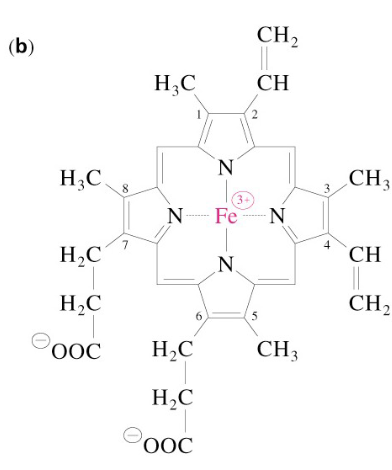
Heme group
Metabolic role: Electron transfer
Mechanistic role: Prosthetic group
Vitamin D
group of related lipids involved in control of Ca2+ utilization
Deficiency causes: weakened bones and rickets in children

Vitamin E
also known as alpha-tocopherol
reducing reagent that scavenges oxygen and free radicals
prevents damage to fatty acids in membranes
Deficiency causes: fragile RBCs and neurological damage
protein coenzymes (group transfer proteins)
contain a functional group as part of a protein or as a prosthetic group
participate in: group transfer reactions and oxidation-reduction reactions
cytochrome
heme-containing coenzymes whose Fe3+ undergoes reversible one-electron reduction
electron transfer potential varies among different cytochrome groups because of their different protein environments
How many peaks does reduced cytochrome C show on an absorbance spectra?
three

How many peaks does oxidized cytochrome C show on an absorbance spectra?
one (Soret band)

Plastoquinone
analog of CoQ used for photosynthetic electron transport
Vitamin C
NOT a coenzyme, but only a vitamin; also known as ascorbic acid
Reducing agent for hydroxylation of collagen
Deficiency causes: scurvy
Obtained from: acidic fruits (limes, lemons, oranges)
nicotinic acid
NAD and NADP precursor
Deficiency causes: pellagra
Obtained from: cereals, meat, legumes