PSY389 Lecture 10/11: Treatment of AOD Disorders Part II: Motivational Interviewing and Other Psychological Interventions
 Call Kai
 Learn
Learn Practice Test
 Spaced Repetition
 Match
Match Flashcards
 Knowt Play
1/26

There's no tags or description
Looks like no tags are added yet.
Name | Mastery | Learn | Test | Matching | Spaced | Call with Kai | Chat |
|---|
No analytics yet
Send a link to your students to track their progress
27 Terms
Needed treatment versus Received Treatment (Australian Institute of Health and Welfare, 2023)

Why don't everyone who needs AOD treatment receive it?
Some people do not recognise that they have a problem.
Some recognise the problem but are not ready or motivated to change.
Some experience stigma, shame or fear of judgement.
Some prefer to manage the problem themselves.
Some do not perceive treatment as necessary or beneficial.
Others face practical barriers to accessing services.
Some people enter treatment but do not continue.
In 2024–25, 19% of AOD treatment episodes ended unexpectedly.
Only 51% went on to receive further AOD treatment within one year after the initial assessment of AOD.
The challenge is not simply getting people into treatment—it is understanding why they may be reluctant to seek, accept or remain in treatment.
Motivational Interviewing (Mi)
It is often assumed that a client is unmotivated, when they refuse to take the sound advice of a practitioner
This assumption is usually false as no person is completely unmotivated. All persons have goals and aspirations.
The way in which therapist talk with clients can substantially influence their personal motivation for behaviour change.
We are more likely to change when we ourselves have argued for it. We believe what we hear ourselves say.
It is generally assumed that individuals with AOD are in denial.
Mi assumes ‘Denial’ (or lack of motivation) is a product of the therapeutic relationship.
Motivation is an “accumulation of opposing forces which influence an individual to decide to act”.
Concept of ambivalence is key.
We are all motivated in many directions (i.e.,people continue drug use not because they are unmotivated, but they are alsomotivated to continue to use).
Works to enhance client’s motivation for change
Clarifies and resolves ambivalence about behaviour change
Creates and amplifies discrepancy (cognitive dissonance) between present behaviour and broader goals/values
Involves collaboration between the therapist and the client & client has responsibility for wanting to make change
Uses empathic and active listening
Assists clients in moving throughstages of change
usually brief (4-6 sessions)
Know the client’s Stage of Change
‘Motivation’ also depends on one’s current “stage of change”: the perceived balance of pros and cons

Elements of Mi
1. MI Spirit (How we approach the conversation)
2. Four Processes (Where we are going in the conversation)
3. Change Talk (What we are trying to evoke)
4. OARS + I (How we communicate)
5. Engaging in 1-4 increases the likelihood of behavioural change

Mi Spirit
Partnership: Collaboration between the practitioner and the client;
Compassion: genuine care and concern for clients
Acceptance: accept clients for who they are (absolute worth, autonomy, accurate empathy and affirmation)
Empowerment (Evocation) – Draw out the client’s own ideas, reasons, values and motivations for change, rather than trying to persuade them.

The four processes of Mi
Engaging – Establish a trusting, collaborative relationship with the client.
Focusing – Agree on a clear direction or goal for the conversation.
Evoking – Elicit the client’s own motivations, reasons and arguments for change.
Planning – Help the client develop a plan for making and sustaining change.
The Principles of Mi
1. Resist the righting reflex: trying to ‘fix’ the client
2. Understand your client’s motivations and reasons for change (financial, familial, health, values?).
3. Listen to your client: paraphrase what they have said, paying attention to the meaning of what they have said.
4. Empower your client: help them explore how they can make a difference in their own health. Outcomes are better when the client takes an active role
Change talk
Ambivalence is a key aspect of behaviour change and the reason why change has not occurred. Expect that change talk will always be accompanied by status-quo or “sustain” talk. Reinforce change talk.
OARS +I skills: the engine of change
ASKING
Open-ended questions: “Tell me more about…”; “How might this change benefit you?”
LISTENING
Affirming their strengths and linking to their successes
Reflecting back the meaning of what they have said, their feelings and thoughts, change talk
Summarising their perceived pros and cons of changing (cons go first, pros last)
INFORMING
“Chunk-check-chunk” i.e. Ask permission, give a small chunk of information, check their understanding, then another chunk of information.
Three communication styles
Directing (Message: I know how you can solve this problem. I know what you should do)
Following (Message: I’ll let you work this out in your own time and at your own pace)
Guiding (Message: I can help you solve this for yourself)
In Mi, therapists generally embrace the Guiding style of communication
Reflective listening is the most powerful component of Mi
Listening means paraphrasing, and reflecting back what clients have said
Client: “ I want to stay stopped but I don’t know if I can. I’ve only ever succeeded for a few weeks. Then I see my old mates and bam! I’ve busted.”
You: “You have doubts about your ability to successfully quit because in the past you busted whenever you had contact with your old drinking buddies. But you really want to figure out how to stay stopped”.
(Note: Reflect ambivalence and put change talk at the end of the sentence)
How effective is Mi?
Clients who received 20 min of Mi in treatment sessions attended more treatment sessions, and were more likely to enrol in other substance abuse services than those who received treatment without Mi.
Clients who received 3-4 Mi sessions with their SUD treatments maintained reduced substance use longer after treatment than those who received usual counselling in their treatment.
A metanalytic study involving 39 studies report positive treatment outcomes in 67% of adolescents with substance use disorder (SUD)
Adolescents prefer Mi’s autonomous and collaborative approach
MI-consistent counselling style was more effective in motivating change compared to the usual counselling style
CBT PRINCIPLES
Core beliefs → automatic thoughts
Automatic thoughts → emotional reactions
Emotional reactions → behaviour
Ineffective behaviours can reinforce unhelpful thoughts and core beliefs

CORE BELIEFS
Develop through a combination of life experiences and interactions with others.
Reflect how we make sense of ourselves, others, and the world.
Are reinforced by our experiences, particularly when experiences seem to confirm what we already believe.
Often develop during childhood, but can change through significant life experiences.
May operate outside our awareness, so we do not always question or examine them.
Beliefs Translated to Thoughts
Anxiety: “Something bad will happen to me.”
Depression: “Life is pointless.”
Paranoia: “People are out to get me.”
Substance abuse: “Life is too painful.”
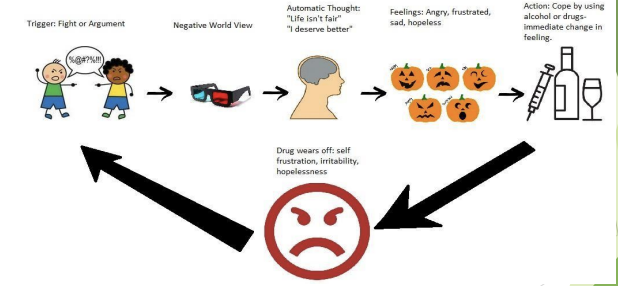
Core beliefs will impact the view and interpretation of events
Core Beliefs and Behavior
Core beliefs molded through lifetime experience.
Trigger occurs and is interpreted through beliefs.
Internal feeling/thought arises as a result of the trigger.
Behavioral response occurs based on thought/ feeling.
Behavior is viewed as purposeful even if unhelpful.
The response of behavior enforces core belief.
Vicious Cycle continues.
Occurrences for Substance Users
Some ‘irrational’ thoughts/beliefs (Cognitive Distortions)

CBT
Increases clients’ awareness of present and future motivations for drug use.
Assumes that psychological problems can be influenced by irrational beliefs, misconceptions, and unhelpful core beliefs.
Examines and challenges unhelpful thoughts and beliefs using evidence and alternative perspectives.
Helps clients identify alternative ways to achieve their goals and meet their needs without relying on drug use.
• views excessive drinking or drug use as maladaptive and avoidance form of coping with problems
• teaches skills to cope with high-risk situations (without resorting to drug)
• teaches clients how to modify their behaviour by changing outcomes or contingencies ofAOD
• teaches skills for reducing and managing stress
• teaches skills to control themselves as well as the environment.
Understands substance use as a learned behaviour (based on learning and conditioning theory)
Behaviour is maintained or reinforced by physiological and psychological states of using
User engages in alternative behaviours to drug use
Recognises psychological, environmental and social cues/triggers that activate drug use
Aims to remove sources of reinforcement (drugs) and associated cues/triggers to reduce motivation for use
Bandura’s Social Learning Theory emphasises that drinking behaviour can be learned by observing others and the consequences of their behaviour.
Learning that reducing drinking can lead to desirable outcomes, such as social approval or improved work performance, can motivate people to change their drinking behaviour.
Develop self-efficacy—the belief that they can control and change their behaviour.
COGNITIVE STRATEGIES
Distraction
Observing thoughts
Advantages-disadvantages analysis
Identifying and modifying drugrelated beliefs (Cognitive Structuring)
Downward arrow/laddering
Reattribution of responsibility
Daily thought record
Imagery
BEHAVIOURAL STRATEGIES
Activity monitoring and scheduling
Behavioural experiments
Behavioural rehearsal (role play and reverse role play)
Relaxation training
Graded task assignments
Problem solving
Exercise
Stimulus control (high-risk situations)
Identifying and modifying drug-related beliefs (Cognitive Restructuring)
Helps client become aware of their thoughts.
Assesses accuracy of thoughts.
More accurate thoughts contribute to more manageable emotions.
Manageable emotions allow for consideration of several behavioral responses.
More effective response is chosen.
Improved outcome challenges core belief.
Klimas et al. (2018) compared effectiveness between different types of psychosocial interventions
Assessed three main outcomes: abstinence, reduced drinking, and substance use
Main findings:
Mi, or CBT led to no differences, or only small differences, for the outcomes assessed.
No difference between CBCST (cognitive-behavioural coping strategy training) and the twelve-step programme.
No difference between brief intervention and usual treatment.
No difference between MI and usual treatment or education only
Brief Motivational Interviewing (BMI) is probably better at reducing alcohol use than usual treatment, but found no differences in other outcomes.
Intensive MI may be somewhat better than standard MI at reducing severity of alcohol use disorder among women, but no gender differences in other outcomes
Integrated therapy: MET & CBT
Share many common goals:
explore costs and benefits of change
build motivation for change
explore deeper reasons for change, how to change, and value/meaning of change)
embed behavioural change
How effective is the integrated therapy: Mi + CBT ?
Cannabis use disorder: 5 Mi + 3 CBT (cognitive behavioural coping skills) sessions reduced cannabis use and illegal behaviours in youths at 12 months compared to those who received ‘treatment as usual’
Cocaine Use disorder: 1 Mi session + 2 CBT sessions increased greater desire for abstinence and greater expectation of success than CBT only sessions
Mi + other therapies enhanced treatment benefits.
Combined Behavioural and Pharmacological Treatment
The COMBINE Study (Anton et al. (2006):
1,383 people with alcohol dependence assigned to different combinations of naltrexone, acamprosate, medical management, and a combined behavioural intervention (CBI) over 16 weeks.
Both medication (naltrexone) and behavioural intervention can help reduce drinking.
Combining them did not necessarily produce greater benefits than either approach alone.
Treatment should therefore be matched to the individual's needs rather than simply adding more interventions.