Wk 9 - (Croup, Bronchiolitis, Epiglottitis)
 Call Kai
 Learn
 Practice Test
 Spaced Repetition
 Match
 Flashcards
 Knowt Play
1/36

There's no tags or description
Looks like no tags are added yet.
37 Terms
What is croup?
Inflammation of the upper airway, larynx and trachea, often worse at night. Characterised by a barking cough and inspiratory stridor. Caused by parainfluenza and is often only mild.
In what age group is croup most common?
6 months to 3 years, more common in females
What is the prodrome for croup?
- Fever
- Runny nose
- Sore throat
Pathophys Steps for Croup
viral infection (parainfluenza)
virus replicates in epithelial cells of the larynx and trachea, triggering inflammatory response
oedema, hyperemia & cellular infiltration develop & affect the subglottic reigon
marked narrowing produces turbulent airflow during insp, heard as stridor
inflammation can extend to vocal chords leading to hoarseness & barking cough
increased airway resistence leads to increased WOB
gas exchange remains intact, but severe cases can cause ventilation-perfusion mismatch resulting in hypoxaemia
Risk factors for severe croup
History of previous severe croup
Pre-existing narrowing of upper airways
Reduced airway tone due to pre-existing conditions eg trisomy 21, neuromuscular conditions
Young age: uncommon in under 6 months old, rare in under 3 months old. Consider alternative diagnosis
What is the disease process for croup?
- Airway inflammation
- Cascade of inflammatory reactions
- Infiltration of white blood cells
- Oedema of the upper airway
- Partial airway obstruction
- Increase WOB
- Turbulent noisy airflow
What is the difference between croup and bronchiolitis?
Croup is a subglottic infection whereas bronchiolitis is much lower down in the bronchioles
What are some general principles for croup management?
- Don't upset the child with your examination
- BP and pulse-ox can be omitted if it will distress child
- No need to examine the throat
- Keep the child with their parent/carer and involve them in the examination
Croup Differentials
Bronchioliti
Croup
Epiglottitis:
Foreign body airway obstruction
Pneumonia
Airway burns or trauma: consider history, soot, singed hair
Signs/Symptoms of croup
- Barking cough
- Inspiratory stridor
- Hoarse voice
- Associated widespread wheeze
- Increased WOB
- Fever
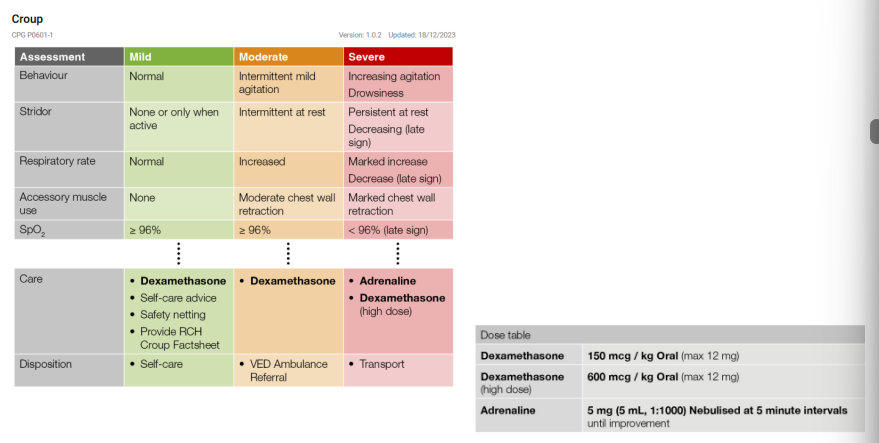
Mild Croup:
- Cough
- Husky voice
- No stridor
Moderate croup:
- Cough and husky voice
- Hard to speak and/or breathe
- Have a stridor (not at rest)
Severe croup:
- Cough and husky voice
- Hard to speak / breathe
- Inspiratory stridor even at rest
- Significant WOB
- Anxious and scared
- Irritable and uncomfortable
Supportive management for croup
- positioning: being held my parent
- Oxygen not usually required
- Analgesics typically unnecessary
- Rest, hydration, nutrition
Mild croup medication:
Usually not needed, Low dose dexamethasone = 150 mcg / kg orally
Moderate croup medication:
Low dose dexamethasone = 150 mcg / kg orally
Severe croup medication:
- 5 mg nebulised adrenaline
- high dose dexamethasone = 600 mcg / kg orally
What are some differentials for croup?
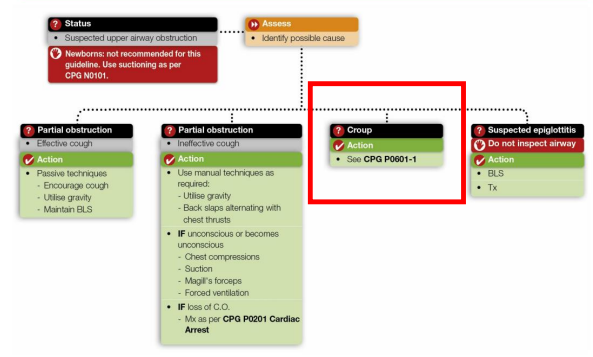
- Foreign body airway obstruction
- Anaphylaxis
- Epiglottitis
Upper Airway Obstruction CPG
Croup CPG
What is bronchiolitis?
A lower respiratory tract infection causes by the RSV virus affecting children aged <12 months
Bronchiolitis Background
clinical diagnosis based off typical history and examination
peak severity at 2-3 days from onset of increased WOB, resolves after 7-10 days
self limiting, usually doesnt need treatment
cough may persist for weeks
Risk factors for bronchiolitis?
- Chronic lung disease
- Congenital heart disease
- Chronic neurological conditions
- Tobacco smoke exposure
- Slow weight gain
- Lower SES
- Immunodeficiency
Pathophysiology of bronchiolitis
Viral infection of bronchiolar epithelium --> causes cell death --> inflammation of small airways --> increased mucous production --> mucous plugging --> airway narrowing and obstruction --> increased WOB
History questions to ask for bronchiolitis
- Cough?
- Fever?
- Difficulty feeding?
- Difficulty sleeping?
- Periods of apnoea?
- Unsettled?
- Restless?
Signs/symptoms of mild bronchiolitis
- Normal behaviour
- Possibly mild tachypnoea
- Unlikely to be accessory muscle use
- O2 >92% room air
- No periods of apnoea
- Normal feeding
Signs/symptoms of moderate bronchiolitis
- Some Irritable behaviour
- Increased respiratory rate
- Some use of accessory muscles (chest wall retraction, nasal flare)
- O2 90-92% room air
- Brief apnoea
- Difficulty feeding
Signs/symptoms of severe bronchiolitis
- Irritable, lethargic, fatigued
- Increased resp rate
- Increased accessory muscle use
- O2 <90 on room air
- Frequent apnoea
- Reluctant / unable to feed
Management for bronchiolitis?
- Supportive management (rest, hydration, nutrition)
What is epiglottitis?
Acute life-threatening bacterial or viral infection that results in swelling and inflammation of the epiglottis
This causes breathing problems, including stridor, that can progressively worsen and may lead to complete obstruction of the airway.
Epiglottitis Background
90% of cases caused by H type influenza type B
increasingly observed in adults
Risk factors for epiglottitis?
- Children who haven't had the Hib vaccine
- Immunocompromised children (due to medications or diseases)
Pathophysiology of epiglottitis
Bacterial infection of supraglottic structures --> rapid inflammation and oedema of epiglottis and surrounding tissues --> narrow airway becomes obstructed --> stridor, drooling --> complete obstruction and respiratory arrest
History consistent with Epiglottitis
quick onset sore throat
fever
muffled voice
inspiratory stridor
Signs/symptoms of epiglottitis
- Drooling
- Difficulty breathing
- Unable to talk
- Leaning forward / tripod
- open mouth
Differentials for epiglottitis
- Acute tonsillitis
- Pharyngitis
- Peritonsillar abscess (quincy)
- Deep neck space infection
Management for epiglottitis
- Suspected epiglottitis is an airway emergency
- No action should be taken to stimulate or irritate them → do not inspect airway or take child from parent
- Manage in an upright position
- Transport with notification to closest facility (with paediatric ENT)