Scoliosis, Scheuremann Disease, Postural Deformities, Lumbar DDx

0.0(0)
Studied by 0 people
call kaiCall Kai
learnLearn
examPractice Test
spaced repetitionSpaced Repetition
heart puzzleMatch
flashcardsFlashcards
GameKnowt Play
Card Sorting

1/73

encourage image

There's no tags or description

Looks like no tags are added yet.

74 Terms

1
New cards

What is normal ROM for cervical spine flexion

80-90

2
New cards

What is normal ROM for cervical spine extension

70

3
New cards

What is normal ROM for cervical spine lateral flexion

20-45

4
New cards

What is normal ROM for cervical spine rotation

70-90

5
New cards

What is normal ROM for thoracic spine flexion

20-45

6
New cards

What is normal ROM for thoracic spine extension

25-45

7
New cards

What is normal ROM for thoracic spine lateral flexion

20-40

8
New cards

What is normal ROM for thoracic spine rotation

35-50

9
New cards

What is normal ROM for lumbar spine flexion

40-60

10
New cards

What is normal ROM for lumbar spine extension

20-35

11
New cards

What is normal ROM for lumbar spine lateral flexion

15-20

12
New cards

What is normal ROM for lumbar spine rotation

3-18

13
New cards

What is normal ROM for TMJ mandibular depression

35-55 mm

14
New cards

What is normal ROM for TMJ protrusion of mandible

7 mm

15
New cards

What is normal ROM for TMJ retrusion of mandible

3-4 mm

16
New cards

What is normal ROM for TMJ lateral deviation of mandible

10-15 mm

17
New cards

How would you perform the TMJ compression test

Patient seated or supine; PT supports and stabilizes head with one hand and uses other hand to push mandible superior (creating a compressive load on the TMJ)

18
New cards

What is a positive test for the TMJ compression test

Pain in the TMJ

19
New cards

What part of the TMJ does the TMJ compression test test

Retrodiscal tissue

20
New cards

Which side of the body should you test first when doing ULTTs

Good side

21
New cards

What is the order you should follow when performing ULTTs

Shoulder → Forearm → Wrist → Fingers → Elbow

22
New cards

How would you further sensitize joints during ULTTs

Add contralateral cervical spine side bending or flexion

23
New cards

During ULTTs, where should you maintain constant depression

Shoulders

24
New cards

What are the contraindications to consider before performing ULTTs

Cauda equina syndrome or Spinal cord lesions
Neurological sings in acute phase or worsening

25
New cards

ULTT 1 tests which nerve

Median

26
New cards

ULTT 2 tests which nerve

Musculocutaneous

27
New cards

ULTT 3 tests which nerve

Raidal

28
New cards

ULTT 4 tests which nerve

Ulnar

29
New cards

Dorsal spinal nerves are responsible for SENSORY/MOTOR

Sensory

30
New cards

Ventral spinal nerves are responsible for SENSORY/MOTOR

Motor

31
New cards

Where do cervical spinal nerves exit

Above the corresponding vertebrae

32
New cards

Where do thoracic and lumbar spinal nerves exit

Below the corresponding vertebrae

33
New cards
What spinal condition is defined primarily by degenerative changes to the intervertebral discs?
Spondylosis.
34
New cards
What specific anatomical structure is fractured or defective in spondylolysis?
The pars interarticularis or posterior arch of the vertebra.
35
New cards
What is spondylolisthesis?
The anterior displacement of one vertebra over another, typically caused by a bilateral pars defect.
36
New cards
What is retrolisthesis, and which trunk motion is contraindicated?
Posterior displacement of one vertebra on the underlying vertebra; trunk flexion exercises are contraindicated.
37
New cards
Which radiographic view is required to evaluate a patient for spondylolisthesis?
A lateral view X-ray.
38
New cards
Which therapeutic exercises are strictly contraindicated for anterior spondylolisthesis?
Trunk extension exercises.
39
New cards

What postural position would you expect to see with Scheuremann disease

Thoracic kyphosis

40
New cards
What radiographic angular criterion defines Scheuermann disease?

Anterior wedging of ≥5∘ in at least 3 adjacent vertebrae

41
New cards
In which regions of the spine is Scheuermann disease most commonly located?
The mid-thoracic and lower thoracic regions.
42
New cards
Which athletic population is often affected by Scheuermann disease?
Young gymnasts.
43
New cards
What radiographic feature on vertebral end plates is characteristic of Scheuermann disease?
Schmorl nodes.
44
New cards
What structural pathology underlies Scheuermann disease?
Congenital or degenerative weakening of vertebral end plates.
45
New cards
Why do patients with Scheuermann disease typically present without radicular symptoms?
Because the nerve roots are not involved.
46
New cards
What directional exercise bias is indicated for Scheuermann disease?
Trunk extension exercises.
47
New cards
What is Pott disease?
Tuberculosis of the spine, presenting as tuberculous arthritis of intervertebral joints.
48
New cards
Which spinal segments are most frequently involved in Pott disease?
The lower thoracic spine and upper lumbar spine.
49
New cards
What is spinal stenosis?
The narrowing of the spinal canal.
50
New cards
How do trunk extension and forward flexed postures alter pain in spinal stenosis?
Extension provokes pain, whereas forward flexed postures (walking uphill or holding a shopping cart) relieve pain.
51
New cards
What directional exercise bias is prescribed for spinal stenosis?
Trunk flexion exercises.
52
New cards
What inflammatory axial skeleton disease produces a radiographic classic known as "bamboo spine"?
Ankylosing spondylitis.
53
New cards
What clinical diagnostic features characterize ankylosing spondylitis?

Night pain, persistent back pain for ≥3 months, onset between ages 20-50, male predominance, and spinal rigidity.

54
New cards
Which laboratory blood markers are characteristically elevated in ankylosing spondylitis?
HLA-B27 level and erythrocyte sedimentation rate (ESR).
55
New cards
What directional exercise emphasis is indicated for ankylosing spondylitis?
Trunk extension exercises.
56
New cards

In a closed kinematic chain, how does anterior pelvic tilt affect hip and leg rotation?

It causes internal rotation of both the hip and the leg.

57
New cards

What knee biomechanical deviation is associated with hip and leg internal rotation?

The knee moves inward

58
New cards

What foot biomechanical deviation is associated with inward knee movement and leg internal rotation?

Overpronation of the foot.

59
New cards
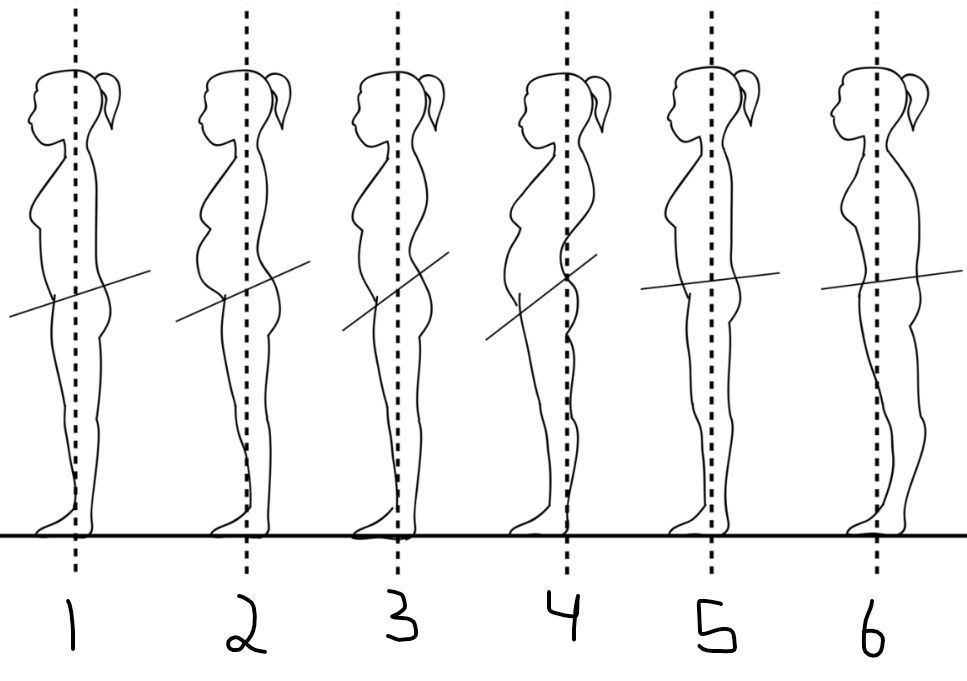
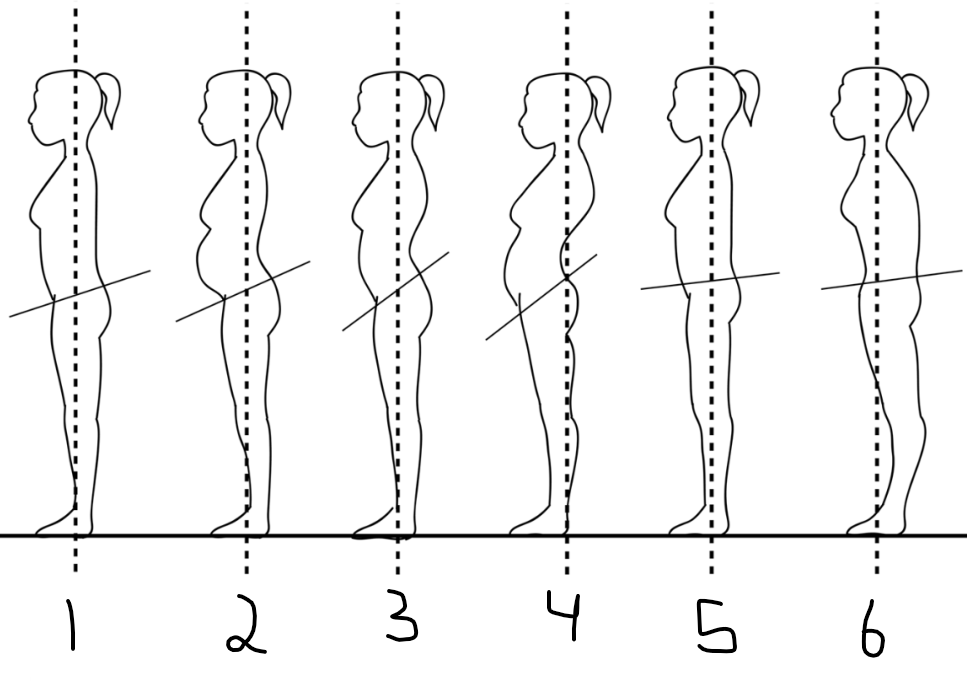
<p>What is position 1</p>

What is position 1

Good

60
New cards
<p>What is position 2</p>

What is position 2

Relaxed faulty posture
61
New cards
<p>What is position 3</p>

What is position 3

Kyphosis lordosis

62
New cards
<p>What is position 4</p>

What is position 4

Sway back

63
New cards
<p>What is position 5</p>

What is position 5

Flat back

64
New cards
<p>What is position 6</p>

What is position 6

Round back

65
New cards

How do functional and structural scoliosis behave during forward trunk bending?

Functional scoliosis disappears with forward bending, while structural scoliosis remains apparent.
66
New cards

What characteristics present on the concave side of a scoliotic curve?

High pelvis, anterior rib hump, spinous process rotation, muscles short and tight, decreased lung volume, narrowing of intercostal spaces

67
New cards
How does lung volume differ between the concave and convex sides of scoliosis?
Lung volume is decreased on the concave side and increased (with expanded costal spaces) on the convex side.
68
New cards
Which trunk muscles should be stretched on the concave side of scoliosis?
Quadratus lumborum, latissimus dorsi, and external oblique.
69
New cards
Why is stretching the iliopsoas on the concave side of scoliosis contraindicated?
Because the iliopsoas on the concave side is weak rather than tight.
70
New cards
Which hip muscle is typically weak in scoliosis and requires targeted strengthening?
Gluteus medius.
71
New cards

What characteristics are seen on the convex side of a scoliotic curve?

Muscles and lengthened and weak, body rotated, shoulder elevated, scapula prominent, increased lateral costal expansion (increased lung volume), widening of intercostal spaces

72
New cards
What limb length perception and foot posture occur on the convex side of scoliosis?
An apparent short limb and foot pronation.
73
New cards
Which trunk muscles should be strengthened on the convex side of scoliosis?
Quadratus lumborum, latissimus dorsi, and external oblique.
74
New cards
How do body rotation and spinous process rotation compare in relation to the direction of a scoliotic curve?
The body rotates toward the side of scoliosis (convex side), whereas the spinous processes rotate to the opposite side (concave side).