Forensic Science ||- DNA Exam Study Guide-University of Southern Mississippi
 Call Kai
 Learn
Learn Practice Test
 Spaced Repetition
 Match
Match Flashcards
 Knowt Play
1/55

There's no tags or description
Looks like no tags are added yet.
Name | Mastery | Learn | Test | Matching | Spaced | Call with Kai | Chat |
|---|
No analytics yet
Send a link to your students to track their progress
56 Terms
Forensic DNA technology is used to prove guilt only.
❌ False - It can also exonerate the innocent.
Forensic DNA technology has the potential to point the fingers at one person.
DNA profiles can uniquely identify an individual (except identical twins).
Forensic DNA analysis can provide information about:
Who committed a crime? - It identifies individuals, not how or when the crime occurred.
The source of cells/DNA in a licked envelope is:
Saliva (buccal cells).
The two different types of DNA found in a cell are:
Nuclear DNA
Mitochondrial DNA
What is a locus?
The physical location of a gene on a chromosome.
Define homozygous and heterozygous.
Homozygous: Both alleles are the same (AA or aa).
Heterozygous: The alleles are different (Aa).
This genotype (AA) is __________ (Homozygous or heterozygous).
Homozygous
This genotype (Bb) is __________ (Homozygous or heterozygous)
Heterozygous
Having two different allelic genes on two corresponding positions of a pair of chromosomes is called:
Heterozygous
The physical location of a gene in a chromosome is called a:
Locus
What is an allele?
A different form or variant of a gene located at a specific locus on a chromosome.
What is a phenotype?
The observable physical or biochemical characteristics of an organism determined by its genotype (for example: eye color, hair texture).
The human genome consists of approximately _________ (# of) base pairs.
3 billion base pairs
The number of chromosomes present in a human diploid cell is
46 chromosomes
The number of chromosomes present in a human haploid cell (spermatozoa or ovum) is
23 chromosomes
The number of chromosomes present in a human red blood cell is:
0 chromosomes (RBCs have no nucleus or DNA)
The chromosomal composition of a normal male human cell is
46 XY
The chromosomal composition of a normal female human cell is
46 XX
In a DNA molecule:
A refers to: Adenine
C refers to: Cytosine
G refers to: Guanine
T refers to: Thymine
In DNA structure, A pairs with G and T pairs with C. True or False.
❌ False — Adenine (A) pairs with Thymine (T), and Cytosine (C) pairs with Guanine (G).
Mitochondrial DNA is located in
The mitochondria of the cell.
DNA stands for
Deoxyribonucleic acid
The nuclear DNA is located in the ______ of the cell.
Nucleus
The proportion of genome that is similar among two individuals is ____%.
99.9%
DNA is unique to individuals except identical twins. True or False.
True
What is a differential extraction?
A process used to separate sperm cells from epithelial (non-sperm) cells in sexual assault evidence before DNA analysis.
What are the three different types of polymorphism that can be used for human identification?
RFLP, STR, and SNP
SNP stands for
Single Nucleotide Polymorphism
STR stands for
Short Tandem Repeat
VNTR stands for
Variable Number of Tandem Repeats
PCR stands for
Polymerase Chain Reaction
RFLP stands for
Restriction Fragment Length Polymorphism
In a PCR reaction the DNA copy number ________ in every cycle.
Doubles
The DNA sequence of one strand of DNA is:G A A T T CWhat will be the sequence on the other strand?
C T T A A G(A pairs with T, G pairs with C)
Identical twins will have the same DNA sequence in their cells.
True
There are approximately _______ (# of) SNPs identified in the human genome.
10 million (10⁷)
Identify the polymorphism found in the sequence of the two samples (where it is located and the name):
There is a Single Nucleotide Polymorphism (SNP) at position 7— Sample 1 has G, Sample 2 has A→ Type of polymorphism: SNP (Single Nucleotide Polymorphism)

Provide an example of a Trinucleotide polymorphism.
Example: (CAG)ₙ repeat (as seen in Huntington's disease)
Pentanucleotide repeats contain a set of _______ nucleotides in each repeat.
5
An STR repeat pattern involving four nucleotides per repeat is called
Tetranucleotide repeat
You need about _______ ng of DNA for STR marker analysis.
1 nanogram (ng)
The national standard for human identification calls for the analysis of ____ (# of) STR loci.
20 STR loci(The FBI expanded CODIS from 13 to 20 core loci in 2017.)
CODIS stands for
Combined DNA Index System
The number of states that participate in the CODIS program are
All 50 states
CODIS is a searchable fingerprint database:
False➡️ CODIS is a DNA database, not a fingerprint system.
The results from a criminal case DNA profiling are given below. Will you include the suspect as a contributor of evidence or not? Why?
Answer: Exclusion
Why: The suspect's DNA profile does not match the evidence profile at every locus. (locus -6)

The type of polymorphism or repeat pattern present in the following sequence is:
CTCTACGTATCG TCTA TCTA TCTA TCTA TCTA GTCATGAATC
STR (Short Tandem Repeat) — specifically a tetranucleotide repeat because "TCTA" is repeated.
A repeat polymorphism with 16 base pairs in each repeat is given below. What type of repeat polymorphism does this example belong to?
Minisatellite (also known as a VNTR — Variable Number of Tandem Repeats)(VNTRs typically have repeat units between 10-100 bp.)

The three samples that are needed for a paternity testing are:
Mother, child, and alleged father
Y chromosome is inherited from ___________ to ___________.
Father to son
The minimum number of samples required for criminal DNA profiling is __________ and they are:
Two samples — evidence sample and reference (suspect) sample
Name any two other areas where forensic DNA technology can be applied besides criminal DNA profiling:
i. Paternity/maternity testing
ii. Identification of human remains (mass disasters, missing persons, war victims)
(Other acceptable answers: wildlife forensics, ancestry studies, medical research, etc.)
Severely degraded DNA is suitable for RFLP analysis:
❌ False
➡️ RFLP requires long, intact DNA fragments. Degraded DNA is better analyzed using PCR-based techniques (STRs).
What are the major differences between criminal DNA profiling and paternity testing analysis?
Purpose: Criminal DNA Profiling: Identify or exclude a suspect in a crime. Paternity: Determine biological parentage Comparison: Criminal DNA Profiling: Evidence sample vs. suspect's DNA. Paternity: Child's DNA vs. alleged parents' DNA
Result : Criminal DNA Profiling: Match, exclusion, or inconclusive. Paternity: Probability of paternity (usually ≥99.9%)
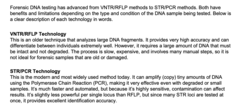
What are some of the advantages and disadvantages associated with the VNTR/RFLP technology and the STR/PCR technology?
RFLP is older, slower, and needs perfect DNA but is highly accurate.STR/PCR is newer, faster, works with tiny or damaged samples, and is now the standard method used in forensic DNA testing and CODIS.