APR Exam 2
 Call Kai
 Learn
 Practice Test
 Spaced Repetition
 Match
 Flashcards
 Knowt Play
1/161

There's no tags or description
Looks like no tags are added yet.
162 Terms
Proactive strategies
Organization takes initiative to engage publics based on timing that fits organization’s interests & resources.
Reactive Strategy
Organization responds to influences from its environment.
Implementation of strategy
(Message/Content + Medium)
Strategy
an organization’s overall plan
Tactics
are the specific communication vehicles to implement the strategy
Action-focused strategy
Tangible deeds undertaken by organization to achieve its objectives (pro-active)
Organizational performance
focus on quality of organization’s goods and services (consumer values, adaptation) (action-focused)
Audience engagement
strong two-way tactics to connect with publics (interest, participation, feedback, triggering event) (action-focused)
Special events
planned activities created so that organizations can interact with their publics (staged activity & photo op vs. publicity stunt) (action-focused)
Alliances, coalitions, & partnerships
relationships among organizations to accomplish tasks (action-focused)
Alliance
an informal, loosely structured, and perhaps small working relationship among organizations, based on shared concerns and supporting mutual interests. Allied organizations agree to cooperate while remaining independent.
Coalition
a more formal and structured relationship among organizations, usually focused on doing some action. May disband when that purpose is achieved.
Partnership
a legal, contractual relationship among organizations to accomplish one or more tasks. Sometimes result in a merger among organizations, particularly those with a business orientation.
Sponsorships
for community relations that involves either creating a program directly, or providing financial, personnel, or other resources for an outside program (proactive)
Niche marketing
An approach to marketing and public relations intended to shore up an organization’s relationship with consumers.
Strategic philanthropy
the process by which business fund or otherwise support community relations gestures with an eye toward enhancing their own business interests as well as the interests of their employees and customers (action)
a) Give more bang for the buck. Provide something more valuable to others than it costs you.
b) Give what you already own.
c) Maximize your investment
Corporate social responsibility
the aspect of community relations and strategic philanthropy in which an organization contributes to the betterment of society, creating an ongoing process to produce a positive social impact.
should be the result of business decisions, not emotion. It’s less about charity and more about positioning the organization to constructively engage its publics, particularly consumers, and ultimately to make money.
Volunteerism
a corporate policy of encouraging and rewarding employees in projects that contribute to a better quality of life in a community (action) (employee participation in community)
Activism
a confrontational strategy focused on persuasive communication; draws on advocacy model of public relations (action)
Advocates
are vocal proponents for causes
Activists
are more inclined to act out their support for the cause
Communication
A category that includes publicity, newsworthy information, generating news, news pegs, and transparent communication (proactive)
Publicity
the aspect of communication strategy that involves the attention given by the news media to an organization, person, event, product, or idea. (proactive)
Third party endorsement
the concept referring to the added credibility that comes with the endorsement of an organization’s message by an outside and unbiased agent, such as a journalist. (proactive)
Media credibility
particularly the gatekeeper, the media person (such as editor, blogger, news director, producer, or webmaster) who controls the flow of information in earned media (proactive)
News
information that offers the audience a new idea, or the latest development, or other previously unknown information important to the audience
Newsworthy information
Significance, Local, Balance, Timely
Significance
First, news is information of importance and impact. It has meaning to many people, even those beyond the organization.
Local
News also deals with information relevant to the local area, defined by the coverage area of medium featuring the information, or to a specialized audience.
Balance
News is information with objectivity and balance. While practitioners use information to promote the organization or client, it should not be presented merely in a promotional manner. Rather, it should have an air of detachment and neutrality
Timely
The final key ingredient in news is that it is current, connected with contemporary issues, especially those high on public and media agendas.
Why news publicity is important?
• Publicity, attention given by the news media to an organization, perceived as more credible because of the nature of unpaid, third-party endorsement
• The news media tell us what to think about
• Issues that the media choose to report can raise them as topics of publics’ interests
Who decides news?
• Journalists as Gatekeepers and Agenda Setters.
• PR Practitioners as Information providers
Accountable
Providing complete and inclusive information
Participative
Encouraging active participation in information seeking, acquiring, and transmitting processes
Substantial
Providing accurate, reliable, timely, and easy to understand information
Reactive Strategies
Respond to negative influences from an organization’s environment (e.g., accusations, criticisms, natural disasters, workplace violence)
goal of Reactive Strategies
To protect organizational identity from internal/external threats, gain public understanding, maintain or restore reputation, and rebuild trust and support
Pre-emptive
Prebuttal
o Announcing its own bad news before target publics or competitors raise a concern
o Attempt to control over news coverage: The first telling of the story becomes normative, and other later versions are considered in light of the first account (reactive)
when to use premptive strategies
only (1) when bad news is inevitable and (2) when the organization has strong evidence to excuse its behavior. Disadvantage: generate more of an audience for the issue than it might otherwise have garnered
When can Offensive Response Strategies be used?
The organization is operating from a position of strength in the face of opposition.
attack
targets accusers, to question the credibility of the source of the accusations or to accusers of their maliciousness for causing the organization’s wrongdoing.
shock
lessening accusers’ influences by revealing their unethical behavior or sensational events.
threat
The harm may be in the form of defamation
Denial Defensive Response Strategies
o Refuses to accept blame (reactive)
o Best to use the strategy of denial only when – the case can be proven that the organization did no wrongdoing.
o strategy can backfire if the organization is responsible
Excuse Defensive Response Strategies
Minimize its responsibility for the harm or wrongdoing. Lack of control, accident, and victimization
Diversionary Response Strategies
Goal: Attempt to shift people’s attention away from the criticism.
o Relabeling: Replacing a negative label perceived by the public
o Disassociation: Distancing the organization from wrongdoing associated with it
Vocal Commiseration Strategies Concern/Condolence
Organization expresses grief or empathy to a problem without admitting guilt
Vocal Commiseration Strategies Apology
o Admits sorrow and accepts responsibility
o Use when the organization is clearly fault and when long-term rebuilding of relationship is vital.
o What, Whom, How, When
Rectifying Behavior Strategies investigation
o Promises to examine the situation and then to fix it accordingly (short-time strategy → buying time)
o Use the investigation strategy only when the facts are uncertain enough.
Rectifying Behavior Strategies corrective strategy
o Repair the damage and prevent the recurrence of the situation
o generally is expected when the organization has been at fault
Rectifying Behavior Strategies Compensation/Restitution
Mends the situation by compensating victims or restoring earlier condition
Rectifying Behavior Strategies Repentance
o The strongest type
o Demonstrates full atonement and becoming an advocate to prevent the recurrence of the situation
o Apology + Corrective action
Reactive Strategies
• Pre-emptive Action
• Offensive Response
• Defensive Response
• Diversion Response
• Vocal Commiseration
• Rectifying Behavior
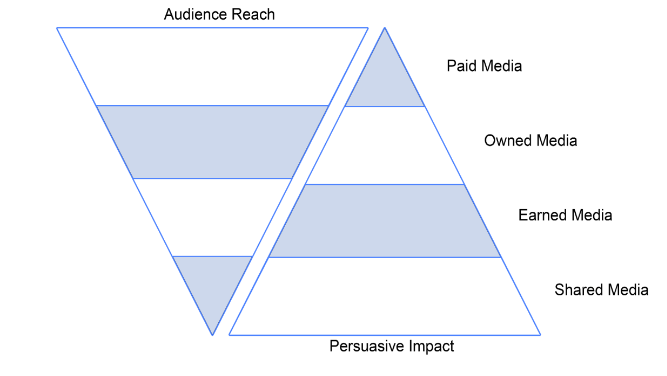
PESO Model
paid media, earned media, shared media, owned media
Paid media
Media purchased by the organization
Earned media
Message written about an organization voluntarily by third parties and published on media channels that the organization does not own (Journalism-based information is a form of earned media)
Shared media
Involve user-generated messages that are shared on a social media network
Owned media
Communication venues that are controlled by an organization (e.g., timing, packaging, distribution, and audience access)
PESO model tactic pyramid
reflects the relationship between the size of the audience that each category can reach and the impact they can have on that audience
print media
media delivered primarily through print vehicles, such as newspapers and magazines - earned
electronic media
media delivered primarily through electronic vehicles, such as television and radio - earned
Benefits of earned media
Wide reach; No cost/low cost; Credibility, power of third-party endorsement – added credibility that comes with the endorsement of an outside and unbiased agent such as reporter or editor
Media Use and Credibility
• People get news from all kinds of media
• But they turn to radio and print publications far less than digital devices and television
Attracting Publicity
• Publicity through news releases is more powerful and valuable than advertising.
• Publicity is “earned”; advertising is bought. There’s a big credibility difference.
• Publicity costs only the time and effort expanded by public relations personnel and
management in conceiving, creating, and attempting to place the publicity effort in the media.
• Publicity, which appears in news rather than in advertising columns, carries the implicit third- party endorsement of the news source that reports it.
– In other words, publicity is perceived not as the sponsoring organization’s self-serving view but as the view of the objective, unbiased, neutral, impartial news source.
Announcing a new product or service - value of publicity
Publicity can be regarded as news, It should be used before advertising commences.
Reenergizing an old product - value of publicity
When a product has been around for a while, it is difficult to make people pay attention to advertising. Therefore, publicity techniques – staged events, sponsorships – may pay off the rejuvenate a mature produc
Explaining a complicated product - value of publicity
Often, there’s no enough room in an advertisement to explain a product or service. Insurance companies which offer products that demand thoughtful explanation, may find advertising space too limiting
Little or no budget. - value of publicity
To make an impact, advertising requires frequency. But when an organization or individual can’t afford the significant sums that advertising demands, seeking publicity is the desired course.
Enhancing the organization’s reputation - value of publicity
Advertising is, at its base, self-serving
Crisis response. - value of publicity
publicity techniques are the fastest and most credible means of response.
Pitching
The activity of trying to place positive publicity in a periodical, on a news site, or in the electronic media—of converting publicity to news. Traditionally, public relations people do this for journalists through mail
Be time sensitive. - pitching publicity
News events should be scheduled, whenever possible, to accommodate news deadlines.
Generally write first then call. - pitching publicity
Reporters are busiest close to deadline time, which is late afternoon for morning newspapers and early afternoon for local television news. Thus, it’s preferable to e-mail news releases first, rather than trying to explain them over the telephone.
Direct the release to a specific person or editor. - pitching publicity
Newspapers are divided into departments; bloggers have specialties: business, sports, style, …
Determine how the reporter wants to be contacted. - pitching publicty
E-mail? Call? Tweet? Treat them as the client!
Direct news subsidy
information presented to the media in ready-to-use formats, such as news releases, News brief, Event listing, Fact sheet, feature releases, and Interview notes.
Fact sheet
brief (one page) outline of bulleted items about a newsworthy event
News release
news-style article written by a PR professional and given to media gatekeepers for verbatim use or as background information
news brief
a two- or three- paragraph article that provides the information of the summary lead of a news release
Event listing
(community calendar listing) – notice for media about an upcoming event
Interview note
a verbatim transcript of an interview with an organizational news source done by the PR writer in question-and-answer format
Feature release
focuses on background on the news; types include biography, history of the organization, backgrounder (on an issue), question-answer piece, and service “how to” article
Photo with caption
a short account of a newsworthy event with a photo - direct subsidy
Audio news release
an edited story package that public relations writers offer to radio journalists (30 to 60 seconds long) - direct subsidy
Video news release
a news release written and produced specifically for television stations, presented as an edited story package (30 to 90 seconds long) direct subsidy
Social media release
direct subsidy an earned media vehicle intended for blogs, websites, and other online uses - direct subsidy
Media kit
a collection of items such as news releases, fact sheets, feature releases, photos, and graphics that can be presented to journalists who attend news conferences; often delivered to invited reporters who fail to attend - Direct News Subsidies
Online newsroom
a comprehensive set of web pages within a website that provides resources for journalists (e.g., news releases, social media releases, transmedia news packages, fact sheets, photo gallery, executive bios, organizational histories, audio and video material) - Direct News Subsidies
Indirect news subsidy
information presented for media guidance but not meant to be published or aired.
Media advisory (a.k.a. media alert)
a brief note given to media gatekeepers; informs them of upcoming news opportunities including photo opportunities (news media can photograph public figures, usually without asking questions), news conferences, or newsworthy activities - indirect news subsidy
Story idea memo (a.k.a. tip sheet)
informal, for media gatekeepers; PR professionals suggest available interview subjects that can be developed by the newsmedia outlet’s reporters - indirect news subsidy
Query letter
written to editors or broadcasters proposing a story and inquiring about their interest; commonly used by freelance writers but also some public relations professionals - indirect news subsidy
Opinion subsidy
use of the news media by public relations professionals to present an organization’s opinion.
Position statement (a.k.a. white paper
a type of opinion material used by organizations to analyze issues and present formal opinions on issues of public policy - opinion subsidy
Letter to the editor
use to announce items that don’t make it into the news columns, to advocate a cause, or to correct errors in published report - opinion subsidy
Interactive Media Engagement
allow public relations practitioners to interact with journalists
News interview
a session in which journalists ask questions and public relations professional or organizational spokespersons respond. Usually one-on-one question-and-answer sessions; resulting news stories are published in print and online newspapers or aired on radio or television newscasts -Interactive Media Engagement
Public affairs program
a radio or television program in which journalists interview community newsmakers about a particular topic; generally 30 minutes or one hour long. Such programming fulfills Federal Communications Commission requirements to act as public trustees and keep station licenses - interactive media engagement
News conference
a hybrid of speech and group interview used to announce important news to reporters and to engage their questions. Use to announce major news, to serve media interests when a prominent newsmaker is available for only a short time, or to avoid accusations of playing favorites among reporters. - interactive media engagement