Exemption Clauses
 Call Kai
 Learn
 Practice Test
 Spaced Repetition
 Match
 Flashcards
 Knowt Play
1/13

Earn XP
Description and Tags
14 Terms
Exclusion Clause
An exclusion clause is a term in a contract that attempts to exclude or limit a party’s liability if something goes wrong, such as a breach of contract or damage.
Purpose: Protects a party against certain legal claims or losses.
Validity: Must be properly incorporated into the contract and satisfy relevant legal requirements.
Consumer contracts: Subject to statutory controls, including fairness requirements under the Consumer Rights Act 2015.
Business contracts: May be controlled by the Unfair Contract Terms Act 1977.
Example: A car park sign states that the operator excludes liability for theft of items left in vehicles, but whether the clause is enforceable depends on the circumstances and applicable law.
Limitation Clause
A limitation clause is a term in a contract that places a limit on the amount of liability a party must pay if something goes wrong.
Purpose: Limits the potential financial losses a party may have to cover.
Difference from exclusion clause: A limitation clause restricts liability, while an exclusion clause attempts to remove it entirely for specified losses.
Enforceability: Must satisfy relevant legal requirements and statutory controls.
Example: A supplier limits its liability for losses caused by faulty goods to £10,000.
L’Estrange v Graucob (1934)
Point of Law:
When a person signs a contract, they are generally bound by its terms, even if they did not read or understand them.

Curtis v Chemical Cleaning & Dyeing Co (1951)
Point Of Law:
If an exemption clause is misrepresented, then it can no longer be relied upon.

Incorporation by Notice
Incorporation by notice is when a contractual term becomes part of a contract because reasonable steps were taken to bring it to the other party’s attention before or when the contract was formed.
Timing: Notice must generally be given before or at the time the contract is formed.
Reasonable notice: The party relying on the term must take reasonable steps to make the other party aware of it.
Unusual terms: Particularly burdensome or unusual clauses require more prominent notice.
Example: A car park displays clear terms and conditions at its entrance before drivers park.
If notice is inadequate: The term may not be incorporated into the contract.
Thompson v LMS Railway (1930)
Point of Law:
Only reasonable notice needs to be given, not ACTUAL.

Spurling v Bradshaw (1956)
Point of Law:
The more onerous or unusual a clause is, the more notice is needed.
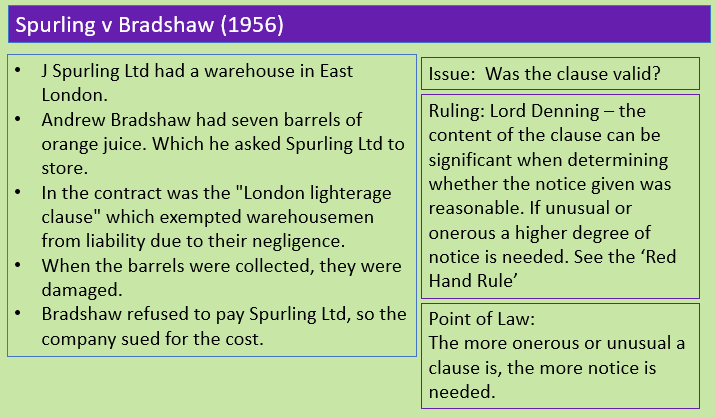
The Red Hand Rule - Lord Denning
The Red Hand Rule, associated with Lord Denning, states that particularly unusual or on
Purpose: Ensures parties are aware of particularly harsh contractual terms.
Key case: J Spurling Ltd v Bradshaw (1956).
Lord Denning’s analogy: A particularly harsh clause should be printed in red ink with a red hand pointing to it.
Application: Relevant to incorporating exclusion and limitation clauses into contracts.
Example: A business cannot necessarily rely on an obscure clause imposing an unusually high penalty if it failed to draw attention to it.erous contractual terms must be brought to the other party’s attention clearly and prominently before the contract is formed.
Chapelton v Barry Urban District Council (1940) - Incorporation by Notice
Point of Law:
Exemption clauses need to be on a contractual document, not a receipt. (could also be used for timing)

Olley v Marlborough Court Hotel (1949) Incorporation by Notice - Timing
Point of Law:
For a notice to be effective it must be given before or at the time the contract is made, otherwise it will be too late.
Thornton v Shoe Lane Parking (1971) Incorporation by Notice - Timing
Point of Law:
For a notice to be effective it must be given before or at the time the contract is made, otherwise it will be too late.
Contra Proferentem
Contra proferentem is a legal rule stating that if a contractual term is ambiguous, it may be interpreted against the party that drafted or is relying on that term.
Purpose: Protects the party who did not draft the contract.
Application: Often used when interpreting exclusion and limitation clauses.
Effect: The court may adopt the interpretation less favourable to the party relying on the clause.
Example: If an exclusion clause is unclear about which losses it covers, the court may interpret it against the business that drafted it.
If the wording is clear and free from ambiguity, then it cannot be denied, even if there is a fundamental breach.
UCTA 1977 Key Provisions – 2 – Protection under the Act
Under s.2(1), clauses that attempt to exempt business liability for death or personal injury, are void
However, this doesn’t apply to personal property