Chapter 9 Ligands/Nomenclature- Inorganic Chemistry
 Call Kai
 Learn
 Practice Test
 Spaced Repetition
 Match
 Flashcards
 Knowt Play
1/57

There's no tags or description
Looks like no tags are added yet.
58 Terms
H—
Hydrido
F—
Fluoro
Cl—
Chloro
Br—
bromo
I—
Iodo
N3—
Nitrido
N3—
Azido
O2—
Common: oxo
IUPAC: oxido
CN—
cyano
SCN—
Common: thiocyano
IUPAC: thiocyanato-S
NCS—
Common: isothiocyano
IUPAC: thiocyanato-N
OH—
hydroxo
CO
Carbonyl
CS
Thiocarbonyl
NO+
nitrosyl
NO2—
Common: nitro
IUPAC: nitrito-N
ONO—
Common: Nitrito
IUPAC: Nitrito-O
NH3
Ammine
MeNH2
Methylamine
NH2—
C: Amido
I: Azanido
NH2—
C: Imido
I: Azanediido
Chelating ligands
2 or more points of attachment to the metal atom/ion.
Ethylenediamine
-Bidentate
-I: 1,2-ethanediamine
-Abb.: en
Formula: NH2CH2CH2NH2
Diethylenetriamine
I: 1,4,7-triazaheptane
Abb.: dien
F: NH2CH2CH2NHCH2CH2CH2NH2
Triethylenetetraamine- tetradentate
-I: 1,4,7,10-tetraazadecane
A: trien
F: NH2CH2CH2NHCH2CH2NHCH2CH2NH2
tetraethylene-pentamine
-Pentadentate
-I: 1,4,7,10,13-pentaazatridecane
F: NH2CH2CH2NHCH2NHCH2CH2NHCH2CH2NH2
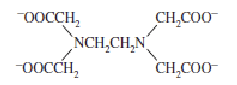
Ethylenediamine-tetraacetate
-Hexadentate
-I: 1,2-ethanediyl tetraaceta
-A: EDTA
The number of ligands is given by the following prefixes. If the ligand name includes prefixes or is complicated, it is set off in parentheses and the second set is used.

Diamminesilver(I)chloride
Cations come first, followed by the name of the coordination sphere, followed by the anion.
Tetraaminecopper(II)sulfate
The inner coordination sphere is enclosed in brackets in the formula. Within this sphere, ligands are named before the metal, but in formulas the meal ion is writted first.
Ligands are named in alphabetical order
-[Co(NH3)4Cl2]+ and [Pt(NH3)BrCl(CH2NH2)]2+
Anionic ligands are given a ‘o’ suffix. Neutral retain the usual name.
-Coordinated water called aqua
-Chloro, Cl—
-SO42—- , Sulfato
[[Pt(NH34]2+ and [Pt(Cl)4]2-
Calculated oxidation number of the metal ion is placed as a roman numeral in parentheses after the coordination sphere
-ate is added if ion charge is negative
Cis (adjacent) and trans (opposite) describes geometrical locations
trans-diamminedichloroplatinum(III) anad cis-tetraaminedichorocobalt (III)
Bridging ligands between two metals have mew.

When the complex is negatively charged

Prefix transition rule
Standard prefixes are reserved for basic, simple ligands. Alternatives prefixes are mandatory under specific criteria to avoid chemical ambiguity.
When to apply alt prefixes
1.When the ligand’s structural IUPAC name contains an embedded number word. (e.g. ethane-1,2-diamine)
2.When dealing with large, multi-atom organic molecules or rings.
Enclose modified ligand’s name inside full parentheses followed by bis/tris/tetrakis…
[Co(en)2Cl2]+
dichloridobis(ethane-1,2-diamine)cobalt (III)
[Fe(ox)3]3-
tris(oxalato)ferrate(III) ion
[Ni(PPh3)4]
tetrakis(triphenylphospine)nickel
Chirality
1.Has no rotation-reflection axes
2.Has no symmetry or only have an axes of rotation.
Molecules with only Cn
Tetrahedral molecules
Octahedral molecules with bidentate or higher chelating ligands
Octahedral species with any combination of M and 3+ elements.
Structural isomerism
Atoms connected with different bonding frameworks
Stereoisomerism
Same bond connectivity, but atoms point differently in space
Linkage isomerism
Occurs with ambidentate ligands that can bind via different atoms (NO2-, SCN-)
Solvate isomerism
A special ionization variant where water molecules swap inside and outside the coordination sphere.
Coordination isomerism
When both cation and anion are complex ions, exchanging their ligands entirely.
Octahedral geometry
-Cis/trans: placement of the two ligands
-Facial/meridional: Found in MA3B3 complexes
Fac
Three identical ligands form one triangular face of the octahedron.

Mer
Three identical ligands form a peripheral arc around the center.

C.N. 1
Rare except in ion pairs in the gas phase
C.N. 2
-Rare: [Ag(NH3)2]+, Ag is d10
-VSEPR predicts a linear structure
-Large ligands help force linear arrangments
C.N. 3
-More likely with d10 ions
-Trigonal planar is the most common
C.N. 4
-Tetrahedral and square planar are most common
-Small ions and large ligands prevent high C.N.
-d0 or d10 structures and Jahn-Teller distortion→ tetrahedral
-d8 have square planar→ Ni(II), Pd(II), and Pt(III)
C.N. 5
-Common structures are trigonal bipyramidal and square pyramid.
-Full range of transition metals
C.N. 6
Most common for octahedral
Exists for all transition metals
C.N. 8
-Large transition elements