Nucleic acids [DNA replication]
 Call Kai
 Learn
 Practice Test
 Spaced Repetition
 Match
 Flashcards
 Knowt Play
1/11

There's no tags or description
Looks like no tags are added yet.
12 Terms
DNA stands for
deoxyribonucleic acid
what is DNA made of?
nucleotides
what are DNA nucleotides made of?
phosphate group
deoxyribose sugar
nitrogenous base
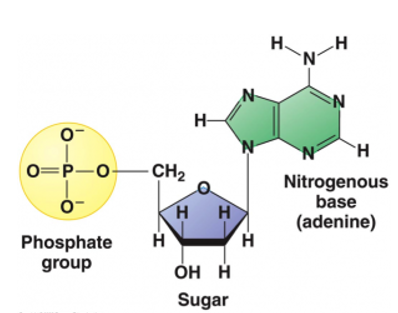
what type of sugar is deoxyribose
pentose sugar ( 5 carbon sugar)
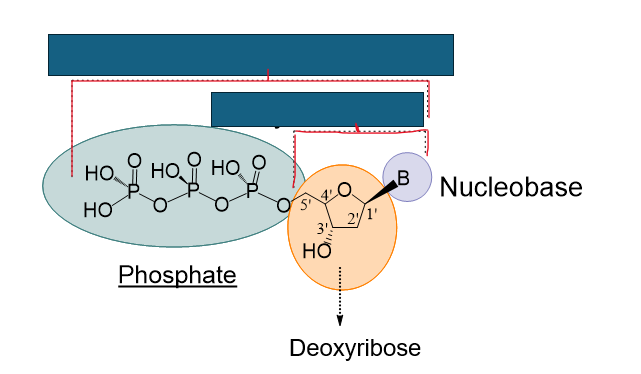
Deoxynucleoside
Sugar + base
Deoxynucleoside triphosphate
Sugar + base + 3 phosphates
[Deoxynucleotide
Sugar + base + phosphate]

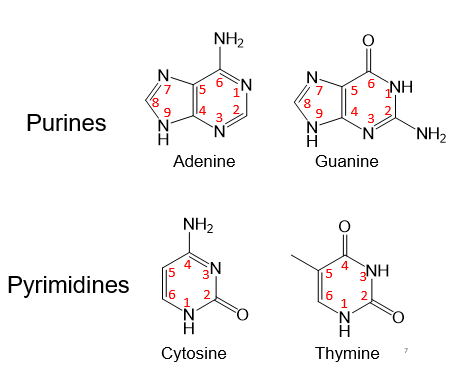
2 types of bases
-what it contains?
-which bases?
purine - contains 2 carbon-nitrogen rings joined together [A and G] [tip: pu and two rhyme]
pyrimidine- contains only 1 carbon-nitrogen ring [T,C and U]
→pyrimidine is smaller than a purine base
[A pyrimidine base always binds to a purine base]
[TIP: u can remember cYtosine and thYmine are pYramindines bcs of the 'Y']
differences between the nucleotides of DNA and RNA
-pentose sugar
-atom in sugar
-base
-strand
DNA
-deoxyribose
-Carbon 2 deoxyribose has a H atom [tip: deoxy-> without oxygen]
-has thymine rather than uracil [RNA doesn't have T]
-2
RNA
-ribose
-Carbon 2 ribose has a OH group
-has uracil rather than thymine [DNA doesn't have U]
-1
DNA bases
RNA bases
DNA
-Adenine
-Thymine
-Guanine
-Cytosine
RNA
-Adenine
-Uracil
-Guanine
-Cytosine

structure of DNA
-double helix
-made of 2 complementary polynucleotides
-3 hydrogen bonds form between C and G
-2 hydrogen bonds form between A and T [H-bonds form between complementary base pairs]
-polynucleotides are anti-parallel [strands run in opposite directions]
-The bases are perpendicular to the helical axis [Think of DNA like a twisted ladder and the bases as the steps]
DNA replication process
-DNA helicase breaks the hydrogen bonds between the complementary bases
-DNA strands separate, creating a replication fork
-Topoisomerase relieves tension produced by unwinding, preventing DNA supercoiling
-SSB proteins (Single strand binding protein) stabilises the separated single stranded DNA [prevent the strands from rejoining and reforming a double helix]
-Primase produces a short RNA primer to provide a starting point for DNA polymerase [it cannot make a new DNA strand on its own]
-DNA polymerase adds nucleotides in the 5’ to 3’ direction
-The leading strand is synthesised continuously towards the replication fork
-The lagging strand is synthesised discontinuously away from the replication fork in short fragments called Okazaki fragments. Each fragment requires its own RNA primer.
-Exonuclease removes RNA primers and are replaced with DNA nucleotides
-DNA ligase joins the Okazaki fragments
-Replication produces two identical DNA molecules. Each DNA molecule contains one original strand and one new strand.
[note: leading and lagging strands are synthesised at the same time
DNA polymerase ONLY synthesizes DNA in the 5′ to 3′ direction]
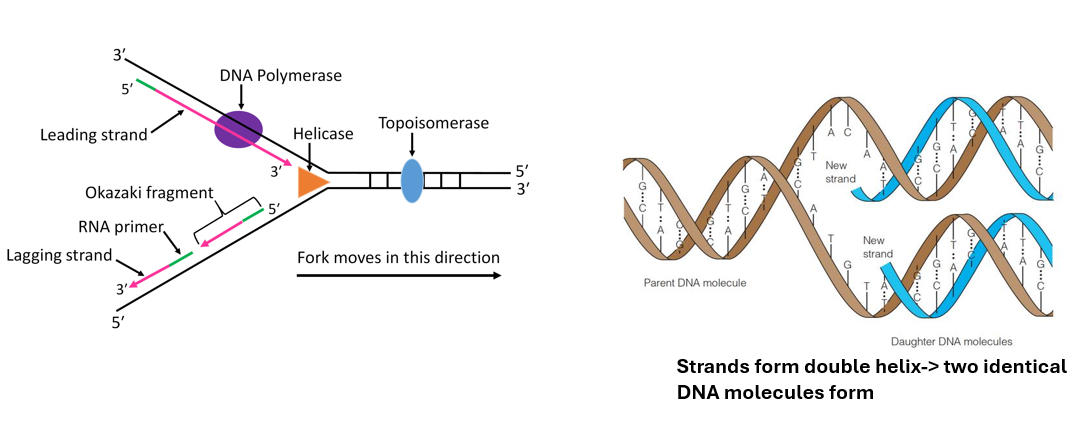
what type of process is DNA replication
semi-conservative [each new DNA molecule has one original strand and one new strand]
diff between prokaryote and eukaryote genes
Prokaryotic genes don’t have introns and exons. Eukaryotic genes have both.