Ultrasound Physics Relationships
 Call Kai
 Learn
Learn Practice Test
 Spaced Repetition
 Match
Match Flashcards
 Knowt Play
1/62

There's no tags or description
Looks like no tags are added yet.
Name | Mastery | Learn | Test | Matching | Spaced | Call with Kai | Chat |
|---|
No analytics yet
Send a link to your students to track their progress
63 Terms
Related
- two items that are associated or affiliated
Unrelated
- two items that are NOT associated, or lacking a logical or casual connection
Directly Related or Directly Proportional
- when one item INCREASES, the other INCREASES
Inversely Related or Inversely Proportional
- when one item INCREASES, the other DECREASES
Reciprocal Relationship
- when two numbers with a reciprocal relationship are multiplied together, the result is 1
- special form of inverse relationship
- reciprocals are inversely related because when one increases, the other decreases
Period (T) and Frequency (f)
- inversely related
- f(o) = 1/T
- as frequency increases, period decreases
- as frequency decreases, period increases
- reciprocals
- the product of (frequency) and (period) is always 1
- f(o) x T = 1
Power (P) and Amplitude (p)
- directly related
- power is proportional to the wave's amplitude squared
- power ∝ amplitude^2
Intensity (I) and Power (P)
- directly proportional
- when a wave's power is doubled, the intensity is doubled
- when a wave's power is quartered, the intensity is quartered
- intensity ∝ power
Intensity (I) and Amplitude (p)
- directly proportional
- intensity is proportional to the wave's amplitude squared
- when a wave's amplitude is doubled. the intensity increases to four times its original value
- intensity ∝ amplitude^2
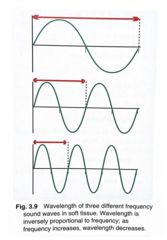
Wavelength (λ) and Frequency (f)
- inversely related
- as long as a wave remains in one medium, wavelength and frequency are inversely related
- as frequency increases, wavelength decreases
- the lower the frequency, the longer the wavelength
- f(o) = c/λ
Stiffness and Speed (c)
- directly related
- when stiffness increases, speed increases
Density (ρ) and Speed (c)
- inversely related
- when density increases, speed decreases
- materials that are stiff but not dense will have the fastest speed
- materials that are not stiff but are very dense will have the slowest speed
Spatial Pulse Length (SPL) and Frequency (f)
- inversely related
- because wavelength decreases with increasing frequency, spatial pulse length decreases with increasing frequency
Spatial Pulse Length (SPL) and the number of cycles per pulse
- directly proportional
- spatial pulse length equals the number of cycles in each pulse times the wavelength of each cycle
Spatial Pulse Length (SPL) and Wavelength (λ)
- directly related
- spatial pulse length is the product of the number of cycles in a pulse and the wavelength
Spatial Pulse Length (SPL) and Pulse Duration (PD)
- directly related
- if spatial pulse length increases, pulse duration increases
- if spatial pulse length decreases, pulse duration decreases
Spatial Pulse Length (SPL) and Speed
- directly related
Pulse Duration (PD) and the number of cycles
- directly related
- if the number of cycles increases, pulse duration increases
- if the number of cycles decreases, pulse duration decreases
Pulse Duration (PD) and Period (T)
- directly proportional
Pulse Duration (PD) and Frequency (f)
- inversely proportional
Pulse Repetition Period (PRP) and Depth of View
- directly related
- as depth of view increases, pulse repetition period increases
- as depth of view decreases, pulse repetition period decreases
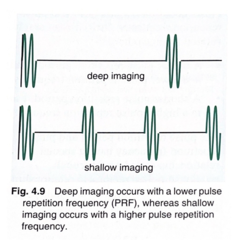
Pulse Repetition Frequency (PRF) and Depth of View
- inversely related
- as depth of view increases, pulse repetition frequency decreases
- as depth of view decreases, pulse repetition frequency increases
Pulse Repetition Frequency (PRF) and Frequency
- unrelated
- PRF is only related to depth of view
Pulse Repetition Period (PRP) and Pulse Repetition Frequency (PRF)
- inversely related
- a longer pulse repetition period results in a lower pulse repetition frequency (PRP = 1/PRF)
- a shorter pulse repetition period results in a higher pulse repetition frequency (PRF = 1/PRP)
- reciprocals
- when two parameters are multiplied together, the result is 1
- PRF x PRP = 1
Distance (d) and Attenuation
- directly related
- the distance that the sound travels directly affects attenuation
- the farther sound travels, the greater the attenuation and the weaker the beam becomes
Frequency (f) and Attenuation
- directly related
- attenuation in a soft tissue depends upon the wave's frequency
- attenuation is greater in higher frequency sound that in lower frequency sound
Attenuation and Scattering
- directly related
- attenuation is the loss of intensity with distance traveled, caused by scattering and absorption of the beam
Attenuation and Absorption
- directly related
- the higher the frequency of the sound wave, the greater amount fo absorption will occur
Attenuation and Reflection
- directly related
Frequency and Absorption
- directly related
- absorption is dependent on the frequency of the sound wave and the characteristics of attenuating tissue
Frequency and Scattering
- directly related
- scattering has a strong dependence on increasing ultrasound frequency
- higher frequency beams scatter much more than lower frequency beams
Frequency (f) and Depth of Penetration
- inversely related
- as frequency decreases, depth of penetration increases
- the higher the frequency, the shorter the distance the field can penetrated into the body
Frequency and Resolution
- directly related
- ultrasound waves with shorter wavelengths have higher frequency and produce higher resolution images
Time of Flight and Depth
- directly related
- greater distances prolong the time of flight
- lesser distances shorten the time of flight
When the Depth of View is shallow, Pulse Repetition Period (PRP) is _______.
- short

When the Depth of View is deep, Pulse Repetition Period (PRP) is _______.
- long

When Depth of View is shallow, Pulse Repetition Frequency (PRF) is _______.
- high
When Depth of View is deep, Pulse Repetition Frequency (PRF) is _______.
- low
Pulse Duration (PD) and Bandwidth
- inversely related
- the larger the bandwidth of the receiver, the shorter the rise time of the edges of the pulse duration
Quality Factor and Bandwidth
- inversely related
- q-factor is a unitless number
- wide bandwidth probes have a low q-factor
- narrow bandwidth probes have a high q-factor
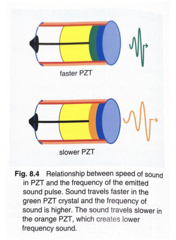
Speed of Sound in PZT and Frequency of Sound
- directly related
- when the speed of sound in PZT is faster, the frequency of sound created by a pulsed wave transducer is higher
- when sound's speed in PZT is slower, the frequency is lower
PZT Thickness and Frequency
- inversely related
- thicker active elements create pulses with lower frequency, longer wavelength cycles
- thinner active elements create pulses with higher frequency, shorter wavelength cycles

Transducer Diameter and Focal Depth
- directly related
- a larger diameter results in a deeper focus

Frequency and Focal Depth
- directly related
- high frequency sound results in a deeper focus

Frequency and Near Zone Length
- directly related
- the higher the frequency, the shorter the length of the near zone
Wavelength and Near Zone Length
- inversely related
PZT Active Element Diameter and Near Zone Length
- directly related
Crystal Diameter and Beam Divergence
- inversely related
- smaller diameter crystals produce beams that spread out more in the far field
- larger diameter crystals produce beams that diverge less in the far field

Frequency and Beam Divergence
- inversely related
- lower frequency sound beams spread out or diverge more in the deep far zone
- higher frequency sound beams diverge less

Frame Rate and Time for One Frame
- inversely related
- as the time needed to make such image decreases, the frame rate increases
- reciprocal
- when the frame rate is multiplied by time for one frame, the result is 1
- T(frame) x Frame Rate = 1
Imaging Depth and Frame Rate
- inversely related
- shallow imaging increases frame rate and improves temporal resolution
- deeper imaging decreases frame rate and degrades temporal resolution

Imaging Depth and Pulse Repetition Period (PRP)
- directly related
- if depth increases, pulse repetition period increases
- if depth decreases, pulse repetition period decreases
Imaging Depth and Pulse Repetition Frequency (PRF)
- inversely related
- if depth increases, pulse repetition frequency decreases
- if depth decreases, pulse repetition increases
Imaging Depth and Power
- inversely related
- if depth increases, power decreases
- if depth decreases, power increases
Intensity and Imaging Depth
- inversely related
- if depth increases, intensity decreases
- if depth decreases, intensity increases
Duty Factor (DF) and Pulse Repetition Period (PRP)
- inversely related
- if duty factor % increases, pulse repetition period decreases
- if duty factor % decreases, pulse repetition period increases
Duty Factor (DF) and Imaging Depth
- inversely related
- f depth increases, duty factor % decreases
- if depth decreases, duty factor % increases
Pulses per Frame and Frame Rate
- inversely related
- higher frame rates are possible when each individual image is made with fewer pulses
- lower frame rates occur when each image is made with more pulses
Field of View (Sector Size) and Frame Rate
- inversely related
- when a sonographer expands the field of view (sector size), more pulses are required to create an image
- narrower (upper) images result in higher frame rates
- wider (lower) images result in lower frame rates

Line Density and Frame Rate
- inversely related
- when line density is low, few pulses create each image and the frame rate is high
- when line density is high, the number of pulses per image increases, frame rate drops

Doppler Shift and Velocity
- directly related
- the faster the velocity, the greater the doppler frequency
Doppler Shift and Frequency
- directly related
- if the transducer's frequency is doubled, the measure doppler shift will also be doubled
Impedance (Z) , Density (ρ), and Propagation Speed (c)
- directly proportional