Exam 1- Counseling Theories and Techniques
 Call Kai
 Learn
Learn Practice Test
 Spaced Repetition
 Match
Match Flashcards
 Knowt Play
1/173

There's no tags or description
Looks like no tags are added yet.
Name | Mastery | Learn | Test | Matching | Spaced | Call with Kai | Chat |
|---|
No analytics yet
Send a link to your students to track their progress
174 Terms
Basic Counseling Skills- Identifying attending skills vs. other techniques
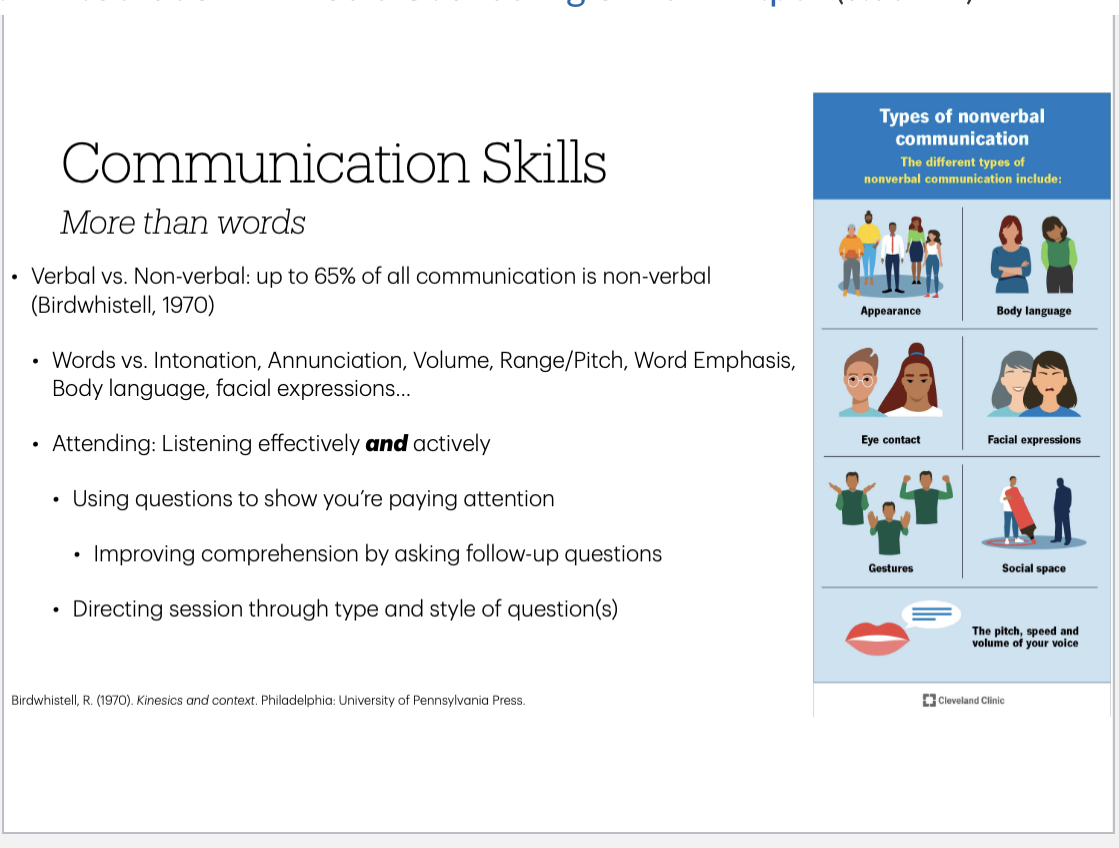
Attending: Listening effectively and actively
• Using questions to show you’re paying attention
• Improving comprehension by asking follow-up questions
• Directing session through type and style of question(s)

Basic Counseling Skills- Identifying attending skills vs. other techniques -Verbal vs. Non-verbal
up to 65% of all communication is non-verbal
Words vs. Intonation, Annunciation, Volume, Range/Pitch, Word Emphasis, Body language, facial expressions…
Basic Counseling Skills
Feedback-Informed Treatment (FIT)
FIT
evidence-based approach where therapists use real-time client input during every session
• Outcome Rating Scale (ORS)
• Individual well-being
• Interpersonal relationships
• Social functioning
• Overall well-being
• Social Rating Scale (SRS)
• Relationship quality
• Goals and topics
• Approach or method
• Overall session quality
Basic Counseling Skills
Evidence of Benefit with FIT
What are the pros and does it actually work?
FIT
Better outcomes - more clients get better and stops people from getting worse
• Higher retention rates
• De Jong et al. (2021) & Delgadillo et al. (2018) found statistically significant effect on symptom reduction
and dropout rates
• Therapists can make changes from session to session
How do these correlate to the 85% accuracy rating of assessing risk for drop out or deterioration according to Rousmaniere?
Basic Counseling Skills
Potential Risks and Complications of FIT
Note: These are common concerns from therapists, however evidence has not supported some of these claims.
Validity research, if any
FIT
Administrative and Implementation Burdens
• Less time in session for clinical interactions
• Ongoing training with clients (and therapists!)
• Financial implications - not all practices can
afford the training and ongoing software
expenses
Why does this matter?
• Staff Resistance
Why would a provider be resistant if there is so
much evidence?
Risks to Therapeutic Relationship
• Minimization of distress or symptom severity
• Misinterpretation of scores
• Unintentional pressures on client
• Including “Tick-box” mentality
Basic Counseling Skills
Identifying attending skills vs. other techniques
Attending- Verbal & non-verbal cues
• Help establish and maintain therapeutic dynamic
• Shows clinician is paying attention and focusing
on client
• Makes client feel especially heard and/or seen
• Encourages more sharing from client
What happens if the therapist actually does not care or empathize with the client?
• Note Taking: What are the positives and negatives?

Basic Counseling Skills
Identifying attending skills vs. other techniques
Attending Presentation
What does attending look and sound like?
Eye contact
• Are you paying attention or distracted when I’m
sharing?
• What is your perception of me and my situation?
• Body language & facial expressions
• Facilitative body language
• Leaning forward
• Unfolded arms and relaxed posture
• Conversational gestures
Paralinguistics or vocal qualities - volume, pitch, pace,
and/or speed of talking
• Moderate levels across the board
• High pitch and fast speed are just as bad as
monotone and slow
• Response Latency
• Long vs. Short vs. None
• Sitting with Silence
• Verbal tracking
• Can help explore topic more in-depth and improve
therapist’s comprehension

Basic Counseling Skills
Open-ended vs. Closed-ended questions
Closed-Ended Questions
“Do you like the Red Sox?”
Can be answered with a few words, often simply “Yes or No”, Multiple
choice, rating, or Identification
• Often direct and clear to client what the desired information is
• More efficient in initial data gathering
• May not be as warm or comforting in rapport building stage
• Too many feel interrogatory: “What is this, 20 questions?”
• Used more on day to day basis for information and interaction with others
Can be answered with a few words, often simply “Yes or No”, Multiple
choice, rating, or Identification
• Often direct and clear to client what the desired information is
• More efficient in initial data gathering
• May not be as warm or comforting in rapport building stage
• Too many feel interrogatory: “What is this, 20 questions?”
• Used more on day to day basis for information and interaction with others
• Almost all Closed-Ended Q’s can be changed to Open-Ended Q’s
Basic Counseling Skills
Open-ended vs. Closed-ended questions
Closed-Ended Questions
“Do you like the Red Sox?”
Example
Do you like the Orioles, Blue Jays, or Red Sox, or Rays?
On a scale of 1 to 10, how much do you dislike the Yankees?
I love the red socks on your shirt, whose logo is it?
Basic Counseling Skills
Active listening
Active Listening
Be sure to turn your ears on!
Encouragers
• Range from “Uh-huh” and/or nodding to simple restatements
• Difference in tone: Question vs. Statement
Client: “The Eagles are driving me crazy!”
Therapist: “The Eagles?” OR “Driving you crazy?”
Basic Counseling Skills
listening
Active Listening
Be sure to turn your ears on!
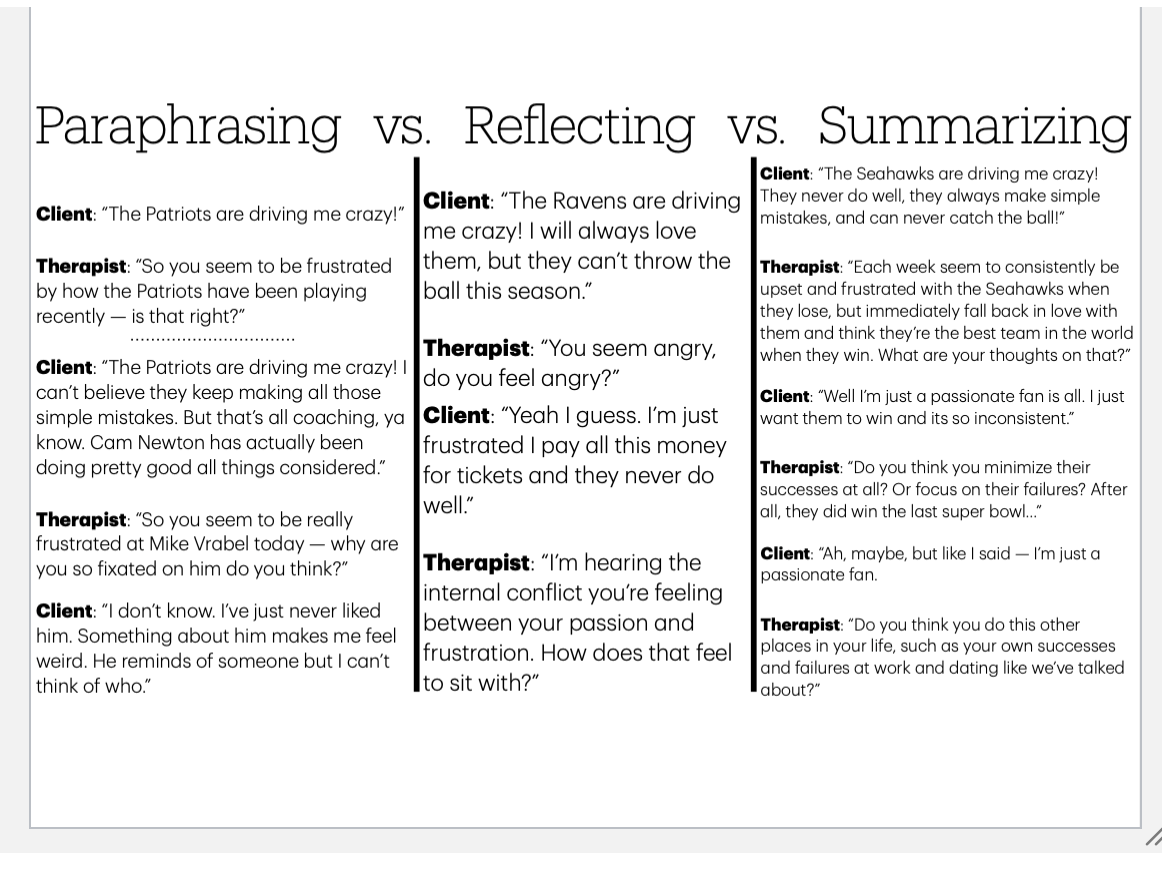
Paraphrasing vs. Reflecting vs. Summarizing
• Response in client’s words or therapist’s?
• Does it elicit more information and focus on content or validate client’s feelings and experience?
• Does it focus on immediate statements or include previous statements and impressions?
Basic Counseling Skills
Paraphrasing vs. Reflecting vs. Summarizing
Paraphrasing
Client: “The Patriots are driving me crazy!”
Therapist: “So you seem to be frustrated
by how the Patriots have been playing
recently — is that right?”
Client: “The Patriots are driving me crazy! I
can’t believe they keep making all those
simple mistakes. But that’s all coaching, ya
know. Cam Newton has actually been
doing pretty good all things considered.”
Therapist: “So you seem to be really
frustrated at Mike Vrabel today — why are
you so fixated on him do you think?”
Client: “I don’t know. I’ve just never liked
him. Something about him makes me feel
weird. He reminds of someone but I can’t
think of who.”

Basic Counseling Skills
-Informed Treatment (FIT)
evidence-based approach where therapists use real-time client input during every session
Outcome Rating Scale (ORS)
ORS vs. SRS
• Individual well-being
• Interpersonal relationships
• Social functioning
• Overall well-being
Basic Counseling Skills
-Informed Treatment (FIT)
evidence-based approach where therapists use real-time client input during every session
Social Rating Scale (SRS)
ORS vs. SRS
Relationship quality
• Goals and topics
• Approach or method
• Overall session quality
Basic Counseling Skills
Paraphrasing vs. Reflecting vs. Summarizing
Reflecting
Client: “The Ravens are driving
me crazy! I will always love
them, but they can’t throw the
ball this season.”
Therapist: “You seem angry,
do you feel angry?”
Client: “Yeah I guess. I’m just
frustrated I pay all this money
for tickets and they never do
well.”
Therapist: “I’m hearing the
internal conflict you’re feeling
between your passion and
frustration. How does that feel
to sit with?”
Basic Counseling Skills
Paraphrasing vs. Reflecting vs. Summarizing
Summarizing
Client: “The Seahawks are driving me crazy!
They never do well, they always make simple
mistakes, and can never catch the ball!”
Therapist: “Each week seem to consistently be
upset and frustrated with the Seahawks when
they lose, but immediately fall back in love with
them and think they’re the best team in the world
when they win. What are your thoughts on that?”
Client: “Well I’m just a passionate fan is all. I just
want them to win and its so inconsistent.”
Therapist: “Do you think you minimize their
successes at all? Or focus on their failures? After
all, they did win the last super bowl…”
Client: “Ah, maybe, but like I said — I’m just a
passionate fan.
Therapist: “Do you think you do this other
places in your life, such as your own successes
and failures at work and dating like we’ve talked
about?”

Evidence Based Research & Practice (EBP)
Which theories/therapies are able to be researched
Psychodynamic Theory & Therapy
Theoretic perspective on disfunction
Where do our problems come from?
*according to Psychodynamic therapists
Early experiences in life shape who we become during the lifespan
• Potential causes for disfunction:
• Unresolved Conflicts
• Often present as psychosomatic symptom(s)
• Object relations
• Objects = People
• Poor caregiving relationships can lead to poor object relations
Roots in Psychoanalytic therapy (Freud)
Psychoanalytic Review
Origins with Freud
Focus on how the unconscious motives and
impulses impact one’s personality and behaviors
• Freud believed personality was fully developed by
5 years old
• Modern interpretations agree in some ways, but
disagree in most
• Also believed most challenges in life were a result
of unsuccessfully progressing through a
developmental psychosexual stage…
• Modern practices view these now as “unresolved
conflicts” and are not linked to sexual ideology

Psychodynamic Theory & Therapy
Supportive vs. Expressive techniques
• Expressive Techniques
• Listening and understanding the dynamic
(unconscious) content
• May show up in different ways
• Making interpretations
• Therapist expressing their hypothesis of the
unconscious material that has emerged in
the therapy session
Supportive Techniques
• Creating the analytic frame
• Pre-conditions of therapy that allow for
trusting relationship
• Consistency
• Neutral and anonymous actions of therapist
• Minimal disclosure by therapist
• Therapist seeks to understand client’s
viewpoint without bias
Psychodynamic Theory & Therapy
Supportive vs. Expressive Techniques
Listening and understanding the dynamic
(unconscious) content
• May show up in different ways
• Making interpretations
• Therapist expressing their hypothesis of the
unconscious material that has emerged in
the therapy session
Psychodynamic Theory & Therapy
Supportive vs. Expressive Techniques
Creating the analytic frame
• Pre-conditions of therapy that allow for
trusting relationship
• Consistency
• Neutral and anonymous actions of therapist
• Minimal disclosure by therapist
• Therapist seeks to understand client’s
viewpoint without bias
Psychodynamic Theory & Therapy
- Unconscious
• Symptoms, actions, speech have
deeper meanings that operate
outside our awareness
(unconscious)
Psychodynamic Theory & Therapy
Where do our problems come from?
*according to Psychodynamic therapists
Unresolved conflicts
Early experiences in life shape who we become during the lifespan
• Potential causes for disfunction:
• Unresolved Conflicts
• Often present as psychosomatic symptom(s)
Psychodynamic Theory & Therapy
Object relations (conditions of worth)
Object relations
• Objects = People
• Poor caregiving relationships can lead to poor object relations
Psychodynamic Theory & Therapy
Poor Object Relations Examples
Object relations (conditions of worth)
Problems with connecting emotionally/trusting others
• Feeling desperate for close relationships and fearful of rejection/abandonment
• Being demanding or controlling of others
What kinds of early life relationships would you hypothesize would lead to some of these patterns?
Are these symptoms of any psychological condition? Or a group of disorders?
Psychodynamic Theory & Therapy
Defense Mechanisms
- Purpose
- Examples
“There’s certain things about ourselves that we’d rather not know…”
• Behaviors that deny or distort reality to help us keep unacceptable and/or uncomfortable feelings
(conflicts) out of awareness
• Viewed as healthy ways of coping
• Operate out of conscious awareness
• Important tool for therapists to highlight areas of
unconscious conflict

Psychodynamic Theory & Therapy
Defense Mechanisms
- Purpose
- Examples
Denial
Regression
Projection
Rationalization
Repression
Reaction Formation
Displacement
Sublimation

Psychodynamic Theory & Therapy
Defense Mechanisms
- Purpose
- Examples
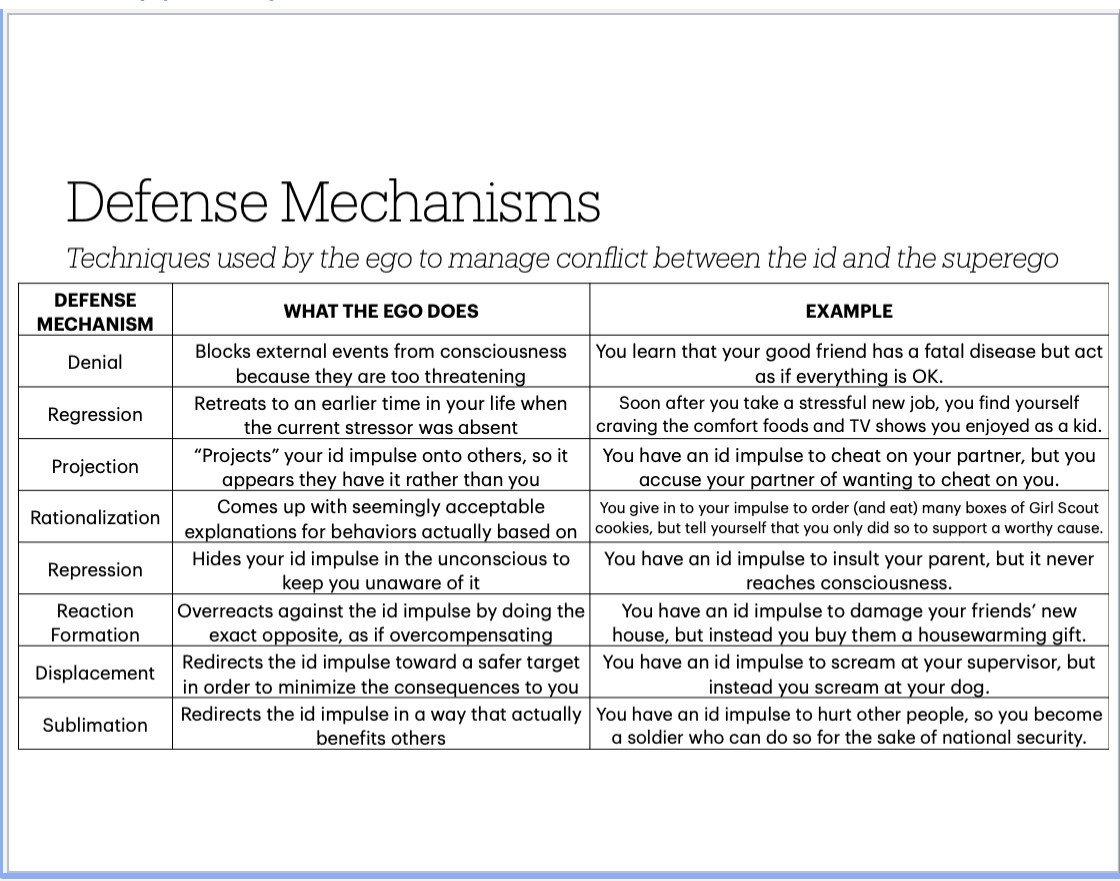
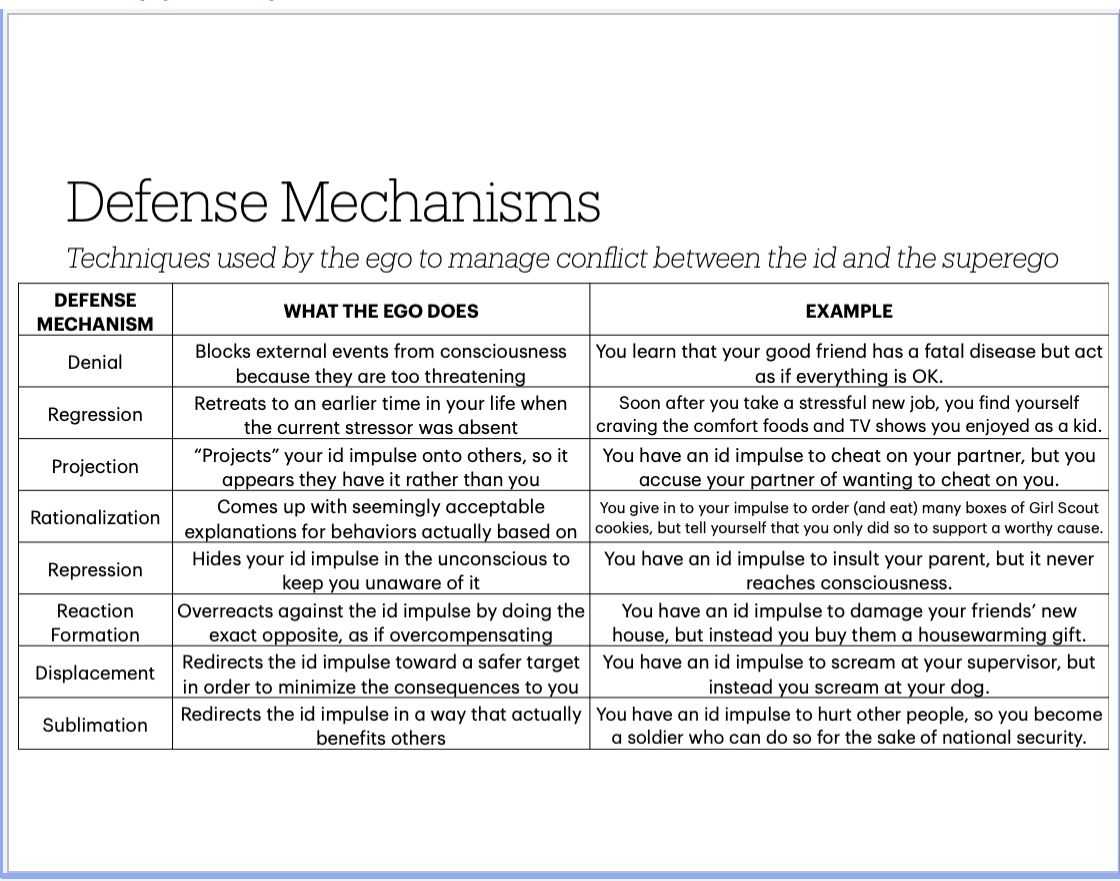
DEFENSE MECHANISM, WHAT THE EGO DOES, EXAMPLE
Denial
WHAT THE EGO DOES- external events from consciousness because they are too threatening
EXAMPLE- You learn that your good friend has a fatal disease but act as if everything is OK.

Psychodynamic Theory & Therapy
Defense Mechanisms
- Purpose
- Examples
DEFENSE MECHANISM, WHAT THE EGO DOES, EXAMPLE
Regression
WHAT THE EGO DOES- Retreats to an earlier time in your life when the current stressor was absent
EXAMPLE- Soon after you take a stressful new job, you find yourself craving the comfort foods and TV shows you enjoyed as a kid.

Psychodynamic Theory & Therapy
Defense Mechanisms
- Purpose
- Examples
DEFENSE MECHANISM, WHAT THE EGO DOES, EXAMPLE
Projection
WHAT THE EGO DOES- “Projects” your id impulse onto others, so it appears they have it rather than you
EXAMPLE- You have an id impulse to cheat on your partner, but you accuse your partner of wanting to cheat on you.

Psychodynamic Theory & Therapy
Defense Mechanisms
- Purpose
- Examples
DEFENSE MECHANISM, WHAT THE EGO DOES, EXAMPLE
Rationalization
WHAT THE EGO DOES- Comes up with seemingly acceptable explanations for behaviors actually based on
EXAMPLE- You give in to your impulse to order (and eat) many boxes of Girl Scout cookies, but tell yourself that you only did so to support a worthy cause.

Psychodynamic Theory & Therapy
Defense Mechanisms
- Purpose
- Examples
DEFENSE MECHANISM, WHAT THE EGO DOES, EXAMPLE
Repression
WHAT THE EGO DOES- Hides your id impulse in the unconscious to keep you unaware of it.
EXAMPLE- You have an id impulse to insult your parent, but it never reaches consciousness.
Psychodynamic Theory & Therapy
Defense Mechanisms
- Purpose
- Examples
DEFENSE MECHANISM, WHAT THE EGO DOES, EXAMPLE
Reaction Formation
WHAT THE EGO DOES- Overreacts against the id impulse by doing the exact opposite, as if overcompensating
EXAMPLE- You have an id impulse to damage your friends’ new house, but instead you buy them a housewarming gift.
Psychodynamic Theory & Therapy
Defense Mechanisms
- Purpose
- Examples
DEFENSE MECHANISM, WHAT THE EGO DOES, EXAMPLE
Displacement
WHAT THE EGO DOES- Redirects the id impulse toward a safer target in order to minimize the consequences to you
EXAMPLE- You have an id impulse to scream at your supervisor, but instead you scream at your dog.

Psychodynamic Theory & Therapy
Defense Mechanisms
- Purpose
- Examples
DEFENSE MECHANISM, WHAT THE EGO DOES, EXAMPLE
Sublimation
WHAT THE EGO DOES- Redirects the id impulse in a way that actually benefits others
EXAMPLE- You have an id impulse to hurt other people, so you become a soldier who can do so for the sake of national security.

Psychodynamic Theory & Therapy
Transference & Countertransference
Transference
Important tool for investigating, uncovering, understanding client’s unconscious conflicts
• Client’s unconscious and unrealistic expectations for the therapist to behave like an significant person from
the client’s past
• Identifying factors:
• Repetition of a past pattern
• Inappropriate
• Doesn’t fit with the reality of the situation

Psychodynamic Theory & Therapy
Transference & Countertransference
Countertransference
Therapist’s reactions and responses toward the patient
• Sometimes viewed as an unconscious replaying of a significant relationship between therapist and
an important figure in their past
• Something to be noticed and managed
• Supervision / Consultation / Therapy
• Possibly a useful source of information about the client

Psychodynamic Theory & Therapy
Psychodynamic therapy
- Goal(s) of treatment
• Resolve conflicts and repetitive patterns
• Develop ability to realistically see self and others
• Relieve symptoms
• Format of treatment:
• Often longer term than other approaches
• Tends to focus on past
• Less structured than other approaches

Psychodynamic Theory & Therapy
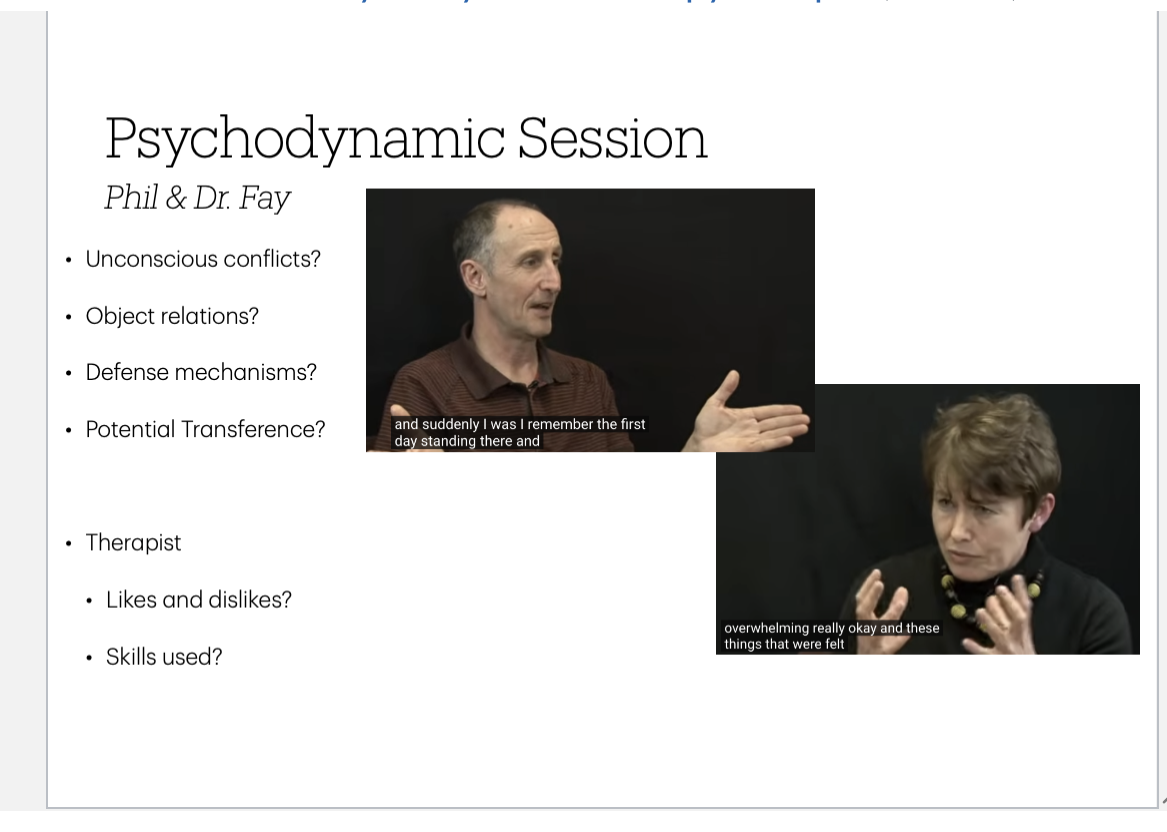
Psychodynamic Session
Phil & Dr. Fay
• Unconscious conflicts?
• Object relations?
• Defense mechanisms?
• Potential Transference?
• Therapist
• Likes and dislikes?
• Skills used?
Psychodynamic Theory & Therapy
Does it work?
Empirical support for Psychodynamic therapies
Validity research, if any
Has not been researched in a scientifically rigorous way
• Some support for brief, manualized psychodynamic therapies
• Helpful for depression, panic disorder, social anxiety disorder
• Lacking support for OCD, Substance use disorders
• Issues in measuring the unconscious conflict
Can we prove the existence of the unconscious let alone how much it is conflicted?
Psychodynamic Theory & Therapy
Does it work?
Empirical support for Psychodynamic therapies
Validity research, if any
“How White are the Data” in psychodynamic research?
• Review of psychodynamic therapy studies, 1960-2010
• Found of studies didn’t report the racial characteristics of the sample
• Studies that reported racial characteristics:
• of the participants were White
Psychodynamic Theory & Therapy
Theoretic perspective on disfunction
Early experiences in life shape who we become during the lifespan
• Potential causes for disfunction:
• Unresolved Conflicts
• Often present as psychosomatic symptom(s)
Psychodynamic Theory & Therapy'
Object relations (conditions of worth)
Poor Object Relations
These are themes, but can you think of specific examples?
• Problems with connecting emotionally/trusting others
• Feeling desperate for close relationships and fearful of rejection/abandonment
• Being demanding or controlling of others
What kinds of early life relationships would you hypothesize would lead to some of these patterns?
Are these symptoms of any psychological condition? Or a group of disorders?
Psychodynamic Theory & Therapy'
Transference & Countertransference
Transference Example
• Patient: I was worried all week about whether I did the homework correctly. I hope you’re not disappointed in me.
• Therapist: You put a lot of pressure on yourself to be a “perfect” patient. What do you fear will happen if you’re not?
• Patient: I’m not sure. I guess I worry that you’ll be upset. It seems silly, but I have this feeling you’re going to yell at me or punish me. Or stop letting me come to see you.
• Therapist: It reminds me of how you tried so hard to avoid mistakes as a child because any little thing could trigger your mom’s temper. What do you make of that similarity?
Psychodynamic Theory & Therapy'
Defense Mechanisms
Name these defense mechanisms
• You meet with a new patient, a 30 year old single male who works very long hours and has few friends and no contact with his family. When you ask him about the reasons for his limited social contact, he says “I just think my time is very valuable. I don’t want to waste it doing what other people want to do. Relationships aren’t worth my time.”
• Your client Amanda, 16-years-old, tells you that she had picked out the car of her dreams, however before she could convince her parents to buy it for her, someone else did. She shares with you that she knows the buyer and initially planned to slash the tires, however after some deep breaths she decided not to. Instead, Amanda went out and bought a car wash gift card and left it under the windshield wiper saying, “If I can’t have her, she might as well still be pretty.”
• A 24-year-old clinician in-training is debating between working in the hospice field because of his personal exposure to terminal illness or the addiction field because his father was an alcoholic who died young. He denies any ongoing grief as well as any emotions related to these fields of work simply stating, “I think they’re interesting — it has nothing to do with my family. Plus I’ve always liked helping people.”
Psychodynamic Session with
Phil & Dr. Fay
What psychodynamic
coping methods do you
see in Phil?
• Defense mechanisms?
• Unconscious
conflicts?
• Object relations?
• Transference?
• What psychodynamic techniques do you see
from Dr. Fay?
Person-Centered Theory & Therapy
Roots in Humanistic theory (Maslow)
- Self-actualization
Humanistic Theory
Pursuit of Self-Actualization
• Self-Actualization - reaching one's fullest potential and becoming the best version of oneself
• Free Will - humans possess agency and can
actively choose their paths
• The Whole Person - attempts to understand
a person’s entire conscious experience
• Including but not limited to: emotions,
reactions, beliefs, and values
• Instead of analyzing behavior(s) as
individual parts

Person-Centered Theory & Therapy
Theoretic perspective on disfunction
Cause of Dysfunctions
*according to person-centered therapy
• “Conditions of worth”
• “You are only loved if you are X”
• “You are only worthy if you achieve X”
• “I only care about you and your feelings when…”
• Leads to a conflict between “true selves” are and who person thinks they should be
• Often from societal pressure or expectation of others, but sometimes self-imposed

Person-Centered Theory & Therapy
Theoretic perspective on disfunction
Conditions of Worth Examples
• Neil’s parents shower him with praise, hugs, rewards for his good report card. He notices that when his grades were worse, they didn’t seem to act this way.
• “I’m only loved if I __________________________”
• Michelle moved around a lot as a child and didn’t make many friends. In high school, she went through a growth spurt and started getting noticed by “popular” guys for her good
looks. She gradually becomes accepted into their social circles.
• “I’m only loved if I __________________________”
• 7-year old Jimmy’s parents always seem to get angry when Jimmy is sad or scared. They tell him not to cry and that he should be a big boy telling him shouldn’t “make such a big deal about these things.”
• “I’m only loved if I __________________________”
Person-Centered Theory & Therapy
- Three (3) necessary and sufficient aspects (Rogers)
- UPR
- Genuineness
- Empathy & understanding
- UPR
- Genuineness
- Empathy & understanding

Person-Centered Theory & Therapy
- Three (3) necessary and sufficient aspects (Rogers)
- UPR
- Genuineness
- Empathy & understanding
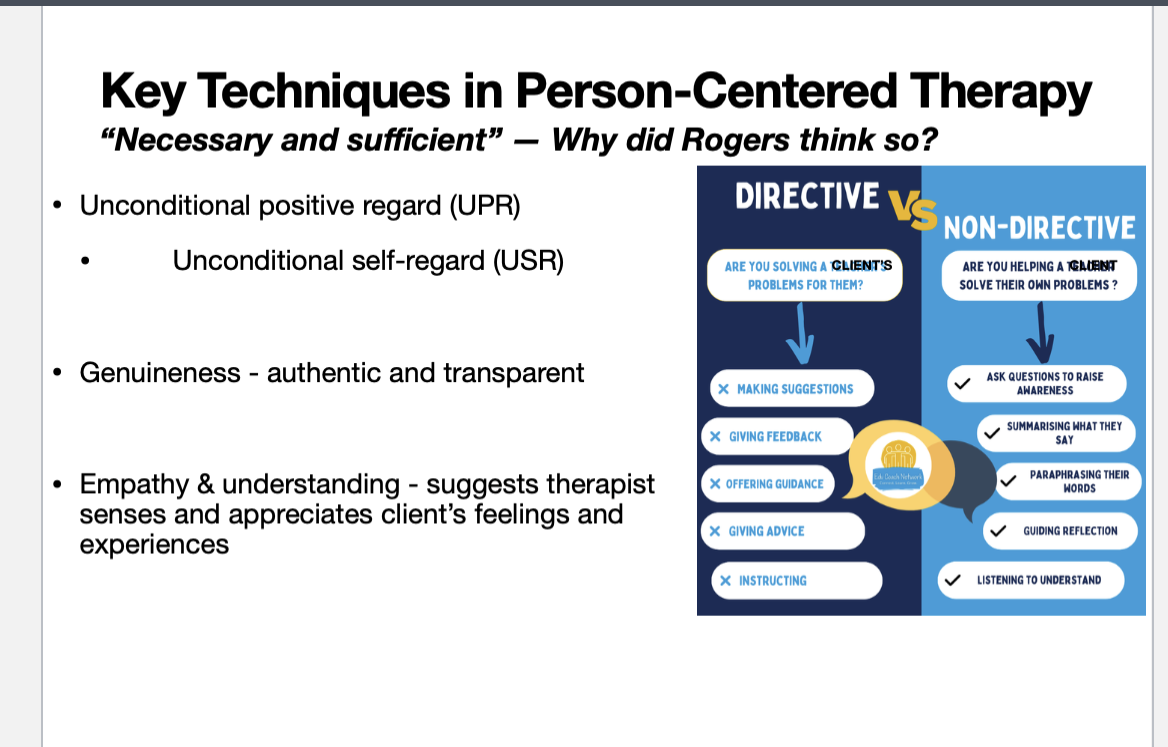
Key Techniques in Person-Centered Therapy
“Necessary and sufficient” — Why did Rogers think so?
• Unconditional positive regard (UPR)
• Unconditional self-regard (USR)
• Genuineness - authentic and transparent
• Empathy & understanding - suggests therapist
senses and appreciates client’s feelings and
experiences

Person-Centered Theory & Therapy
- Three (3) necessary and sufficient aspects (Rogers)
- UPR
- Genuineness
- Empathy & understanding
• Unconditional positive regard (UPR)
• Unconditional self-regard (USR)
Person-Centered Theory & Therapy
- Three (3) necessary and sufficient aspects (Rogers)
- UPR
- Genuineness
- Empathy & understanding
Genuineness - authentic and transparent

Person-Centered Theory & Therapy
- Three (3) necessary and sufficient aspects (Rogers)
- UPR
- Genuineness
- Empathy & understanding
Empathy & understanding - suggests therapist
senses and appreciates client’s feelings and
experiences

Person-Centered Theory & Therapy
Evidence for Person-Centered therapy(?)'
Goal(s) of treatment
Validity research, if any
• Correlation between a stronger therapeutic alliance and better patient outcomes
• Eclectic treatments added to person-centered methods improves outcomes in specific populations
Person-Centered Theory & Therapy
Goal(s) of treatment
Encouraging personal growth through support
• People are inherently good
• People have the ability to grow and lead
productive, fulfilling, and effective lives
without the pressures or expectations of
others
• Self-actualization
• People have the ability to heal themselves
• Without direct intervention from a therapist or provider
• Contrasts with theories that view people as neutral, untrustworthy, or trained to act poorly (ie., Freud, Behaviorists)
Motivational Interviewing
- OARS
MI has core skills of OARS, attending to the language of change and the artful exchange of information”.
- Open-ended questions
- Affirmation
- Sound like anything from Rogers?
- Reflections
- Summarizing
MI Concept & techniques
MI Techniques: Open-ended questions and Reflections
Moving client towards discussing reasons for change
- “Tell me about your substance use history.”
- “What brought you here today?”
- “What happens when you behave that way?”
- “So what I hear you saying is…”
- “So on one hand, it sounds like… And, yet, on the other hand…”
- “It sounds like you are very conflicted about the options before you.”
MI Technique: Eliciting Change Talk
“Attending to the language of change”
“I just hate the way that I am…”
- “It’s just too overwhelming, I can’t even think about doing that right now.”
- “I just hate my life. Everything sucks.”
- “My family doesn’t care about me, I don’t know why they’re forcing me to come here.”
- “Everything used to be great, but now it sucks and there’s nothing I can do about it.”
MI Technique: Feedback
Feedback
“Artful exchange of information”
Needs to be done non-judgmentally and
with client’s permission
• Sharing is a “two-way street”, but still
responsive to client’s present
• Make sure everyone is clear the therapist
is not telling the client what to do
• Respects expertise of both client and
therapist
• Can include correcting or improving
client’s knowledge or understanding
MI Technique: Feedback
Feedback
“Artful exchange of information”
Example
“I heard the nicotine patch doesn’t work at all.”
“My friend told me that vaccines can cause developmental disorders.”
“My friend told me her therapist always gives her advice on dating.”
Basic Counseling Skills
Identifying attending skills vs. other techniques
ATTENDING
Attending skills may be defined as the verbal and nonverbal counseling skills that communicate the therapeutic conditions, show clients that counselors are focusing their attention on them and what they have to say, facilitate strong thera-peutic relationships, and encourage and reward continued client communication). As already noted, all interpersonal communication includes both verbal and nonverbal channels. The nonverbal channel is com-posed of at least two components, kinesic and paralinguistic. Kinesic components include both eye contact and body language, the latter comprising more specific components. Paralinguistic components of communication include the voice qualities of volume, pitch, pace, and ! uency. As also previously noted, much of communication occurs through nonverbal channels, particularly the communi-cation of emotion (e.g., a smile, a red face, a raised voice with increased volume). Further, when the verbal and nonverbal components of a message con! ict (e.g., a person saying the words, “I am NOT angry,” with a red face, a loud voice, and a shaking fi nger), the nonverbal message is the more likely to be believed.
Basic Counseling Skills
Identifying attending skills vs. other techniques
Specific Attending Skills
Eye contact
Body language and facial expression
Paralinguistics or vocal qualities
Verbal tracking
Basic Counseling Skills
Identifying attending skills vs. other techniques
Specific Attending Skills
Eye contact
is one of the most important attending skills, showing clients that counselors are paying attention and that they are interested in what clients have to say. Failure to maintain eye contact may be interpreted by clients as disin-terest, discomfort with the client or the topic being discussed, or distraction or preoccupation with other matters as opposed to what the client is communicat-ing. Facilitative eye contact involves simply looking at the person in a natural way, without “glaring” or “staring.” Some breaks in eye contact are perfectly natural, while still maintaining a focus on the client. Counselors are more likely to maintain eye contact with clients as they are talking, maybe glancing away occasionally as they are collecting their thoughts and responding. One impor-tant function of eye contact is the regulation of turn-taking in communication, with the speaker sometimes breaking eye contact, occasionally glancing away while talking, and then looking at the other person when it is his or her turn to talk. Because of the importance of eye contact in communication, it is more com-mon for two people to interrupt one another while talking on the telephone, as opposed to face-to-face conversations, because the absence of eye contact makes it more difficult to effectively regulate turn-taking.
Basic Counseling Skills
Identifying attending skills vs. other techniques
Specific Attending Skills
Body language and facial expression
represent another component of attending behavior. Facilitative body language typically includes facing a client directly and leaning slightly toward the client, with a comfortable posture and arms unfolded, not slouching and not ramrod straight. Natural physical gestures are consistent with facilitative body language, consistent with the content and flow of the conversation, not sitting totally still and stiff. Smiles and head nods, again not overdone, and facial expressions conveying attention and concern are also components of facilitative body language.
Basic Counseling Skills
Identifying attending skills vs. other techniques
Specific Attending Skills
Paralinguistics or vocal qualities
are also components of attending behav-ior, including volume, pitch, and pace or speed of talking. Facilitative communi-cation is characterized by volume that is moderate, not too loud and not too soft; pace or speed of speaking that is moderate, not too quick and not too slow; and pitch that is appropriately modulated according to the words and ideas being communicated, as opposed to ! at and monotone.
Basic Counseling Skills
Identifying attending skills vs. other techniques
Specific Attending Skills
Verbal tracking
is one of the most important of the active listening skills and is also one of the most difficult to master. Verbal tracking occurs when counselor responses follow from client leads, continuing on the same or a related topic that follows directly from what the client is communicating, as opposed to introducing new topics. Verbal tracking leads to more organized interviews as opposed to interviews that seem to “bounce around” from topic to topic. One of the benefits of verbal tracking is that clients will likely perceive counselors as listening to what they have to say, as verbal tracking can only be accomplished if the counselor hears what the client is communicating. In addition, verbal track-ing can serve to facilitate understanding of client stories by exploring what the client is communicating in greater depth, not leaving topics until they are more fully explored. Thus, verbal tracking can produce many important benefits in counseling and are basic to some of the other microskills yet to be discussed in this chapter.
Basic Counseling Skills
Open-ended vs. Closed-ended questions
Open-Ended and Closed-Ended Questions
Closed-ended and open-ended questions represent two general ways of formu-lating questions. Closed-ended questions can be answered with one or a small number of words (e.g., “Do you like school?”), whereas open-ended questions request more elaborate responses (e.g., “What things do you most like about school?”). It is important to note that some questions, which are technically yes–no questions, actually function like, and can be considered to be, open-ended (e.g., “Can you tell me about school?” is technically a yes–no question, but the response requested is clearly not a yes–no response).
Closed-ended questions tend to provide very specific direction to a client and are thus highly efficient in getting specific information sought ; for example, it is much more efficient to learn a client’s age by asking “How old are you?” as opposed to “Please tell me about yourself” and hoping that age will be a part of the response. Because of the effi ciency provided by closed-ended questions, a great deal of specific information can be obtained in a short amount of time. In addition, for some clients, closed-ended questions from counselors are less threatening because the counselor assumes more responsi-bility for the interaction, with the client simply giving short answers to direct, specific questions. Finally, closed-ended questions give the counselor greater control over the interaction and the responses that are likely to come from the cli-ent; because of the control given to the questioner, attorneys conducting a cross-examination will frequently use closed-ended questions (e.g., “Is it not true that you disliked Mr. Jones, the victim of this crime?”).
Basic Counseling Skills
Open-ended vs. Closed-ended questions
Open-Ended and Closed-Ended Questions
Open-ended questions may be further divided into direct and indirect open-ended questions. Direct open questions would be clearly seen as questions ending with a question mark (e.g., “What is school like for you?”). In contrast, indirect open questions do not end with a question mark, although they func-tion like questions (e.g., “Tell me about school” or “I’m interested in knowing more about what school is like for you”). Open questions, whether direct or indirect, can be open to different degrees (e.g., “What is school like for you?”vs. “What do you enjoy about school?” vs. “What is the single thing that you enjoy most about school?”). Sometimes a client may not be able to handle the degree to which a question is open. For example, a counselor may say, “Please tell me about yourself” to which the client may reply, “Well, what do you want to know?” indicating that he or she is having diffi culty answering, so the counselor may follow up with a less open alternative, “Well, I’m interested in knowing about your family.”
Open-ended questions also have advantages. Although closed-ended ques-tions may sometimes produce a longer client response than a simple “yes” or “no,” open-ended questions generally tend to produce much longer and more elaborate responses than closed-ended questions. Thus, open-ended questions will typically elicit more extensive and detailed information, which can then be followed up by the counselor, and clients will tend to do more of the talking and counselors less (Ivey et al., 2014). Open-ended questions also put more of the control for the interaction in the hands of clients, giving them more freedom to tell their stories. Because of the more elaborate responses that open-ended ques- tions produce, attorneys conducting a direct examination of their own witnesses will often use more open-ended questions (e.g., “Please tell the court about your relationship with Mr. Jones”).
Basic Counseling Skills
Open-ended vs. Closed-ended questions
Open-Ended and Closed-Ended Questions
Uses and Types of Open-Ended Questions
Opening New Topics of Discussion
Open questions are typically used to open an interview whether an initial interview (e.g., “What brings you in to see me today?” or “Please tell me about yourself” or “I’m interested in knowing what’s on your mind, so where would you like to start?”) or a subsequent interview (e.g., “What has been happen-ing with you since we last talked?” or “At the end of our last interview, you were all set to follow up on that job lead that you were excited about, and I’m interested in knowing all about it”). Open-ended questions are also typically used to open a new topic of discussion in an interview after transitioning from the previous topic (e.g., “Tell me about the role that your sister might be playing in these diffi culties that you’ve been having” or “How about the relationship with your other boss?”).
Basic Counseling Skills
Open-ended vs. Closed-ended questions
Open-Ended and Closed-Ended Questions
Uses and Types of Open-Ended Questions
Obtaining Information
Who, what, where, or why questions elicit specifi c facts or information (e.g., “In the offi ce where you work, who seems to take the major responsibility for get-ting those types of things done?” “What responsibilities in your offi ce would you most like to have?”). “Why” questions can sometimes come across as chal-lenging and may thus provoke defensiveness, and this can be due to the experi-ences that we have had with “why” questions dating back to our childhood (e.g.,“Johnny, why is your room always such a mess?” or “Johnny, why can’t you be nice to your little sister?” or “Johnny, why do you persist in tormenting me?”).“Why” questions (e.g., “You’re unhappy with your work situation, so why don’t you do something about it?”) can easily be rephrased as “what” questions (e.g., You’re unhappy with your work situation, so what do you see as your options to deal with it?”), so the use of “why” questions can be minimized relatively eas-ily, avoiding their possible disadvantages
Basic Counseling Skills
Open-ended vs. Closed-ended questions
Open-Ended and Closed-Ended Questions
Uses and Types of Open-Ended Questions
Following Up on Client Communications to Explore Topics in Greater Depth
Questions can be used for verbal tracking to stay with a topic and explore it in further depth. Some very simple open-ended follow-up questions can be used to accomplish this purpose (e.g., “Could you tell me more about that?” or “Please tell me more” or “Can you go a little further with that?”). In contrast to these more general follow-up questions seeking elaboration, other follow-up questions can attempt to obtain greater detail in understanding client stories and communications (e.g., “Can you tell me more specifically what you mean?” or “When you say that she is sometimes combative, can you tell me what you mean by ‘combative’?”). A particularly helpful type of follow-up ques-tion asks for specific examples (e.g., “Can you give me an example of a typical day at work for you?” or “Can you give me a specific example of a time when he said something that specifically bothered you in that way?”). Asking for specific examples can be extremely helpful in more fully understanding a client’s story and communications. Consistent with the attending skill of verbal tracking, follow-up questions can be used to stick with topics and explore them more fully. Leaving topics and moving on to new topics more quickly may provide a more superfi cial picture of client stories, and counselors may often not explore topics in suffi cient depth.Following is an example, beginning with no follow-up and, instead, moving on to a new related topic
Co: Have you been looking for work?
Cl: Yes, every single day I have been looking and working hard at it, but I haven’t been able to find anything.
Co: That’s got to be really frustrating. How is the money holding out after being unemployed for so long?
Following is an alternative, following up on the client’s last response:
Cl: Co: Yes, every single day I have been looking and working hard at it, but I haven’t been able to fi nd anything. I’m interested in knowing more about your job hunt. … Can you tell me more about it?
Cl: Well, like I said, it’s every single day … a real grind?
Co: Well, let’s take yesterday as an example. Perhaps you can tell me specifically what you did yesterday in your job hunt.
Cl: OK, yesterday. … It was pretty much like all of the days … I got my cup of coffee and sat down with the newspaper first thing in the morning and looked at the job ads and, just like all or the other days, there was absolutely nothing worthwhile, so I went on with my day
.The counselor follow-up in this alternative interchange brought out a more specifi c picture of the client’s job hunt, much different from the picture from the first interchange, showing the value of following up and not leaving topics too quickly.
Basic Counseling Skills
Open-ended vs. Closed-ended questions
Open-Ended and Closed-Ended Questions
Uses and Types of Open-Ended Questions
Closed Versus Open-Ended Questions
An interview that is composed almost entirely of questions may sound much like an interrogation rather than a counseling or interview session. This is particularly true if the questions are predominantly closed-ended, tending to elicit “yes–no” or other very short client responses to the counselor questions; a preponderance of closed-ended questions will also typically reduce the proportion of talk time on the part of the client versus the counselor, making it more difficult to get a thorough and in-depth understanding of client stories. Closed-ended questions tend to be commonly used in day-to-day communica-tion because of their efficiency in getting some information and then moving on. Thus, people generally tend to be more skilled in asking closed rather than open-ended questions and tend to automatically phrase questions in a closed-ended format, so work is needed to build skill in using open-ended questions as a part of the repertoire of questioning skills. It is relatively easy to rephrase a closed question into an open-ended format (e.g., “Do you want to go to the technical school?” can be rephrased as “What are your thoughts about going to technical school?”). So, skill in formulating questions in an open-ended format can be developed through practice in regular day-to-day conversations, taking a moment to think about the question that you are about to ask, determining whether it is closed or open-ended and, if closed- ended, rephrase it in an open-ended format. One possible goal of such practice is to work toward the point of being able to carry on a conversation, say for 20 minutes, without asking a single closed-ended question. Working toward this goal is not meant to imply that closed-ended questions are “bad,” but rather to become as skilled in formulating questions in an open-ended format as in asking closed-ended questions; as this skill is established in the repertoire of questioning skills, open-ended questions can be readily formulated whenever they are judged to best serve a purpose at any point in an interaction. In addition, using more indirect open questions, as opposed to direct open questions, can also make a difference in the tone of an interview or counseling session, making it sound. less like an interrogation, and the use of indirect open questions can be practiced in a similar manner, consciously reformulating direct open questions into an indirect format.
Basic Counseling Skills
Active listening
Active listening responses provide alternatives to questions, facilitating follow-up and verbal tracking. Nearly all active listening responses focus on some aspect of what the client has communicated and indicate what you have heard in the client’s message. Active listening responses may focus on the content of a client response or on the affective component of what the client has communicated. Because they require that the counselor listen in order to respond to the client’s message, active listening responses show the client that the counselor is paying attention and lis-tening. In addition, they provide alternatives to questions, reducing the reliance on questions as a general type of counseling response.
Basic Counseling Skills
Paraphrasing vs. Reflecting vs. Summarizing
Paraphrases
Paraphrases summarize or relect the content in a client response, as opposed to the affective or feeling component of the message, using the counselor’s own words to summarize or rephrase what the counselor has heard the client say. Unlike an encourager, which repeats verbatim a word or phrase that the client has stated, a paraphrase does not “parrot” what the client has stated, but rather states the essence of what the client has communicated using new words that often will clarify the client’s message and the thoughts under-lying that message. The purpose of a paraphrase is to both show the client that the counselor is listening and to encourage the client to expand on the content of what has already been communicated. In addition, in highlighting the most important parts of the client’s communication, without some of the peripheral parts of the message, a paraphrase can help clients clarify their thoughts. A paraphrase of a client response is composed of several components. First, the counselor must be paying attention and listening to what the client is communicating, including key words used by the client. The counselor must then think about and process what has been heard in order to formulate a paraphrase. A paraphrase always includes a summary that captures the essence of what the client has communicated, using the counselor’s own words, whichis the defining characteristic of a paraphrase. However, a paraphrase often also includes one or more of the client’s own key words. In addition, the paraphrase may, although not always, include a stem (e.g., “So you seem to be saying …” or “So it looks to you like …” or “It sounds like you’re thinking that …”). Finally, a paraphrase may have a check for accuracy (e.g., “Am I hearing you correctly?” or “Have I got that right?”).
A paraphrase may attempt to be all-inclusive in summarizing the essence of an entire client response, even a lengthy response. Alternatively, a paraphrase of a client response, particularly a lengthy one, may focus only on a part of the response, encouraging the client to expand on that part that the counselor might see as useful to explore. For example:
Cl: Co: I don’t know what to think. Sometimes the possibility of taking this new job sounds really good to me, but on the other hand, the job that I have is OK, I’m doing a good job, and I know that I can stay there as long as I want, and I know that I will never have to move away, and I know that my wife really likes living here. So there are some things about the new job that really sound good to you. This paraphrase would encourage the client to talk more about and explore some of the specific things about the new job that are attractive to him.Alternatively,
Co: So staying put in your current job has some advantages, too. This paraphrase would encourage the client to talk more about and explore things about the current job that are appealing. Yet another possibility:
Co: So your wife has some thoughts about this decision, too. Another option might be to summarize the alternative sides of the decision to be made.
Co: So on the one hand the new job has some big advantages, but there are some good things about your current job, too, and your wife also has some thoughts about this, too. Paraphrases may stick closely to what has been explicitly communicated by a client or may go beyond what the client has stated explicitly to infer what the client seems to be saying implicitly. For example,
Co: So there is some risk in moving into this new job, where your current job offers you a great deal of security. If a paraphrase is accurate in capturing an implicit message being commu-nicated by a client, it can stimulate a greater depth of exploration. However, even if the paraphrase accurately captures an implicit message, but is too far ahead of a client’s awareness, the client may deny the accuracy of the paraphrase in the next response or may even respond defensively. Paraphrases can produce a number of benefi ts in counseling. As just noted, a client response can be accurately paraphrased only if the counselor is listen-ing carefully to what the client is communicating, so the paraphrase is a clear indication that the counselor is paying attention and listening. Further, the per-ception of a client that the counselor is listening and attempting to understand can contribute substantially to the development of a good working relationship or rapport. In addition, a paraphrase can serve as an alternative to questions in helping clients to explore and talk about their concerns, the context surrounding their concerns, their thoughts and, more generally, expanding on and telling their stories in greater depth. Finally, because paraphrases highlight the essence of what has been communicated, they may help clients clarify their thoughts
Basic Counseling Skills
Paraphrasing vs. Reflecting vs. Summarizing
Reflections of Feeling
In contrast to paraphrases, re! ections of feeling focus on the affective component of client responses, encouraging the exploration of feelings as opposed to the content. Because the communication of feelings often occurs through nonverbal channels, the verbal components of a client response may or may not explicitly state the feeling being communicated, and a client may not be fully aware of the feelings being expressed. The exploration of feelings is often a major component of counseling, as feelings may play impor-tant roles in concerns brought to counselors. For example, clients may often talk about needing to “sort out” their feelings in attempting to resolve a con! ict or make a decision, and re! ections of feeling may play an important role in under-standing those concerns and the surrounding context. In addition, dysfunctional feelings, such as fear and anxiety, can pose major barriers to pursuing and achiev-ing goals and may even be primary concerns brought to counselors.Re! ections of feeling also have several components . As with paraphrases, re! ections of feeling require that the counselor listen to what the client is communicating and to process and think about what has been heard, considering both the verbal and nonverbal components of a client response, as nonverbal channels are particularly important in the communication of affect. ref ection of feeling always includes a feeling label, which is the defi ning char-acteristic of this type of response (e.g., “You are angry” or “You are feeling very discouraged”). In addition, because the focus of the exploration of feelings in counseling may be in the present rather than the past, often termed “the here and now,” re! ections of feeling often use the present verb tense (e.g., “You feel angry about what he said” as opposed to “You felt angry when he said that”). A#re! ec-tion of feeling may also provide a context for the feeling re! ected (e.g., “You are feeling __________ about ____________” or “You are feeling _____________
because ____________”). In addition, as with a paraphrase, a stem may be included, and a check for accuracy may also be included. Finally, because con-cting feelings are often important in counseling in sorting out those con! icting feelings, re! ections may highlight those con! icting feelings (e.g., “So, on the one
hand you are feeling ____________________ but at the same time you are also
feeling _____________________.”).
Reflections of feeling encourage clients to continue talking and exploring the feelings communicated in greater depth. As with paraphrases, re! ections of feeling may have different degrees of inference in the extent to which they go beyond the feelings explicitly communicated in the words spoken by clients, but perhaps communicated through nonverbal channels. Going beyond what has been communicated explicitly may facilitate greater depth of exploration and, as indicated for paraphrases, clients may not accept the re! ections or may even react defensively, particularly if they are not aware of the feelings they are com municating implicitly, or if the re! ection is not particularly accurate. Also, as true for paraphrases, re! ections of feeling can serve as alternatives to questions in encouraging exploration of feelings. Finally, clients may not be accustomed to being listened to, particularly when they are communicating feelings, and re! ec-tions can thus communicate caring and attempts to understand, facilitating the development of working relationships with clients
Basic Counseling Skills
Paraphrasing vs. Reflecting vs. Summarizing
Summarizations
Summarizations are also listening responses, similar to paraphrases and re! ec-
tions of feeling, and they may focus on content or feelings communicated by cli-ents or both. The difference from paraphrases and re! ections of feeling is that, rather than focusing on an immediately previous client response, they focus on a more extended series of client responses. Summarizations can have several important uses in counseling. They can be used at the end of an interview, summarizing what has occurred in the interview and highlight-ing the things that counselors may particularly want clients to remember and re! ect on prior to the next interview. Similarly, summarizations may be used at the beginning of an interview, summarizing what occurred in the previous ses-sion or sessions and then using this summary to move into the current interview. Summarizations may also be used to summarize an extended interaction of a topic just discussed in an interview before transitioning into another topic. Such a use of summarizations can also occur when a client seems to be rambling, to wrap up the topic and transition into a new one. Summarizations are, of course, active listening responses and clearly demonstrate to a client that a counselor has listened and heard what has been communicated and also show that the coun-selor is attempting to understand what the client is communicating.
Basic Counseling Skills
Validity research, if any
EVIDENCE SUPPORTING BASIC COUNSELING SKILLS
A number of reviews and meta-analyses have been provided regarding basic counseling or helping skills training, including the research on the microcounsel-ing or microskills approach. As noted previously, indicate that more than 450 empirical studies have been conducted to support the microcounseling or microskills approach. As has generally been true of other reviews of research on microcounseling, Ridley et#al. criticize the hundreds of studies conducted for methodological limitations and for the limited focus of the research in documenting the effects of training over short time intervals and using primarily novice counselors as research participants; however, they go on to state, “Even with their ! aws, the hundreds of studies examining the microskills approach to counselor training are truly impressive.” Ridley et al., along with the other reviewers of this body of research, have pointed out that effects have typically been documented in terms of the production of the target skills in training with students, often beginning students, and research has rarely looked at the effects of training on the effective-ness of counselors with clients in real-life counseling sessions
Psychodynamic Theory & Therapy
- Analytic frame
• Supportive Techniques
• Creating the analytic frame
• Pre-conditions of therapy that allow for
trusting relationship
• Consistency
• Neutral and anonymous actions of therapist
• Minimal disclosure by therapist
• Therapist seeks to understand client’s viewpoint without bias
Psychodynamic Theory & Therapy
Psychodynamic Approach
“Psychodynamic therapy” is a broad term used to
encompass the many approaches for fostering under-
standing and alleviating human suffering that were
directly influenced by Sigmund Freud, the intellec-
tual father of psychodynamic therapy. Like all chil-
dren, Freud’s progeny have made choices that,
although individual and autonomous, are nonethe-
less reflective of his influence. Some have decided to
adhere closely to Freud’s original formulations, others
intensively focused upon one or more aspects, and
several reacted against core principles while retaining
others. This rich heterogeneity eventuated in a multi-
tude of approaches with which therapists can flexibly
treat the vicissitudes of human psychopathology,
but also had the unintended consequence of making
it particularly difficult to summarize across modali-
ties without gross oversimplification or error. While
acknowledging this risk, we will attempt to broadly
describe the current state of the field. Prior to dis-
cussing specific content, it will be helpful to cast
this modality in sharper relief by briefly describing
what some have termed the psychodynamic “sensi-
bility” This sensibility has many components. Psychodynamic therapists could be described as operating under a “hermeneutic of suspicion”
Specifically, the superficial or manifest contents of
speech, actions, and symptoms are often not taken
at face value, but are instead openly questioned in the
hope of revealing other meanings/values that may
have been lost, disavowed, or never fully considered.
Such meanings (although somewhat hidden) are
nevertheless thought to possess relevance for, and
impact on, the patient’s present life, level of distress,
and understandings of self and other. A corollary of
this is a belief in, and overriding respect for, the
complexity of human thought, action, emotion,
and behavior in all of its many varieties and shades.
This can be seen in Wäelder’s (1936) concepts of
“over-determination” (i.e., the belief that every mental
event has many causes) and “multiple function”
(i.e., that every action/symptom intended to solve
one psychological conflict or problem is simultane-
ously an attempt to solve other problems). Further,
understanding oneself and increasing freedom from
the many determinisms present in life requires a
high level of honesty and self-exploration (for both
patient and therapist). What is not said can be as
important as what is, and therapists strive to attend
to the multiple levels of verbal and nonverbal com-
munication; for, as Freud wrote in 1905, “betrayal
oozes out of… every pore.” Finally, the dynamic
sensibility could also be characterized by a profound
recognition of the human psyche’s fragility. Namely,
no one is immune from falling ill, psychopathology
exists on a continuum (and in normal life), and we
are all more vulnerable than we think. This can clearly
be seen in dynamic therapy’s proposed etiologies.
Psychodynamic Theory & Therapy
- Theoretic perspective on disfunction
- Difference(s) in therapeutic approach from Person-Centered
- Roots in Psychoanalytic therapy (Freud)
- Analytic frame
- Unconscious
- Unresolved conflicts
- Object relations (conditions of worth)
- Goal(s) of treatment
- Defense Mechanisms
- Purpose
- Examples
- Supportive vs. Expressive techniques
- Goals of each
- Example(s) of each
- Transference & Countertransference
- Validity research, if any
The Process of Therapy
targets of dynamic psychotherapy
In a quote attributed to Freud (but not found in his
corpus) it is stated that the capacity to love and
work are indicators of mental health and, therefore preeminent targets of treatment.
These goals possess a commonsense and intuitive
appeal, and further seem to converge with the realistic
worldview of the psychodynamic therapies.
This willingness to realistically interpret oneself
and the world with neither “rose-colored” nor “dark-
colored” glasses pervades several other targets of
therapy. For instance, attaining a realistic sense of
self and other is a principal focus of many dynamic
approaches (e.g., object relational and self psychologies). This necessarily entails a recognition (and possibly acceptance) of traits and qualities that may be unattractive or unflattering, yet nonetheless real.
Relatedly, helping to instill a sense of realistic hope
for patients is also important, as is an acceptance of
the many determinants in life (e.g., including much
of what would fall under Heidegger’s concept of
“thrownness,” or the fact that we exist, that we exist
in a particular time, that we have particular parents
or, put another way, that we were “thrown” into a
world not of our choosing). We would argue that
the acceptance of that which cannot be changed and
an ability to take pride and enjoyment in who and
what one is are both strong indicators of psycho-
logical health. Further, these factors are also condu-
cive to the attainment of authentic senses of meaning
and purpose. Along with these somewhat more abstract targets, dynamic therapies also share clinical goals with other modalities. Symptom relief is often emphasized,
especially in short-term psychodynamic psycho-
therapies (e.g., Milrod, Busch, Copper, & Shapiro,
1997), where longer-term goals (e.g., significant
personality modification) may be inappropriate or
unrealistic. Dynamic therapies also assist patients in
freeing themselves from repetitive patterns (inter-
personal or otherwise) that inevitably only lead to
despair, pain, and thwarted potential. As with behav-
ior therapy, there is a desire to help patients adapt to
their particular environmental demands and contin-
gencies. And, as is probably universal among the
many talk therapies, there is a general belief that
flexibility is good and rigidity is undesirable
Psychodynamic Theory & Therapy
- Theoretic perspective on disfunction
- Difference(s) in therapeutic approach from Person-Centered
- Roots in Psychoanalytic therapy (Freud)
- Analytic frame
- Unconscious
- Unresolved conflicts
- Object relations (conditions of worth)
- Goal(s) of treatment
- Defense Mechanisms
- Purpose
- Examples
- Supportive vs. Expressive techniques
- Goals of each
- Example(s) of each
- Transference & Countertransference
- Validity research, if any
therapist techniques and the emergent
properties in therapy
Most interventions contained in the armamentar-
ium of dynamic therapists can be roughly divided into expres-sive and supportive techniques ;
the former focuses on uncovering relevant clinical
material, as well as in increasing self-understanding
and self-attunement. Expressive techniques are epitomized by “interpretations,” in which observ-
able thoughts, feelings, or behaviors are directly
linked to the dynamic content that are assumed to
give rise to them. It is important to note that expres-
sive techniques are not merely arid intellectual exer-
cises, but must take place with affective urgency
(and relatedness) in order to be effective.
In contrast, supportive techniques are intended
to bolster and support adaptive defenses, shore up
ego boundaries, make the patient feel more com-
fortable and more accepting of themselves, and
facilitate the development of a positive therapeutic
alliance. Some authors also consider interventions to
be supportive if they facilitate the therapeutic pro-
cess itself and enable patients to “open up.” However,
supportive techniques do not lead to or encourage
regression, but instead are typically intended to
combat immediate distress and return patients to
their level of baseline functioning.
We term the many subtle forms of interaction
arising between patient and therapist “emergent
properties.” This would include constructs such as
the therapeutic alliance, transferences, countertrans-
ferences, and the “real” relationship. The therapeutic
alliance has received much discussion, and will not be described further
here. The current status of key dynamic constructs
as transference (the attributing of qualities from ear-
lier life relationships/experiences onto the therapist)
and countertransference (the therapist’s subjective
experiences that are triggered by patient material)
differ in some significant ways from Freud’s original
formulations, and definitions remain both in flux
and hotly contested. In general, though, whereas
transference was once seen as primarily a contribu-
tor of grist for the analytic mill, it has been increas-
ingly viewed as important on its own terms, due to
its many relational implications. Further, counter-
transference has ceased being viewed as merely a
negative indicator of unresolved therapist issues,
and is more often seen as an important font of clin-
ical information in its own right. Finally, there is the
“real” relationship, which has typically been consid-
ered how patient and therapist relate on their own
terms and not as “parent substitute or working
partner. It is important to note, however, that these
various distinctions between relational constructs
may not be as clear cut as they seem, for a therapist’s
“real” character traits may serve as “hooks” upon
which they can more plausibly hang their transfer-
ence reactions (e.g., an obese therapist may engender
particular transferences. Further, all of these may have a direct (e.g., alliance) or indirect
(e.g., interpretation of the transference leading to
self-understanding) impact on outcome.
Taken together, the application of expressive and
supportive techniques in a judicious manner (taking
into account the idiosyncratic character, context,
and strengths of the patient), when utilized in con-
junction with the above-mentioned emergent prop-
erties, all join together to set the stage for work toward
dynamic targets. However, we have yet to discuss the
various therapeutic actions that may mediate dynamic
therapy outcome.
Psychodynamic Theory & Therapy
- Theoretic perspective on disfunction
- Difference(s) in therapeutic approach from Person-Centered
- Roots in Psychoanalytic therapy (Freud)
- Analytic frame
- Unconscious
- Unresolved conflicts
- Object relations (conditions of worth)
- Goal(s) of treatment
- Defense Mechanisms
- Purpose
- Examples
- Supportive vs. Expressive techniques
- Goals of each
- Example(s) of each
- Transference & Countertransference
- Validity research, if any
therapeutic actions
Although therapeutic actions have been discussed in
the literature, and several edited volumes on the
topic exist, empirical work and
evidence have significantly lagged behind theory.
We group therapeutic actions into increases in self-
understanding (SU) and the attainment of corrective
emotional experiences (CEE).
We have found it useful to conceptually subdivide
“global” SU into specific subtypes, and we will
briefly describe five of them here. First, the explora-
tion of conflicts (both intrapersonal and interper-
sonal) is considered to be a core focus of dynamic
therapy leading to greater self-understanding and
positive outcome. Second, a patient’s characteristic
defense mechanisms or “character armor” are held to be expressions of these very same
unconscious conflicts, motivations, and desires. And,
consonant with classical psychoanalysis, under-
standing and changing defenses are primary foci in
psychodynamic therapy. Third, the exploration of a
patient’s object relations and capacity for object
relatedness is thought to increase self-understanding,
as well as contribute to therapy outcome. This often
takes place in the context of the transference. Fourth,
therapists who adopt a more hermeneutic approach
to therapy look to narrative change as a means for
increasing SU. In this, self/life-narratives are explored
(and often co-written) in order to make them more
coherent, comprehensible, nuanced, and capable of
reflecting and encompassing the many complexities
of lived human experience. A greater understanding
of self and other is thought to result. Finally, reflec-
tive functioning is also related to SU. Reflective
functioning, also termed mentalization, is the capacity to understand the behavior of oneself (and others) in terms of internal mental
states (i.e., beliefs, thoughts, and emotions).
Corrective emotional experiences, or “reexperi-
encing the old, unsettled conflict but with a new nding” (Bridges, 2006, p. 551) may be another
important therapeutic action. As one prototypical
example of a CEE, a patient becomes angry with the
therapist and holds the expectation that the thera-
pist (like others) will respond to anger with rejection
and more anger. However, the therapist’s different-
than-expected responses to anger (e.g., curiosity and
empathy) provides the patient with a novel experi-
ence that holds the potential to modify rigid schemas,
foster interpersonal flexibility, and even (if powerful
enough) modify psychic structure. Whereas some
early theorists toyed with directly influencing the
therapeutic environment in order to elicit these
experiences, most today would view CEEs more broadly and less manipulatively. Corrective emotional experiences can occur without the therapist necessarily deviating from “normal” dynamic therapy protocol. In this
conception of CEEs, the empathic mode of non-
judgmental listening, interpersonal reliability, and
therapeutic structure can provide patients with
reparative experiences. Further, the very act of feel-
ing understood and accepted by another can elicit
profound changes, as can the presence of an impor-
tant individual in one’s life who acts in ways (as just
described) that do not “fit the pattern” one expects.
Person-Centered Theory & Therapy
- Theoretic perspective on disfunction
- Difference(s) in therapeutic approach from Psychodynamic
- Roots in Humanistic theory (Maslow)
- Self-actualization
- Validity research, if any
- Three (3) necessary and sufficient aspects (Rogers)
- UPR
- Genuineness
- Empathy & understanding
- Goal(s) of treatment
MAJOR CONCEPTS
The basis of Rogers’s grand conception was the notion of self-actualization. Put simply, humans have the inherent (almost magical) capacity to grow in a positive direction and to realize their full potential, if they are (lucky enough to be) nour-shed by the unconditional positive regard and understanding of signifi cant oth-ers. This pivotal idea, like the theme of a great symphony, would recur again and again in different variations of person-centered practice throughout Rogers’s life. Of all of the major counseling theories, person-centered theory most epito-mizes democratic and libertarian ideals. It is the ultimate statement about toler-ance, acceptance, and willingness to allow others to live as they see fit. It mostexplicitly informs people that if they want to help others to blossom, then they must accept or prize them unconditionally while simultaneously staying out of their way and allowing them to move toward self-actualization. Rogers (1980) was eventually to suggest a universal formative tendency that extended the idea of self-actualization to the entire universe. Over the past half-century, this seemingly simple idea has grown into a far-reaching philosophical system with
Person-Centered Theory & Therapy
- Theoretic perspective on disfunction
- Difference(s) in therapeutic approach from Psychodynamic
- Roots in Humanistic theory (Maslow)
- Self-actualization
- Validity research, if any
- Three (3) necessary and sufficient aspects (Rogers)
- UPR
- Genuineness
- Empathy & understanding
- Goal(s) of treatment
CLASSICAL PERSON-CENTERED THERAPY
In classical person-centered psychotherapy (PCT), Rogers proposed that treatment is no more or less than the therapeutic relationship between the counselor and the client. If that relationship is characterized by six necessary and suffi cient conditions, then constructive personality change will take place. This seemingly simple formula would become one of the most controver-sial ideas in the entire realm of psychotherapy. The phrase “necessary and sufficient” was the ribbon around the package; it had strong heuristic value because it implied a declaration of war on the established therapies of the day. Later in this chapter, some modifications are discussed that have evolved over the years to Rogers’s original theory of therapy. To begin to appreciate the importance of the six conditions of therapy, begin-ning counselors need to become steeped in the material; they need to study and observe person-centered practice and then experience it directly in supervised laboratory or practicum settings. The following quotation from Rogers in his book A Way of Being gives an excellent sense of how he saw the facilitative conditions contributing to the process of therapy: What do I mean by a person-centered approach? It expresses the primary theme of my whole professional life, as that theme has become clarified through experience, interaction with others, and research. I smile as I think of the various labels I have given to this theme during the course of my career—non-directive coun-seling, client-centered therapy, student-centered teaching, group-centered leader-ship. Because the fields of application have grown in number and variety, the label “ person-centered approach” seems the most descriptive. The central hypothesis of this approach can be briefly stated.…Individuals have within themselves vast resources for self-understanding and for altering their self-concepts, basic attitudes, and self-directed behavior; these resources can be tapped if a definable climate of facilitative psychological attitudes can be provided. There are three conditions that must be present in order for a climate to be growth-promoting. These conditions apply whether we are speaking of the relation-ship between therapist and client, parent and child, leader and group, teacher and student, or administrator and staff. The conditions apply, in fact, in any situation in which the development of the person is a goal. I have described these conditions in previous writings; I present here a brief summary from the point of view of psycho-therapy, but the description applies to all of the foregoing relationships.
Person-Centered Theory & Therapy
Three (3) necessary and sufficient aspects (Rogers)
- UPR
- Genuineness
- Empathy & understanding
The first element could be called genuineness [italics added], realness, or con-gruence. The more the therapist is himself or herself in the relationship, putting up no professional front or personal facade, the greater is the likelihood that the client will change and grow in a constructive manner. This means that the therapist is openly being the feelings and attitudes that are flowing within at the moment. The term “transparent” catches the flavor of this condition: the therapist makes himself or herself transparent to the client; the client can see right through what the therapist is in the relationship; the client experiences no holding back on the part of the thera-pist. As for the therapist, what he or she is experiencing is available to awareness, can be lived in the relationship, and can be communicated, if appropriate. Thus,there is a close matching, or congruence, between what is being experienced at the gut level, what is present in awareness, and what is expressed to the client.
Person-Centered Theory & Therapy
Three (3) necessary and sufficient aspects (Rogers)
- UPR
- Genuineness
- Empathy & understanding
The second attitude of importance in creating a climate for change is accep-tance, or caring, or prizing—what I have called unconditional positive regard. When the therapist is experiencing a positive, accepting attitude toward whatever the client is at that moment, therapeutic movement or change is more likely to occur. The therapist is willing for the client to be whatever immediate feel-ing is going on—confusion, resentment, fear, anger, courage, love, or pride. Such caring on the part of the therapist is nonpossessive. The therapist prizes the client in a total rather than a conditional way
Person-Centered Theory & Therapy
Three (3) necessary and sufficient aspects (Rogers)
- UPR
- Genuineness
- Empathy & understanding
The third facilitative aspect of the relationship is empathic understanding. This means that the therapist senses accurately the feelings and personal meanings that the client is experiencing and communicates this understanding to the client. When functioning best, the therapist is so much inside the private world of the other that he or she can clarify not only the meanings of which the client is aware but even those just below the level of awareness. This kind of sensitive, active listening is exceedingly rare in our lives. We think we listen, but very rarely do we listen with real understanding, true empathy. Yet listening, of this very special kind, is one of the most potent forces for change that I know. How does this climate which I have just described bring about change? Briefl y, as persons are accepted and prized, they tend to develop a more caring attitude toward themselves. As persons are empathically heard, it becomes pos-sible for them to listen more accurately to the flow of inner experiencings. But as a person understands and prizes self, the self becomes more congruent with the expe- riencings. The person thus becomes more real, more genuine. These tendencies, the reciprocal of the therapist’s attitudes, enable the person to be a more effective growth-enhancer for himself or herself. There is a greater freedom to be the true, whole person.
Person-Centered Theory & Therapy
The following excerpt from an interview carried out by Carl Rogers in 1983 illustrates some of the basic skills used in person-centered counseling
Therapist (T-1): OK, I think I’m ready. And you . . . ready?
Client (C-1): Yes.
T-2: I don’t know what you might want to talk about, but I’m very ready to hear. We have half an hour, and I hope that in that half an hour we can get to know each other as deeply as possible, but we don’t need to strive for anything. I guess that’s my feeling. Do you want to tell me whatever is on your mind?
C-2: I’m having a lot of problems dealing with my daughter. She’s 20 years old; she’s in college; I’m having a lot of trouble letting her go. . . . And I have a lot of guilt feelings about her; I have a real need to hang on to her.
T-3: A need to hang on so you can kind of make up for the things you feel guilty about—is that part of it?
C-3: There’s a lot of that. . . . Also, she’s been a real friend to me, and filled my life. . . . And it’s very hard . . . a lot of empty places now that she’s not with me.
T-4: The old vacuum, sort of, when she’s not there.
C-4: Yes. Yes. I also would like to be the kind of mother that could be strong and say, you know, “Go and have a good life,” and this is really hard for me to do that.
T-5: It’s very hard to give up something that’s been so precious in your life, but also something that I guess has caused you pain when you mentioned guilt.
C-5: Yeah, and I’m aware that I have some anger toward her that I don’t always get what I want. I have needs that are not met. And, uh, I don’t feel I have a right to those needs. You know. . . . She’s a daughter; she’s not my mother—though sometimes I feel as if I’d like her to be mother to me. It very difficult for me to ask for that and have a right to it.
T-6: So it may be unreasonable, but still, when she doesn’t meet your needs, it makes you mad.
C-6: Yeah, I get very angry, very angry with her.
PAUSE
T-7: You’re also feeling a little tension at this point, I guess.
C-7: Yeah. Yeah. A lot of confl ict . . .
T-8: Umm-hmm . . .
C-8: A lot of pain.
T-9: A lot of pain. Can you say anything more what that’s about?
C-9: (sigh) I reach out for her, and she moves away from me. And she steps back and pulls back. . . . And then I feel like a really bad person. Like some kind of monster, that she doesn’t want me to touch her and hold her like I did when she was a little girl. . . .
T-10: It sounds like a very double feeling there. Part of it is, “Damn it, I want you close.” The other part of it is, “Oh my God, what a monster I am to not let you go.”
C-10: Umm-hmm. Yeah. I should be stronger. I should be a grown woman and allow this to happen.
Person-Centered Theory & Therapy
- Theoretic perspective on disfunction
- Difference(s) in therapeutic approach from Psychodynamic
- Roots in Humanistic theory (Maslow)
- Self-actualization
- Validity research, if any
- Three (3) necessary and sufficient aspects (Rogers)
- UPR
- Genuineness
- Empathy & understanding
- Goal(s) of treatment
The interview just quoted reveals many examples of the way in which change and growth are fostered in the person-centered approach. Rogers’s straightforward statements in opening the interview (T-1 and T-2) allow the client to begin with a statement of the problem of concern to her and to initiate dialogue at a level comfortable for her. Just as he does not reassure, Rogers does not ask questions. In response to C-2, he does not ask the myriad questions that could construct a logical background and case history for dealing with the presenting problem. Rogers does not see himself as responsible for arriving at a solution to the problem as presented, or determining whether this is the problem that will be focused on in therapy, or changing the client’s attitudes. The therapist sees the client as having these responsibilities and respects her capacity to fulfil them.
Often the use of reflections, as illustrated by Rogers in this case study, is misconstrued by beginning counselors. They see reflections as a passive technique that simply parrots back, almost facetiously, what the client has said: “I hear you saying you are feeling depressed, and you are going to jump out the window.” While somewhat humorous, nothing could be further from the truth. A careful examination of Rogers’s reflections reveals them to be highly perceptive, selective, and provocative. They have a laserlike quality that focuses on the deeper emotional meanings that need to be explored. Watching Rogers in the widely available “Gloria” tapes will quickly illustrate this point. He is constantly repeating the essence of the client’s statements, but in a facilitative way that encourages her to go ever deeper with self-exploration. Inadequate reflections that are mechanical and do not go beyond the surface will be seen as tedious and stultifying by many clients. On the other hand, sensitive reflections can offer the profound expression of empathy usually associated with client gain.
Culturally Responsive Therapy
- Goal(s) of treatment
- Treating patients without directly relevant research
- Addressing cultural differences between therapist and client
- Professional responsibilities
- Cultural competence
- Role of intersectionality
Culture “broadly refers to a system of beliefs, perspectives, and values a group of a particular race/ethnicity or geographic region collectively share” (
• Age and generational influences
• Developmental disabilities and Disabilities obtained in later life
• Religion and spiritual orientation
• Ethnic and racial identity
• Socioeconomic status
• Sexual orientation
• Gender identity
• Heritage and Immigration Status
• Indigenous heritage
• National origin
• Reason(s) for emigrating
Individually and combined, these demographics (and more) can be the core of someone’s cultural identity.
Culturally Responsive Therapy
- Goal(s) of treatment
- Treating patients without directly relevant research
- Addressing cultural differences between therapist and client
- Professional responsibilities
- Cultural competence
- Role of intersectionality
Therapist’s Cultural Competence
• Awareness of own identities and biases based
on experiences
Should these be overtly addressed in therapy?
Who should lead that interaction?
• Use of culturally competent language
What are some examples of this?
• Pursuit of continuing education opportunities
Why is this important?

Culturally Responsive Therapy
- Goal(s) of treatment
- Treating patients without directly relevant research
- Addressing cultural differences between therapist and client
- Professional responsibilities
- Cultural competence
- Role of intersectionality
Culturally Responsive Therapy
aka Multicultural Therapy, aka Culturally Sensitive Therapy, aka…
• Rooted in Person-Centered theory
• Non-directiveness focused on cross-cultural therapeutic relationships
• Actively recognizes and seeks to understand the intersectionality of client’s identities and experiences
• Modifying treatment approaches to better suit client’s needs
• Appreciation of psychosomatic symptoms and their origins
Culturally Responsive Therapy
- Goal(s) of treatment
- Treating patients without directly relevant research
- Addressing cultural differences between therapist and client
- Professional responsibilities
- Cultural competence
- Role of intersectionality
Clinical Applications of a White Therapist Working With People of Color
Two Worlds: The story of Marcos
Case Description
Dr. Frieden, a White, Jewish therapist, presented a case in which she ex-pressed feelings of “frustration,” “helplessness,” and “sadness.” She described working with a client by the name of Marcos, an 18‐year‐old Hispanic1 student from New York City attending a predominantly White, Christian college in upstate New York. Marcos was a first‐generation college student. His parents were born and raised in Puerto Rico, had not completed highschool, and spoke limited English. His younger sister, Lita, enrolled in fourth grade in a public school in New York, was having academic diffi-culties. She was accustomed to her older brother walking her to and from school and helping her with her homework. Now that he was away atcollege, she found it difficult to stay motivated. As the eldest child, and boy, Marcos served as a language and cultural broker for his parents in a variety of situations, including hospitals, schools, and government agencies. He had assumed this role from a young age. In this capacity, he was thrust into a role typically reserved for adults, which produced conflicting feelings for Marcos. On one hand, he felt smart and “in charge.” At the same time, he often felt that he was in over his head, such as when translating diagnoses and treatment options for his parents in medical settings if a Spanish‐speaking professional was not available. This was Marcos’s first time away from home. He described cultural differences, as most of the other students were White, non‐Hispanic, and from upper‐middle to upper‐class New England backgrounds. Marcos described himself as social and extroverted, and the therapist perceived him as extremely likable, skills that helped to mitigate the challenges of adjusting socially. He seemed to have a diverse friendship network but at the same time described having difficulty relating to the experiences of his classmates (e.g., summer vacations in Europe, entertainment choices, etc.). He felt pressure to conform but struggled with what that would mean in terms of his cultural identity. Moreover, he was not sure that he could in fact pull it off. Marcos felt like he was an imposter when he tried to engage in conversations on topics outside of his experience, such as visiting museums in Europe. The more he tried, the more like an outsider he felt. In addition, Marcos struggled academically because he did not enter college as prepared as the other students. Although he was obviously bright and described doing well in high school, he expressed a lack of confidence in his ability to compete academically on the college level and perceived faculty expectations that he would not succeed. A constant strain on Marcos related to familial pressures and obligations. Family members asked him, in his role as the language and cultural broker, to make regular trips home in order to help his parents navigate various institutions and their daughter’s school, in particular. Marcos often found himself covering for his sister. On one occasion, for example, her parents were called in to the principal’s office for her frequent use of profanity. Marcos convinced his parents that this was merely a misunderstanding. Familial and cultural expectations resulted in a great deal of psychological strain for Marcos, interfering with his academic success as well as his feel-ing completely integrated socially.
Culturally Responsive Therapy
- Goal(s) of treatment
- Treating patients without directly relevant research
- Addressing cultural differences between therapist and client
- Professional responsibilities
- Cultural competence
- Role of intersectionality
He started to experience headaches and anxiety attacks when the phone rang. Casual conversations with family became less frequent as they pressed him for advice and urged that he make more frequent visits home to NYC. Visits home left him feeling drained by family obligations. In addition, his friends back home taunted him about his college attendance and acting “too White” as he described concepts and used language to which they could not relate. Friends ridiculed him for schedul-ing time to write a paper or study for an exam. Marcos frequently entertained the notion of dropping out of college. He described cultural pulls and a primary duty to be responsible as the older child and son. Dr. Frieden felt frustrated every time the client brought this up. She perceived a great deal of potential in Marcos and was concerned about how dropping out would impact his future success. She did her best to try to encourage him to stay in school but was often at a loss in terms of guiding him in his conversations with his parents and of-fering “solutions.” Dr. Frieden relied on encouraging statements related to Marcos’s intelligence and potential. Her focus on his future achievements and potential success often fell flat as Marcos focused on his current stress-ors. The potential role of support networks was absent from their conver-sations. Dr. Frieden felt that Marcos’s lack of access to transportation at this relatively rural college prevented him from participating in supportive networks and communities. She believed that applying the values that she internalized as a student, such as delaying gratification and focusing on career goals, would be enough and seemed to lack a deep understanding of the cultural stressors he faced. Many counseling discussions revolved around negotiating the two worlds of home and family versus the academic environment. Dr. Frieden attempted to explore ways in which Marcos could continue to be successful and still retain his cultural and familial obligations. She often felt uncertain as to the best ways to help Marcos negotiate the challenges he experienced. Although Dr. Frieden also had been raised in New York City, she was brought up in a different economic and cultural context from Marcos. More specifically, the therapist grew up in an upper‐middle‐class setting and attended a predomi- nantly White, non‐Hispanic private high school and predominantly White university. She was certainly sympathetic but could not relate on a personal level. Dr. Frieden tended to emphasize individuation, independence, and personal choice, believing that this would lead to less frustration, greater academic and career success, and overall satisfaction. Dr. Frieden felt that she and Marcos bonded as New York City resi dents as the therapist herself felt a bit out of place in a Christian college in upstate New York. Although she felt a certain kinship with the client, given their New York City connection and the relative ease with which they communicated, they were raised in different cultural and economic settings. Cultural differences between the therapist and client along the lines of race, ethnicity, gender, and socioeconomic status (SES) were not discussed. Dr. Frieden felt that such a conversation was unnecessary, given the ease with which they communicated. Marcos felt pulled in the direction of greater independence but also felt that he could not abandon his familial obligations. Marcos was on the verge of dropping out of school when counseling was terminated due to reaching a limit on the number of sessions allowable at the center.
Evidence Based Research & Practice (EBP)
- Which theories/therapies are able to be researched
- Which theories/therapies have supporting evidence
- Which theories/therapies do NOT have supporting evidence
- “Gold standard” research methods
Evidence Based Practice
aka EBP
“Integration of the best available research with clinical
expertise in the context of client characteristics, culture,
and preferences”
• Improve effective psychological practice
• Utilizing empirically based treatments to improve
individual and community mental health
• Consideration for client preferences

Evidence Based Research & Practice (EBP)
- Which theories/therapies are able to be researched
- Which theories/therapies have supporting evidence
- Which theories/therapies do NOT have supporting evidence
- “Gold standard” research methods
Evidence Based Practice
• Clinically relevant results and research supporting:
• Intervention strategies
• Often one or more evidence-based therapies
• Clinical problems & assessment
• Case formulation
• Therapeutic relationship
• Client population needs
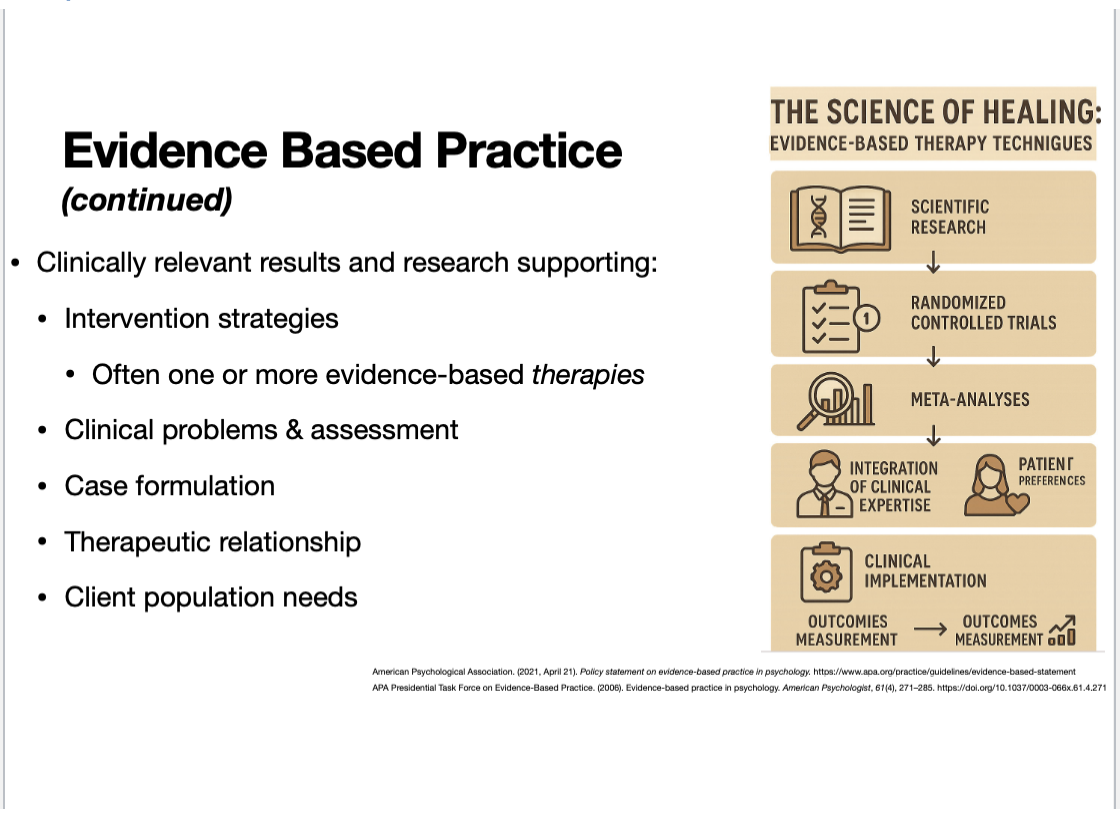
Evidence Based Research & Practice (EBP)
- Which theories/therapies are able to be researched
- Which theories/therapies have supporting evidence
- Which theories/therapies do NOT have supporting evidence
- “Gold standard” research methods
Finding EBP’s
“Why is this important?”
• Review and compilations of multiple studies on a topic or area and often (but not always) includes:
• A “body of evidence” rather than just one
• Usually multiple research designs &
methodologies
• Studies completed in laboratory and
observation settings
• Validity and reliability
Are all studies representative of all populations?
What are the risks if the sample population is not representative of the desired population?
What could impact the effectiveness of a treatment on populations not sampled correctly?

Evidence Based Research & Practice (EBP)
- Which theories/therapies are able to be researched
- Which theories/therapies have supporting evidence
- Which theories/therapies do NOT have supporting evidence
- “Gold standard” research methods
Types of Evidence-Based Research
• Clinical observation
• Qualitative research
• Systematic case studies
• Single-case experimental designs
• Public health and ethnographic research
• ie. availability, utilization, and acceptance of mental health treatments
• Process–outcome studies - trying to identify specific changes that happen in therapeutic session (process) and
improvements in clients (outcome)
• Effectiveness research
• Random control trials
• Meta-analysis
