W4: Personality
 Call Kai
 Learn
 Practice Test
 Spaced Repetition
 Match
 Flashcards
 Knowt Play
1/20

There's no tags or description
Looks like no tags are added yet.
21 Terms
What does ‘personality’ refer to?
Individual differences in characteristic patterns of thinking, feeling and behaving
What are 3 key assumptions of personality?
Personality is stable over time
Personality influences behaviour
There are a (finite) number of dimensions on which people can differ, also known as personality traits
What does Hippocrates’ 4 humors theory say?
Bodily fluids dictate our emotional temperament
What are the 4 humors (temperaments)?
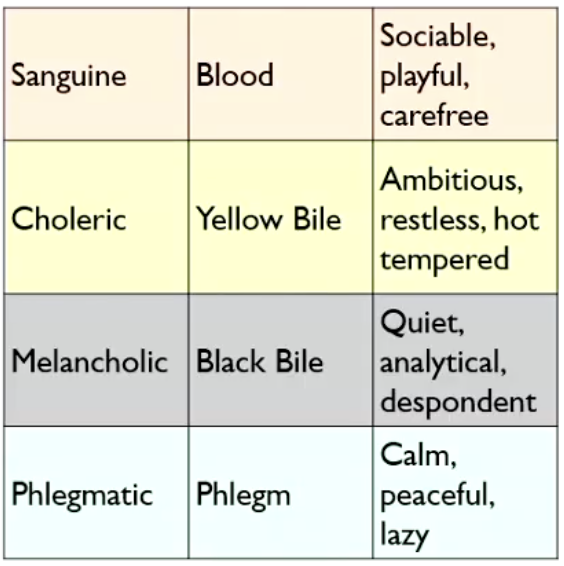
What is the method used to condense personality traits?
Factor analysis
How does it work?
Combine items that correlate highly with e/o but lowly with other items on the scale

What are the major personality theories?
Cattell’s 16PF
Eysenck’s 2-factor model
Big 5 personality factors (dominant)
How does Eysenck’s original 2-factor model map onto Hipprocates’ 4 humours theory
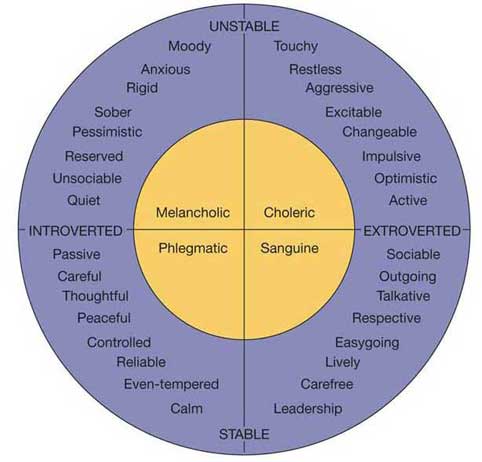
What are the 3 factors of Eysenck’s model? (PEN)
*Psychoticism - aggression, lack of empathy, manipulative (later added)
Extraversion/introversion
Neuroticism - emotionally unstable/ stable
What is the big 5 personality factors?
OCEAN
Openness
Conscientiousness
Extraversion
Agreeableness
Neuroticism
What are the 3 strengths of the Big-5 model?
Stable results over time
Universal across cultures
All 5 factors were heritable (through twin studies)
What factors were found to be the most & least heritable?
Most: openness and extraversion
Least: agreeableness

What is the main scale used to measure the Big 5?
NEO-Personality Inventory Revised (NEO-PI-R)
What are the 2 strengths of the NEO-PI-R?
High reliability (internal consistency of ~0.9)
High validity
Criterion validity (conscientiousness predicts GPA of uni students)
Convergent validity (NEO-PI-R extraversion score correlates highly with eysenck’s)
What are the neurobiological correlates of the Big 5?
O → not significant
C → MFG
E → medial orbitofrontal cortex (links to inhibition)
A → STS (monitoring intentions of others)
N → many, including amygdala (fear)

How to explain extraversion?
People are less inhibited are rated high on extraversion
How to explain agreeableness?
People who can predict people’s behaviours and mapping intentions well are rated high on agreeableness
What mental disorder is linked to people who can’t perform that well?
Autism
What is The Dark Triad?
A group of 3 subclinical set of negative traits
Narcissism
Psychopathy
Machiavellianism
What is the found relationship between DTT and attractiveness?
Participants who scored high on TDT were rated as more attractive than those who scored low
What is the core shared correlation of DTT and Big 5?
Agreeableness consistently shows a strong negative correlation with all three dark triad traits (low A with high of the 3 DTT)