Gait Cycle
 Call Kai
 Learn
 Practice Test
 Spaced Repetition
 Match
 Flashcards
 Knowt Play
1/113

There's no tags or description
Looks like no tags are added yet.
114 Terms
What defines a single gait cycle?
The time taken or sequence of motions occurring between two consecutive initial contacts (heel strikes) of the ipsilateral leg
Where is the body's center of gravity (COG) normally located?
Approximately 2 inches (5 cm) anterior to the second sacral segment (S2).
How does center of gravity (COG) height differ between males and females?
The center of gravity is slightly higher in males.
How does forward propulsion affect the center of gravity relative to the base of support?
Propulsion pushes the center of gravity anterior to the base of support.
How many step lengths equal one stride length?
Two step lengths added together equal one stride length.
What does 1 gait cycle correspond with
1 stride length
What is the average distance of a normal stride length?
Approximately 56 inches (142 cm).
What is step length?
The distance between the point of heel strike of one foot and the point of heel strike of the opposite foot.
What is the average distance of a normal step length?
Approximately 28 inches (71 cm).
What is step width
Distance between the feet
Forms the BOS
What is the normal range for step width?
Between 2 and 4 inches (5 to 10 cm).
What does a larger-than-normal step width indicate clinically?
A pathology involving balance (cerebellar dysfunction, inner ear problems, diabetes mellitus, or neuropathy)
What is lateral pelvic shift (pelvic list)?
The side-to-side movement of the pelvis during walking necessary to center the body's weight over the stance limb.
How does lateral pelvic shift affect the weight-bearing limb?
It causes relative adduction of the weight-bearing limb, facilitating the hip adductors.
What gait deviation occurs if the hip abductors are weak during single-limb stance?
Trendelenburg gait.
What is the normal magnitude of lateral pelvic shift?
1 to 2 inches (2.5 to 5 cm).
How does a wider base of support affect lateral pelvic shift?
A wider base of support increases the magnitude of lateral pelvic shift.
What is the primary function of vertical pelvic shift?
To prevent the body's center of gravity from moving up and down by more than 2 inches (5 cm).
During which phase of gait does the high point of vertical pelvic displacement occur?
Midstance (MSt).
During which phase of gait does the low point of vertical pelvic displacement occur?
Initial contact (IC).
What pathology causes the high point of vertical pelvic shift to increase during the swing phase?
A fused knee or a knee that does not bend during swing.
How does hip height change on the swing side during the swing phase?
The hip is lower on the non-weight-bearing (swing) side.
What is the relative rotational relationship between the pelvis and thorax during swing phase?
The pelvis rotates clockwise while the thorax counter-rotates counterclockwise (or vice versa) to maintain balance.
What anatomical effect does pelvic rotation have on the femur during gait?
It lessens the angle of the femur with the floor, effectively lengthening the limb.
How does pelvic rotation preserve energy during gait?
It decreases the center of gravity dip by reducing the amplitude of vertical COG displacement.
What is the normal degree of pelvic rotation per side during normal gait?
4° on each side (forward on the swing leg, backward on the stance leg).
What is cadence?
The number of steps taken per minute.
How does increasing cadence at a constant walking speed affect step length?
It results in a shorter step length.
What is the typical cadence range for a normal walking gait cycle?
90 to 120 steps per minute.
What is the typical average gait speed in healthy adults?
1.4 m/s (approximately 3 mph).
What is the average cadence during running?
180 steps per minute.
How does cadence generally differ between biological sexes?
Cadence is usually higher in females.
What is double support in the gait cycle?
The period when both lower limbs are in contact with the ground (stance phase) at the same time.
What is 'double float' or zero support?
The period during running or jogging when neither foot is in contact with the ground.
How does required hip flexion range of motion differ between walking and running?
Walking requires 40° to 45° of hip flexion, whereas running requires 60° to 75°
Which muscle group strength is most critical for running?
Hip extensor strength.
What is the normal metabolic cost of walking on a level surface?
5.5 kcal/min.
What three factors increase the metabolic cost of walking?
Increased age, abnormal gait kinematics, or use of an assistive device.
What kinematic changes characterize mature walking?
Walking velocity and step length increase, while cadence decreases.
At what age does mature walking typically establish?
Between 6 and 7 years of age.
Which gait variables are classified as temporal variables?
Stride duration, step duration, and cadence.
Which gait variables are classified as spatial variables?
Degree of foot angle, width of base of support (BOS), step length, and stride length.
Which gait parameter is classified as a spatiotemporal variable?
Walking speed.
What subphases are grouped under the functional task of Weight Acceptance?
Initial contact (IC) and Loading response (LR).
What subphases are grouped under the functional task of Single-Limb Support (SLS)?
Midstance (MSt), Terminal stance (TSt), and Preswing (PSw).
What subphases are grouped under the functional task of Limb Advancement?
Initial swing (ISw), Midswing (MSw), and Terminal swing (TSw).
What percentage of the gait cycle is spent in the stance phase versus swing phase?
Stance phase comprises 60%, while swing phase comprises 40% of the gait cycle.
What defined period constitutes the Stance Phase?
The period when the foot is on the ground and bearing body weight.
What are the 5 subphases of the stance phase in sequential order?
Initial contact
Loading response
Midstance
Terminal stance
Preswing
What occurs during Initial Contact (heel strike)?
The precise moment when the foot makes initial contact with the ground (0% of the gait cycle).
What occurs during Loading Response (foot flat)?
Weight is rapidly transferred onto the outstretched stance limb (0% to 10% of gait cycle).
What occurs during Midstance?
The body progresses forward over a single stable stance limb (10% to 30% of gait cycle).
What occurs during Terminal Stance (heel-off)?
Progression over the stance limb continues, body weight moves ahead of the limb, and weight is transferred onto the forefoot (30% to 50% of gait cycle).
What occurs during Preswing (toe-off)?
Rapid unloading of the limb occurs as body weight is transferred to the contralateral limb (50% to 60% of gait cycle).
What defined period constitutes the Swing Phase?
The period when the foot is non-weight-bearing and moving forward through the air.
What are the 3 subphases of the swing phase in sequential order?
Initial swing
Midswing
Terminal swings
What occurs during Initial Swing (acceleration)?
The thigh begins to advance forward as the foot comes completely off the floor (60% to 73% of gait cycle).
What occurs during Midswing?
The thigh continues to advance as the knee begins to extend and the foot clears the ground (73% to 87% of gait cycle).
What occurs during Terminal Swing (deceleration)?
The knee extends completely and the limb decelerates to prepare for initial contact with the ground (87% to 100% of gait cycle).
What is the total pelvic rotation range of motion needed on either side for normal gait?
5° on either side.
What hip flexion range of motion is required during the Stance Phase of normal gait?
0° to 30° flexion.
What hip hyperextension range of motion is required during the Stance Phase of normal gait?
0° to 10-20° hyperextension.
What hip flexion range of motion is required during the Swing Phase of normal gait?
20° to 30° flexion.
What knee flexion range of motion is required during the Stance Phase of normal gait?
0° to 40° flexion.
What knee flexion range of motion is required during the Swing Phase of normal gait?
0° to 60° flexion.

What event happens at 0% gait
Initial contact

What event happens at 10% gait
Opposite toe off
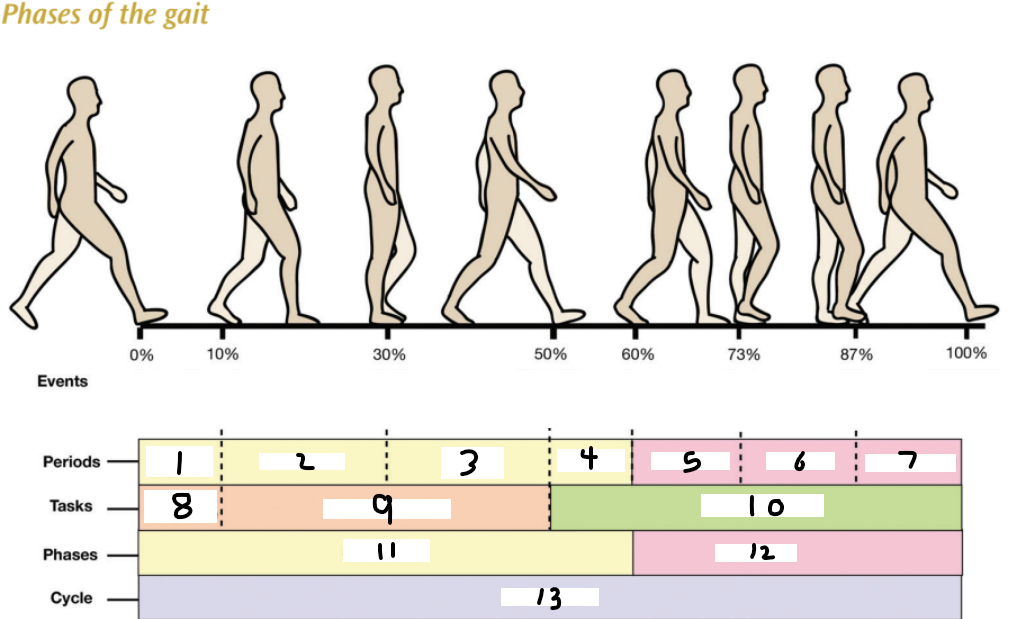
What event happens at 30% gait
Heel rise

What event happens at 50% gait
Opposite initial contact

What event happens at 60% gait
Toe off

What event happens at 73% gait
Feet adjustment

What event happens at 87% gair
Tibia vertical

What happens at 100% gait
Next initial contact

What period is 1
Loading response

What period is 2
Mid stance

What period is 3
Terminal stance

What period is 4
Pre swing
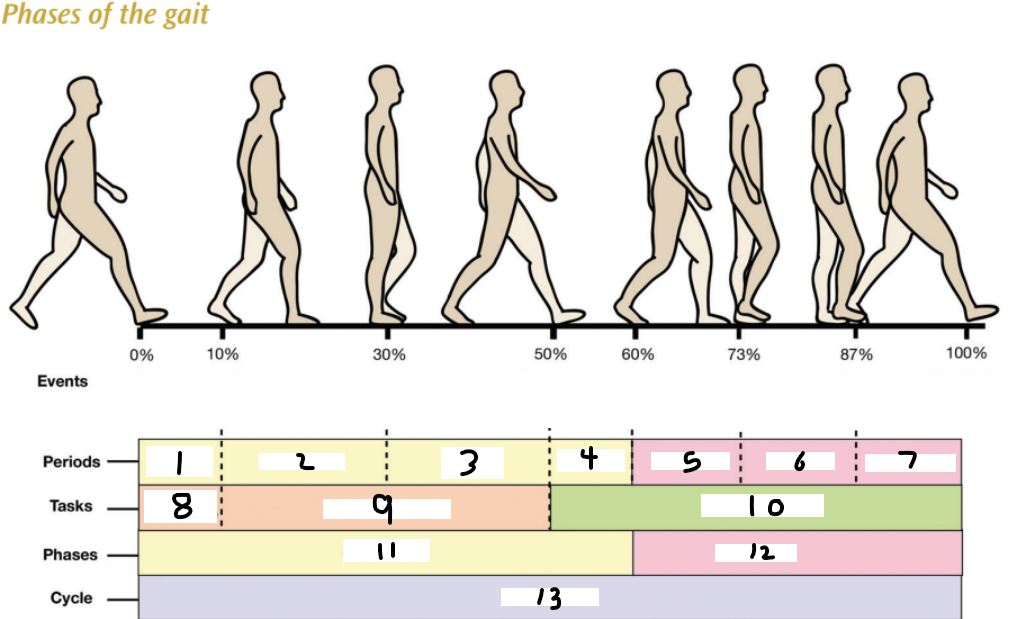
What period is 5
Initial swing

What period is 6
Mid swing
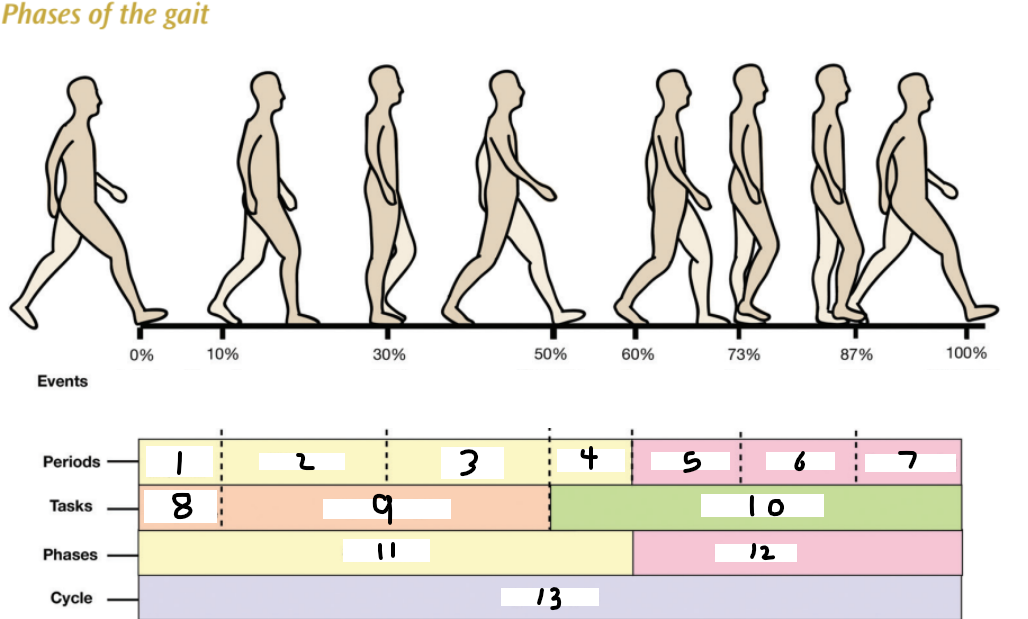
What period is 7
Terminal swing
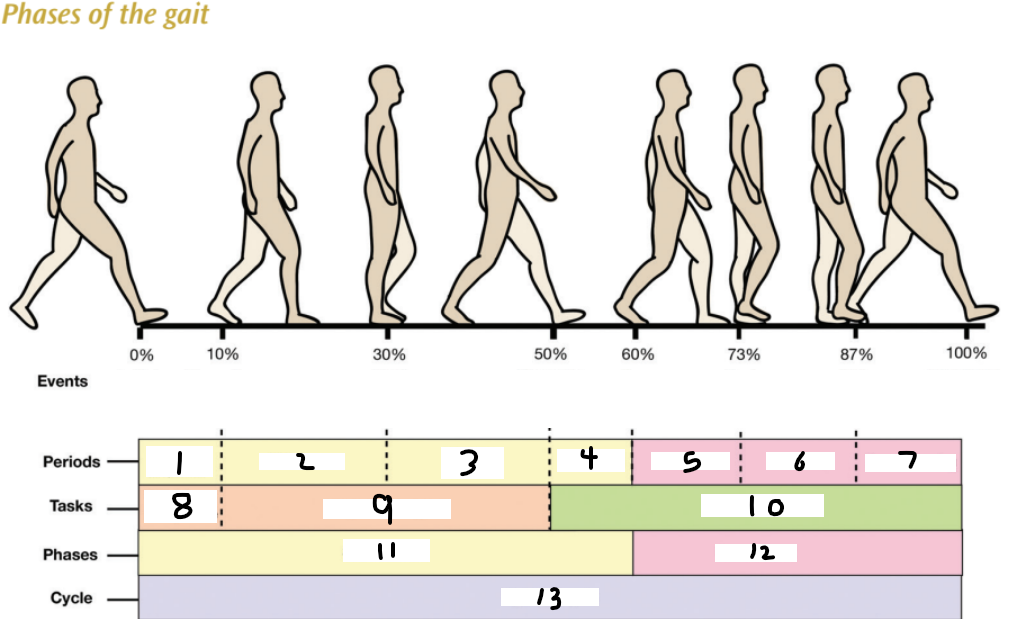
What task is 8
Weight acceptance
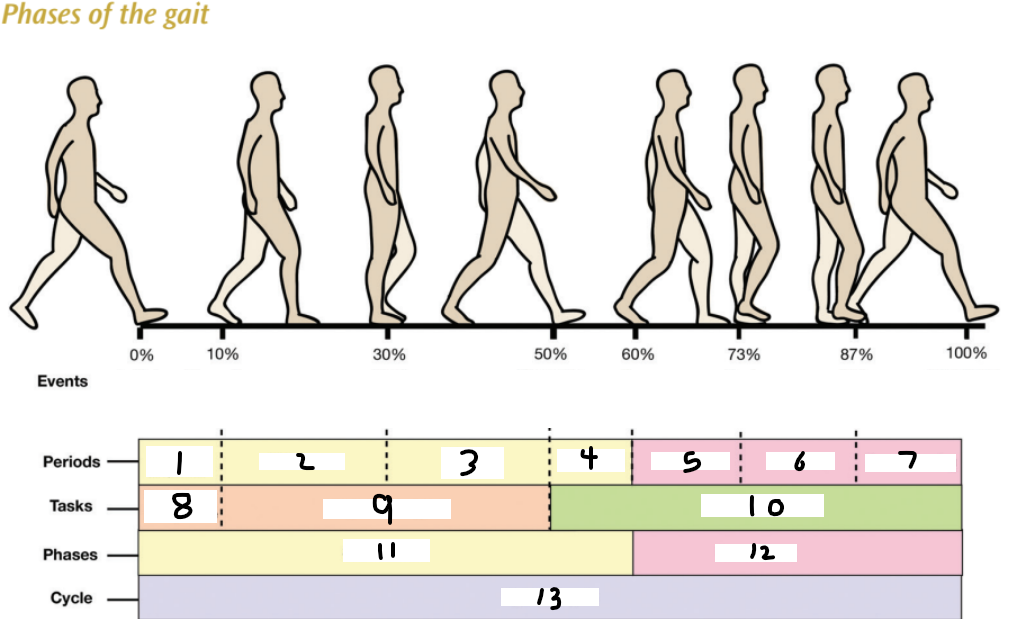
What task is 9
Single-limb support

What task is 10
Limb advancement
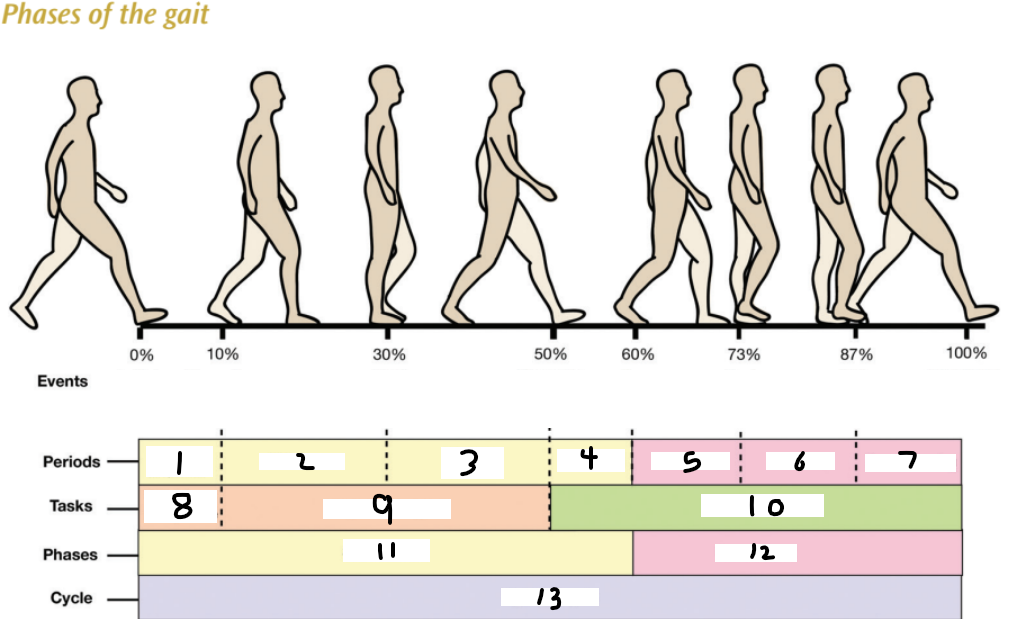
What phase is 11
Stance phase

What phase is 12
Swing phase

What cycle is 13
Right gait cycle

What is the pelvis doing in 1
Internally rotating
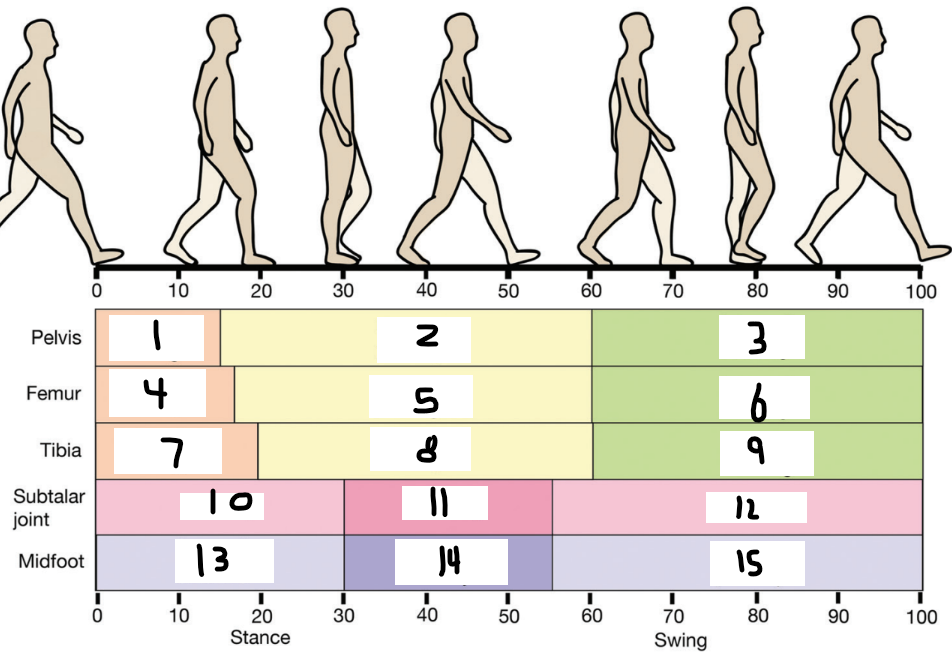
What is the pelvis doing in 2
Externally rotating

What is the pelvis doing in 3
Internally rotating

What is the femur doing in 4
Internally rotating

What is the femur doing in 5
Externally rotating
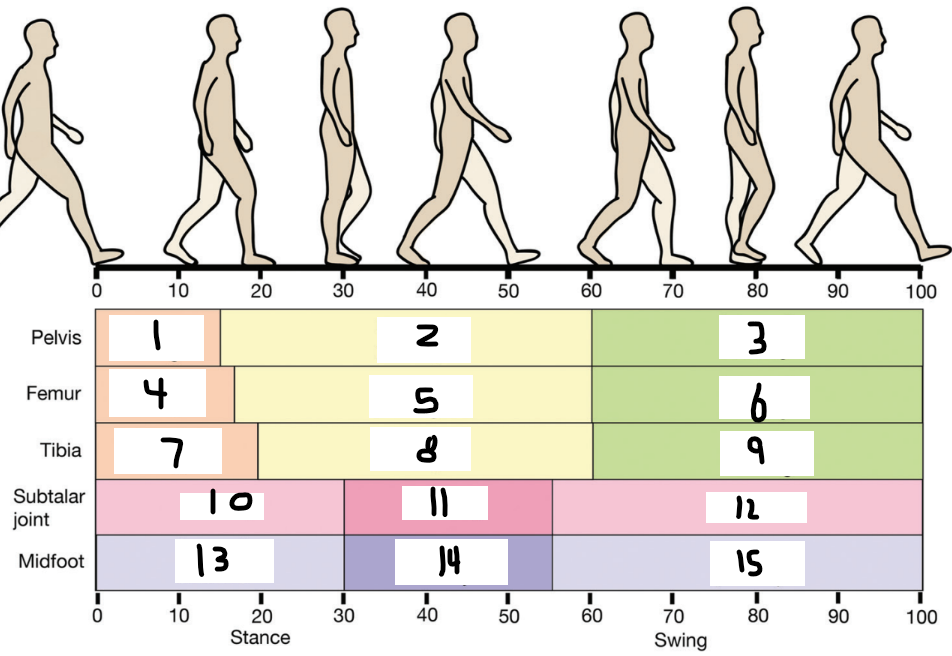
What is the femur doing in 6
Internally rotating
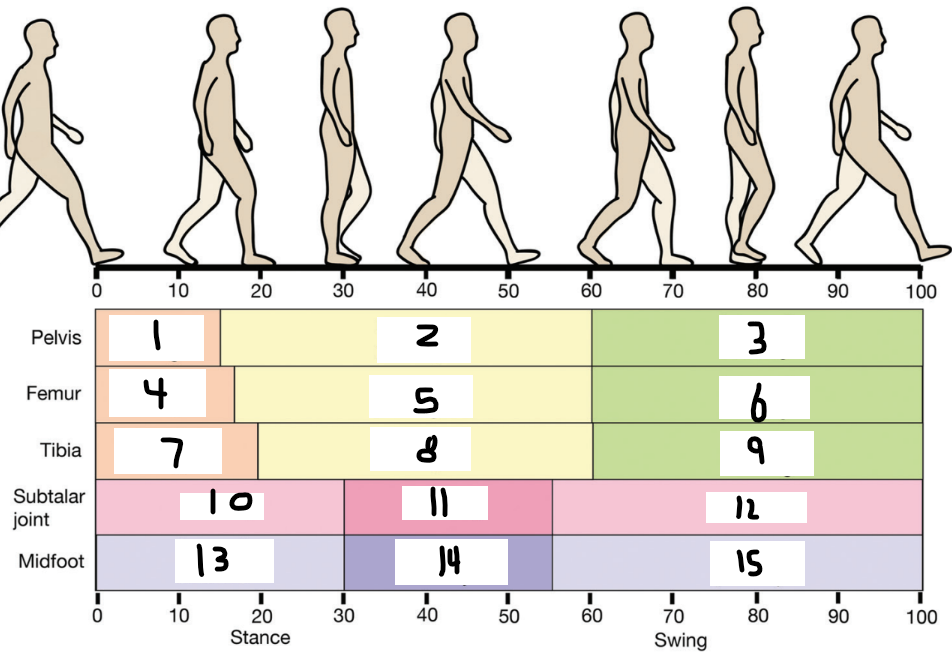
What is the tibia doing in 7
Internally rotating

What is the tibia doing in 8
Externally rotating

What is the tibia doing in 9
Internally rotating

What is the subtalar joint doing in 10
Everting

What is the subtalar joint doing in 11
Inverting

What is the subtalar joint doing in 12
Everting

What is increasing in the midfoot in 13
Pliability
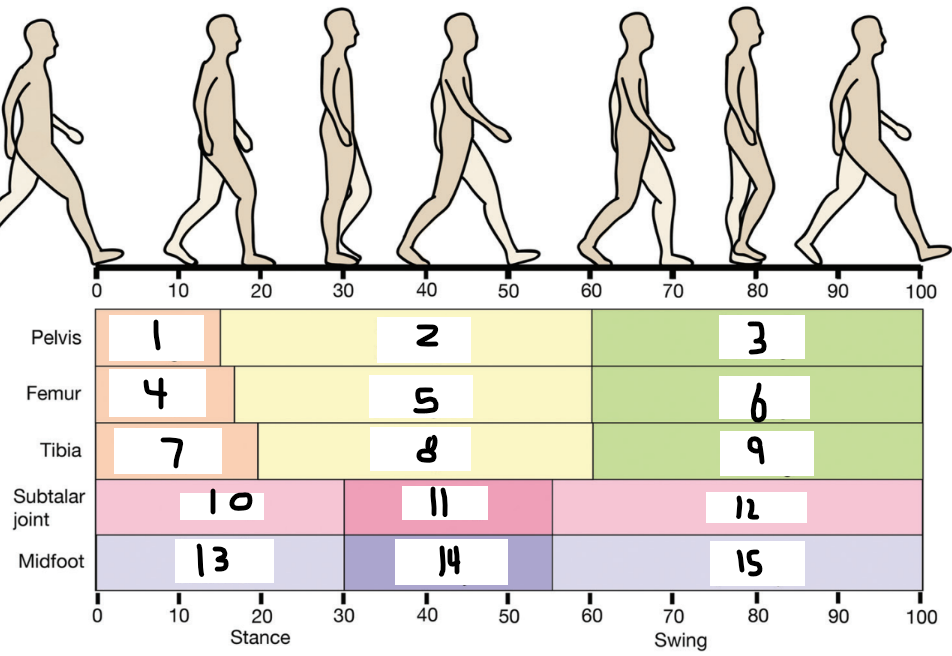
What is increasing in the midfoot in 14
Stability