Topic 3: Species Interactions, Communities and Ecosystems
 Call Kai
 Learn
 Practice Test
 Spaced Repetition
 Match
 Flashcards
 Knowt Play
1/300

There's no tags or description
Looks like no tags are added yet.
301 Terms
Ecological niche
Habitat or the specific area an organism inhabits
The role or function of an organism or species in an ecosystem
Interrelationship of a species with all the biotic and abiotic variables affecting it
What is a niche NOT
BUT
Definition of a niche is not a location
Habitat is a place
A niche is the conditions and resources needed to survive – these exist together in some places
Niche definition
Niche of a species is a multidimensional hyperspace, containing conditions and resources that allow the species to survive
Abiotic variables for each realm
Freshwater - small stones, big stones etc,

Environmental gradients
• Elevation
• Cover
• Aspect
• Solar radiation
• Temperature
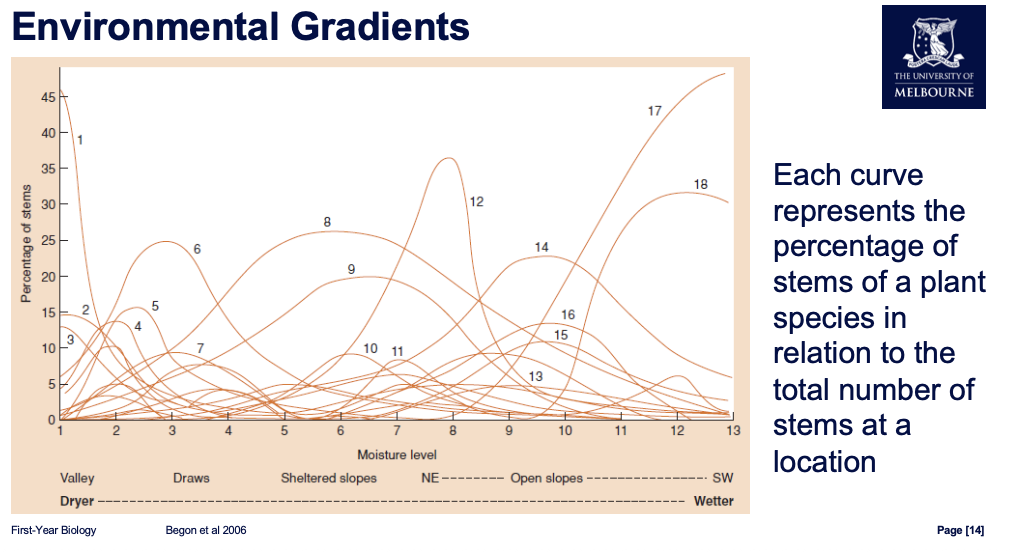
Begon et al 2006 environmental gradient example
From drier areas to wetter areas, he counted the number of stems present as a percentage of the total number of stems
What determines where a species can live?
Abiotic
Soils
Temperature
Water
Shelter
But also:
Food
Competitors
Predators
Parasites
Niches are multidimensional
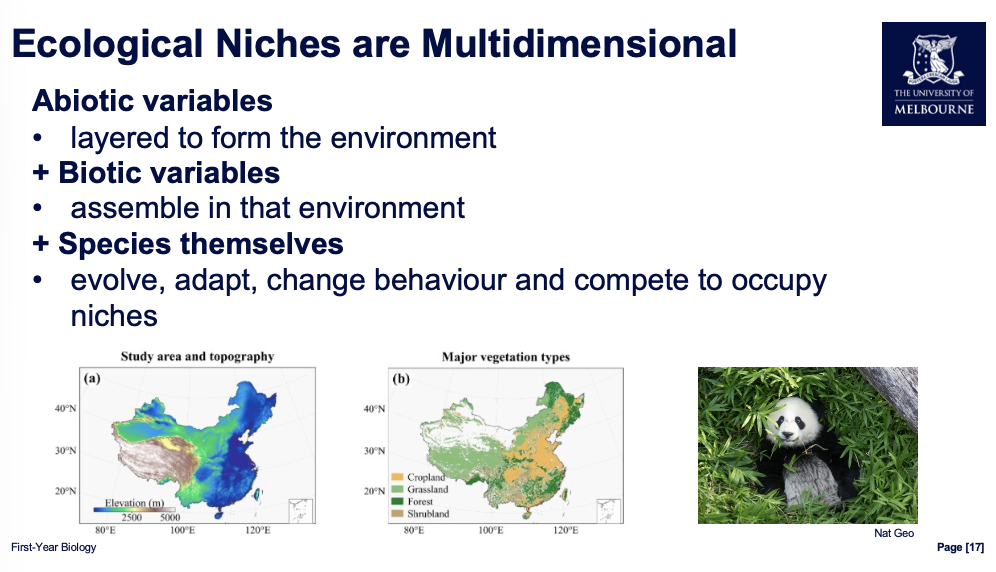
Ecological niches are multidimensional
• Abiotic and biotic factors layer to present niches
• Species evolve, adapt and compete to occupy niches
when water deeper, flamingos are evolved to take advantage of this niche whereas ducks can duck and can catch food at the bottom

Summary of what contributes to the multidimensionality of ecological niches
Fundamental niche
We think of a niche as a multidimensional space. That space contains the conditions and resources a species needs to survive
A Fundamental Niche = anywhere those conditions are available (where a species could live)
A Realised Niche
A Realised Niche is smaller (where a species actually
lives)
Why realised niches are smaller than fundamental niches
‒ Competition, predation, parasitism
in this case, the blue one might be out competing the brown one here so the brown one’s realised niche is smaller
‒ Dispersal limitations
maybe that brown one might only be able to disperse to those upper levels
‒ Disturbances
‒ Stochasticity
regular wave action or storms that reduce the realised niche for that species

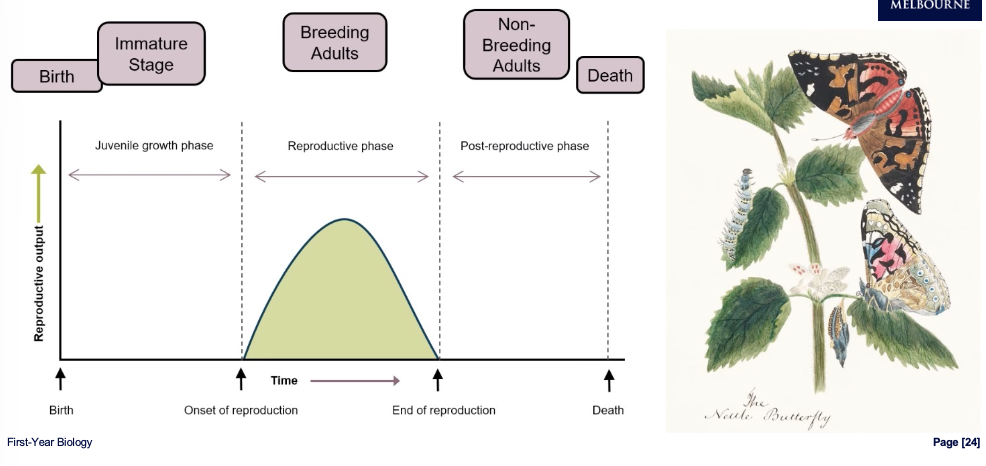
What is a life history?
Patterns of survival and reproductive events across an organism’s lifetime

Life history of a butterfly
Life history trade offs
Throughout their lives, these animals have to make compromises to maximise their success with reproduction and lifespan throughout their lives
one penguin spends all its energy on one egg while the other produces two smaller eggs with smaller resources

What does r represent? (population models)
The intrinsic rate of increase in a population (growth rate)
What does K represent (think about logistic growth curves)?
The carrying capacity of a population
r and K selected species comparison (mice vs elephants)
elephants’ reproduction timing is later bc they know they have that longer life
bigger animals tend to have lower reproductive rates

Continuum - which animals might be more K vs r selected

r selected species can ‘boom’ and ‘bust’
African locusts – an r-selected species
Populations boom with good environmental conditions (abundant food)
The life history strategy booms possible
Females mature early, can lay 100 eggs at a time, and have a short lifespan
2-5 generations per year
10 fold increase in numbers possible from one generation to the next

K species more stable but can fluctuate
Fluctuations can occur in K species for biotic and abiotic reasons
E.g. first crash in moose population due to high predation by wolves
Second major crash due to harsh winter and food limitation

Survivorship Curves
• Show survival patterns across age
• Plot proportion surviving at each age
• Reveal when mortality is highest
• Three classic patterns: Type I, II and III
• Linked to species' life-history strategies
There should be a log scale though - cannot have just percentages

Survivorship table

Key aspects of life histories
Number of reproductive events
Duration of a generation
Timing of reproductive events
2 types of ‘number of reproductive events’
Semelparous
Iteroparous
Semelparous
individuals breed once in their life
Large investment in single reproductive event
Often followed by death
Examples: salmon, annual plants

Why choose semelparity?
Conditions favour one large effort
When adult survival is low enough (relative to juvenile survival), evolution should abandon withholding resources for a future reproduction and instead favour semelparity
basically short life span animals potentially
Iteroparous
individuals (potentially) breed multiple times in their life
Reproduce multiple times during lifetime
Investment spread across reproductive events
Survival allows future reproduction
Examples: marine turtles, kangaroos, humans, Eucalyptus trees

Two types of ‘duration of a generation’
Annuals
Perennials
Annuals
one generation per year (all lifespan into one year)

Perennials
one generation over several years

Summary of niches, r- and K-selected species, semelparity vs iteroparity and annual vs perennial
• Fundamental and realised niches differ
• r- and K-selected species differ in life-history traits
• Semelparous species reproduce once; iteroparous species
reproduce repeatedly
• Annual species reproduce within one year; perennial species
reproduce over multiple years
What is predation
This is a form of species interaction where one species eats another species
Can also include:
Herbivory
Parasitism – Lecture 27
Different types of species interactions

What do predators need to do?
Predators need to:
• Detect prey
• Locate prey
• Approach prey
• Capture prey
• Handle prey
What are the adaptations predators have to do these things?
• Sharp teeth
• Claws
• Talons
• Venom
• Sticky webs
• Powerful jaws
Types of predator
Specialists or generalists
there are always trade offs (some things are advantageous vs disadvantageous)
Specialists
• Focus on particular prey
• Highly adapted to those prey
• Efficient at exploiting them
• Often have specialised hunting adaptations
eg. anteaters
Generalists
• Eat many prey types
• Have flexible diets
• Can switch between prey
• Can exploit changing food supplies
eg. dingoes
3 different strategies used to capture prey
a. crocodile
b. blue dasher (flying insect)
c. lion

Ambush Predation
• “Sit-and-wait” predators
• Heightened visual, chemical or tactile senses to detect prey
• Rapid movement of predator is key
• Most effective with high density prey
• Where prey low density – lures can be used (eg. angler fish using glowing bacteria)

Ballistic Interception
• Initially observe prey
• AND predict future prey location
• Escape by prey depends on:
Local habitat
Prey behaviour
How prey can avoid ballistic interception
Prey actually waits for snake to get closer…
Possibilities other prey will distract snake
“Close quarters effect” increases angle of adjustment
Frog often waits until after the snake initiates a strike to begin its jump

Pursuit Predation
• Predator visual and auditory camouflage favoured
• High-speed locomotion of both predator and prey favoured
• Faster speed and acceleration improve fitness
Some more details abt relative size and speed of pursuit predators

How do prey escape from pursuit predation
Pursuit predation:
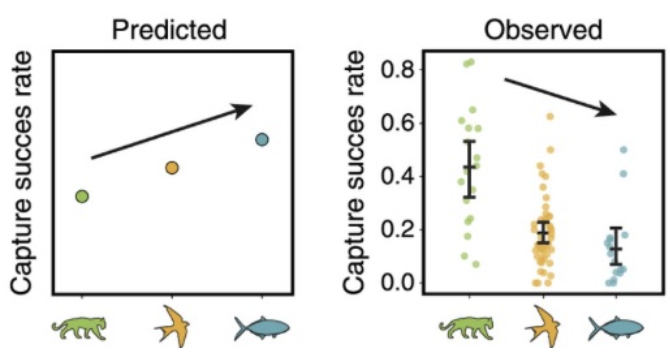
• Turning Gambit (Howland 1974)
smaller animals can turn faster?
the recent study in image found that it might be more related to neural networks rather than size
Cooperation
Predators might also pool together and cooperate in order to increase hunting success
EG
Wolves
African Wild Dogs
Lions
Dolphins
Orcas
Cooperation Pros
Increased hunting success
Efficient energy expenditure
Resource and territory protection
Enhanced safety
Social learning and care
Cooperation Cons
• Shared rations
• Social conflict and dominance
• Increased visibility
• Cheating and free-riding
Prey strategies
Strategies prey use to avoid predation:
• Avoiding detection
• Avoiding capture
• Physical defences
• Chemical defences
• Warning signals
• Mimicry systems
• Behavioural mechanisms
Avoiding detection
• Match the environment
• Break up body outline
• Remain motionless
• Reduce detection

Avoiding capture
• Speed
• Agility
• Erratic movement
• Flight
• Burrowing
• Swimming

Physical defences
• Spines
• Shells
• Armour
convergent evolution example here

Chemical defences
• Toxins
• Venom
• Bad taste
Warning signals - Aposematism
Defence strategy where animals use bright colours, sounds or smells to warn predators they are harmful or unpalatable

Two types of mimicry
Batesian mimicry
Müllerian mimicry
Batesian mimicry
Harmless species resembles a defended/harmful species.

Müllerian mimicry
Multiple defended species share the same warning signals.
eg. black and yellow stripes on wasps and bees

Behavioural mechanisms
Group living
Warning signals
Group living pros
• More eyes detect predators
• Dilution of individual risk
• Confusion of predators
• Collective defence

2 theories of why animals prefer group living
Dilution effect
Selfish Herd
Dilution effect
The probability of any one individual’s dying is diluted by the presence of others
Selfish herd
Individuals in a large group attempt to adjust their position by moving to the centre of the group because predators may be more likely to attack the outside
Cons of Group Living
• More conspicuous (easier to spot for predators)
• Higher competition
Warning signals
The deer flashes it’s tail to indicate danger is coming
The wallabies make a stomping sound
Auditory signalling - just screeching lol

Naivity and learned behaviours
• “Naïve” prey may lack experience with predators
• Predators learn which prey are vulnerable
• Successful attacks reinforce predator behaviour
• Predation can shape behaviour over time
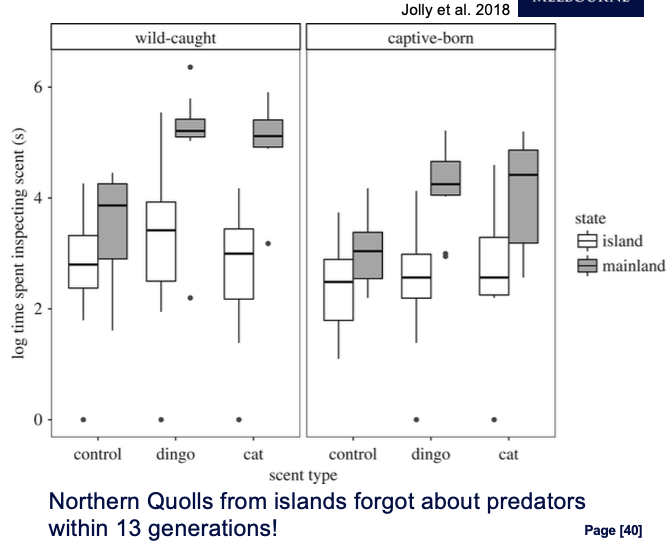
E.g. island species - mainland species bc they are around foxes etc. spent more time acknowledging the scent of these predators while island species ignored it
Fiddler crabs example
Fiddler Crabs shelter in burrows to avoid predators but
• Lost time foraging (might not be able to find food)
• Lost reproductive opportunities (might not be visible to females)

Parasitism
“Parasites are predators that eat prey in units of less than one”
“Tolerable parasites are those that have evolved to ensure their own survival and reproduction but at the same time with minimum pain and cost to the host.”
Edward O. Wilson
Characteristics of parasites
Approximately 40% of all animals are parasites!
Parasites are:
• Smaller than their host
• Live on or in the host
• Usually don’t kill the host (but can)
• Hosts can recover from parasites
• Parasites habitats are alive, and can
Grow
Mount defences against parasites
Evolve
Move
Organisms that can be parasites
Can be:
• Protozoans
• Bacteria
• Animals
• Fungi
• Plants
Parasites - diversity
Super divers
• Important part of global biodiversity
• Parasitism is the most common consumer strategy among organisms

Trends across parasite diversity
Parasite diversity also:
◦ Poorly studied, grossly underestimated (Linnean shortfall)
◦ Newer species have fewer hosts
◦ Newer species have smaller distributions
Orange is what we currently know abt and blue is the ones that probs exist that we don’t know abt

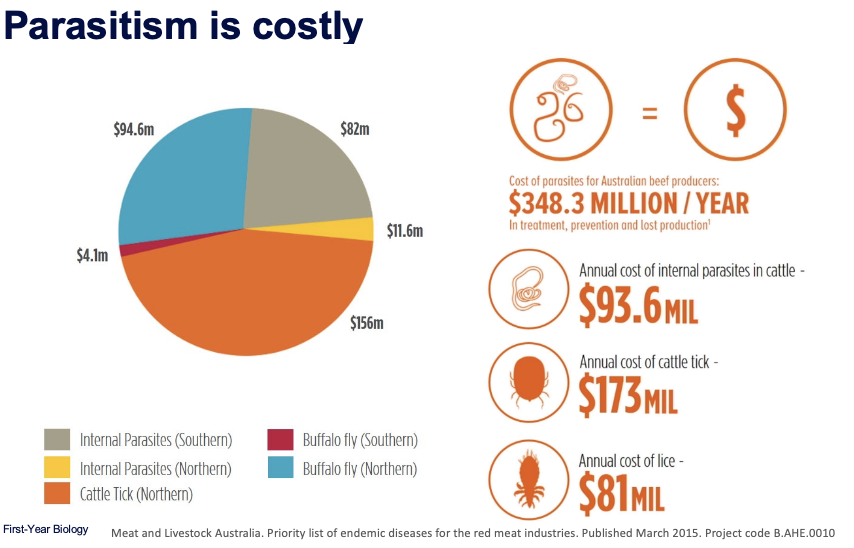
Parasitism is costly as well
Types of parasites
microparasites
macroparasites
Microparasites
• Usually microscopic
• Multiply within host
• Often reproduce rapidly
• Individual parasites difficult to count
• Often cause infections rather than infestations
• e.g. bacteria, protozoa
Macroparasites
• Relatively large parasites
• Usually do not multiply rapidly within host
• Often present as individual parasites
• May live on or inside hosts
• Often have complex life cycles
• e.g. helminths, nematodes, tapeworms
Different techniques of transmission
How does a parasite (or the next generation) reach the next host?
• Direct contact
• Food
• Water
• Vectors
• Predation
• Sexual transmission
• Environmental stages
Parasite Manipulation
Ophiocordyceps unilateralis:
• Locally specialised parasite of arboreal Carpenter ants.
• Ant infecting Ophiocordyceps are known to make hosts climb down to a height of 25cm and bite onto vegetation before killing them.
Toxoplasmosis (example of parasite manipulation)
Toxoplasmosis in mice causes a characteristic "fatal attraction" phenomenon, removing their innate fear of cat odours and drawing them closer to predators
2 types of transmission
Definitive host (in Toxoplasmosis this is the cat)
Intermediate host
Definitive host
is an animal where a parasite grows into an adult and reproduces sexually (cat in toxoplasmosis)
Intermediate host
is an animal where the parasite lives as an immature larva and grows or reproduces asexually (mice, birds in toxoplasmosis)
3 types of life cycles for transmission
Direct or Monoxenic
Indirect of Heteroxenic
Direct or Monoxenic Life Cycles
feature one host

Indirect or Heteroxenic
life cycles involve multiple (often completely unrelated) organisms as hosts
seems risky - trying to find a cow, ant and snail

What are the advantages of heteroxenic life cycles
Parasites can safely grow, multiply, and store energy without killing the definitive host
A single parasite can replicate into thousands or millions in intermediate host
By splitting their life cycle adults and larvae do not compete for resources
Using mobile hosts allows sedentary or aquatic parasites to cross geographic barriers and spread
Many heteroxenic parasites align their life cycles perfectly with existing food chains
Parasites connect us to the world

What ‘One Health’ means
Why does ecology matter to human health?
We can’t remove ourselves from ecological systems
We are linked by:
• Habitat change
• Wildlife contact
• Livestock production
• Vectors
• Water
• Food
Hendra Virus
First detected in the Brisbane (Hendra) in 1994
20 horses affected, 13 died
2 people affected, 1 died
Sporadic spill-overs from 1995 – 2005
More frequent events since 2005
Up to April 2026:
90 outbreaks (63 QLD, 27 NSW)
110 dead horses (incl. suspect cases)
Seven affected people, four have died
Fewer outbreaks since introduction of vaccine in 2012

Transmission pathway of Hendra Virus

Spillover events of Hendra Virus
Spillover events associated with food shortages and splintering of roosts into urban and agricultural areas
Following El Nino peaks (green), we’ve had increase of spillover events bc drier conditions mean food shortages for flying foxes - this makes them stressed so they come closer in contact with humans to get food and then it spillovers into horses and then us humans
Nipah Virus

Malaria in the Amazon
A 10% increase in deforestation leads to a 3.3% increase in malaria incidence
The effect is larger in the interior and absent in outer states where little forest remains.
This strong effect is only detectable after controlling for a feedback of malaria burden on forest loss

The influence of changes in environment on the risk
Climate change → vector distribution
Habitat change → wildlife contact
Urbanisation → new host interactions
Biodiversity change → alters disease transmission
Competition
Most typically considered the interaction of individuals that vie for a common resource that is in limited supply
• Organisms need resources in their daily life
• Resources are not unlimited
• Individuals may need the same resources
• Competition occurs when needs overlap
What do organisms compete for?
• Food
• Water
• Space
• Light
• Shelter
• Mates
2 types of competition
Intraspecific Competition
Interspecific Competition
Intraspecific Competition
• Between individuals of same species
• Same ecological requirements
• Particularly strong at high density
• Can reduce growth or reproduction
Interspecific Competition
• Between different species
• Resource requirements overlap
• Can affect population growth
• Can influence where species occur
Forms of competition
