Lecture 33: EQUINE disease of nasal passages and paranasal sinuses
 Call Kai
 Learn
 Practice Test
 Spaced Repetition
 Match
 Flashcards
 Knowt Play
1/35

There's no tags or description
Looks like no tags are added yet.
36 Terms
- dry MM (cold weather)
- exertion
- ethmoid hematoma
- nasal polyps
- guttural pouch mycosis
- neoplasia
What are the causes of unilateral epistaxis?
- EIPH
- head trauma
- clotting disorder
- severe pleuropneumonia
What are the causes of bilateral epistaxis?
- cartilaginous support over nasoincisive notch
- the first major site of upper airway resistance
What is the importance of this external nares or a false nostril in the horses nose?

- cyst in false nostril
- cause is unknown
What is atheroma or epidermal inclusion cyst?

- mass (3-5 cm) spherical nodule
- FNA + cytology if indicated
How do you diagnose atheroma or epidermal inclusion cyst?
- surgical removal
How do you treat atheroma or epidermal inclusion cyst?
- excellent --> no recurrence reported
What is the prognosis for atheroma or epidermal inclusion cyst?
- trauma
- inflammation
- infection (abscess or granuloma)
- neoplasia
- congenital = wry nose
What are etiologies of general problems of the nasal passage even though uncommon?
- clinical signs: RR noise, decreased airflow, nasal discharge, facial deformity
- rads: DV = best
- CT
How can you diagnose problems with the nasal spetum?
true
- can do but less helpful to see the rostral portion of the nasal passage
True or false
endoscopy is not helpful with diagnosing issues with the nasal septum
- resection of the septum
- must leave the rostral section to prevent collapse
How do you treat problems with the nasal septum?

- pedunculated growths from the mucosa of the nasal cavity, septum, ect
- treated with surgical excision
What are nasal polyps? How are they treated?
- inspiratory dyspnea
- nasal discharge
- odor
What are the clinical signs seen with nasal polyps?

- slowly expanding non-neoplastic mass
- originates from submucosa of ethmoid labyrinth or paranasal sinuses
- can expand down the nasal passages +/- into the sinuses
What is progressive ethmoid hematoma?
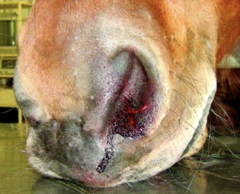
- unilateral serosanguinous nasal discharge
- respiratory noise and dyspnea = if large enough
- head shaking
- halitosis
- facial deformity = less common
What are the clinical signs seen with progressive ethmoid hematoma?

- clinical signs --> unilateral serosanguinous nasal discharge
- endoscopy --> smooth greenish-yellow to purple-red mass (+/- fungal plaques
- radiographs --> will see it
How do you diagnose progressive ethmoid hematoma?
- surgical excision (mass removal + destruction of origin)
- transendoscopic (laser or intra-lesional formalin inj)
How can you treat a progressive ethmoid hematoma?

- concho frontal sinus = blue
- rostral maxillary sinus = yellow
- caudal maxillary sinus = orange
What are these equine structures?

- all compartments communicate directly or indirectly
- all will eventually drain together through the nasomaxillary opening
What is important to know about the paranasal sinuses?

- Primary = often following and URT infection especially if strep sp.
- Secondary = tooth abscess, trauma (facial fracture), neoplasia
What are the primary and secondary etiologies for sinusitis?

- unilateral nasal discharge = Most common
.....- Odor - often a root tooth abscess
.....- Purulent
- +/- epiphora, conjunctivitis, enlarged submandibular LNs, respiratory noise
What are the clinical signs seen with sinutsitis?
- sinuses
- nasal cavity
Where might the fluid be from with unilateral discharge?
- guttural pouches
- nasopharynx
- lungs
- bilateral paranasal sinus disease ( primary sinusitis)
Where might the fluid be from with bilateral discharge?
- radiographs= see opacity in sinuses and fluid lines
- endoscopy= pus from nasomaxillary opening, BUT can't see into sinus
- sinocentits - cytology + culture (can LAVAGE at the same time)
- sinoscopy - visualization of sinus, minimally invasive
- CT - complicated cases
How do you diagnose sinusitis?

- primary: abx and lavage
- secondary: treat secondary issue
- failure is common = warn client
How do you treat sinusitis? What should you warn the O about?
- inspissated pus (ventral conchal sinus)
- failure to treat the primary problem
- fungal infection
- neoplasia
Why does sinusitis treatment often fail?
- has an unknown etiology
- fluid filled structures lined by epithelium and will deform the bone --> facial deformation
What is a sinus cysts?

- facial deformities
- unilateral mucoserous nasal discharge
- reduced airflow on affected side
- NO ODOR since no bacterial involved
What are the clinical signs seen with sinus cysts?
- RADS (CT and MRI)
- remove since will recur if you do not remove the lining
- good prognosis if fully removed
How do you diagnose and treat sinus cysts? What is the prognosis?
- squamous cell carcinoma
What is the most common sinus neoplasia?
- typically malignant and invasive
- nasal discharge, facial deformities, loose teeth and epiphora (tearing)
What are sinus neoplasia like in horses?
- aspirate fluid for cytology or biopsy
- surgical margins hard to get --> euthanasia
How do you diagnose and treat sinus neoplasias?
- synoscopy with a scope
- sinus flaps where you open the sinuses
How can you do surgeries on the sinus?
- standing or under GA
- cutting 3 of edges and break the 4th to hinge it open
- use a mallet and osteotome or oscillating saw
- bevel the flap
How do you create a bone flap for sinus surgery?
- make a large opening into the nasal cavity to facilitate drainage
- post-op levage may be needed
- pack the sinus post op --> controls hemorrhage
What are considerations for surgery of the sinuses?
- hemorrhage --> especially ethmoid hematoma
- recurrence
- failure to resolve clinical signs
What are complications for surgery of the sinuses?