Post-Impressionism - Search for Structure 7/8
 Call Kai
 Learn
Learn Practice Test
 Spaced Repetition
 Match
Match Flashcards
 Knowt Play
1/15

There's no tags or description
Looks like no tags are added yet.
Name | Mastery | Learn | Test | Matching | Spaced | Call with Kai | Chat |
|---|
No analytics yet
Send a link to your students to track their progress
16 Terms
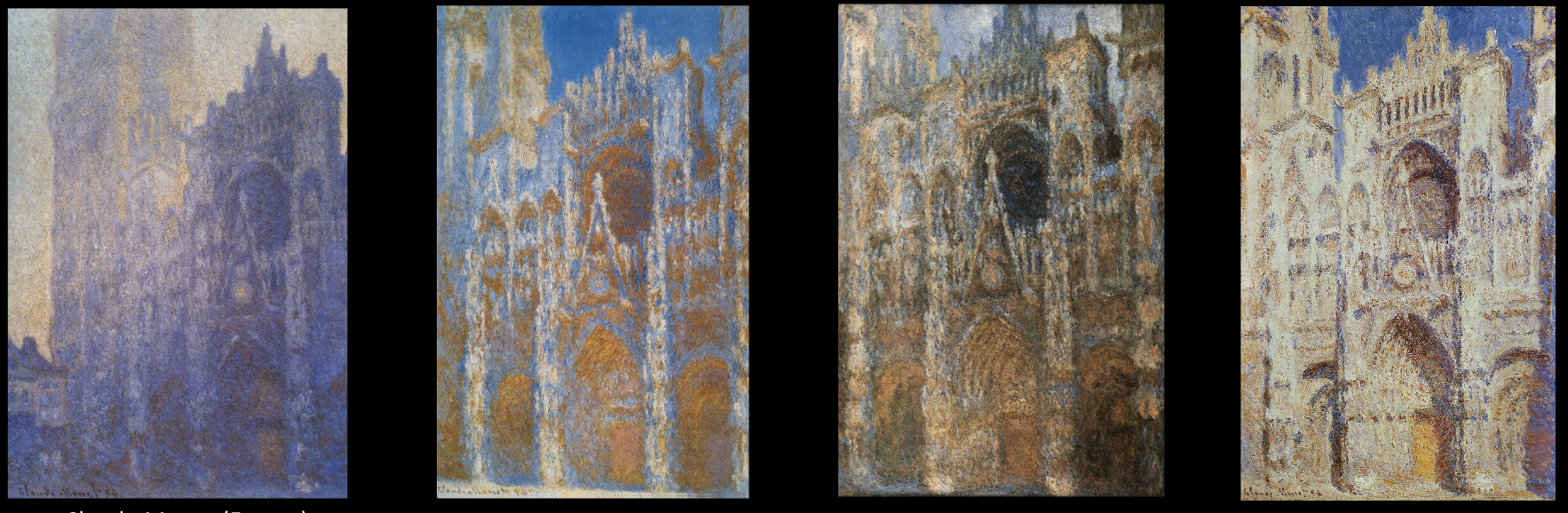
Claude Monet (France). Rouen Cathedral. 1894
Series depicting one cathedral at different times of day
Changing flux of different lighting
Chose one of the most PERMANENT and UNMOVING structures, yet it still changes in his eyes through the light

Claude Monet. Three Poplars. 1891
Trees become vertical bars, organized by the repeated tree forms
Search for underlying impression
Trees become the structural subject
Post-impressionism- using these structures and moving away from impressions of them and into his own interpretation of WHAT YOU FEEL when you see these things.

Claude Monet, Four Poplars, 1891

BOTH are Claude Monet, Morning on the Seine, 1896
Both same place, objective lake, but changing in his eye at different times of the day
Move toward representing the visual experience of seeing, and nothing else!

Claude Monet, Water lillies, 1920
No stable viewpoint, no horizon, what are we looking at? Water Lillies blending in
Cropped so we dont see the horizon and just see the reflection and water lillies in the water
asks our brains, what is this?
Neo - Impressionism- Pointillism
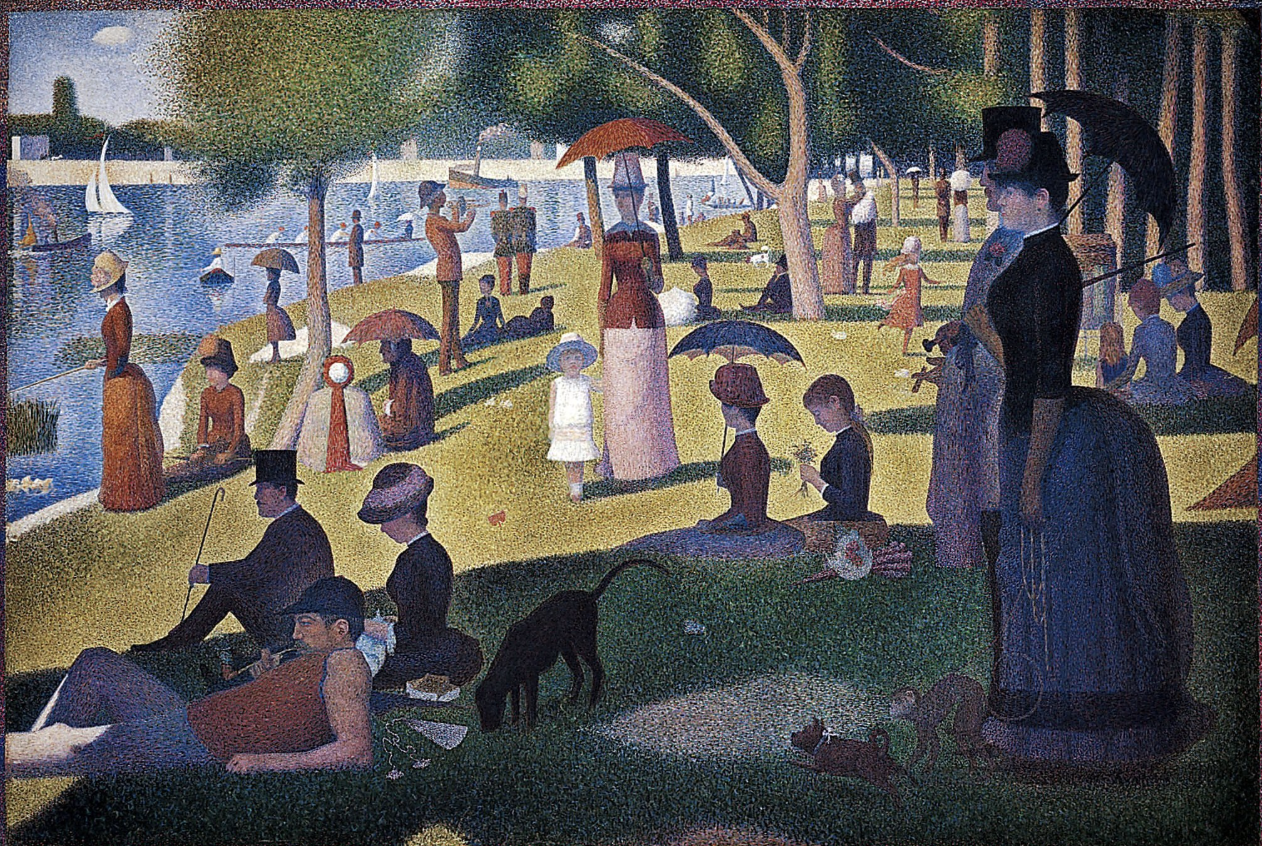
Georges Seurat, Sunday Afternoon on the Island of Grand Jatte, 1884-1885
Stiffer bodies, order, etc
Pointillism- how color and vision ACTUALLY works in our brain
If you zoom in, the colors are extremely separate, but when we look from afar it creates a realistic color expression
separate colors blur together in our minds
He asked, how do I create systemic language for representing color and light-muted?
Sensation, Brushwork and the Fictive Picture Plane

Cezanne, Orchard, Côte-Saint-Denis. Pointise, 1877
Cezanne was asking how do we rebuild the world structurally? On a 2D canvas…
Here he is taking a new trajectory with thick brushstrokes, landscape construction
Directional use of brushstrokes to create solids- POST-IMPRESSIONISM - gets a little more wonky to evoke a feeling rather than their own interpretation of objective truth

Paul Cézanne, Mont Sainte-Victoire, 1885
Less interested in plays of light and turning to an interest in perception and volumetric structure

Paul Cezanne, Mont Sainte- Victoire, 1902-4
Blocky paint to create structure
Cezanne makes us aware that this surface is 2D while also trying to create perception and ~some~ depth

Paul Cézanne (France). The Black Clock. 1867-68
Perspective is off
ADD MORE HERE

Paul Cézanne. Basket of Apples. 1895
Table does not line up correctly, perspective looks weird
tilt of the table, apples look odd
as a body, painting, the artist moves a lot to see it from every angle
THis changes how we see the subject, and he reflects that in his work

Paul Cézanne. Mme. Cézanne in a Yellow Chair. 1888-90
Portrait of a woman, not lifelike

Paul Cézanne. The Large Bathers. 1898-1905
How do shapes relate to one another
Women are unproportional
Serat vs Cezanne vs Monet
Monet- What happens to optical perception if we continue to push light and atmosphere?
Serat- Let’s take color and its scientific study to fuse in our own mind
Cezanne- 3D Architectural shape, yet calling attention to the flat canvas