Cognitive Psychology
 Call Kai
 Learn
 Practice Test
 Spaced Repetition
 Match
 Flashcards
 Knowt Play
1/308

There's no tags or description
Looks like no tags are added yet.
309 Terms

information processing model
- active
- in each stage, info is held for a certain duration, and gets processed to the next stage or forgotten
- modeled after computers
- forgetting can happen at any stage, it prevents overload by getting rid of 'useless' info
mental resource
needed for focusing and processing important info, especially when there are distractions
selective attention
attending to certain stimuli while intentionally blocking out others
divided attention
paying attention to more than one task at a time, multitasking
- not easy to do due to limited cognitive resources
- people are overconfident about multitasking
- can be trained, but success depends on the person, task, training, etc.
value-directed remembering
even with more distractions, the brain can still prioritize attention to more important (higher valued) info
sustained attention / vigilance
maintained selective attention for a long period of time
task switching
alternating between tasks back and forth
- NOT divided attention
alternating runs paradigm
an activity where the task changes every N trials
- e.g. sort numbers to odd/even 3 times, then higher/lower 3 times, then odd/even 3 times, ......
switch cost
in task switching, the increase in reaction time on a switch trial than a non-switch/task-repetition trial
preparation effect
in task switching, the decrease in average switch cost when there is an advance notice of the task and time
residual cost
in task switching, how the preparation effect reduces switch cost but does not eliminate it
mixing cost
in task switching, how there is always an increase of reaction time in switch tasks than in single tasks
mobile phones and attention
phones act as distractions in learning environments (yeah duh)
- even if switched off, the mere presence effect still makes it a distraction, with the urge to check notifications, etc.
inattentional blindless
the failure to notice out-of-place/unexpected objects/events when attention is focused on other things
- e.g. not noticing a person in a gorilla costume walking by when you're counting how many times someone is passing a ball
- happens due to selective attention
- but can make us miss important info
- it is debated whether there are individual differences in attentional blindless
factors that influence inattentional blindness
- more likely to notice an unexpected object when it has similarities with the attended items
- less likely to notice unexpected objects when the attended task requires more cognition or has more distrations
dichotic listening
a task where people wearing headphones hear different messages presented to each ear, and they have to repeat aloud the message of one ear and ignore the other
- subjects do not notice small changes in the other ear
- inattentional deafness
cocktail party problem
the process of tracking one conversation in the face of the distraction of other conversations
- stronger selective attention when the attended speech has distinct traits, is louder, and/or comes from a closer place

Broadbent's model of selective attention
1. register sensory stimuli
2. reach filter
3. depending on the stimulus' quality (e.g. pitch, volume), reaches perception or does not
- info that requires higher perceptual processes may go unnoticed if unattended to

selective filter model (Moray)
personally important messages can break through the selective attention filter
- e.g. your name
- otherwise same as Broadbent's model
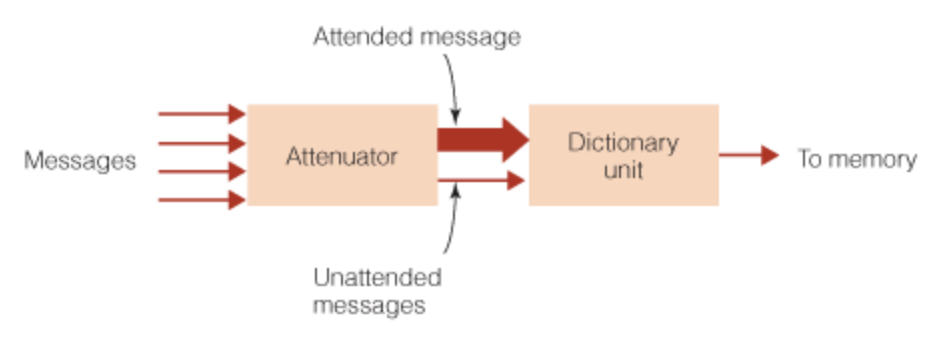
attenuation model (Triesman)
the only bottleneck model!! (according to coordinators)
1. information that does not have the target properties gets weakened by the selective attention filter, but not gone
2. the weakened stimulus' message and relevance gets perceptually analyzed

late-filter model
selective filtering occurs after analysis of the stimulus' traits and meaning
- explains how people can pick up certain info from unattended senses, like your name
synthesis of early-filter and late-filter models (Neisser)
1. preattentive processes: only notices sensory characteristics
- fast, automatic, and happens in parallel
2. attentive, controlled processes: observe and create mental representations of objects
- later, executed serially, takes time and attention

attentional blink
an inability to report a 2nd target stimulus of two target stimuli that are shown together quickly
benefits of task-irrelevant mental activity study (2005)
- background: attentional blink is generally explained by the 1st visual target using up the attentional resources, but in some experiments subjects can report the 2nd visual target more when they are somewhat unfocused on the task
- method: four groups of subjects doing the attentional blink task
1. control: told to focus and do their best
2. free-association: think about their last holiday while doing task
3. listen to music while doing task
4. reward: gets paid depending on their performance
- result: free-association and listen-to-music groups performed clearly better, reward group performed just slightly better
- theories: the increased performance is due to 1. heightened arousal 2. a more positive mood/state 3. a more distributed state of attention where attention widens temporally
prospective memory
remembering a planned intention or remembering to do a planned action
- can be time- (at a specific time) or event-based (specific circumstances/cues)
retrospective memory
recalling past information
long-term memory
the relatively permanent storage of information
- unlimited capacity
- long duration
eyewitness memory
many times inaccurate
- psychologists warned about it since the 1970s, but it was not accepted until DNA testing was available in the 1990s
procedural memory
the gradual acquisition of skills as a result of practice, or "knowing how" to do things
- long-term memory
- skills becoming automatic through practice
- non-intentional recall
- resistant to forgetting
- e.g. playing an instrument
declarative memory
the memory of knowledge
- semantic and episodic memory
semantic memory
memory for knowledge about the world
- facts, definitions, etc.
- resistant to forgetting
episodic memory
memory for one's personal past experiences
- autobiographical
- recollective experience
- easier to be forgotten

episodic memory process
1. encoding: learning info and connecting details
2. storage: maintenance
3. retrieval: accessing the info when needed
4. consolidation: neural changes occur after learning continuously, imprints engram
episodic memory encoding
- continuous, selective attention (depends on the distinctiveness and emotional content)
- flashbulb memories
- recoding
- engrams
flashbulb memories
a clear vivid memory of an emotionally significant moment or event
recoding
converting information with methods that make them more memorable
- e.g. memorizing a series of numbers as a story
engrams
traces of memories
- left by experience
consolidation
the changes that take place in the structure and functioning of neurons when a memory is formed
decay (memory)
engrams (memory traces) fading away over time
retrieval botteneck
the phenomenon of how we encode and store much info, but most of it will never be accessed again
biases in encoding
- presence of violence
- expectations
- confirmation bias
presence of violence - biases in encoding
causes poorer recall for observers
- weapon focus
- proved in study where subjects were shown a non-violent or violent movie, subjects of the violent condition recall less
weapon focus
the finding that eyewitnesses have poor memory for details of a crime event because they focus their attention on the culprit's weapon
expectations - biases in encoding
desires and expectations can bias perception, and alter memories
- e.g. people might sense more faults in the opposing sports team in a game
confirmation bias - biases in encoding
the tendency to search for, favor, and recall information in a way that supports prior beliefs and values
- male and POC are more likely to be identified as perpetrators
biases in storage
- learning new consistent info -> strengthens stored memory
- learning new inconsistent info -> can distort memory
learning new consistent info - biases in storage
can strengthen stored memory by merely mentioning relevant things
- e.g. mentioning the item in a question about recall
learning new inconsistent info - biases in storage
can distort memory
- post-event misinformation effect
- e.g. video with red car passing -> ask 'did the yellow car have a passenger?' -> subjects may memorize that the car was yellow
post-event misinformation effect
in eyewitness testimony, when people first view an event and then given misleading/inconsistent information about the event, they would mistakenly recall the misleading information, rather than the actual event
- retroactive interference
- memory coexistence theory
retroactive interference
the disruption of memory through learning new material during the retention interval of previous material
memory coexistence theory
in post-event misinformation effect, both real and false memories exist in the mind, but the false info is more accessible due to it being acquired more recently
- caused by faulty source monitoring
- not caused by social pressure
- not caused by memory replacement theory (original real memories still exist and can be available if probed)
faulty source monitoring - memory coexistence theory
the inability to attribute the source of information
- e.g. can't remember that the misinformation came from somewhere else and is not their original memory
short-term memory
the memory system that holds a small amount of info that is taken in recently
- limited amount, limited duration
magic number seven
the idea that short-term memory in humans can hold about 7 items of information/chunks, give or take 2
chunk
a memory unity with components that are strongly related to each other
- e.g. combining letters or numbers into single chunks
Brown/Peterson and Peterson technique
researchers present several items to a participant, who is instructed to remember these items, then the participant performs a distracting task and then attempts to recall the original items
- showed that info held in memory for less than a minute usually gets forgotten

serial position effect
our tendency to recall best the last and first items in a list
- primacy and recency effect
- the curve indicates that we can hold 3-7 items in short-term memory
primacy effect
tendency to remember words at the beginning of a list especially well
recency effect
tendency to remember words at the end of a list especially well
proactive interference
previously learned material disrupting the learning of new material
- 'release from PI' happens when the new material is a different category (numbers to letters) or new semantic category (fruits to occupations)
- more semantic similarity causes stronger interference
working memory model (Baddeley & Hitch)
a model to replace the short-term memory concept
- 4 components
1. central executive
2. phonological loop
3. visuo-spatial sketchpad
4. episodic buffer
- each component can only handle one task at a time, but dual tasks are doable if each task uses a different component
central executive
the main component of working memory that all info passes through
- modality-free: processes info from all 5 senses
- involved in almost all complex cognition, but does not store info
- responsible for executive processes
executive processes
processes that organize and coordinate the functioning of the cognitive system
- handled by the central executive
- debated on which ones and how many are there
executive processes (Miyaka)
1. inhibition function: resisting distractions
2. shifting function: switching fast between tasks/mental sets
3. updating function: rapid adding/deleting of working memory contents
- all related but seperable
dysexecutive syndrome
a condition caused by damage to frontal lobes, impairing the central executive
- impairs response inhibition, rule deduction & generation, maintenance & shifting of sets, and info generation
executive processes (dysexecutive syndrome)
different brain regions (components) were identified for different executive processes by studying people with limited frontal lobe damage (only damaged in certain areas)
1. task-setting: planning
2. monitoring: checking one's performance/progress
3. energisation: sustained attention/concentration
4. metacognition/integration: coordinating what one knows and what one believes
- each associated with a different brain region
the two brain networks (from Glascher's study)
1. cognitive control network: response inhibition
2. value-based decision-making network: emotion and value judgments
phonological loop
the component of working memory that holds info in speech-based form
- preserves word order
- has two components: phonological store & articulatory process
- used for language learning
- and as an 'inner voice' to control actions when there is high demand
phonological store
the component of the phonological loop for passive speech perception
articulatory process
the component of the phonological loop that processes speech production
- e.g. rehearsal
articulatory suppression
rapid repetition of a simple sound
- uses the articulatory process
- e.g. "the, the, the..."
phonological similarity effect
an effect that occurs when letters or words that sound similar are confused
- acoustic similarity (sound) affects it more when it's written
- articulatory similarity (mouth movements) affects it more when it's spoken
word-length effect
how verbal memory is weaker with longer words
- shorter words allow for faster rehearsal
- some doubt whether it is actually more caused by orthographic neighbourhood size
visuo-spatial sketchpad
the component of working memory that processes spatial and visual info
- has two components: visual cache and inner scribe
- debated on whether they are separate
visual cache
the component in the visuo-spatial sketchpad that stores info of visual form and color
inner scribe
the component in the visuo-spatial sketchpad that processes spatial and movement info, rehearses visual cache info, and transfers info from visual cache to central executive
episodic buffer
the component of working memory that is temporary storage for integrated info from the phonological loop and visuo-spatial sketchpad
- passive
- allows recall of info more than what the other two components can store
- info is integrated into it without much help from central executive
verbal working memory capacity study (2021)
(guys honestly idk with this article)
- background: traditionally, simple span tasks are used to measure verbal working memory, but it only concerns storage and not processing, so it underestimates verbal working memory capacity
- method: trying a 'maxispan' procedure that modifies the digit span task to make use of both storage and processing
- result: maxispan condition displayed a higher capacity of verbal working memory

dimensions of emotion
- arousal: aroused <-> calm
- valence: pleasant <-> unpleasant
- no correlation, emotions can be any combination
- both can be measured with physiological responses
emotion
a state of mind and the physiological response in the moment
influence of emotion on selective attention
attention is involuntarily most drawn to objects that trigger high arousal + low valence emotions
- e.g. noticing a snake first before a mushroom
- useful for survival
influence of emotion on stroop task
emotionally-charged words (e.g. "death") cause slower responses
- even slower for subjects who get triggered by words related to their trauma (i.e. PTSD patients)
- the emotional effects can last for a while, subjects still experienced an attention impairment when they did a neutral words round after the emotional words round
influence of emotion on memory
images with high arousal + extreme high/low valence emotion are more memorable
- when paired with those images, words become more memorable
- reconsolidation occurs during retrieval, but not restudy
- memories enter a labile state where they get strengthened with emotion
reconsolidation
a process in which previously stored memories, when retrieved, are potentially altered before being stored again

Yerkes-Dodson law
the principle that performance increases with arousal only up to a point, beyond which performance decreases for difficult tasks
- for simple tasks, the performance improves with higher arousal
- Easterbrook hypothesis
Easterbrook hypothesis
arousal tends to narrow attentional focus, so that more attention is directed at whatever is eliciting the emotions
- explains flashbulb memories
Galton-Crovitz technique
participants are presented with word cues and are asked to retrieve an autobiographical memory associated with each cue, write a short description, and the date
- allows research on the distribution of autobiographical memories across the life span
development of autobiographical memories across the lifespan
1. childhood amnesia: no memories before ~3yo
2. reminiscence bump: the disproportionately great number of memories from during 10-30yo
3. forgetting curve: forgetting memories in the last 20 years, only mostly recalling recent things
childhood amnesia
the inability to remember things from the first few years of life
- wane of childhood amnesia is regarded as the point where you go from 'knowing' memories to 'recollecting' them
- still debated when it exactly ends
explanations for the emergence of autobiographical memory / wane of childhood amnesia
- neurological development
- language development
- cognitive development
neurological development - emergence of autobiographical memory
the development of the hippocampus and prefrontal cortex
- does not account for procedural memory, as that is present even during childhood amnesia or for people with hippocampus damage
- does not account for childhood amnesia fully, as children themselves do not have amnesia (e.g. a 3yo can recall events 2 years ago)
language development - emergence of autobiographical memory
autobiographical memories develop as children get the ability to describe them
- parents play an active role by reminiscing events to their child in certain narrative styles, elaborative or pragmatic style
elaborative style of reminiscing
long elaborations with rich details
- causes better and earlier autobiographical memory in the child
- more commonly done to daughters
pragmatic style of reminiscing
succinct with fewer details, more factual
- more commonly done to sons
cognitive development - emergence of autobiographical memory
autobiographical memories only start emerging when they can be organized by a sense of self
- individualistic cultures have earlier childhood memories and they reflect more autonomy
- children get a sense of self faster when their mother uses more elaborations in recounting memories
socio-cognitive account - emergence of autobiographical memory
combines all three accounts (neurological + language + cognitive development)

reminiscence bump
the empirical finding that people over 40 years old have enhanced memory for events from adolescence and early adulthood, compared to other periods of their lives
explanations for reminiscence bump
- cognitive factors
- peak-functioning account
cognitive factors - reminiscence bump
events during this period are generally the most significant ones in life, distinct and critical experiences, therefore are the most memorable
- does not explain the mundane memories included in the reminiscence bump
peak-functioning account - reminiscence bump
cognitive abilities and brain development peak during adolescence, therefore most memories get encoded then
- explains how mundane memories are also included
- but important memories still get rehearsed more, so they are still more memorable as one ages