Biology- Lesson 7: Circulatory System
 Call Kai
 Learn
 Practice Test
 Spaced Repetition
 Match
 Flashcards
 Knowt Play
1/20

There's no tags or description
Looks like no tags are added yet.
21 Terms
What is the circulatory system?
A system of organs responsible for moving blood to and from other organs of the body
Why is the circulatory system important? (4 reasons)
To supply oxygen to organs
Removes carbon dioxide and other waste products from organs
Supports immune activity
Regulate body temperature
Blood vessels
Tubular organs
Transport blood to and from cells
3 types of blood vessels
Veins
Arteries
Capillaries
Veins - structure and function
Structure:
Thin elastic walls
Large circumference
Function:
Transports blood towards the heart
Arteries - structure and function
Structure:
Thick elastic walls
Small circumference
Function:
Transport blood away from the heart

Capillaries - Structure and function
Structure:
Very thins elastic wall of endothelial cells
Smallest circumference
Function:
Exchanges material between blood and organs

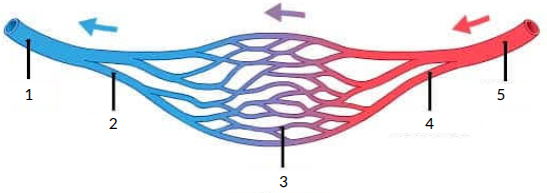
Label the blood vessels
Vein
Venule (smaller branch of vein)
Capillaries
Arteriole (smaller branch of artery)
Artery
What type of cells is the heart made of and how do they work together
Muscle cells pulse together to keep blood flowing in one direction throughout the body
Why does the heartbeat have two thuds
Because of the closing of the valves in each chamber

Label the parts and explain their functions in the pathway of DOB
Superior vena cava
Inferior vena cava
Septum
Deoxygenated blood (DOB) enters through the superior and inferior vena Canva from the upper and lower body
The septum separates DOB and oxygenated blood (OB)

Label and explain their functions (DOB)
Right atrium
Blood enters the right atrium from the vena cavas
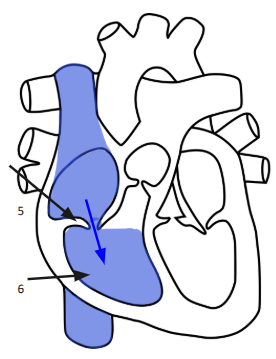
Label and explain their functions (DOB)
Tricuspid valve
Right ventricle
From the atrium, the heart contracts and pushes blood through the tricuspid valve into the right ventricle

Label and explain their functions (DOB)
Pulmonary valve
Pulmonary artery
The ventricle contracts and pushes the blood up through the pulmonary valve into the pulmonary artery to each of the lungs to become oxygenated
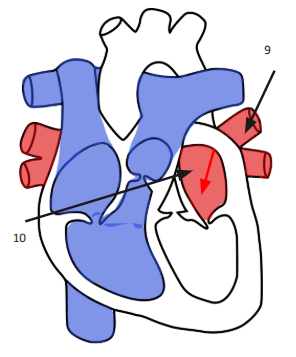
Label and explain the functions (OB)
Pulmonary vein
Left atrium
OB from the lungs enter through the pulmonary vein into the left atrium

Label and explain the functions (OB)
Mitral valve
Left ventricle
Left atrium contracts and pushes blood through the mitral valve to the left ventricle
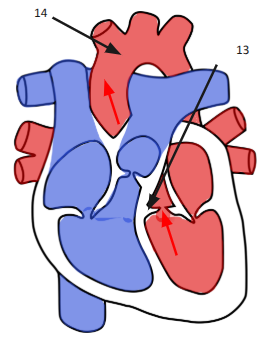
Label and explain the functions (OB)
Aortic valve
Aorta
Left ventricle contracts and pushes the blood through the aortic valve to the aorta
The aorta carries the OB to the rest of the body organs
What are some functions of blood
Transports glucose, nutrients, and gases throughout the body
Maintain pH, temperature, and osmotic pressure
What are three components of blood
Plasma - liquid portion of blood
contains water, lipids, and proteins
Red and white blood cells
red: transport gases
white: fights infections
Platelets
help with blood clotting
Valves
One-way chambers in the heart, prevent backflow of blood
What is blood
Fluid carrying nutrients, oxygen and waste products in the body