Coral Reef: Corals
 Call Kai
 Learn
 Practice Test
 Spaced Repetition
 Match
 Flashcards
 Knowt Play
1/74

Earn XP
Description and Tags
Give both full name and AGGRA
75 Terms
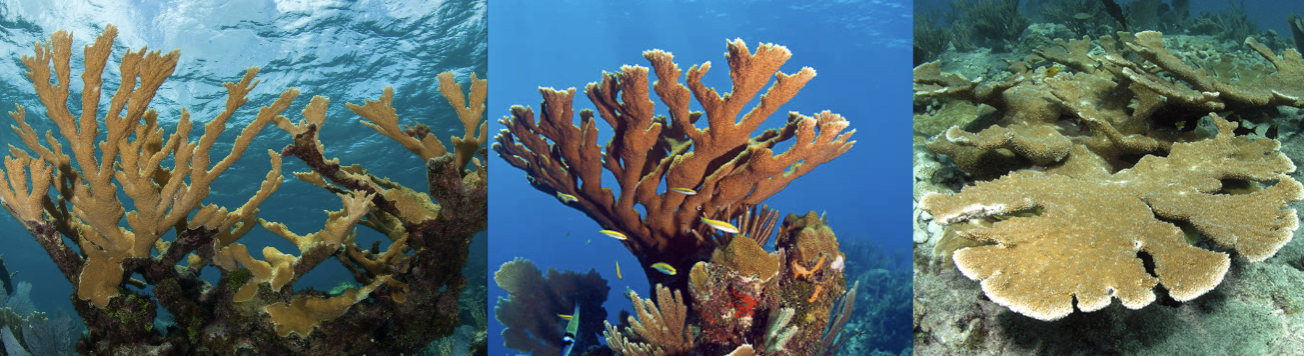
What is this?
Acropora palmata (APAL)
Acropora palmata (APAL) defining characteristics
Large, thick flatted branches resembling elk horns “Elkhorn coral”
Small, tube-like protruding polyps, white at tips
Light brown, yellow, or orange in color

What is this?
Acropora cervicornis (ACER)
Acropora cervicornis (ACER) defining characteristics
Cylindrical branches, like horns on a stag “staghorn coral”
Grows in tangles, thickets
Small, tube -like, protruding polyps, white at tips
Pale yellow or orange in color
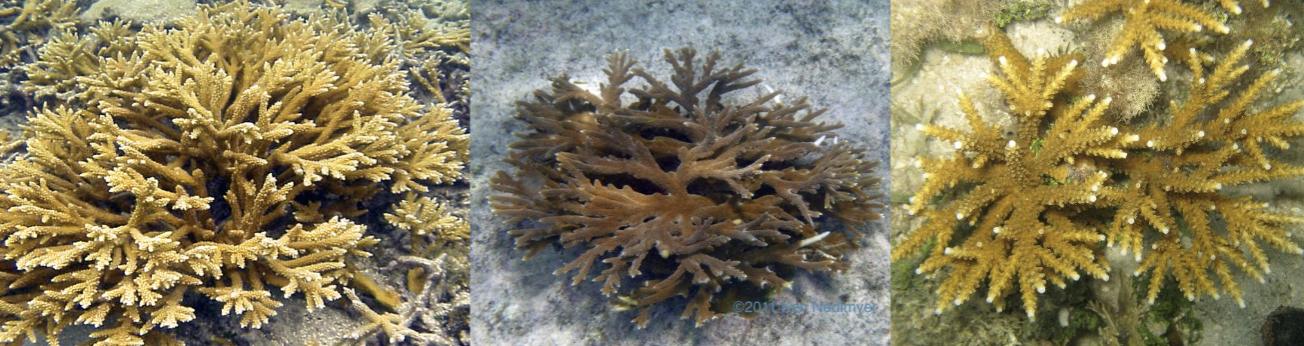
What is this?
Acropora prolifera (APRO)
Acropora prolifera (APRO) defining characteristics
• Hybrid of APAL and ACER
• Looks like APAL or ACER but something is just not right
• Typically has short branches that are stubby and almost fused
• Many intermediates - may look more like APAL or ACER
• Small, tube-like, protruding polyps, white at tips

What is this?
Porites porites (PPOR)
Porites porites (PPOR) defining characteristics
Thickest branches
Densely packed thick, clubbed, stubby branches (clubbed finger coral)
Branches ~2cm thick
Appear “fuzzy” polyps extended for feeding
Grayish, yellow, brown in color

What is this?
Porites divaricata (PDIV)
Porites divaricata (PDIV) defining characteristics
• Branches more spaced out than PFUR
• Usually bi-furcating tips
• Branches <1cm thick (thin finger coral)
• Greyish, yellow, brown in color

What is this?
Porites furcata (PFUR)
Porites furcata (PFUR) defining characteristics
• Branches more spaced out than PPOR (branched finger coral)
• Usually bi-furcating tips (furcata)
• Branches ~1-2cm thick
• Greyish, yellow, brown in color

What is this?
Madracis decactis (MDEC)
Madracis decactis (MDEC) defining characteristics
Stubby sometimes irregularly shaped lobes
Color contrasted polyps, polyp different color from tissue
Can be green, yellow-brown, or grey
Looks “off” from porites porites

What is this?
Madracis auretenra (MAUR)
Madracis auretenra (MAUR) defining characteristics
• Thin, densely packed, yellowish protruding fingers (Yellow pencil coral)
• Branches are usually the same height
• Cream or yellow in color

What is this?
Dendrogyra cylindrus (DCYL)
Dendrogyra cylindrus (DCYL) defining characteristics
• Encrusting base with stubby cylindrical columns or pillars
• “Fluffy” appearance, polyps extended throughout day
• Meandering/brain corallites
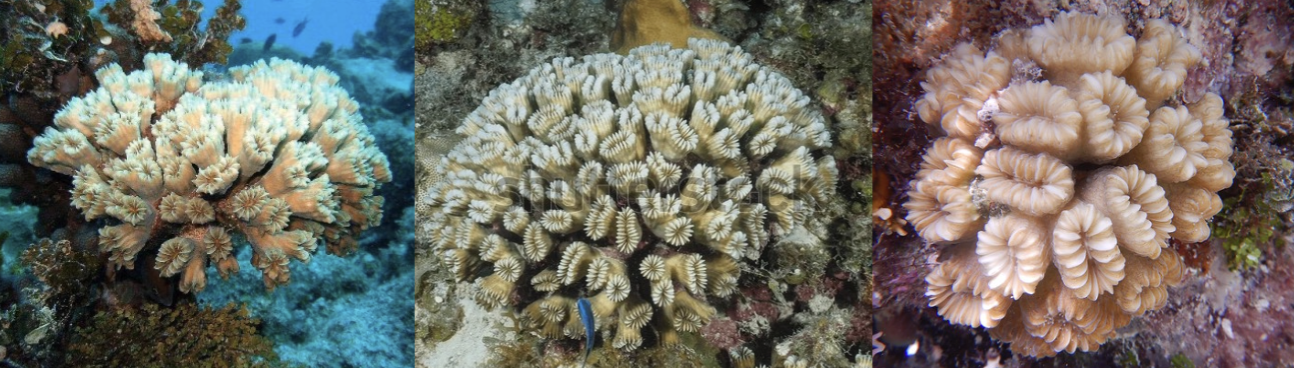
What is this?
Eusmilia fastigata (EFAS)
Eusmilia fastigata (EFAS) defining characteristics
• Large elongated, irregular, toothy, polyps
• Polyp stalks are widely spaced
• Only alive at the tip of branches
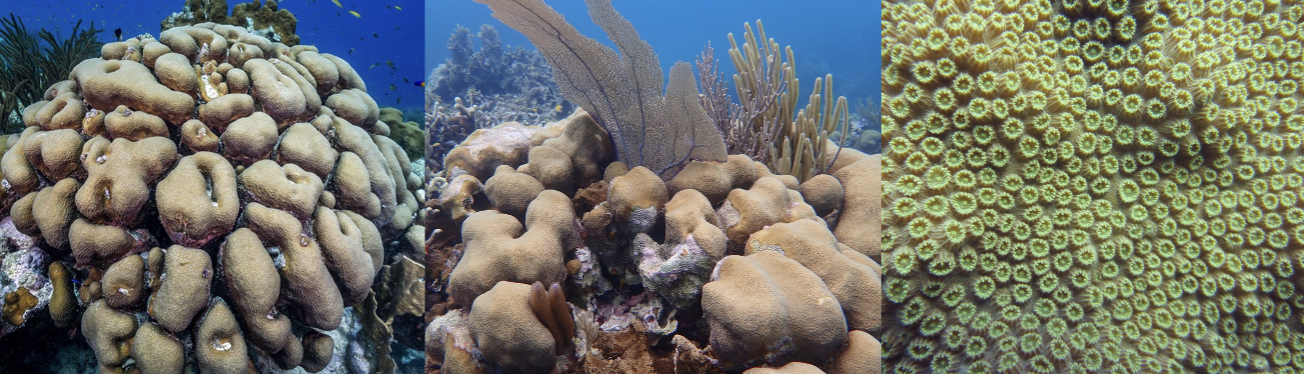
What is this?
Orbicella annularis (OANN)
Orbicella annularis (OANN) defining characteristics
• Large mounding colonies with radiating lobes
• Only tops of the columns are alive
• Small round polyps, tan or green in color

What is this?
Orbicella faveolata (OFAV)
Orbicella faveolata (OFAV) defining characteristics
Smoothed, ridged, or bumpy vertical rows
Mounds have skirts edges
Small round polyps, tan or green in color
Ridges

What is this?
Orbicella franksi (OFRA)
Orbicella franksi (OFRA) defining characteristics
Enlarged, irregular polyps on scattered lumps
Mounds have skirted edges
“Looks like it has a weird disease”
Polyps can look pale/white
Usually found deeper
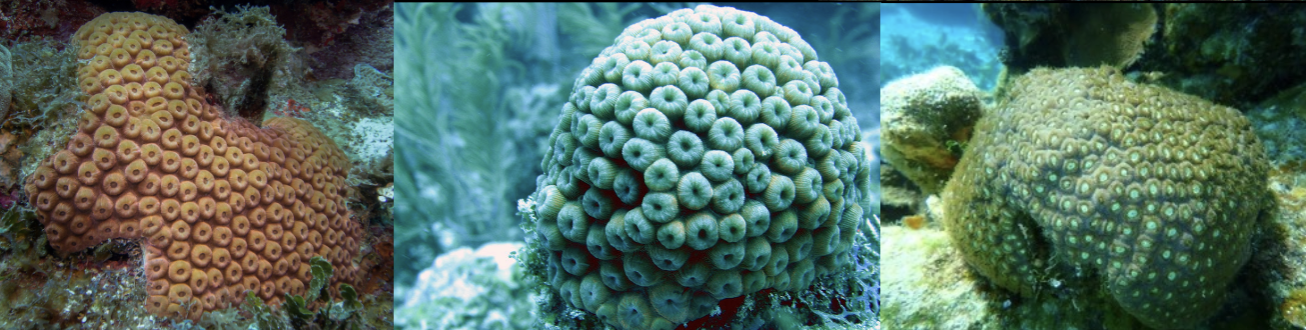
What is this?
Montastrea cavernosa (MCAV)
Montastrea cavernosa (MCAV) defining characteristics
Large round fleshy protruding polyps
Usually mounding, but sometimes found in more encrusting form
Various color morphs - reds, oranges, greens, grays, sometimes two-toned colors
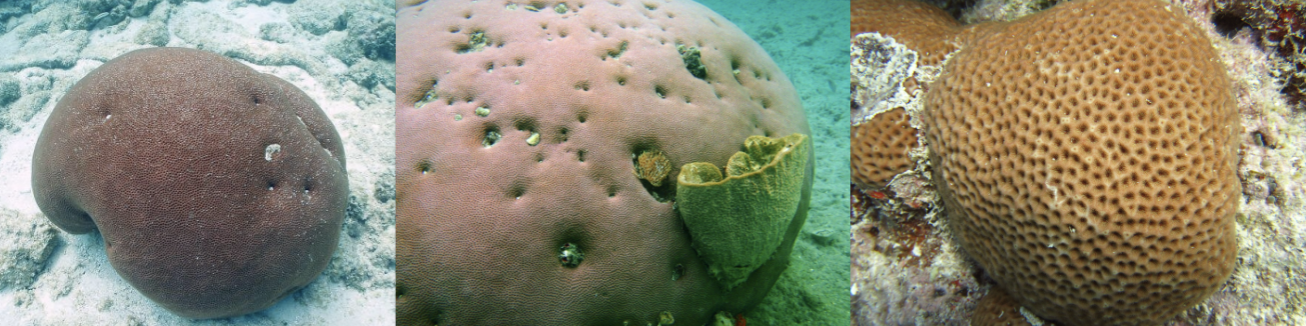
What is this?
Siderastrea siderea (SSID)
Siderastrea siderea (SSID) defining characteristics
• Large, round, coral
• Many deep pitted polyps-looks like it was stabbed thousands of
times with a pencil
• Usually pink, red, and orange in color

What is this?
Siderastrea radians (SRAD)
Siderastrea radians (SRAD) defining characteristics
• Small flattened crusts on benthos
• Sometimes found in loose balls
• Pale color with dark and shallower polyps
than in SSID
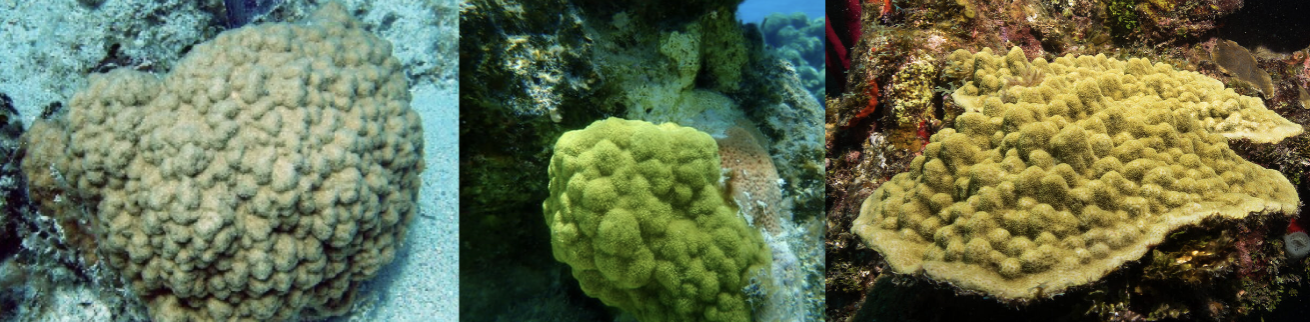
What is this?
Porites astreoides (PAST)
Porites astreoides (PAST) defining characteristics
• Fuzzy, small, very lumpy mounds (mustard hill coral)
• Sometimes encrusting and plating in low-light
• Can be yellow, green, or brown in color
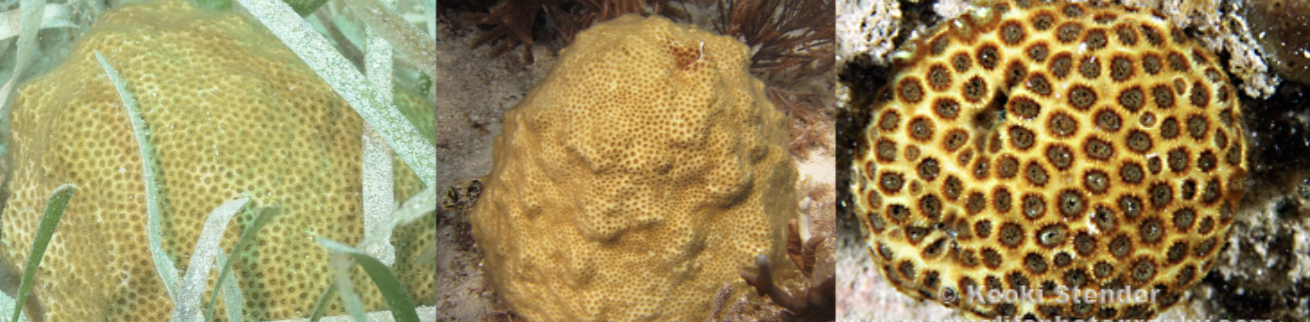
What is this?
Solenastrea bournoni (SBOU)
Solenastrea bournoni (SBOU) defining characteristics
• Colonies form smooth or irregularly shaped domes
• Polyps slightly protrude
• Polyps are darker than the tissue spaces between polyps
• Cream to light brown in color
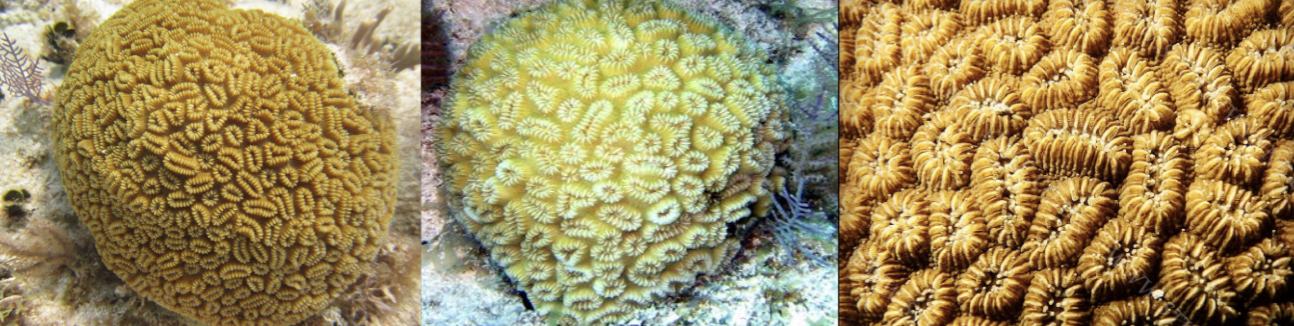
What is this?
Dichocoenia stokesi (DSTO)
Dichocoenia stokesi (DSTO) defining characteristics
Large irregular protruding elliptical shaped polyps
Cream, yellow, or brown in color
Medium sized round colonies
Less branchy than eusmilia
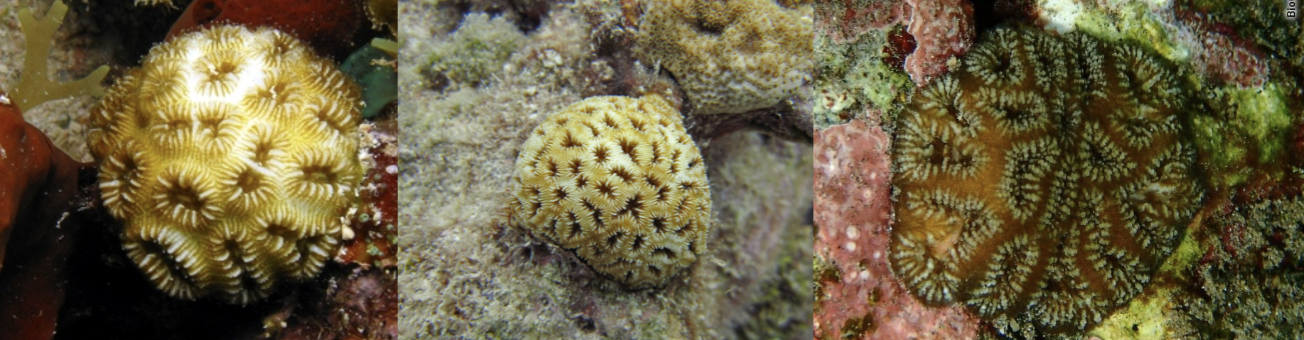
What is this?
Favia fragum (FFRA)
Favia fragum (FFRA) defining characteristics
Small hemispherical dome-like colonies (golf ball coral)
Polyps are usually flat with flesh. Distinct white teeth
Pale yellow or brown
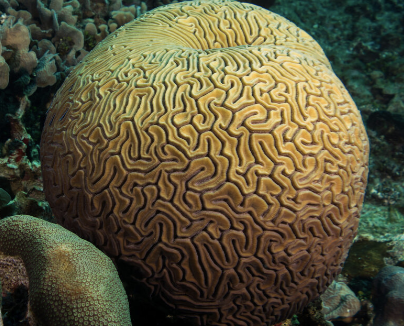
What is this?
Diploria labrynthiformis (DLAB)
Diploria labrynthiformis (DLAB) defining characteristics
Wide ridge groove
Deep, narrow valleys
• Large hemispherical boulders (up to 1m in diameter)
• Highly convoluted and interconnected valleys
• Tan to yellow-orange to gray in color
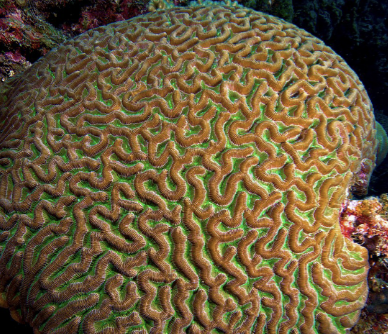
What is this?
Colpophyllia natans (CNAT)
Colpophyllia natans (CNAT) defining characteristics
Thin groove on ridges
Wide valleys
• Large rounded domes (up to 2m)
• Long, winding valleys
• Ridges and valleys are usually two different colors
(green/orange, gray/green, orange/yellow) or a
different tone of the same color
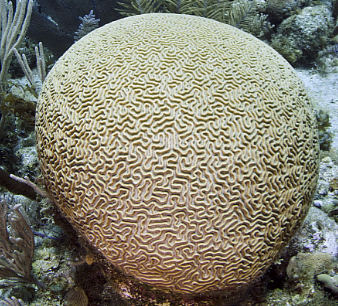
What is this?
Pseudodiploria strigosa (PSTR)
Pseudodiploria strigosa (PSTR) defining characteristics
Deep, narrow valleys
Thin groove on ridges
• Large hemispherical mounds or domes (up to 2m)
• Long interconnected valleys
• Green to brown, yellow-brown, and bluish gray
Brain coral: wide ridge groove and deep valley . Give code?
DLAB

Brain coral: thin ridge groove and wide valley. Give code?
CNAT
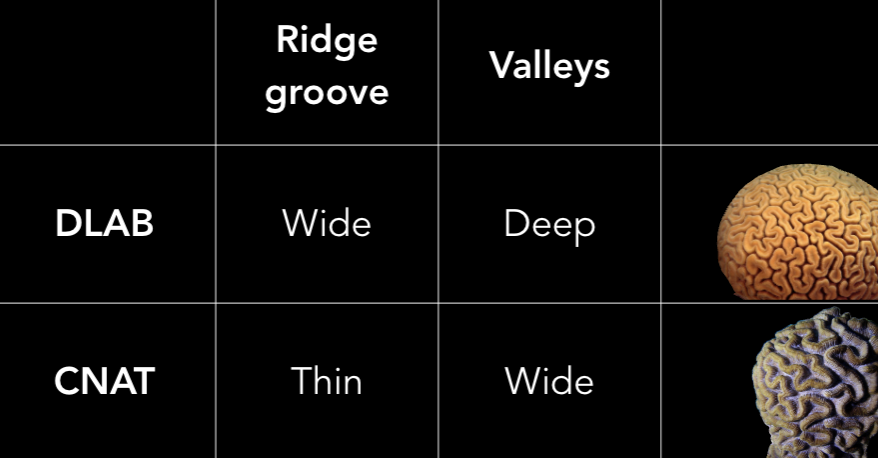
Brain coral: thin ridge groove and deep valley. Give code?
PSTR


What is this?
Pseudodiploria clivosa (PCLI)
Pseudodiploria clivosa (PCLI) defining characteristics
Thin groove on ridges
Wide valleys
• Large mound with many irregular knobs
and lumps and sporadic protruding
columns (up to 1.2m)
• Grey, or brown/light brown in color

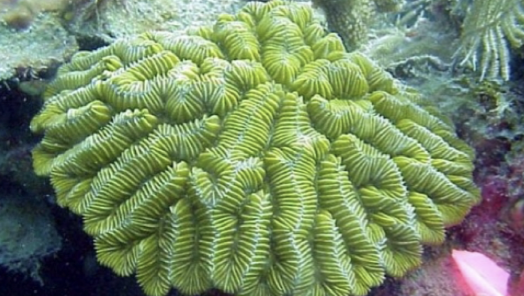
What is this?
Meandrina meandrites (MMEA)
Meandrina meandrites (MMEA) defining characteristics
Narrow ridge groove
Large, thick septa
Deep, narrow valleys
• Medium sized (1m) plates, mounds, or knobby
columns
• Zipper like appearance (Zipper coral)
• Cream, light brown or yellow in color
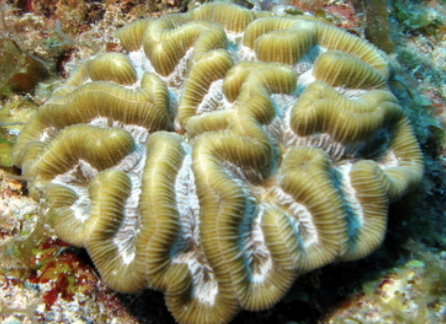
What is this?
Manicina areolata (MARE)
Manicina areolata (MARE) defining characteristics
• Small free-living colonies (unattached to substrate)
(0.15m)
• Found in seagrass meadows, rubble, or sand areas
• Yellow-brown, green, or grey

What is this?
Agaricia agaricites (AAGA)
Agaricia agaricites (AAGA) defining characteristics
• Grows as thick protruding flat blades (up to 1m)
• Sometimes can grow as mounds with irregular lumps
• Reticulated corallites with prominent ridges
• Tan, yellow, gray, brown, pink, or bluish in color

What is this?
Agaricia tenufolia (ATEN)
Agaricia tenufolia (ATEN) defining characteristics
• Thin upright blades in lettuce-like clumps or large
buttresses (up to 3.5m)
• Wavy, parallel ridges across the blades
• Tan, yellow, or orange in color, blade tips can look
pale or white

What is this?
Palythoa caribaeorum (PCAR)
Palythoa caribaeorum (PCAR) defining characteristics
• Large round or oval protruding polyps
• Encrusts and forms large mats over any available
reef substrate
• Cream or yellow in color

What is this?
Purple Sea Fan Gorgonia ventalina (GVEN)
Gorgonia ventalina (GVEN) defining characteristics
• Large flexible fans, sometimes multiple with a
latticework of branches
• Purple (polyps retracted) or brown (polyps extended
for feeding)
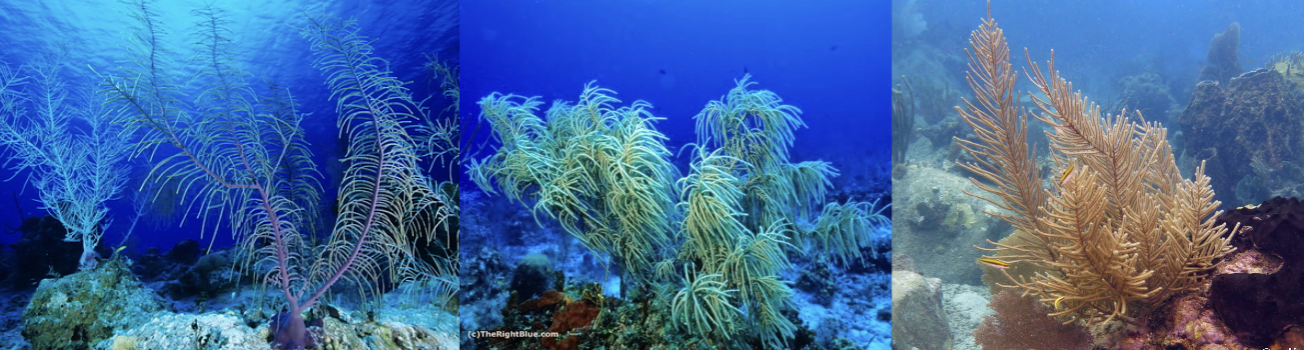
What is this? (common name & scientific)
Sea plumes (Pseudopterogorgia spp.)
Sea plumes (Pseudopterogorgia spp.) defining characteristics
• Bushy clusters of tall, feather-like plumes (2m)
• Purple, yellow, orange, or gray in color

What is this? (common name)
Sea whips
Sea whips defining characteristics
• Long, thin, and wirey bundles
• Gray, red, yellow in color

What is this? (common name)
Sea rods
Sea rods defining characteristics
• Thick rods that appear bushy when polyps are extended
• From unbranched colonies to dichotomous and/or lateral branching colonies

What is this?
Millepora alcicornis (MALC)
Millepora alcicornis (MALC) defining characteristics
• Thinly branched colony with many small lateral branches
• Often found encrusting gorgonians, mainly sea fans
• Yellow, orange, or tan with pale tips
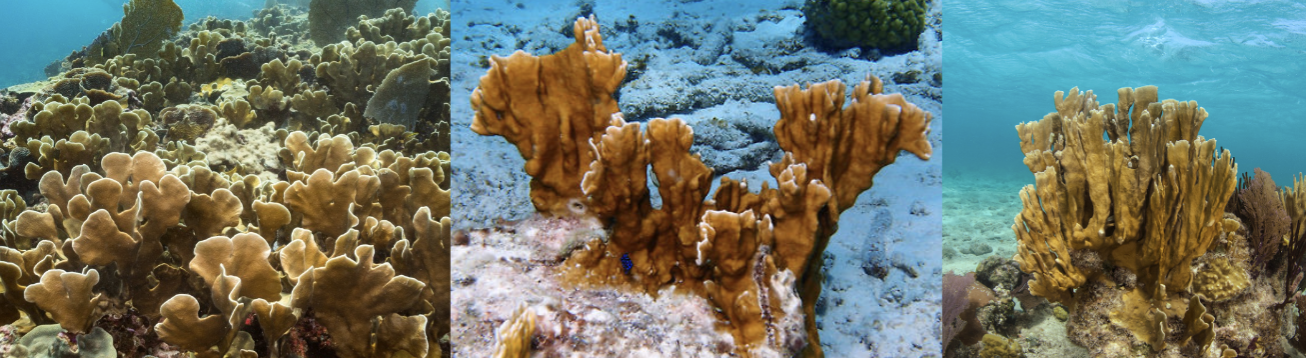
What is this?
Millepora complanata (MCOM)
Millepora complanata (MCOM) defining characteristics
• Thin, smooth, upright blades that extend from an encrusting base
• Outer edge of blades uneven with multiple extensions or short branches
• Yellow, orange, or tan with pale tips

What is this?
Stylaster roseus (SROS)
Stylaster roseus (SROS) defining characteristics
• Small colonies form laterally branched fan like structures (2-10cm)
• Cryptic - often in cracks, under ledges, or overhangs on the reef
• Purple, pink, or red in color