Vital Signs - Slides
 Call Kai
 Learn
Learn Practice Test
 Spaced Repetition
 Match
Match Flashcards
 Knowt Play
1/32

There's no tags or description
Looks like no tags are added yet.
Name | Mastery | Learn | Test | Matching | Spaced | Call with Kai | Chat |
|---|
No analytics yet
Send a link to your students to track their progress
33 Terms
What are Vital Signs?
1. Temperature
2. Pulse rate
3. Respiratory rate
4. Blood pressure
We also think of PAIN assessment as the 5th vital sign.
On acute care units – Pulse Oximetry is included as vital sign
Taking vital signs is a simple task however interpretation of vitals requires knowledge, critical thinking and experience
Vital Signs Table

When to measure vital signs?
Inpatient settings - minimal frequency will be ordered.
Upon admission to health care facility or when making home visits
Evaluation of treatment- For example: before and/or after medication; before during and after blood transfusion
Establish baseline – For post-operative evaluation and monitoring
When a patient’s condition changes or ”I feel funny”
In stable patients – taking vital signs may be delegated, however, the nurse will analyze the results.
Monitor trends!!!
Temperature
Normal adults is 36.5o to 37.5oC (97.7o to 99.5oF)
Average oral= 370C (98.60 F)
Rectal– may be 1o F higher
Axillary – may be 1o F lower
Route – mouth, rectum, ear, forehead and axilla
Body temp varies with age
Elderly may have lower temps – 36-36.8o C (96.8- 98.3oF)
Neural & Vascular Control of Temperature
Hypothalamus = body’s ‘thermostat’
Hypothalamus response to decreased temperature
◦Vasoconstriction
◦Shivering occurs if vasoconstriction ineffective
Hypothalamus response to increased temperature
◦Vasodilation
◦Sweating
Body Temperature Factors
Age (Newborns at risk for hypothermia; Elders may have lower average body temperatures (36o C or 96.8oF)
Exercise (temp increases with exercise)
Hormones (progesterone hormone increase temp for women)
Time of Day/Circadian rhythm (temp commonly lowest in morning)
Stress (can elevate temp)
Environment (exposure to extreme heat or cold)
Fever (pyrexia)
An important defense mechanism
Results when heat-loss mechanisms are unable to keep pace with excessive heat production:
◦Example: When pyrogens alter hypothalmus set point
Metabolism and oxygen consumption increase during a fever
Heat Loss
Radiation: Transfer of heat from one surface to the other without actual contact (heat lost from the body to a cold room)
Conduction: Transfer of heat from the body to another surface (bathing a patient with cool cloth)
Convection: Dispersion of heat by air currents (wind blowing across exposed skin - fan)
Evaporation: Heat loss through water vapor (sweating, diaphoresis)
Tempurature Procedure
Oral temperature?
Insert under tongue into posterior sublingual pocket of mouth, ask to close lips and hold
Rectal temperature?
Ask patient to take a deep slow breath
Insert thermometer into anus towards belly button
1in for child and 1.5 in for adult
Axillary temperature?
Place against middle of axilla, fold arm down and place across chest, enclosing thermometer
Tympanic temperature?
Pull pinna back up and out (6mo-3yr= down and back)
Rotate handle towards jawline
Nursing Interventions:
Hyperthermia
•Pyrexia (fever) – not harmful if below 39oC, and enhance the body’s immune system.
•An abnormally elevated body temperature. Exceeds 39o C (102.2 F)
•Cool environment if possible.
•Obtain blood cultures if ordered prior to antibiotic administration.
•Administer antipyretics. Aspirin is not recommended for management of fever in children with viral illness.
•Non-pharmacologic methods - cooling blanket (follow instructions) ; tepid bath - Watch for shivering.
•Encourage oral fluids (3 L/day) and rest.
•* if cardiac and renal status normal
•Provide frequent mouth care q4h and prn
•Those with cardiac or respiratory disease, fever=stress
Nursing Interventions:
Hypothermia < 35 C (<95 F)
•Caused by prolonged exposure to cold; may be intentional in a surgical procedure.
•Remove wet clothes
•Blankets; cover head
•Warm liquids (if conscious)
•Increase room temperature
•Warmed IV fluids
Pulse
Indicator of circulatory status
Pulse is indirect measurement of cardiac output
Pulse can be palpated at multiple sites in body. Rate is usually assessed at radial or apical site
Evaluate rate, rhythm, intensity, and equality
Recorded as beats per minute (bpm)
Measure 30 seconds X 2
If irregular: count for one entire minute!
Pulse and Pressure Points
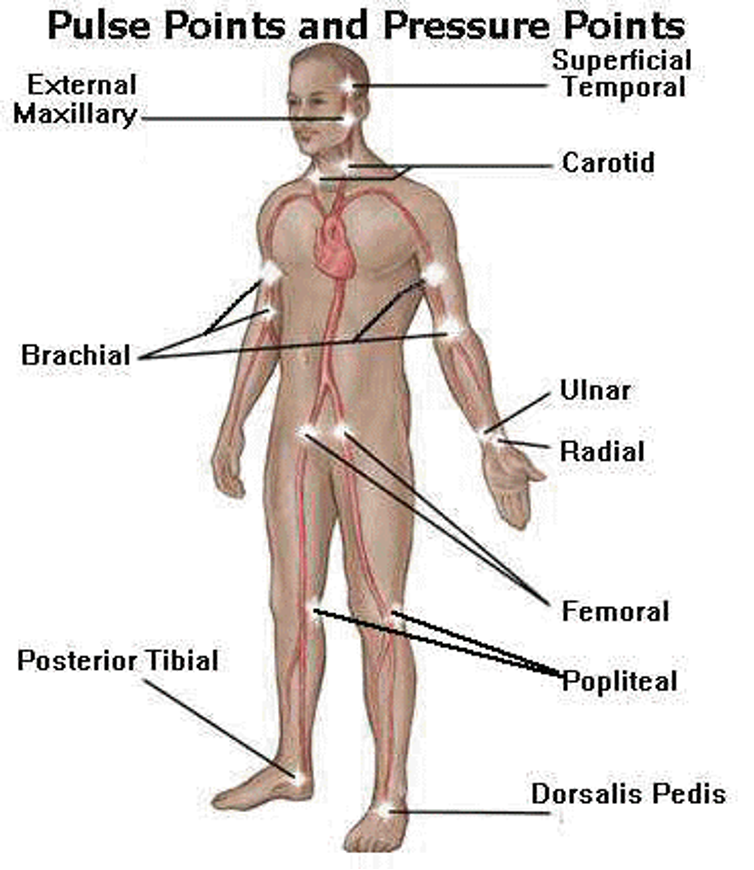
What is a normal pulse rate?
•Adult = 60-100 beats per minute (bpm)
•Tachycardia > 100 bpm in adults
•Bradycardia < 60 bpm in adults
•Infant = 80-160 bpm. Pulse will decrease as the child ages. Average pulse of a 14-year-old is 60-90 bpm
•Normal pulse has regular rhythm
•Strength of pulses is described as: Bounding (4+); Full or Strong (3+); Normal (2+); Diminished or barely palpable (1+); or Absent (0)
•Equality: pulses should be equal when comparing right and left side of body
Factors Affecting Heart Rate
•Conditioning (Athletes have lower heart rates)
•Medications
•Decreases pulse (Beta blockers, Calcium channel blockers, digoxin)
•Meds can cause postural changes – pulse temporarily increases when a person changes from lying to a sitting or standing position
•Temperature: Fever increases; hypothermia decreases
•Acute pain and anxiety: Increases pulse – sympathetic stimulation
•Chronic pain: Decreases rate - Parasympathetic
•Deficient fluid (dehydration, hemorrhage): Increases rate
RESPIRATORY RATE
One respiratory cycle = inhalation plus exhalation
Mechanics of breathing (musculature, effort)
Character of respirations
◦Women tend to be chest breathers
◦Men tend to be diaphragmatic breathers
◦Infants & children – irregular pattern is normal
Respiratory Assessment
Assess rate, depth, and rhythm of respiratory pattern
Assess mechanics of breathing- intercostals, accessory muscles, nasal flaring
How hard are they working??
Assess respirations in context- exercise, position, pain, smoking, medication (opioids), and anxiety
Respirations by age
Rate, Depth, Rhythm
Respiratory rate decreases with age:
•Newborn: 35-40/minute
•Infant: 30-50/minute
•School-aged child: 20-30 /minute
•Adolescent: 16-20 / minute
•Adult: 12-20 / minute
•Bradypnea:
•Tachypnea:
•Hyperpnea:
•Apnea:
•Hyperventilation:
•Hypoventilation:
•Cheyne-Stokes:
•Kussmaul:
•Dyspnea:
•Bradypnea: < 12 per minute
•Tachypnea: > 20 per minute
•Hyperpnea: > 20 and deep, labored (ie post exercise)
•Apnea: absence of respiration
•Hyperventilation: rapid or deep breathing
•Hypoventilation: slow or shallow breathing
•Cheyne-Stokes: rate & depth irregular, alternating apnea/hyperventilation
•Kussmaul: abnormal deep, regular, increased rate
•Dyspnea: feeling shortness of breath
Pulse Oximetry
•Noninvasive measurement of the oxygen saturation of the blood.
•A pulse oximeter is a device with a clip-on sensor that is secured to the patient’s finger, toe, nose, earlobe or forehead.
•Normal values are 95-100%.
•Acceptable values: 93 and above. Results <90% indicate an emergency!
BLOOD PRESSURE (what+sbp,dbp)
•BP reading is recorded as SBP/DBP in mmHg (millimeters of mercury)
•Systolic blood pressure (SBP)
•Diastolic blood pressure (DBP)
•2 ways to take a blood pressure reading:
oManual BP
oAutomatic BP
Cuff Size
Choose the Correct Size Cuff
(newborn, infant, child, adult, large adult, thigh)
If BP cuff is too large, BP reading will be falsely low
If BP cuff is too small, BP reading will be falsely high
Bp systole/diastole, variation
•Systolic- heart at work
•Diastolic- heart at rest
•Sitting is the preferred position
•Onset of the sound corresponds to the systolic BP. What is this sound called? (Korotkoff Sounds)
•The disappearance of the sounds corresponds with the diastolic pressure
•5-10 mm difference between arms is normal
•Older adults sometimes have an increase in systolic pressure while diastolic pressure remains the same.
Classifications of BP for Adults
<120/<80 = NORMAL
120-139 OR 80-89 = PREHYPERTENSION
140-159 OR 90-99 = STAGE 1 HYPERTENSION
> 160 OR > 100 = STAGE 2 HYPERTENSION
Average Optimal BP for Age
•1 month old = 85/54
•1 year old = 95/65
•6 years old = 105/65
•10-13 years old = 110/65
•14-17 years old = 119/75
•18 years or older = < 120/ < 80
Factors Influencing BP
•Age (BP gradually increases with age)
•Stress/Anxiety/Pain (commonly increase BP)
•Ethnicity (African Americans at risk for high BP)
•Time of day (BP highest in the morning)
•Medications (for example, diuretics can decrease BP)
•Activity and weight (increases BP)
•Smoking/caffeine (increases BP)
•Fluid depletion (decreases BP)
Hypertension vs Hypotension
HYPER
More common than hypotension
• Thickening of walls
• Loss of elasticity
• Family history
• Risk factors
HYPO
•Systolic <90 mm Hg
•Dilation of arteries
•Loss of blood volume
•Decrease of blood flow to vital organs
•Orthostatic/postural
What do you do if the BP is abnormal? Select all that apply
A. ___ Panic
B. ___ Pretend it is normal
C. ___ Ask the patient if they know their usual BP
D. ___ Assess proper cuff size, positioning
E. ___ Check the blood pressure in the opposite arm
F. ___ Assess level of consciousness, pulse, color, temperature, pain level, wounds, intake and output status……
cdef
Risk Factors for Hypertension
•Family History
•Excessive sodium intake
•Physical inactivity
•Obesity
•Heavy alcohol consumption
•African American
•Hyperlipidemia
•Stress
BP Considerations
There are many instances when you would not take a BP in an arm:
•IV location
•AV Fistulas (shunts)
•Post mastectomy
•Casts
•Hand trauma
Patient may have a wristband indicating “No BP”
Orthostatic BP Assessment
•Orthostatic hypotension (postural hypotension) – lowering of BP when a patient rises. (Drop in SBP of at least 20mmHg, or drop in diastolic of 10mmHg with increase in heartrate of al least 10 beats per minute
•How to measure? Obtain BP reading before and 1-3 minutes after changing position. This is an RN assessment (do no delegate)
•Associated symptoms: Dizziness and/or Syncope. Advise pt to lie down if these symptoms occur.
•Who gets orthostatic? Patients who are anemic or dehydrated, elderly, medication side effects (particularly BP meds), or fluid depletion.
•Education: Advise pt to get up slowly, avoid sudden changes in position or ask for assistance when getting up from sitting or lying.
PAIN: The ‘5th Vital Sign’
•Rated on 0 to 10 scale
•0 equals no pain
•10 equals the worst pain ever experienced
•Check pain level with every VS assessment
BP Remember this…
•You do not need an order to assess vital signs
•If you notice a sudden change in patient status – ASSESS VS
•Assess trends, do not simply fill in boxes
•Context is important in your VS interpretation
•When in doubt, check it out & report it!