Social Identity Theory Tajfel & Turner (1979)
 Call Kai
 Learn
 Practice Test
 Spaced Repetition
 Match
 Flashcards
 Knowt Play
1/12

There's no tags or description
Looks like no tags are added yet.
13 Terms
Social Identity Theory Tajfel & Turner (1979)
•Tajfel & Turner (1979) surmised that being part of social groups allows people to feel a sense of social identity and it makes up part of their self-image that comes from belonging to social categories.
•Social Identity:
•The sense of self in terms of group membership.
•Can be positive or negative depending on societal evaluations.
•+’ve: Those who attend World Youth Day.
•+‘ve social identity allows for increased self-esteem!
•-’ve: Members of a violent street gang.
Social Identity Theory
Tajfel & Turner (1979)
Tajfel & Turner explained how people move through 3 cognitive stages when determining others as part of their ingroup or part of an outgroup
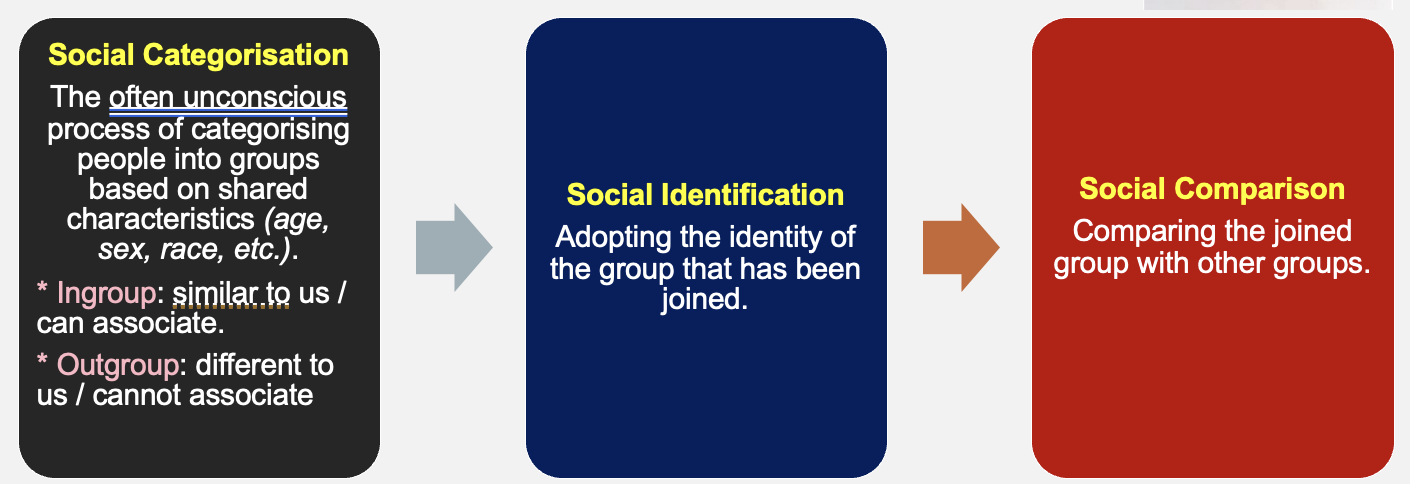

A consequence of social comparison is

strengths and limitations

Stereotypes as a form of
social categorisation
•Stereotype:
•An oversimplified belief about an outgroup pertaining to either positive or negative thoughts about its members.
a set of cognitive generalizations, beliefs, or expectations about the personal qualities and characteristics of the members of a group or social category. [1]
stereotypes
•First impressions of a group can form the basis of a stereotype:
•Interacting with someone for the first time.
•Begin to make judgments (clothes, how they speak, their name, etc.)
•Judgements are coloured by previous experience, influences around us and what groups we are and not a part of.
•Functions of stereotypes:
•Cognitive schemata used to quickly and simply process large amounts of info, freeing up cognitive processing that can be used to perform other mental tasks.
•From an evolutionary perspective, stereotypes may have helped people assess social situations and consequently avoid danger.
Relationship between attitude, prejudice & discrimination

•Direct Discrimination
•Intentional
•Occurs when an individual is treated unfairly because of a characteristic they have or are assumed to have.
Indirect Discrimination
May be unintentional
Occurs when individuals who have a particular characteristic are unfairly disadvantaged due to conditions or regulations that apply to everyone.
Prejudice: Causes

Racism: Reducing Prejudice
