Dental midterm - Fall 2026
 Call Kai
 Learn
Learn Practice Test
 Spaced Repetition
 Match
Match Flashcards
 Knowt Play
1/49

There's no tags or description
Looks like no tags are added yet.
Name | Mastery | Learn | Test | Matching | Spaced | Call with Kai | Chat |
|---|
No analytics yet
Send a link to your students to track their progress
50 Terms
Posterior teeth
Are the teeth posterior to the canines
The four first permanent molars are
3, 14, 19, and 30
The maxilla is the bone which
Contains the upper teeth
The TMJ (temporomandibular joint) is the
Joint which allows the lower jaw to move
The most common bacteria in the mouth and the one most responsible for tooth decay is:
S. mutans
The first sign of periodontal disease is:
Bleeding gums
Among the many OSHA regulations which must be followed in a dental practice include
all of the above
The branch of dentistry which treats infections within the pulp canal (root) is:
Endodontics
In general, the needles used to inject local anesthesia are
Blue for upper teeth and yellow for lower teeth
The items needed for rubber dam placement are:
Clamp forceps, clamp, frame, rubber dam, hole punch, floss

In the photo at the right, the usual transfer zone to pass instruments is:
The 4-7 o’clock position (over the bib)
The rule of thumb for the HVE (suction) by the assistant is to have the bevel or opening of the suction tube:
Facing the tooth being prepared
Following treatment, high and low speed handpieces must be:
Oiled, if recommended, and autoclaved
Floss is placed (tied) on the rubber dam clamp:
To aid in the retrieval of the clamp should it fall off the tooth
An autoclave sterilizer (pick the best)
A. Uses steam pressure and heat to kill germs
The Statim autoclave is popular in many dental offices because
The cycle is much faster than regular autoclaves
A rubber dam clamp used for bicuspids is:
2A
Whenever using the air-water syringe, the assistant should
also have the HVE suction close to the tooth
The x-ray tube inside a dental x-ray machine operates in the voltage range of
70,000 to 90,000 volts

In the x-ray control panel at right, the button for setting the machine for a lower molar is:
‘A’
If it is the office policy to use a lead apron on a patient for dental x-rays, the correct procedure for doing so is:
Put the apron on the patient, wash hands, glove up, take the x-rays

The Rinn holder at right is assembled correctly for taking x-rays in the
Upper right and lower left quadrant
The sensor for taking digital x-rays
Costs from $6000 to $8000

When the angle of the x-ray beam is positioned as shown here
Shorter than the actual teeth
While the primary advantage of a panoramic x-ray that it is quick, the main disadvantage over an FMX is that a panoramic x-ray:
Isn’t as sharp as an FMX
The x-ray technique(s) used in dentistry are the
A. B and C
A periapical x-ray of tooth #3 is taken by positioning the x-ray head:
At a downward angle on the patients right side
The correct sequence of treatment in light-cured composite fillings is:
Etching, bonding, cure, composite placement, cure, polish
The plastic instrument is
Used for composite placement

Sectional matrix bands as shown here are sometimes preferred over traditional Tofflemire matrix bands because the sectional matrix
Makes a tighter contact between the teeth
When polishing composites, the sanding discs are secured to the lowspeed handpiece using a:
Mandrel
To help secure a matrix band to the tooth in composite procedures a _____ is sometimes used.
Wooden wedege
An alginate impression
Should be poured immediately or wrapped in a wet paper towel
Using a vibrator is necessary when pouring up plaster models because:
It removes the air bubbles trapped in the plaster
Sealants applied to children’s and adolescent’s teeth
All of the above

The instrument at the right is
A Tofflemire matrix band holder
Permanent crown and bridge, power-liquid cements should be mixed
Very quickly on a disposable mixing pad if desired
One of the permanent, modern cements for cementing crowns is:
RMGI cement, resin-modified glass ionomer cement (RelyX)
Match restoration with the cement commonly used for each: Acrylic (plastic) temporary
Temp bond
Match restoration with the cement commonly used for each: Metal shell temporary
IRM
Match restoration with the cement commonly used for each: Permanent crown
RMGI or Zinc phosphate cement

The jaw position (maxilla to mandible) shown at right is
Class II

Orthodontic brackets (right) are attached (cemented) to teeth using
Composite type (bonding) cement
During orthodontic treatment, the specific hardware that does most of the work to straighten the teeth is:
The wire
The main advantage of the modern cement types, like RMGI (RelyX) and all-resin cements, is:
The are insoluble (don’t wash out) in oral fluids

Identify (#) tooth shown on x-ray:
20

Identify (#) tooth shown on x-ray:
3
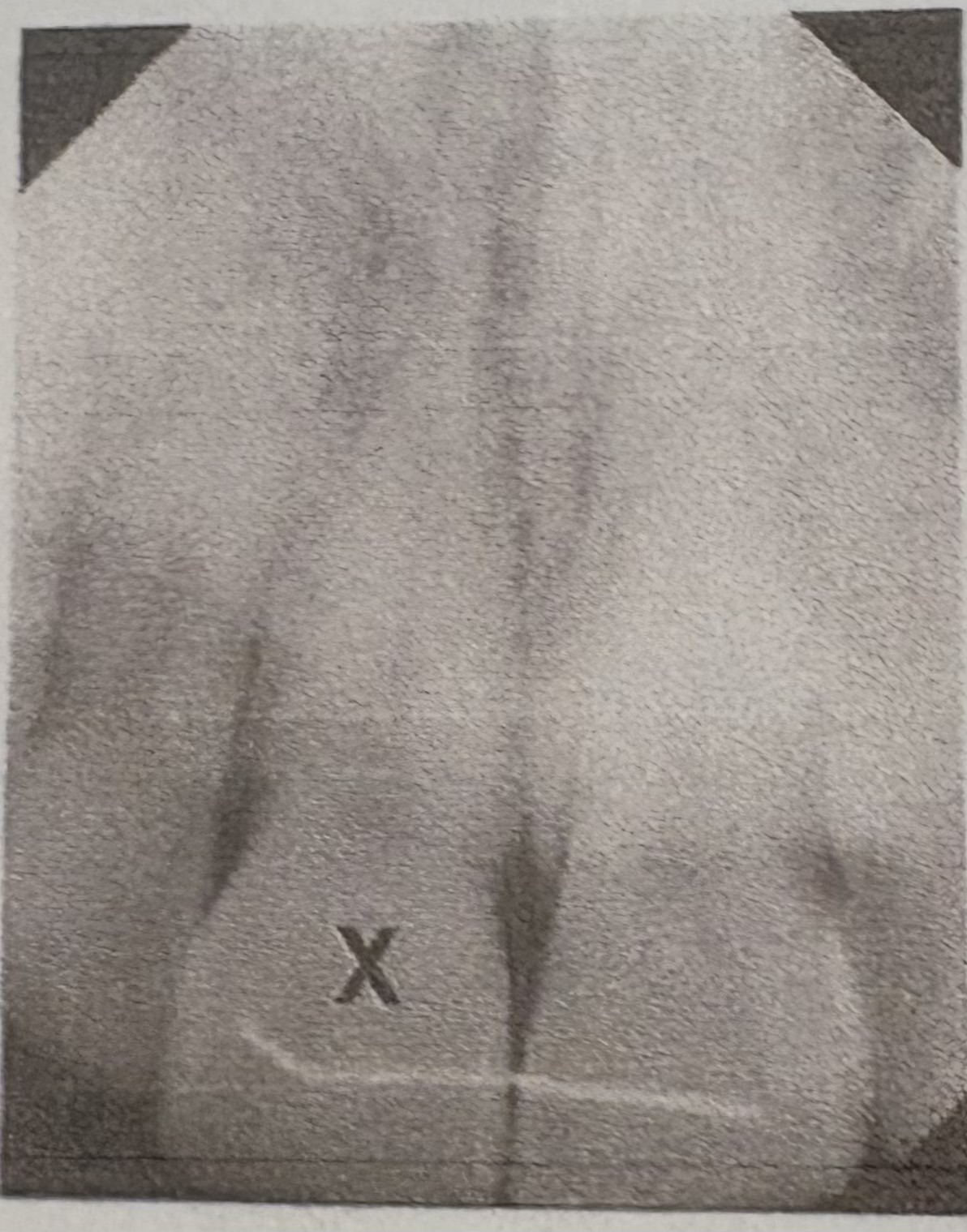
Identify (#) tooth shown on x-ray:
8

Identify (#) tooth shown on x-ray:
29

Identify (#) tooth shown on x-ray:
24