Lectures 22-23 biochem sad day sad day
 Call Kai
 Learn
 Practice Test
 Spaced Repetition
 Match
 Flashcards
 Knowt Play
1/92

There's no tags or description
Looks like no tags are added yet.
93 Terms
kcat
turnover number, the maximum number of substrate molecules converted to product per enzyme active site per second
kcat/Km
Catalytic efficiency; describes how effectively an enzyme processes substrate, particularly at low substrate concentrations
Oxidoreductases
Electron transfer
Transferases
Group transfer
Hydrolases
addition of H2O
Lyases
Bond cleavage without hydrolysis or electron transfer
Racemases and Epimerase
Isomerizations
Ligases
Bond formation
Catalysis
What can destabilizing the substrate ground state can promote?
Electrostatic stabilization
Favorable interactions between charges or dipoles that lower the free energy of a particular state
Induced dipole
A redistribution of electron density caused by a nearby charge or electric field
transition state
An enzyme active site is designed to favor the shape and charge distribution of the
The active site provides favorable interactions with the transition state’s shape and electrostatic distribution, reducing the activation barrier
Why does an enzyme stabilize the transition state more effectively than the substrate?
Transition state analog
A stable molecule that resembles the transition state of an enzyme catalyzed reaction
transition state
The enzyme’s active site is optimized for the
molecules that resemble the transition state can bind more tightly than ordinary substrates
what does optimization for the transition state get you?
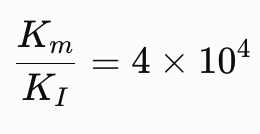
inhibition constant, used to describe inhibitor binding
What does KI mean?

Stronger inhibitor binding
the smaller the KI
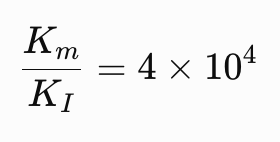
substrate affinity measure
The transition state analog binds extraordinarily strongly relative to the
the transition state analog is a very potent, tight-binding enzyme inhibitor
what does a large Km/Ki ratio mean?
Near attack complex
Configuration in which reacting groups are positioned at favorable distances and orientations for chemical reaction
It increases the probability of productive reaction by organizing the reactants into favorable positions and orientations
What is the advantage of a near attack complex?
Proximity effect
Increased reaction rate because reacting groups are held near one another
Orientation effect
Increased reaction rate because reacting groups are aligned appropriately
effective concentration
The locally enhanced availability of one reacting group to another when they are positioned together
Orbital
correct —- alignment is essential for efficient bond formation and bond cleavage
Covalent catalysis
occurs when an enzyme temporarily forms a covalent bond with a substrate during the reaction
Covalent catalysis
in ——- the enzyme directly participates in bond formation rather than only positioning the substrate
Electrophile
Electron deficient species that accepts an electron pair
Nucleophile
Electron rich species that donates an electron pair to form a bond
Electrophiles
Protons, metal ion, carbonyl carbons, and cationic imines are examples of
Nucleophiles
Hydroxyls, sulfhydryls, amino, imidazole are all examples of
covalent catalysis
this is an example of

Low-energy barrier hydrogen bond
A hydrogen bond in which the barrier to proton movement between donor and acceptor atoms is unusually small
Proton transfer
The distance between proton donor and acceptor atoms can influence the barrier for
Proton transfer is relatively difficult
Normal hydrogen bond- high energy barrier

Proton transfer becomes easier and potentially faster
Low barrier hydrogen bond- reduced energy barrier

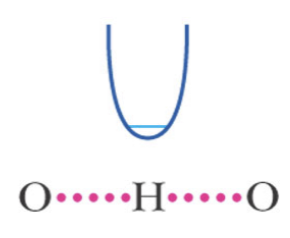
There is no central barrier separating two proton positions
Single-well hydrogen bond- essentially no central barrier
Specific acid-base catalysis
Catalysis involving H+ or OH-
General acid-base catalysis
Catalysis involving other proton donors or acceptors, such as buffer molecules
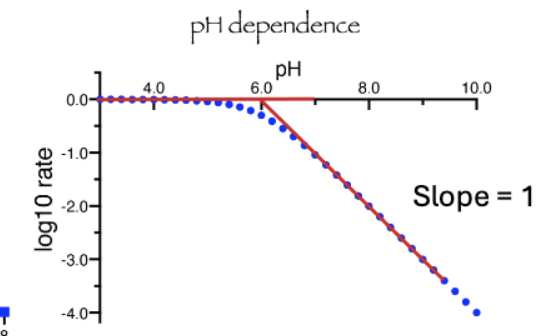
Specific acid base
what acid base graph is this showing?

General acid base
what acid base graph is this showing?

General base
A species that accepts a proton during a catalytic step
General acid
A species that donates a proton during a catalytic step
Imidazole facilitates hydrolysis of p-nitrophenyl acetate by accepting a proton

Uncatalyzed keto-enol tautomerization

Acid catalyzed keto-enol tautomerization
(electron withdrawing)

Base catalyzed keto-enol tautomerization
(electron donating)

most enzyme is protonated, 50% is protonated, most enzyme is deprotonated
at low pH what happens? at pH=pKa? at high pH?

less abundant
The reaction rate decreases as the protonalted active form becomes
protonated, deprotonated
Some enzymes require one group to be —— and another to be ——
a graph of enzyme activity and pH
what is this graph showing?
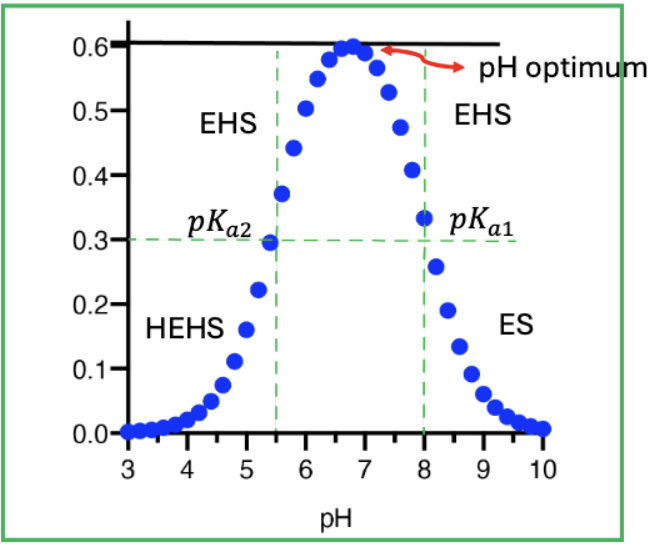
The catalytic groups must have specific protonation states, and those states are most favorable within a particular pH range
Explain why enzyme activity may be low at both acidic and basic pH
Lysozyme
an enzyme that hydrozyles polysaccharide chains in certain bacterial cell walls
Lysozyme and pH dependence, supporting involvement in ionizable catalystic groups
What does this show?

Mass spectrometry
what does this image show?
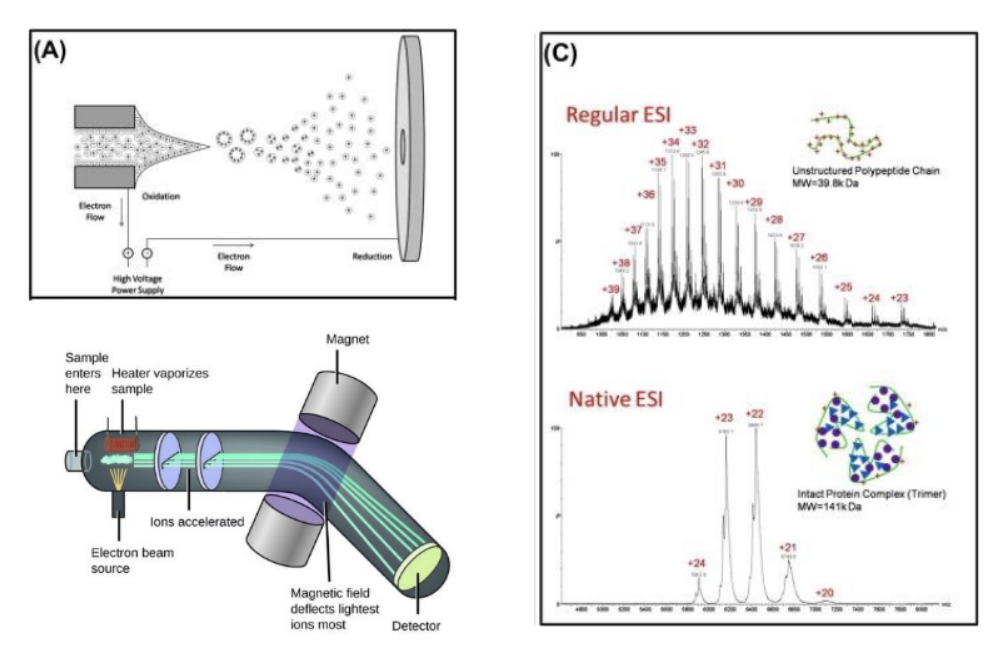
Mass spectrometry
analytical technique that measures mass-to-charge ratios (m/Z) of ions
D52
What forms a covalent adduct with the substrate
The mechanism involving a covalent enzyme-substrate intermediate formed by Asp52
Which mechanism is supported for HEWL?
Chymotryspin
A serine protease that catalyzes hydrolysis of peptide bonds
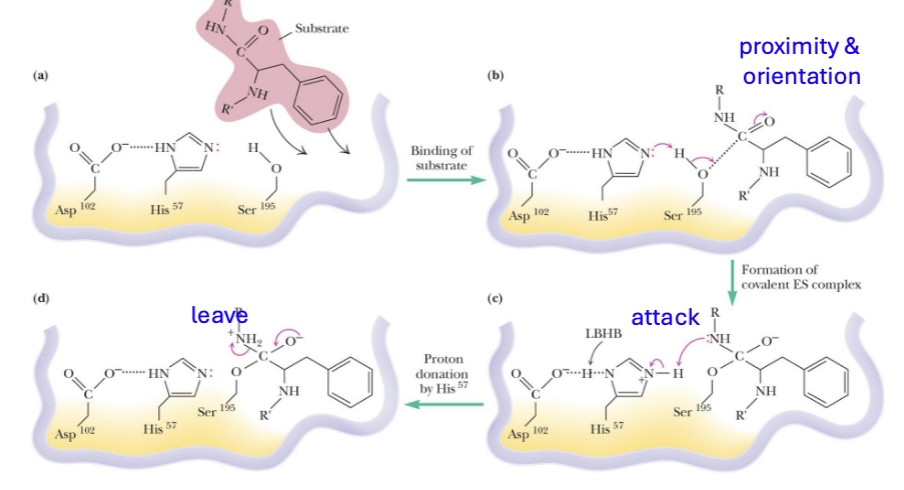
Chymotryspin: covalent and acid base catalysis
What is this showing?

enzyme substrate intermediate
Fast reaction kinetics provide evidence for a temporary covalent
fast formation of an acyl enzyme intermediate
Initial rapid burst corresponds to

intermediate adn enzyme regeneration
The slower phase reflects subsequent processing of the

Neutron diffraction
How can you find which group accepts the proton from serine during catalysis?
Neutron diffraction
Determins structural information using neutron scattering by atomic nuclei
Mechanism involving covalent catalysis with acid base assistance
What does this show?
equilibrium for free molecules
The equilibrium between enzyme bound substrates and enzyme bound products can differ from the
substrate and product species have equal intensities, supporting equilibrium constant near 1
what does this NMR signal show

Metals
What provides chemical capabilities that amino acid side chains alone may not supply?
Heme
Iron containing prostehtic group that participates in electron transfer and oxygen binding
HEME
what structure is this showing?

FADH+
what does this show?

FADH2
What does this show?

They can participate in both ratical and hydride equivalent chemistry
Why are flavins versatile in redox reactions?

NADPH
what is this showing?
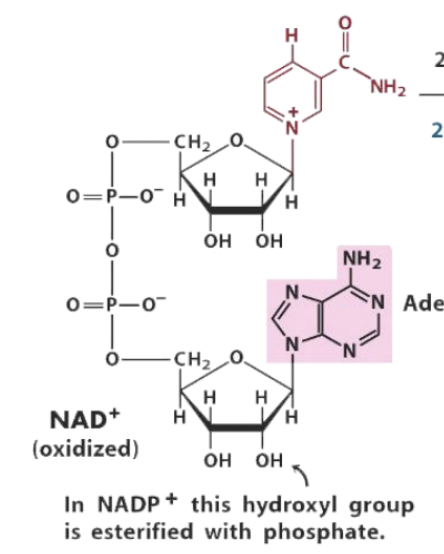
NADH
What is this showing?

Pyruvate Dehydrogenase Complex
what is this showing?

Cobalamin
a colbalt containing cofactor involved in certain rearrangement reactions
Cobalamin
what diagram is this illustrating

Pyridoxal phosphate
what is this showing?

Pyridoxal phosphate
a vitamin B6 derived cofactor that facilitates amino acid chemistry by stabilizing reactive intermediates
It stabilizes otherwise unfavorable carbanion like intermediates through resonance
Why is PLP useful in amino acid reactions?
HIV protease
— contains flexible flaps that msut move to alllow substrate entry and product release

NMR spectroscopy
what can help identify protonation states of catalytic groups?
NMR chemcial shifts, investigating catalytic asparte residues
what graph is this showing?

Liver alcohol
a dehydrogenase uses zinc to faciliate hydride transfer
Zinc
Stabilizes the developing negative charge on oxygen and facilitates hydride transfer to the carbonyl carbon
Carbonic anhydrase
catalyzes reversible interconversion between carbon dioxide and bicarbonate
Electron tunneling
quantum mechanical process that allows an electron to pass through an energy barrier taht would be forbidden by classical mechanics
Electron transfer rates
— depend on the distance between electron donors and acceptors
quantum tunneling
electron transfer can occur by