CF Chapter 17: Limits to the Use of Debt
 Call Kai
 Learn
 Practice Test
 Spaced Repetition
 Match
 Flashcards
 Knowt Play
1/85

There's no tags or description
Looks like no tags are added yet.
86 Terms
What is the result of the optimal capital structure?
Maximize firm value
Minimize cost of capital WACC
What begins to happen when you deploy too much debt? (Cost of Using Debt)
Value of the firm begins to decrease (after previously increasing)
WACC begins to increase (after previously decreasing)
The rate of debt (RD) begins to increase
Firms do not use an infinite amount of debt, why not?
Bankruptcy costs, financial distress costs
Debt puts pressure on the firm since interest and principal payments are obligations
If these obligations are not met, bondholders can force bankruptcy
What happens in a bankruptcy?
Bondholders take over
Ownership of the firm is legally transferred from stockholders to bondholders
If a company experiences $0 to stockholders in a market state, stockholders of that corporation enjoy _______ _______ in that state
limited liability
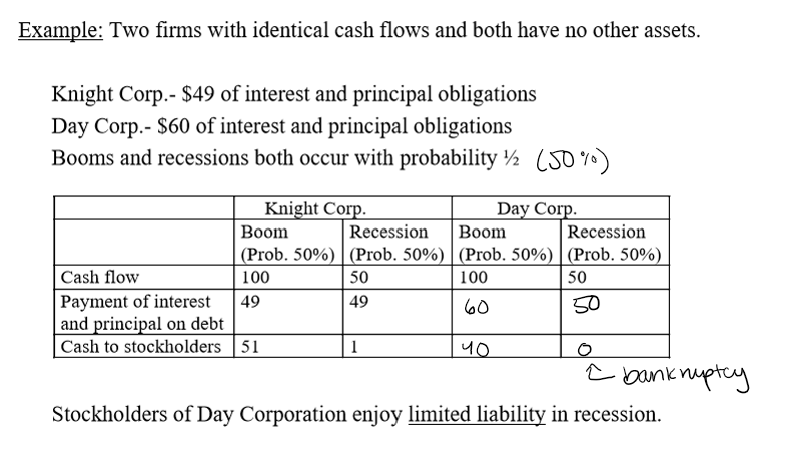
You MUST consider _________ costs
Bankruptcy costs
Why would the prospect of bankruptcy further diminish cash flows?
Lawyers Fees: If bondholders are not paid in full, they will hire lawyers to negotiate or to sue the company. The firm will hire lawyers to defend itself
Further costs will be incurred: Loss in consumer confidence, managers may not take care of equipment
How to translate a bankruptcy cost of $15 into a sentence
“In a default, assume costs are $15”
T/F With bankruptcy, the change in the value of the firm (decrease) is equal to the change debt (decrease)
TRUE
Who bares the cost of the decrease in debt/value of the firm?
Shareholders
The possibility of bankruptcy has a ________ effect on the value of the firm
negative
T/F the risk of the bankruptcy itself is what lowers the value of the firm
FALSE
it is the costs associated with bankruptcy
Who bares the costs of bankruptcy?
Almost ALWAYS equity/shareholders
Bankruptcy Costs are borne by equity holders since debtholders pay fair price for debt by anticipating bankruptcy costs
T/F Equity holders lose value for what they can sell debt for due to bankruptcy costs
TRUE
What are the two kinds of bankruptcy costs?
Direct Costs
Indirect Costs
Agency Costs
Examples of direct costs
Legal expenses
Expert witnesses
Administrative and accounting fees
How large are direct costs
Large firms: on average 3% of market value of firm
Direct bankruptcy costs are larger for smaller firms
Examples of indirect costs
Impaired ability to conduct business
Sales are loss because of impaired service and loss of trust drive customers and suppliers away
Costs can amount to 20% of firm value
Which costs are almost always greater? (Direct, indirect, or agency)
Indirect
Side: Case 2 is about what aspect of bankruptcy costs?
Impaired ability to conduct business
Definition: Agency Costs
When a firm has debt, conflicts of interest arise between stockholders and bondholders. These conflicts are magnified when financial distress (high leverage, debt-agency cost) is incured and impose agency costs on the firm
When a company has high leverage & debt agency cost, what begins to happen?
Debt & Equity begin to impact assets (by increasing RWACC) even though they should be independent
Who has a conflict of interest with the agency cost of equity?
Conflict of interest between managers and shareholders
What are the three agency cost “Strategies”
Incentive to take on excessive risk
Incentive toward underinvest
Milking the property
Taking on Excessive Risk: Explain the two kinds of projects, the projects impact on company value, and which parties would pick each projects (managers, equity holders, debtholders)
Projects: Low Risk and High Risk
Impact
Low Risk project increases the value of the firm more than the high risk project (technically the more optimal project)
The high risk project does not increase the value of the company as much as the low risk project, BUT it increases the value of EQUITY more
What parties choose
Debtholders choose the less risky project because it increases the value of the firm
Managers and equity holders choose project two because it increases the value of equity (equity holders choose the higher risk even though it has less firm value than the other project)
Why are equity holders willing to take on more risk/ier projects?
Because of limited liability
Taking on Excessive Risk: T/F - If debt = 0 then firm value is equal to equity value and there is no preference for which project to take
TRUE
Strategy 2: Incentive towards underinvestment in basic terms
Firm rejects a positive NPV project (because equity holders do not want the project), agency cost of debt
Strategy 2: Incentive towards underinvestment scenario
A firm has $4,000 in debt due next year
Can invest in project that costs $1,000 and pays of $1,700 (NPV = +700, must accept)
KEY ASSUMPTION: Project must be financed by stockholders
When must a project be financed by stockholders?
Happens when a company has too much leverage, debt market refuses to finance the firm, so the firm issues more shares to equity holders
Directly covered in case study

Explaining this picture
If equity holders must cover the cost of $1,000, and their increase in equity is 900, that leaves them with a negative net: -$100, so they will reject the project even though the NPV is negative
This negative 100, gets added onto the positive NPV for debtholders as an asset buffer with NPV, so debtholders like the positive NPV project
Change in debt = NPV - EH net (so if EH net is negative, will get added onto change in debt)
Strategy 3: Milking the property
Managers or shareholders would have incentives to pay out large extra dividends, especially in times of financial distress, leaving less in the firm for bondholders. This is known as “milking the property”
Example of Milking the Property: Liquidating dividends
Suppose a firm pays out a large dividend to the shareholders and this leaves the firm insolvent, with nothing for bondholders, but plenty for the former shareholders
Such tactics often violate bond indentures
How to reduce milking the property from a bondholder’s perspective
A debt covenant
(**Note: there is no perfect covenant)
Definition: Covenant
Clauses in debt contracts to avoid inefficient behavior
Difficult to write the “perfect” contract, both comes with cost
Examples of negative covenants
Restrictions on dividends
Restriction on using assets for new collateral
Restrictions on mergers
Why? → Mergers hare high risk projects (agency cost #1: take on excessive risk)
Restriction on asset sales
Restrictions on new borrowing
Examples of positive covenants
Must maintain certain financial ratios indicating financial health
Provide financial statements to lender
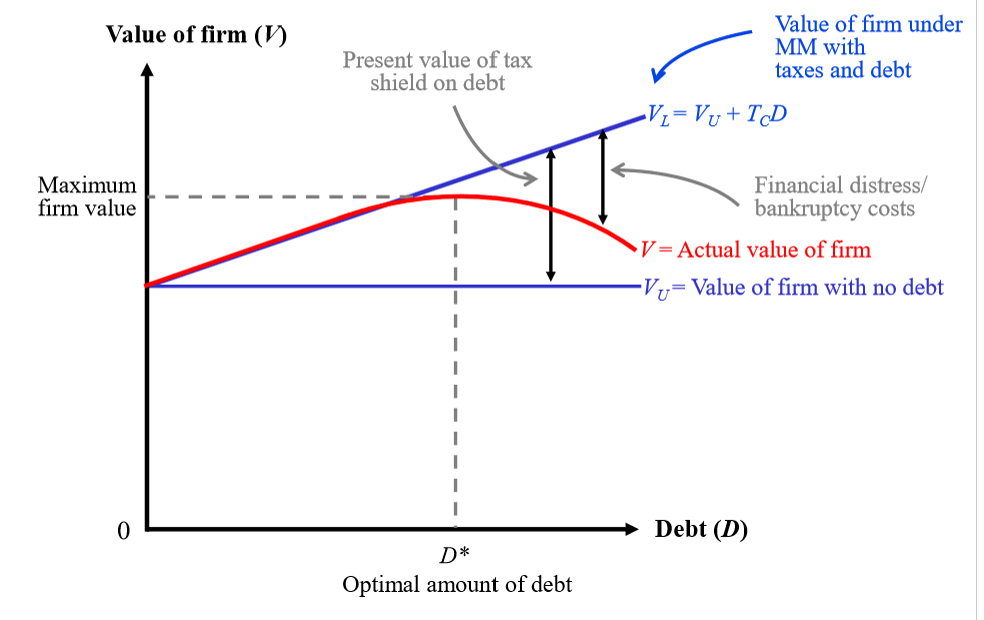
Graph with considerations of perfect world, with tax, with bankruptcy costs

Optimal Capital structure considering M&M propositions with taxes in Chapter 16
A firm will borrow because the interest tax shield is valuable
Optimal Capital Structure Considering Bankruptcy Costs
At relatively low debt levels, the probability of bankruptcy is low, and the benefit from debt outweighs the cost
At very high debt levels, the probability of financial distress/bankruptcy is very high, so the bankruptcy costs outweigh the benefit from debt financing
An optimal capital structure would exist somewhere in between these extremes
Trade off theory of firm value with debt
Evidence related to tradeoff theory (4 pieces)
Strong industry trends in capital structure (highest leverage, lowest cost of debt)
Firms/industries with high costs of debt financing tend to use less debt
Firms/industries with high benefits of debt financing tend to use more debt
Evidence that firms behave as if they had a target debt-equity ratio
Expansion: Firms/industries with high costs of debt financing tend to use less debt
firms with lots of tangible assets (ex: employee talent, growth opportunities)
firms with unique or specialized assets (cannot easily sell in market → ex: pharm, IT)
Expansion: Firms/industries with high benefits of debt financing tend to use more debt
Firms with lots of tangible assets (hotel, real estate)
Firms with very stable cash flow
Expansion: There is evidence that firms behave as if they had a target debt-equity ratio
Ex: Firms experiencing “shocks” to their debt ratios due to major issuance activity or change in stock price subsequently rebalance
2008 Market Collapse: Wanted to go back to old cost of debt means that it was believed that the prior cost of debt was the optimal cost of debt
Who has a conflict of interest with agency cost of debt? What are the three kinds?
Debt and equity holders have conflicting interest
Take on excessive risk
Underinvestment
Milking property
Who has a conflict of interest with cost of equity?
Managers and equity holders
Diffuse of ownership
How do you reduce the agency cost of equity
Reduce by using debt
Two Agency costs of equity scenarios
Choice 1: Issue $2 million in bonds at 12%. Employee who owns stock retains 100% of equity
Choice 2: Issue $2 million in stock. Employee who owns stock retains only 33% of firm’s equity
With the two choices, what happens with the employee’s incentive to work hard?
Choice 1: Issue $2 million in bonds at 12%. Employee who owns stock retains 100% of equity
More incentive to work hard
100,000 equity increase (full amount)
Choice 2: Issue $2 million in stock. Employee who owns stock retains only 33% of firm’s equity
Less incentive to work hard
equity increase is 100,000(1/3) = $33,333
Agency cost of debt scenario conclusion
Incentive for a manager/employee with stock to work hard is higher with debt financing
Other than less motivation to work hard, what is another problem with equity financing?
Prerequisite consumption
Ex: Big office, a company car, more expense account meals
Who pays for the agency cost of equity?
The manager/management
What may help reduce the agency cost of equity problem?
Leverage Buyout (LBO) may help reduce the agency cost of equity problem
What kind of companies are a target of a private equity takeover and why?
Companies that are doing poorly because they are a lot cheaper to buy into
Private Equity holders takeover poor management
Once they take over, captures all profit (choice one from previous scenario)
Definition: Free Cash Flow
Excessive Cash left over after projects are taken on
Hypothesis for the question: Can the agency costs of equity be reduced?
Free Cash Flow Hypothesis
2 statements from the Free Cash Flow Hypothesis
An increase in dividends should benefit stockholders by reducing the ability of managers to pursue wasteful activities
An increase in debt will reduce the ability of managers to pursue wasteful activities more effectively than dividend increases
**Additional side: Also argues that can waste FCF on negative NPV projects (and take on unreasonably risky projects?)
Recap of the Free Cash Flow Hypothesis
Increasing dividends and debt both use up FCF and require managers to not be wasteful because they are obligated to pay back holders (makes it effective)
What is more expensive?
A personal tax on a dividend gain OR a tax on debt interest
A tax on debt interest
(Personal Taxes) Investors ultimately care about…
the money that ends up in their pocket
Personal Taxes: Dividends vs. Capital Gains
Many firms do not pay out all earnings as dividends
Allows investors to take equity return as a capital gain
Allows investors to defer personal taxes into the future
What does Te mean
Effective personal tax on each dollar of earnings
What does TD mean?
Effective personal tax rate on each dollar of interest
Will personal taxes result in companies using more or less debt?
Less (because the tax on debt is more expensive than the personal tax on a dividend gain)
Value of debt also decreases
What would happen if the personal tax rate decreased?
Equity holders would pay less tax
How to convert annual cash flows into firm values (equation)

Equation for firm value if TD = TE
VL = VU + TCD
Equation for firm value if TD = TE = TC
VL = VU
Value gain from leverage decreases as TD - TE _________
increases
Can use this to predict how tax changes corporate tax structure
If you are in favor of personal tax, which kind of financing should you go for?
Equity financing
If not in favor of personal tax, which kind of financing should you go for
Debt financing
If corporate taxes increase, should you use more or less debt?
Use more debt
What are the two sides of the equation
(1-TC )(1 - TE) = (1 - TD )
Goes to EH = Goes to DH
(1-TC )(1 - TE) = (1 - TD ) when firm value…
VL = VU
(1-TC )(1 - TE) > (1 - TD ) when firm value…
Money going to equity financing is greater, so equity financing is better…
VL < VU
(1-TC )(1 - TE) < (1 - TD ) when firm value…
VL > VU
Graph visual of the different inequality scenarios

Do examples on slides 23-24
ok
If you do not have a well developed stock market, what do you use?
The bank
If the US government raises personal tax rate…
Value of the company decreases due to leverage
If TE = 0 what does the government want to do?
Help the stock market & drive more investment into equity
Most corporations have high or low debt-asset ratios?
low
The market likes or dislikes increases in leverage?
LIKES
Leverage increase is met with a positive market reaction
Leverage decrease is met with a negative market reaction
Why might leverage vary substantially across industries?
Depending on their assets/products are tangible (high leverage, hard assets) vs intangible (low leverage, products/ideas are a lot harder to sell if takeover occurs)
Practical considerations (5)
Corporations that have lots of taxable income should have a preference for debt
Firms with intangible assets such as R&D, talented employees, will have higher bankruptcy costs → should use less debt
Firms in risky industries have a high probability of financial distress → should use less debt
If stable, then use more debt
If firms prefer internal finance (like retained earnings) to external finance (like new debt issues, new equity issues). New issues are costly
Following industry norms in capital structure decisions may be a very safe strategy