Day 21 - spherical mirror and thin lens
 Call Kai
 Learn
 Practice Test
 Spaced Repetition
 Match
 Flashcards
 Knowt Play
1/100

There's no tags or description
Looks like no tags are added yet.
101 Terms
the _____ is the thing producing/emitting the light rays
object
the _______ is where the light rays appear to come from OR actually converge
image
what does virtual mean?
rays ONLY appear to come from a point actually diverge
what does real mean?
actual rays converge
to have the same orientation means to be..
upright
to be upside means to be…
inverted
the sign of image distance is connected to what?
real/virtual
the sign of magnification is connected to what?
upright/inverted
what variable is associated with image distance?
s’
What are the two (2) sign rules regarding image distance?
+s’ (real image)
—s’ (virtual image)
If you have positive image distance (+s’) that means you have what type of image?
real image
If you have negative image distance (—s’) that means you have what type of image?
virtual image
a virtual image produces what type of image distance?
negative image distance (—s')
a real image produces what type of image distance?
positive image distance (+s’)
if s’ is less than 0 than you have a ______ image
virtual
If s’ is more than 0 you have _______ image
real
what variable represents magnification?
m
m represents….
magnification
if you have a positive magnification you have an _______ image (inverted/upright)
upright
if +m then your image is…(inverted/upright)
upright
if you have a negative magnification your image is…(inverted/upright)
inverted
if —m then the image is…(inverted/upright)
inverted
True or false?
when m =1 then your image and object are the same size
True
Memorize this info
Positive image distance = real.
Negative image distance = virtual.
Positive magnification = upright.
Negative magnification = inverted.
What formula(s) can be used to solve for magnification?
m= —s’ /s OR m= h’ / h
True or false?
the absolute value of magnification tells you how large the image is relative to the object?
True
Memorize this info about absolute value of magnification
|m| > 1 → MAGNIFIED 🔍
|m| = 1 → SAME SIZE
|m| < 1 → REDUCED
if the absolute value of m is equal to one (1) then your image is…
the same size as your object
if the absolute value of m is greater than 1 (m>1) then the image is…
magnified
if the absolute value of m is less than one (m<1), the image is …
reduced
Example: m = —2
What information can be gather about the image?
the image is inverted because m < 0
the image is magnified because the |m| = 2 which is greater than 1
the image is 2x the size of the object
What are the two (2) types of spherical mirrors?
Concave mirrors
Convex mirrors

A concave mirror’s edges curve ______ the light source
toward
Is a concave mirror converging or diverging?
converging

With a concave mirror, parallel rays reflect toward a _____ _____
focal point
Convex mirror’s edges curve ____ from the light source
away
Is a convex mirror considered converging or diverging?
diverging
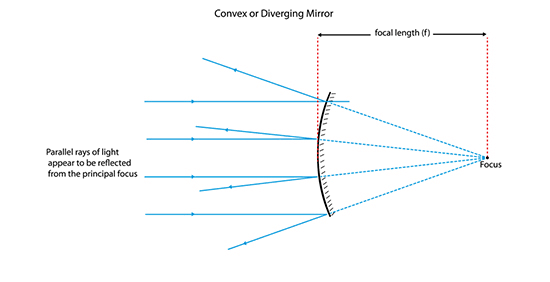
With a convex mirror, the reflected rays spread apart or come together?
spread apart
Where do convex mirrors’ ray extensions appear to originate from?
from behind the mirror
What type of image do convex mirrors ALWAYS produce?
virtual images
Virtual images are always produced with convex or concave mirrors?
convex mirrors
convex mirror & concave mirrors produce virtual images HOWEVER only convex mirrors ALWAYS produce virtual images
Where do parallel rays of light converge/meet at?
the focal point
Where do parallel rays of light appear to diverge at (when tracing backward)?
the focal point
The focal point represented by what veriable?
F (capital f)
where is the mirror’s vertex?
right down the middle (vertically) of the mirror

The distance between the mirror’s vertex to the focal point (F) is known as the
focal length (f)
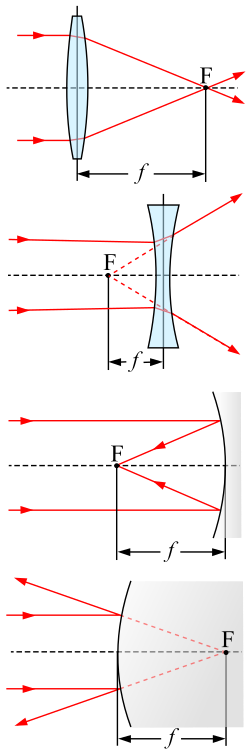
How is focal length calculated for curved mirrors?
f = R/2
f = focal length
R = radius of curvature of mirror
What does R represent has it relates to curved mirrors?
the radius of curvature
If you want to find the radius of curvature for a curved mirror, what equation could you use?
R = 2f
because f=R/2
Example: a concave mirror has R = 20cm. What is f?
f = R/2 so 20cm/2 equals 10cm
f= 10cm
A concave mirror always has a Radius...
greater than 0
positive
A convex mirror has a Radius that is…
less than 0
negative
A convex mirror has a _______ radius
negative
A concave mirror has a _______ radius
positive
a concave mirror has a negative or positive focal length (f)?
positive focal length
a convex mirror has a negative or positive focal length (f)?
negative focal point
Is the focal point and radius considered a inverse or direct relationship (because of their signs)?
f and R have a direct relationship
+f, +R → concave mirror
-f, -R → convex mirror
What is the mirror equation?
1/f = 1/s + 1/s’
f = focal length
s = object distance
s’ = image distance
used to solve for curved mirrors
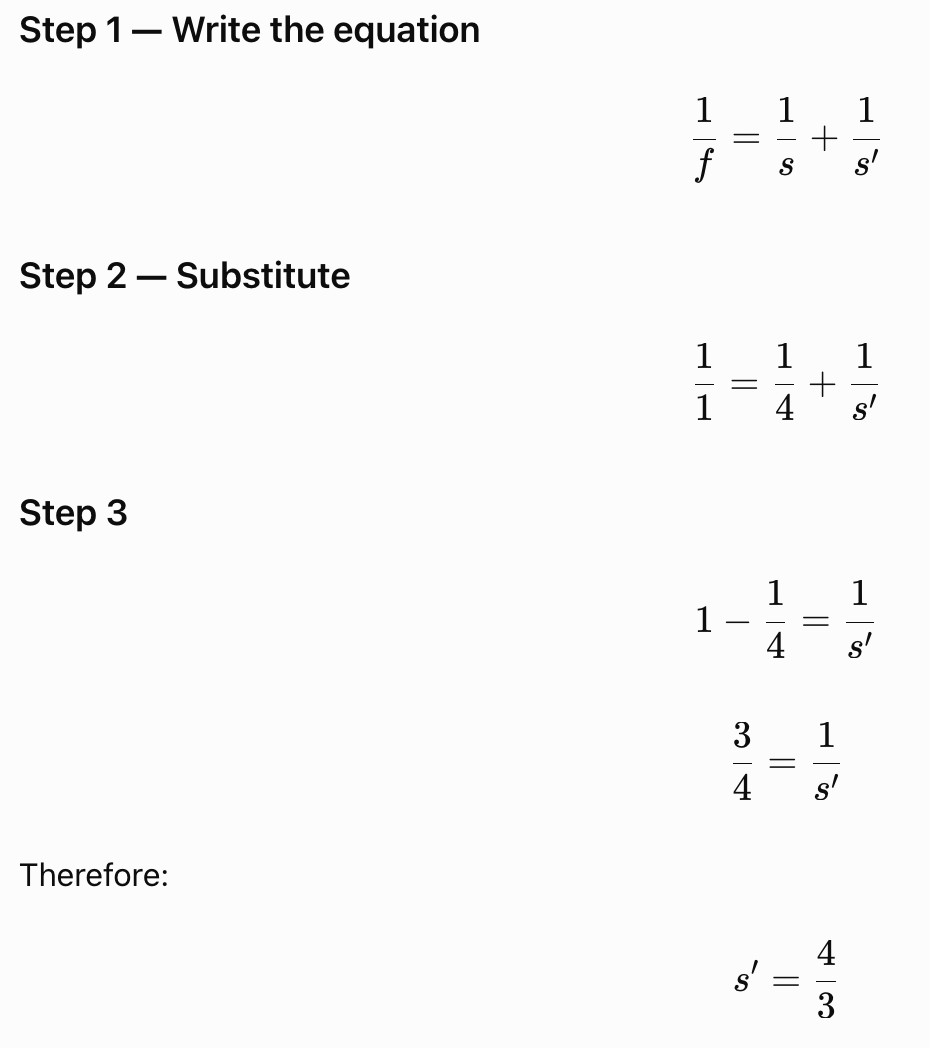
Example: An object is 4.0 m from a concave mirror with f = +1.0 m. Find and describe the image
f is positive so concave mirror
s’ = + 1.33m → REAL image
m = -0.3325 →inverted
absolute value of m = 0.3325 →reduced
What are the two types of lenses?
converging lens
diverging lens
Which lens is thicker in the middle?
converging lens
What do converging lenses do to parallel rays?
they bring parallel rays together
What is one contribute associated with converging lenses?
they are thick in the middle

What are examples of converging lenses?
meniscus
planoconvex
double convex

Because converging lenses have a thick center, their focal length is _______-
positive
Converging lenses have a positive _____ _____
focal length
What mirror(s) and lens(es) are associated with positive focal length (+f) ?
Mirror: concave mirror
Lens: convex lens
both are converging
Are diverging lens or converging lens thin in the middle?
diverging lens are thin in the middle
Describe the center of a diverging lens
the center is thin
What type of lens are considered diverging lenses?
meniscus
planoconcave
double concave
The diverging lens has a ________ focal length
negative
Diverging lenses have a negative focal length
True or false?
true
What do diverging lens do to rays?
it spreads rays apart
Why does a magnifying glass work?
a magnifying glass uses a converging lens, s<f, image is upright + virtual+ magnified
The object distance (s) is less than the focal length(f) when using a magnifying glass (converging lens).
True or false?
True
If the object distance (s) is less than the focal length (f) then that means the object is…
inside F
Describe the object distance as it relates to a congvering lens
s < f
object distance is less than focal length
What other instruments use converging lenses?
magnifying glass
microscopes
binoculars
The resulting image of a binocular, microscope, or magnifying glass results in what type of image?
upright
magnified
virtual image
Which lens can start a fire?
converging lens
The sun sends ______ rays toward the lens.
parallel
When light enters a converging lens, at the focal point the light energy is _________ into a small region
concentrated
True or false?
converging = concentrates light
True
The thin lens equation is the same as what equation?
mirror equation
The mirror lens equation is the same as the…
thin lens equation
Memorize chart

memorize chart

What is the formula for Lens Power?
P = 1/f
f MUST be in meters
f = focal length in meters
This formula: P =1/f relates to what?
Lens Power
In Lens Power formula, f MUST be measured in which unit?
Meters
When you get your answer after using the Lens Power equation, your answer should be written in what unit?
Diopter
variable: D
Diopter is represented by which variable?
D
D represents which unit of measurement?
Diopter when solving for Lens Power
Example: f = 50cm
Solve for Lens Power
use P = 1/f
Convert 50 cm to meters → 0.50 m
Plug into equation
1/0.50 = 2 D
What is the relationship between the focal length and power?
An inverse relationship
If you have short focal length the power is
large power
If you have long focal length, what is power like?
small power
*i meant to include this flashcard as an earlier concept myb
What is the principle axis?
an imaginary straight line that pass through the center of a lens
horizontal axis
also known as the optical axis
NOTE
ALWAYS DRAW OUT THE RAYS
this will help you especially if you are a visual learner
Study this chart
