Vision
 Call Kai
 Learn
 Practice Test
 Spaced Repetition
 Match
 Flashcards
 Knowt Play
1/53

Earn XP
54 Terms
What are the 4 measured components of light?
wavelength
intensity
changes in time
changes in space
What are the units for rate of emission?
Candela
a 60W bulb gives about 100cd
How is light received measured?
Illuminance (lux)
Light received/unit area
full sunlight ~ 100,000 lux
What is the measure of scattered light?
Luminance (cd/m²)
What is albedo?
The light transmitted as a fraction of the light received
Luminance/illuminance
What are the 3 types of vision and their associated light levels and receptor cells?
Phototopic
well lit
rods are saturated
uses cones
mesoscopic
medium lighting
uses both rods and cones
scotopic
dim light
below cone threshold
uses rods
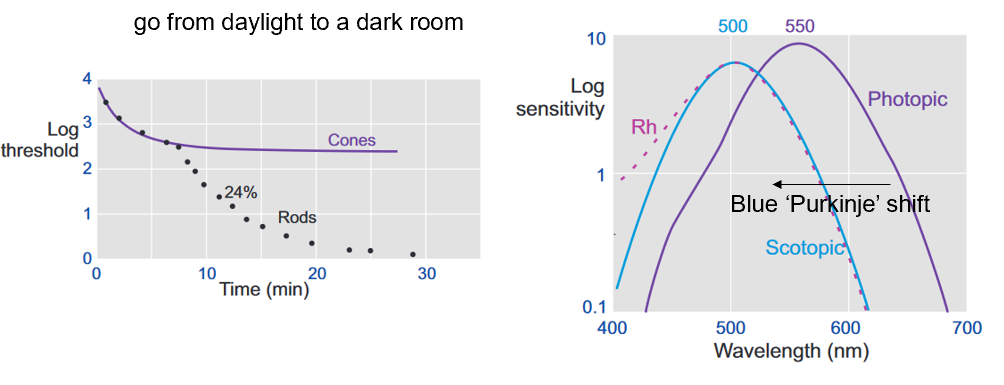
What are the 2 ways and timescales that light receptor cells adapt to the dark?
Initial lowering of threshold for both rods and cones (8mins)
Rods shift to become more sensitive to blue light
What is the formula for contrast and why is contrast used by the eye?
C = (L1-L2) / (L1+L2)
Contrast remains constant for objects and doesn’t change with lighting levels
Where is the light focused in the centre of vision?
Onto the fovea
Which organs focus the light and how refractive are they?
Lens - 19D
Cornea - 57D
How do you calculate the power of a refractive surface?
1/focal length
If measured in a refractive medium then you should multiply it by the refractive index
What is the role of the lens?
Changes shape to alter the focal length by contraction of the cilliary muscle
Define emmetropia
perfect vision
What is myopia and how is it fixed?
Short sightednesss
fixed with a negative lens
What is hypermetropia and how is it fixed?
Long sightedness
positive lens
How does astigmatism cause error?
Curvature of cornea is different in different meridians, so light in a horizontal plane is refracted differently to vertical light.
What 4 optical factors can cause errors of image formation?
Chromatic aberration
spherical aberration
glare
diffraction
How does chromatic aberration impair vision and how does the body react?
Refractive index decreases with wavelength of light
blue light is more refracted than red
monochromatic yellow light gives 25% better acuity
body covers fovea with a yellow pigment
improves acuity at cost of letting less light in
fewer blue cones are in the centre of the fovea
What is spherical aberration and how is it fixed?
lens is a sphere not an ellipsoid
spheres bend light too much at the edges so light becomes unfocused in periphery
body closes pupil to let less light in around edge
can make lenses out of cyclinders to fix
What is glare?
The scattering of light inside the eye, by the lens or cornea, or reflection off the retina
How does diffraction hinder sight?
light spread out more when passing through a smaller aperture, so gets worse when pupil constricts
What is the point spread function?
Light spreading out before it reaches the retina
What are the 2 pupil muscles, their functions and nervous systems?
constrictor (sphincter pupillae)
around circumfirence of iris
allows closing of pupil
parasynpathetic
dilator
radially around iris
increases pupil size
sympathetic
What is the tradeoff influencing pupil size?
Balancing error due to refractive errors, glare, and other aberrations against diffraction
What are the 3 types of cone cell?
Long, medium and short wave receptors
How do rod cells transduce light?
Rod cell is depolarised when at rest
Light stimulation to rhodopsin causes cGMP Na+ channels to close
causes hyperpolarisation
What are the chemical components to rhodopsin?
opsin
large peptide
loops disk membrane 7 times
Retinal
has 11-cis and all-trans form
when light hits, goes from 11-cis to all-trans
What is the molecular process behind rod hyperpolarisation?
Stimulated rhodopsin activates transducin
transducin activates a phosphodiesterasae
phosphsdiesterase decreases cGMP concentration
channels close
depolarisation
How do afterimages form?
If they’re flashed with a bright light then receoptors can saturate and remain hyperpolarised for a bit.
What is a receptive feild?
The area on the retina where a cell is responsive to light.
Can be neurones furhter up the chain as well as rods and cones
What are the 2 pahtways from a receptor cell, how do they connect and what are they stimulated by?
On
sign inverting projection
excited by the cone being hyperpolarised
Off
sign preserving connection
excited by cone being depalarised
excited by darkness
What is the use of lateral inhibition?
Increases sensitivity to contrast
What is the nature of the receptive field of a bipolar cell?
Centre-surround receptive field
How is the centre-surround receptive field of a bipolar cell achieved?
The bipolar cell connects directly to its centre
Connects via horizontal cell to surround
How does information from rods integrate with information from the cones?
Amacrine cells (above the rod bipolar cells) project to the cone bipolar cells
How does the eye react to light intensity change?
Pupil can change size from 2mm to 8mm diameter
Photoreceptors can change sensitivity
How does a photoreceptor change its sensitivity?
Some way as it depolarises
Increased light exposure increases rhodopsin activity
more transducin is activated
Phosphodiesterase becomes more active
Less cGMP
Fewer channels open so less Ca2+ influx
less Ca2+ means less active rhodopsin
What are the types of ganglion cells, their features and ratios?
Magno
5% of ganglion cells
llarger Rf
faster and more transient, lower threshold
Parvo
90% of ganglion cells
smaller RF
slower, longer signals, but higher threshold
can be sensitive to differences in wavelength, so colours can cancel each other out
Red-green
blue-yellow
non-P, non-M
5%
do other stuff
What 2 theories have informed our understanding of colour perception?
Trichomic theory
any natural light can be made by combining Red, Blue, and Green
Opponent process theory
There are some colour combinations that we’ll never see like reddish greeen or blueish yellow
What are the causes and prevelances for colour-blindness?
Caused by only have 2 out of 3 types of cones
1% of men don’t have L and 1% don’t have M
0.1% of all people don’t have S
What are the direction terms for the sides of the retina?
Nasal and temoral
How where does the nasal side of each retina transfer to?
The contralateral side
What is the pathway visual signals take to get to the brain?
Optic nerve
Optic chiasm (meeting point of optic nerves)
Optic tract
What are the targets of the optic tract and what do they do?
Lateral geniculate nucleus
Main gateway to primary visual cortex
Target of 90% of retinal ganglion cells
underlies concious peception
Superior colliculus
target of 10% of retinal ganglion cells
Good response to moving objects
fight or flight response
Motor command signals to help plan and generate eye movement
Non-imageforming pathways
Hypothalamus
Synchronising biological rhythms
Prectectum
Controls pupil size
Where does the optic tract project to in non-primates?
Superior colliculus is the main target for non-primates
90% of retinal ganglion cells in mice with only 35% going to the LGN
Superior colliculus is called the Optic tectum in non-mammalian vertebrates and is a major target
How does the signal get from the Lateral Geniculate Nucleus to the Visual Cortex?
Via the Optic radiation
What is cortical blindness and it’s cause?
No concious perception of light
Still reacts to stimuli
Will catch a ball, but can tell you anything’s coming towards them
Caused by a lesion somewhere in the pathway from eye to end of optic radiation
What is the structure of the lateral Geniculate nucleus?
6 layers bent like a knee joint
number 1 is most ventral
Where do the areas of the retina synapse in the Lateral Geniculate Nucleus?
Temporal retinal signals synapse on 2,3 and 5 on their ipsilateral side
Nasal retinal signals go to 1,4 and 6 on their contralateral side
What is the input for each layer of the Lateral Geniculate Nucleus and how big are the neurones?
Layers 1 and 2
Magnocellular (input from M cells)
Larger neurones
Layers 3, 4, 5 and 6
parvocellular (input from P cells)
smaller neurones
Where do non-P non-M cells project to in the LGN?
K1-K6
Gaps ventral to each principal layer
What are the features of the different types of LGN cells?
Magnocellular LGN cells
Large centre-surround receptive feild
Transient response
Insensitive to wavelength differences
Parvocellular cells
Small centre-surround RF
sustained response
Can have colour opponency
Koniocellular cells
centre surround
either light/dark or colour opponency
What are the layers of the Primary visual cortex (V1)?
I
II
III
IV
A
B
C
Alpha
Beta
V
VI