UNT A&P 1 Exam 3
 Call Kai
 Learn
 Practice Test
 Spaced Repetition
 Match
 Flashcards
 Knowt Play
1/62

There's no tags or description
Looks like no tags are added yet.
Name | Mastery | Learn | Test | Matching | Spaced | Call with Kai | Chat |
|---|
No analytics yet
Send a link to your students to track their progress
63 Terms

What two types of tissues compose muscles?
Skeletal muscle tissue and dense regular connective tissue.
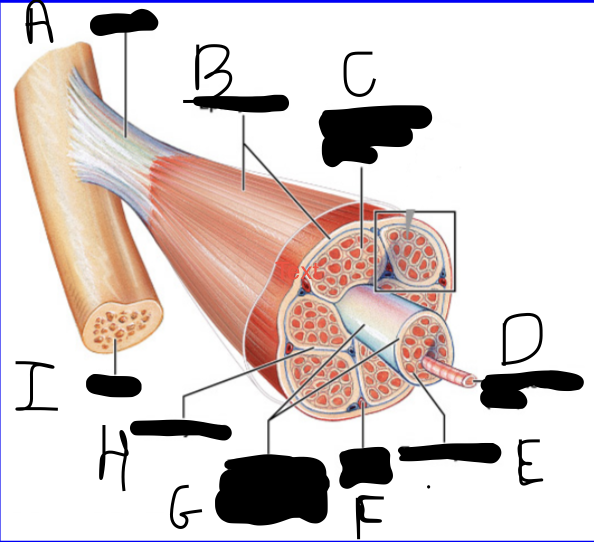
Identify structure A?
Tendon

Identify structure B?
Epimysium
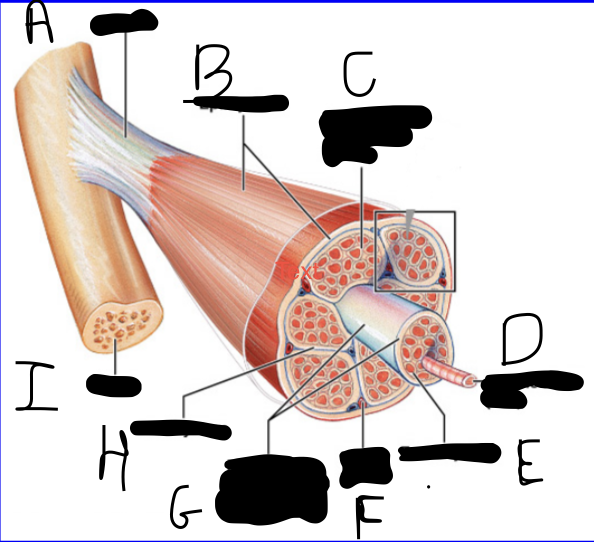
Identify structure C?
Endomysium (between fibers)
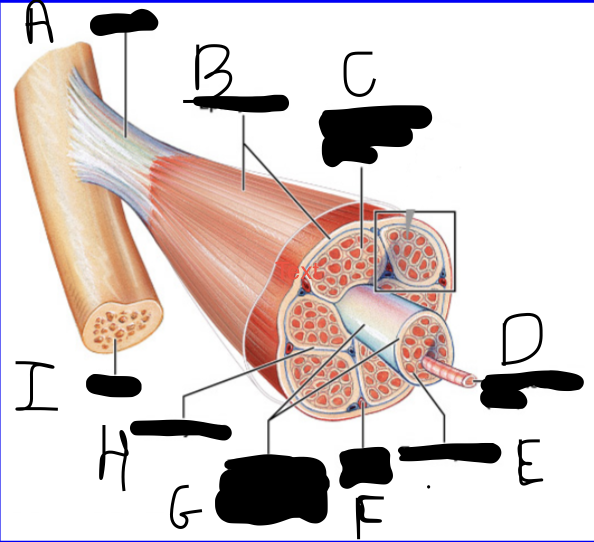
Identify structure D?
Muscle fiber (cell)
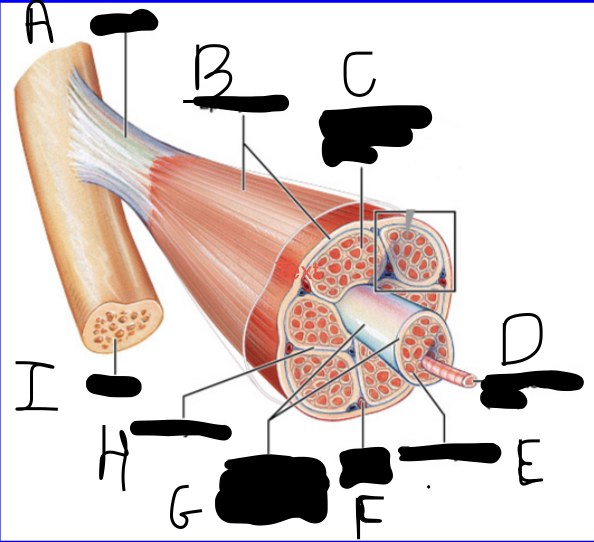
Identify structure E?
Endomysium

Identify structure F?
Blood vessel

Identify structure G?
Fascicle (wrapped by perimysium)
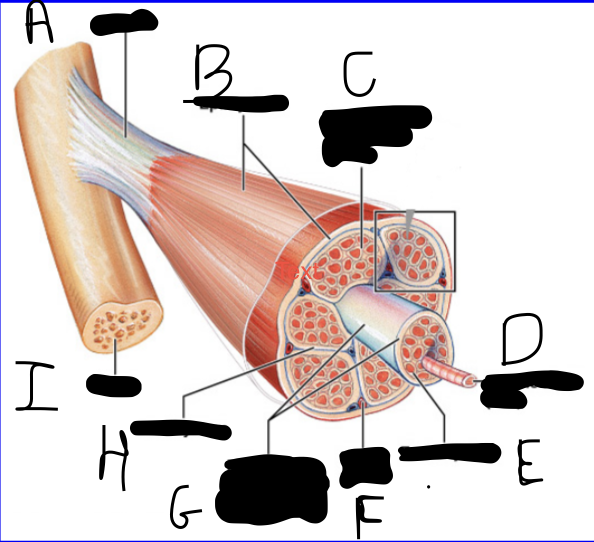
Identify structure H?
Perimysium

Identify structure I?
Bone
What tissue covers individual muscle fibers?
Endomysium - connective tissue sheath.
What tissue covers the fascicles?
Perimysium - connective tissue sheath.
What structure do blood vessels and nerves travel through in muscles?
The perimysium
What tissue covers entire muscle tissue?
Epimysium - a connective tissue sheath
What structure is formed from all the connective tissue sheaths of the muscles collagen fibers coming together?
Tendon
Tendon
Join muscles to muscles or bones to muscles. All of their collagen fibers are parallel so they are strong along their long axis.
Aponeuroses
Flat sheet of tendon
Origin of muscle?
immoveable attachment site of a muscle
Insertion of muscle?
moveable attachment site of a muscle.
Prime mover
AKA agonist; primary muscle responsible for a given movement
Antagonists
Muscles that oppose a given movement.
Synergist
Aid agonists by preventing unwanted movement in particular joints
Fixator
special type of synergist that immobilizes the origin of another muscle
Criteria for naming muscles:
1) direction of muscle fibers, 2) relative size of the muscle, 3) location of the muscle, 4) number of origins, 5) location of origin and insertion, 6) shape of the muscle, 7) action produced by the muscle.
Rectus muscle
has fibers parallel to the axis
Transverse muscle
has fibers perpendicular to the axis
Oblique muscles
run at an angle to the axis
Maximus muscles
largest of a group of muscles
Minimus muscles
smallest of a group of muscles
Longus muscles
longest of a group of muscles
Brevis muscles
shortest of a group of muscles
Root -ceps
means head, or origin. Ex: biceps brachialis would be a muscle with two origins overlying the brachium
When naming muscles depending on the location of origins and insertions, does the origin or insertion name come first?
Origin. Ex: sternocleidomastoid muscle; two origins (sternum and clavicle) and one insertion (mastoid process of temporal bone).

Deltoid muscle
muscle with triangular shape (like the greek letter delta Δ)

Rhomboideus muscle
muscle shaped like a rhomboid

Trapezius muscle
muscle shaped like a trapezoid
Flexor digitorum muscles
cause flexion at the joints of the digits: example of muscle named from its action
Adductor longus muscle
adducts the thigh at the hip joint; example of muscle named from its action

Identify this structure?
Skeletal muscle; longitudinal section

Identify this structure?
Skeletal muscle; cross section

Identify this structure?
Neuromuscular junction

Identify structure A?
Corrugator supercilli
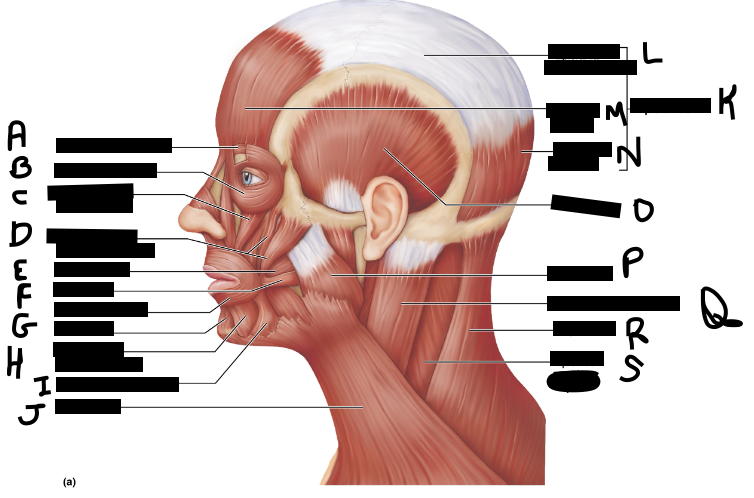
Identify structure B?
Orbicularis oculi
One action, one origin, and one insertion for Orbicularis oculi?
Action: closes eye lids
Origin: frontal bone
Insertion: skin of orbital region

Identify structure C?
Levator labii superioris

Identify structure D?
Zygomaticus minor and major
One action, one origin, and one insertion for Zygomaticus major?
Action: elevates and draws angle of mouth upward for smile or laugh
Origin: lateral surface of the zygomatic bone
Insertion: angle of the mouth (modiolus)
One action, one origin, and one insertion for Zygomaticus minor?
Action: elevates upper lip (helps form smile)
Origin: anterior surface of zygomatic bone
Insertion: mascular tissue and skin of upper lip

Identify structure E?
Buccinator
One action, one origin, and one insertion for Buccinator?
Action: compresses cheek against molar teeth during mastication
Origin: Alveolar process of the maxilla
Insertion: Modiolus
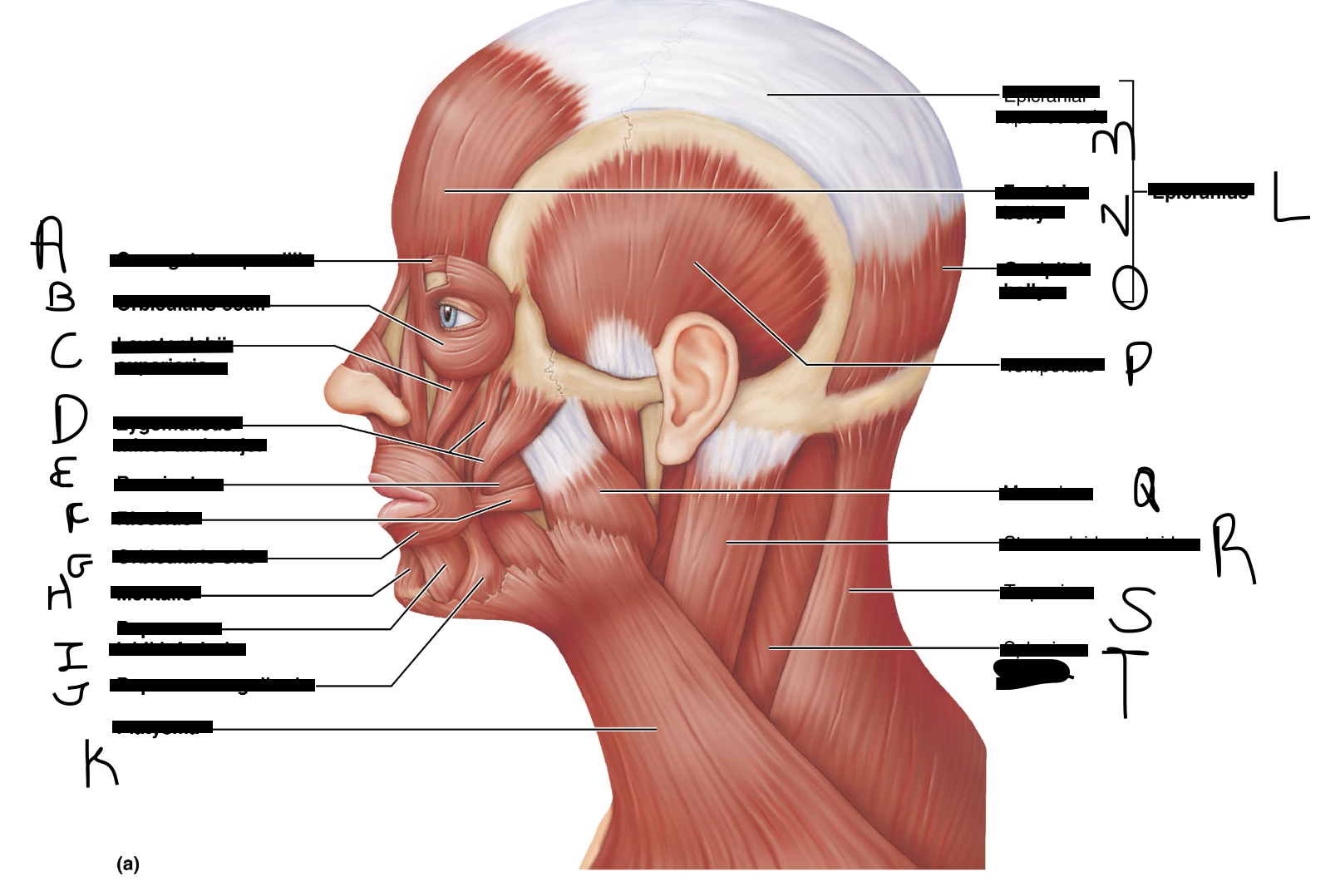
Identify structure G?
Orbicularis oris

Identify structure H?
Mentalis
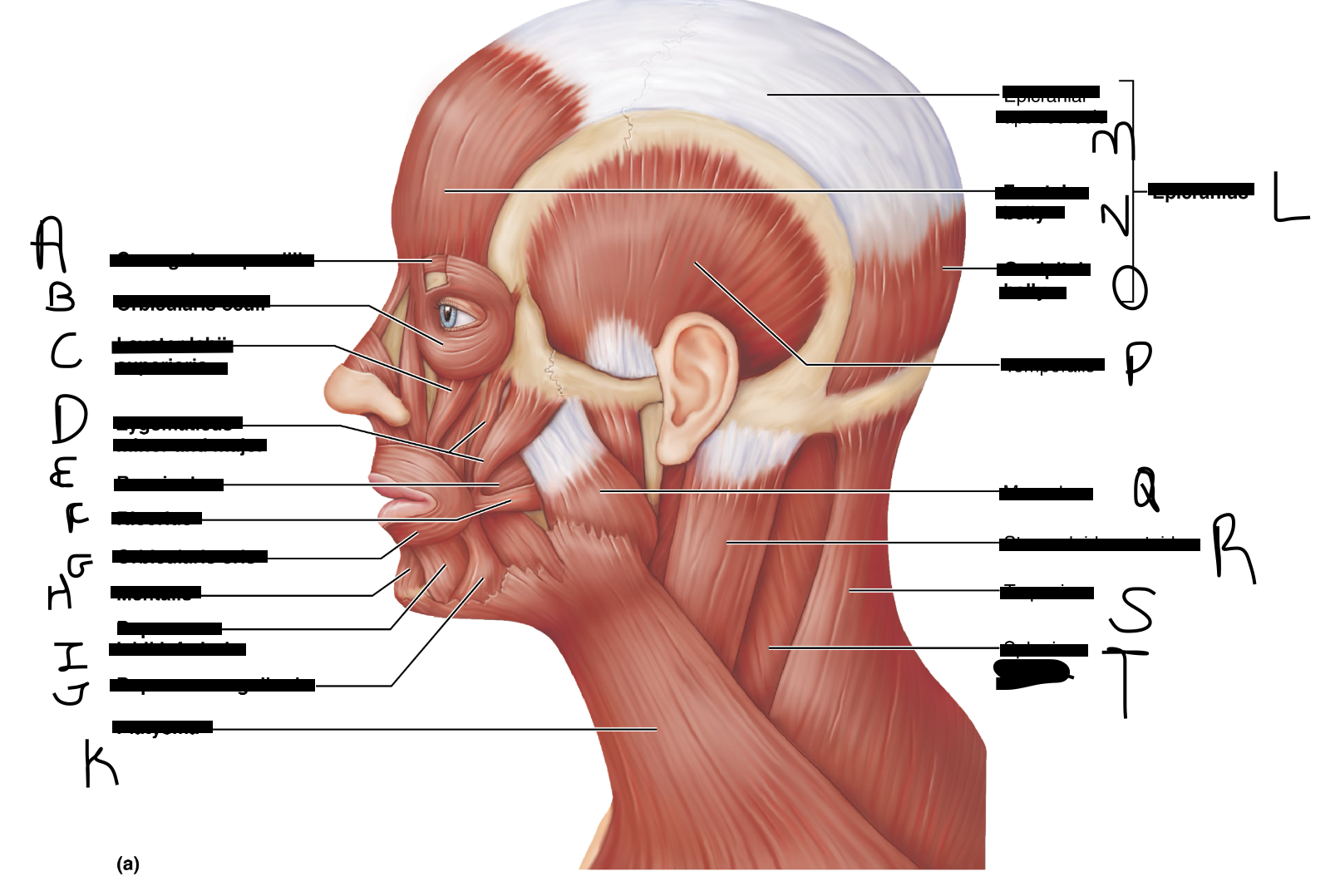
Identify structure I?
Depressor labii inferioris

Identify structure L?
Epicranius
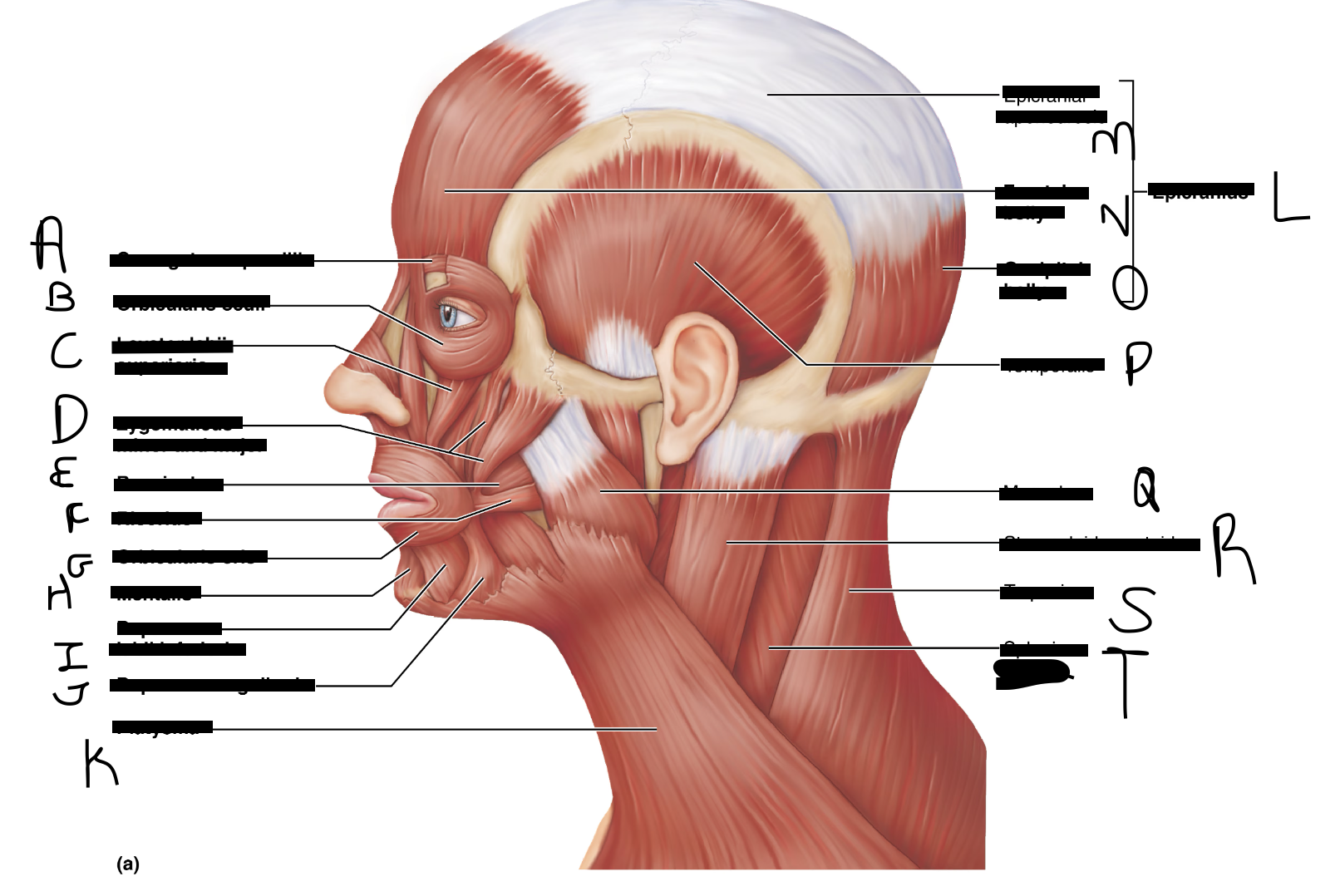
Identify structure N?
Frontal belly

Identify structure O?
Occipital belly

Identify structure P?
Temporalis

Identify structure Q?
Masseter
One action, one origin, and one insertion for Masseter?
Action: elevation of the mandible (closes the jaw)
Origin: Zygomatic arch
Insertion: lateral surface of the angle

Identify structure A?
Orbicularis oris

Identify structure B?
Buccinator

Identify structure D?
Temporalis

Identify structure E?
Masseter