Evolution of terrestrial ecosystems
 Call Kai
 Learn
 Practice Test
 Spaced Repetition
 Match
 Flashcards
 Knowt Play
1/6

There's no tags or description
Looks like no tags are added yet.
7 Terms
What is the miocene biota of Ribesalbes, Spain?
The atmospheric and climate barriers of life on terrestrial ecosystems
Variation in solar luminosity (how bright the sun is, this has been increasing over time. when life first evolved the sun was much dimmer)
Orbital parameters - how earths orbit changes around the sun.
Atmosphere and hydrosphere composition and dynamics → humidity, oxygen levels
Continental configuration → pangea
Planetary albedo (surface and cloud reflectance, this changes with the amount of vegetation on the surface).
What are the Milankovitch cycles
Changes in shape of the earth’s orbit - this is known as eccentricity.
The angle Earth’s axis is tilted with respect to Earth’s orbital plane, known as obliquity;
The direction Earths axis of rotation is pointed, known as precession.
Physiological problems associated with life on land
Water balance
Availability of essential nutrients and gases (Easier to gather these when it flows in the water right by you)
Support → gravity.
Protection from UV-B radiation
Reproduction in a non-aqueous environment - amniote egg (shelled with gas exchange organs)
How plants overcame the barriers of life on land:
Water balance (water is no longer everywhere (ubiquitous), they need to use systems like a xylem and a phloem
Availability of essential nutrients and gases and have to collect them from the soil and atmosphere using roots and stomata.
Support ( No longer in the supporting medium water therefore use stiff lignified conducting tissues)
UV-B protection (no longer protected by water therefore use cuticle)
Reproductive strategy (Now have to release reproductive propagules into the air, not water, so they need to be protected by enclosure in a sporopollenin wall with dispersal by new vectors-wind/animals)
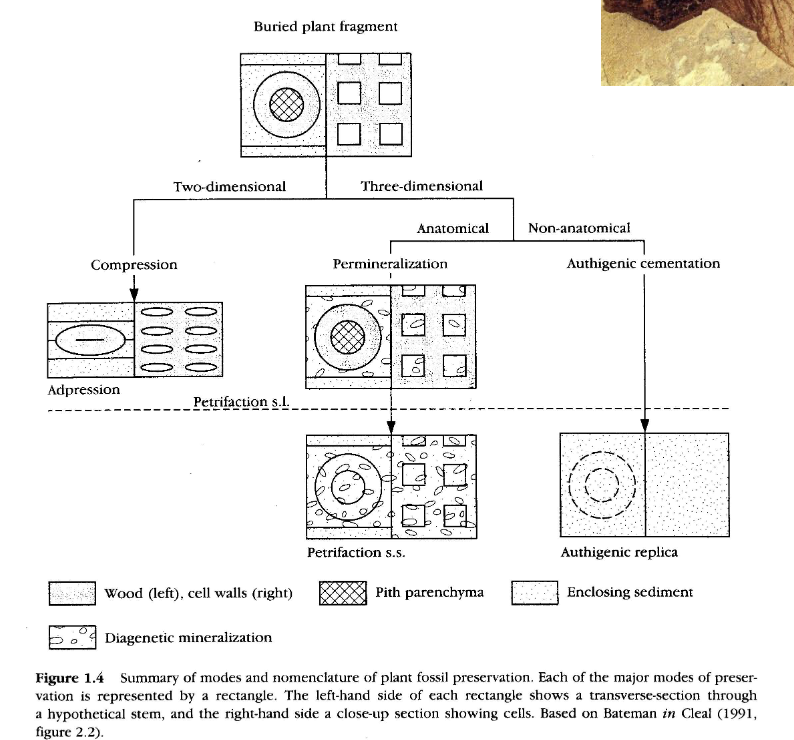
How plants are fossilised: