Biology Chapter 6: A Tour of the Cell
 Call Kai
 Learn
 Practice Test
 Spaced Repetition
 Match
 Flashcards
 Knowt Play
1/45

There's no tags or description
Looks like no tags are added yet.
46 Terms
What are the two different types of cells?
eukaryotic (more complex, with nucleus and membrane bound organelles), prokaryotic (simpler, smaller and without nucleus)
Plasma membrane
-All cells contain it
-is a selective barrier. in small things, non polar, not charged
-cell increases in size, volume grows more proportionately than are (plasma) hence why cells split before getting too large
Why do organisms generally have many cells, not smaller cells?
-cells increase, volume grows way more than area, so cell splits before it gets too large
What is the fluid inside a cell?
Cytosol, cytoplasm
What are chromosomes?
Carry genes in form of DNA
What are ribosomes
organelle that makes proteins
What are some differences between prokaryotic and eukaryotic cells?
1) location of DNA - prokaryotes dont have
2) other membrane bound organelles - prokaryotes dont
3) complexity - eukaryotes more complex
4) size - eukaryotes tend to be larger
5) Presence of flagella/fimbriae - prokaryotes have, eukaryotes dont
Prokaryotes have:
fimbrae - movement on the surface of some
nucleoid - region where cell's DNA is, but not enclosed
ribosomes - make proteins
plasma membrane
cell wall/capsule
flagella - for movement
What is the nucleoid?
In prokaryotes, it is where the cell's DNA is stored, but it is NOT an enclosed organelle.
What are some differences bw an animal and a plant cell?
Animal - has centriole, lysosomes, ECM
Plant - has central vacuole, chloroplasts, amyloplast (starch grain), cell wall, chlorophyll, photosynthesizes
Cell Membrane is also known as
Plasma membrane
What are membranes made of usually?
A double layer of phospholipids, as well as other lipids (like cholesterol) and proteins
What is the primary purpose of a cell membrane?
To control movement in and out of the cell, define cell from outside space
The nucleus
-part of the endomembrane system
-contains most of genes
-has double membrane itself
-has pores that allow mRNA in and out of the nucleus
-pore complex lines each pore and regulates entrance and exit of proteins
Structure of the nucleus

DNA is loacted in
chromosomes, made up of a material called chromatin (proteins and DNA)
what is the nucleolus?
Nucleolus produces ribosomes
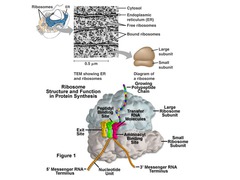
Ribosomes
-make proteins
-both in prokaryotic and eukaryotic
Ribosome
Notice that there is a space b/w small subunit and large subunit. This is where the ribosome pieces together a protein.
Transport vesicles
Transport vesicles budd off ER and other endomembrane organelles. It fuses with their membrane.
-walks along tracks of microtubules (think kinesin feet)
What is the golgi Apparatus
A stack of flattened sacks
What happens in the golgi?
-packing, sorting, modification of phospholipids, proteins
-many polsyaccharides are made here
-storage of lysosome enzymes
Lysosomes
membranous sac of digestive enzymes
-mergers with food vacuoles at eats them!
Vacuoles
For:
-water balance,
-waste storage
-food storage
What is the central vacuole in a plant cell?
In plants, holds food, water, waste, starch
-also helps to hold up the cell (it's HUGE)
solution inside vacuole is sap and not cytosol
What are the organelles in the endomembrane system? What organelles are membrane bound?
plasma
nucleus
endoplasmic reticulum
Central Vacuole
Golgi
Vesicles
What are the two types of ER?
-made of rough ER - protein synthesis and storage, smooth er - lipid synthesis
What do rough ER do?
-Rough ER has ribosomes attached
-these ribosomes are where protein syntehsis takes place
-transport vesicles bud from rough ER
What do smooth ER do?
-outer surface lacks ribosomes - smooth
-synthesices lipids
structure of ER

What are chloroplasts
only in plant cells, source of photosynthesis
What is the structure of a chlorplast?
outside is outer membrane
inner membrane
In the stroma (flui), there are stacks of thylakoids
Structure of a chlorplast

Mitochondria's function
site of metabolic activity, creates ATP
extracts energy from food
Structure of mitochondria
outside layer smooth
inbetween is intermembrane space
inside membrane layer folded into layers of cristae
Structure of a mitochondria

cytoskeleton
network of fibers extending through cytoplasm for support and movement
Motor proteins interact with cytoskeleton for cell motility - flagellum and cilia
What are the two types of cytoskeleton fibers we learned about?
1) microtubules
3)microfilaments
Microtubules
Main functions: cell motility, maintenance of cell shape, chorosome movements in cell division (division spindle forms here), organelle movements
Structure-hollow tubes made from proteins
Cilia and flagella are made out of which cytoskeleton type?
Microtubules
What is the difference between cilia and flagella
Cilia - usualy has many, but shorter and they beat like oars. Can also be used for senseing what's going on ouside cell
Flagella, one or a few, longer, undulating motion that generates movement
What is the structure of microtubules?
They grow by adding subunits (protwins). they are HOLLOW
they are organized in centrosomes
What are centrioles?
used for cell division in animal cells, grows out of centrosomes. Division spindle grows out of the centrioles.
Which is the thickest cytoskeleton type?
microtubules
Microfilaments
Main functions: maintenance of cell shape, changes in cell shape, muscle contraction, cell motility, cell division (cleavage formation), muscle contraction, cytoplasmic streaming
Structure-globular protein actin.
Plant cell walls
-made from microfibrils of cellulose
-primary cell wall (young plant cell, thin and flexible)
-middle lamella (b/w primary walls of adjacent cells, have pectins)
-secondary cell - matures and stops growing, plant cell strengthens its walls