Outputs and Costs
 Call Kai
 Learn
Learn Practice Test
 Spaced Repetition
 Match
Match Flashcards
 Knowt Play
1/21

Earn XP
Description and Tags
Name | Mastery | Learn | Test | Matching | Spaced | Call with Kai | Chat |
|---|
No analytics yet
Send a link to your students to track their progress
22 Terms
How does a firm typically increase output in the short run?
They usually increase labour with fixed capital
Why is the Marginal Product Curve negative U-Shaped?
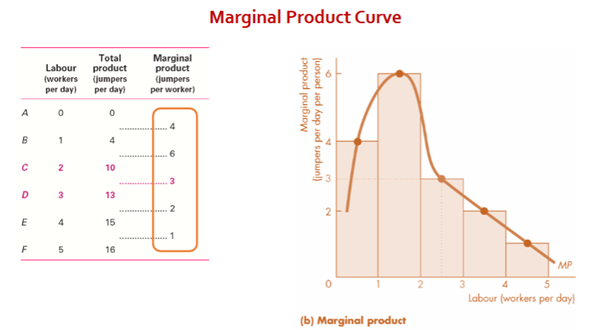
Marginal product originally increases average product per worker due to the division of labour and increased specialisation; but due to limited capital, when additional labour is added, the marginal increase in productivity is smaller, so the MP curve decreases
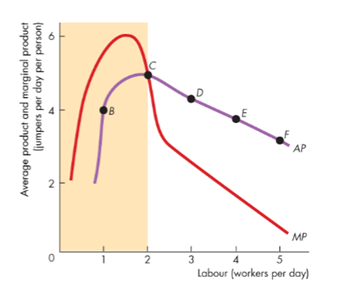
When is productivity at a maximum?
When MP=AP (at this point AP is at a maximum)
What is total fixed costs (TFC)?
Cost of a firm’s fixed inputs. Cost of setting up operations, and don’t change with output
What is Total Variable Cost (TVC)?
Cost of a firm’s variable inputs, which change with output. Also described as the product of wage rate and units of labour
What is Total Costs (TC)?
Sum of TFC and TVC
What is the Marginal Cost (MC)?
The change in total output resulting from producing an additional unit of output (MC = 𐤃TC/𐤃Q)
What is the Average Total Cost (ATC)?
What it costs on average to produce a unit of output
What is average fixed cost (AFC)?
Total fixed costs per unit of output (TFC/Q)
What is the average variable cost (AVC)?
The total variable costs incurred per unit of output (TVC/Q)
GRAPH SHOWING HOW MC, ATC, AVC AND AFC CHANGE WITH OUTPUT
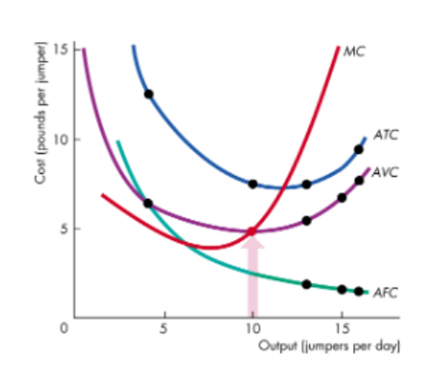
Why is the AVC curve U-Shaped?
Law of Variable Proportions, where the curves moves up or down towards the given technology’s “ideal” combination of inputs, which increases technological efficiency
What is a key difference between outputs and costs in the long run compared to the short run?
In the short run, at least one factor of production is fixed; whilst in the long run, all quantities of all resources, including plant size, can be varied.
What are sunk costs?
Costs incurred by a firm and can’t be changed. However, they are irrelevant to a firm’s decisions
What is a firm’s production function?
It’s the relationship between the maximum attainable output and the quantities of both labour and capital
What 2 things do firm’s production functions exhibit, and how do these affect the ATC curves?
Diminishing Marginal Returns to Labour (for a given plant size)
Increasing plant size gives a greater output to which ATC is at a minimum
Diminishing Marginal Returns to Capital (for a given quantity of labour)
Explains the U-Shaped nature of the ATC curve
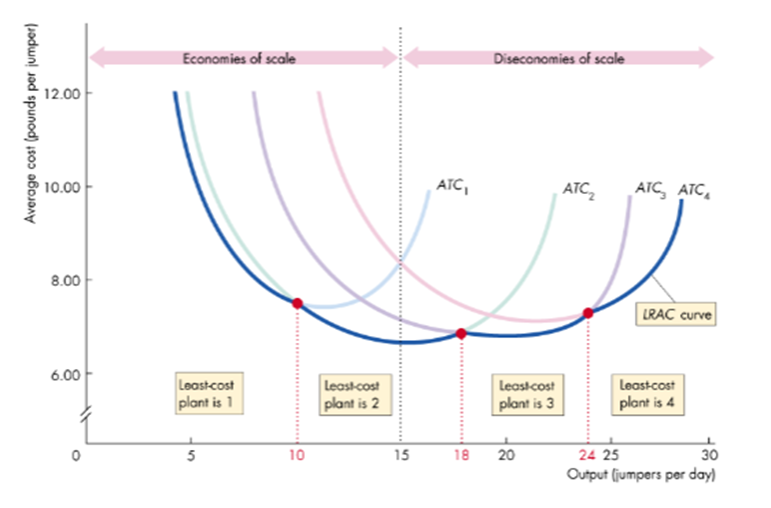
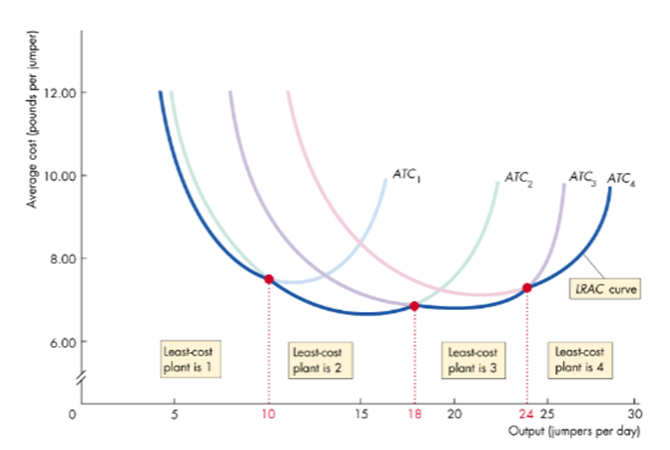
What is the LRAC curve, and how is the Long-Run Average Cost (LRAC) curve found?
LRAC Curve = The planning curve that tells the firm the plant size that minimises the cost of giving a certain output range
Found by taking the minimum parts of each plant size’s ATC curves
What are economies of scale?
Features of a firm’s technology that lead to FALLING LRAC as output increases
What are diseconomies of scale?
Features of a firm’s technology that lead to rising LRAC as output increases
What are constant returns to scale?
Features of a firm’s technology that lead to constant LRAC as output increases
What is the minimum efficient scale?
Smallest quantity of output at which the LRAC reaches its lowest level.