Chapter 6: Applications of Rational Choice and Demand Theories
 Call Kai
 Learn
 Practice Test
 Spaced Repetition
 Match
 Flashcards
 Knowt Play
1/123

There's no tags or description
Looks like no tags are added yet.
124 Terms
Why is pricing public transport difficult?
Trade off betw:
Low fare:
Increase use of PT → reduce traffic, pollution
Accessible/affordable for low income citizens (w no car access)
High fare:
Increase revenue (cover costs)
Expensive to maintain
Most consumers are well-off
Why might passenger numbers rise despite a fare increase?
Other factors may increase demand
Shift DC right
Why is PED greater in the LR than SR? (more elastic)
More time to find subs
Why might governments subsidise public transport?
To
Improve mobility
Reduce inequality (more affordable for low income citizens)
Reduce congestion
Reduce emissions
What is the main trade-off of cheaper public transport?
Greater accessibility vs lost gov revenue
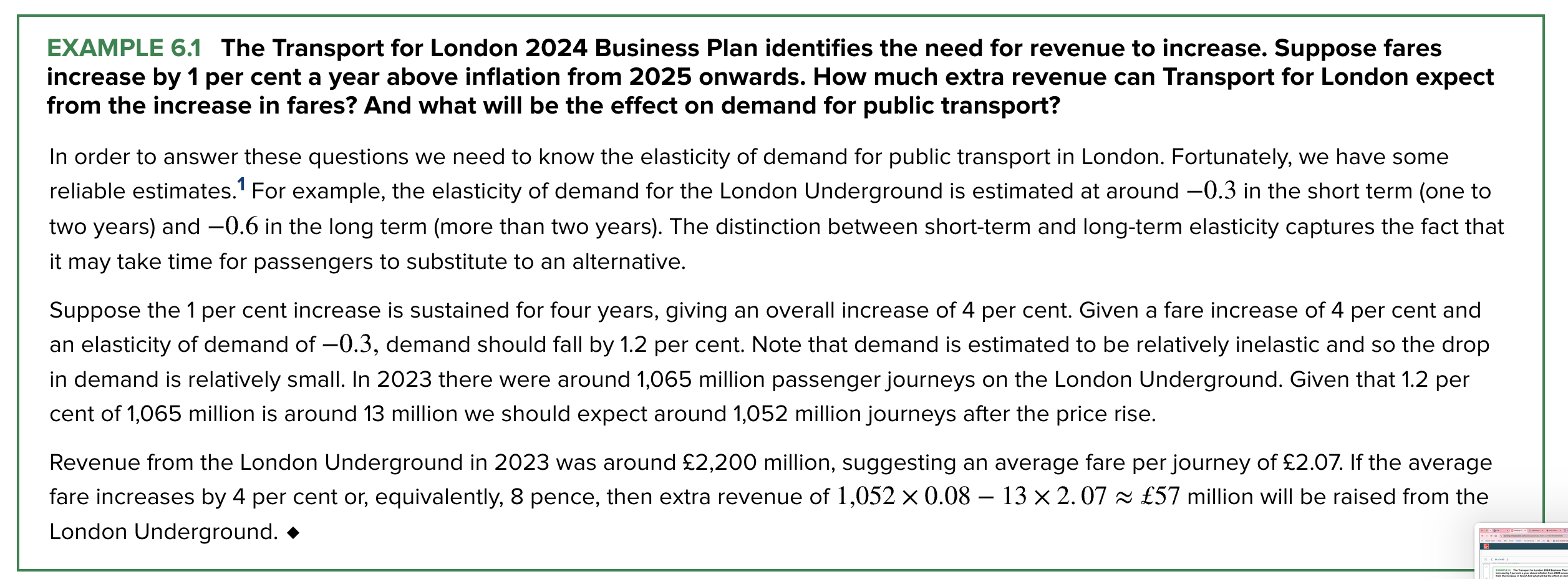
How to calculate % change in QD
PED x % change in price
What can PED help predict?
Changes in QD after a price change
Which can be used to estimate gain / loss in revenue after a price change
Why do we need PED for different consumer groups?
PED differs betw consumer groups → avg PED = misleading + hides differences betw groups
Eg need to know if low income residents will acc increase PT use if prices fall (ie have elastic demand)
Normative judgement abt public transport
Policymakers must decide whether the social benefits of cheaper transport justify the financial cost.
A value-based judgement about whether a policy is desirable

Are people living in the suburbs proportionally more or less likely to be in poverty?
More
Purpose of very very low fares for public transport
Help people in poverty afford PT / increase mobility + reduced CO2 emissions
Redistributive policy from those with high → low incomes
Pros + cons of redistributive policies (ie very low PT fares)
Benefit | Cost |
|---|---|
Greater mobility for poorer households | Lower government revenue |
Reduced inequality | Financial pressure on public transport |
Reduced congestion and emissions |
What does an inelastic PED imply for a fare increase?
Proportionately smaller fall in QD
Decrease in gov rev
Sin tax
A tax on goods considered harmful to individuals or society
Eg sugary drinks, alc, tobacco
Eg sugar tax
Aim of sin taxes
Increase price → consumers switch to healthier subs:
Discourage consumption of harmful goods
Improve health
What is needed to analyse the effect of a sin tax?
PED
Effect of sin tax
Sin tax = increase price
Elastic demand: larger reduction in consumption, less revenue (preffered)
Inelastic demand: smaller reduction in consumption, more tax revenue
For sin taxes, would gov prefer reduction in consumption or increase revenue?
Reduction in consumption
Bc main aim is to change behaviour (not max gov rex)
Why is an elastic PED desirable?
Consumers respond strongly to higher prices,
Greater reduction of consumption of harmful goods
Cons of sin tax
Regressive
Regressive tax
Disproportionately affects lower income households
Takes larger proportion of income from poorer than richer households
Why are sin taxes potentially regressive?
Poorer households spend a larger proportion of their income on goods like sugary drinks.
→ price increases affect them disproportionately
When might a regressive sin tax still be justified?
If reduced consumption produces sufficient health benefits.
Inelastic demand: poor consumers pay more but consumption is barely reduced. Tax is HARMFUL
Elastic demand: pay more but consumption decreases significantly → improves health. Tax is BENEFICIAL
What does the argument for regressive sin taxes not neccessairily being bad assume?
Low income consumers have elastic demand (not js avg consumers)
Consumers may underestimate the LT health consequences of their consumption
For addictive goods, is the substitution effect small or large?
Small
Why might heavy drinkers have inelastic demand?
They drink bc it is a habit (addictive)
So small substitution effect
What are the two effects of an alcohol price increase?
Income effect
Substitution effect
Explain the 2 effects of a price increase on alcohol (alc tax)
1. Substitution effect
Alc becomes relatively more expensive.
Consumers substitute towards other goods.
Expected to be small for heavy drinkers because of habitual consumption.
2. Income effect
Higher alcohol prices reduce consumers' real purchasing power.
Heavy drinkers often spend a large proportion of their income on alcohol.
Their incomes also tend to be lower than average.
Therefore, the income effect can be substantial, forcing them to reduce consumption.
Evidence:
Estimated PED for heavy drinkers = −0.3.
This suggests demand is relatively inelastic.
Alcohol taxes reduce overall consumption, but heavy drinkers bear a disproportionate financial burden.
Why can the income effect be large for heavy drinkers?
Heavy drinkers:
Drink lots of alc = expensive = large budget share
Tend to have smaller incomes = alc takes up larger proportion of income
So substantial alc tax can decrease consumption
Why can heavy drinkers have elastic demand in the long run (if price of alc increases)?
Small / no substitution effect bc addictive
But large income effect bc alc takes up large portion of income + lower incomes
Pros of alcohol tax
Reduce alc consumption of heavy drinkers → reduce problems asociated w alc abuse (improve health)
Cons of alcohol tax
Demand tends to be inelastic (bc addictive) (SE>IE)
So won’t significantly reduce consumption
Would a small tax on alcohol be a good policy (ie effective)?
No
Small vs large alcohol tax
Small tax | Large tax |
|---|---|
May affect moderate drinkers | More likely to affect heavy drinkers |
Little effect on heavy drinkers | Could reduce excessive drinking |
May be ineffective | Also places a larger burden on moderate drinkers |
What do policy decisions involve?
Economic calculations
Trade-offss
Normative judgements