[AP Psychology] Biological Bases of Behavior Part B
 Call Kai
 Learn
Learn Practice Test
 Spaced Repetition
 Match
Match Flashcards
 Knowt Play
1/50

There's no tags or description
Looks like no tags are added yet.
Name | Mastery | Learn | Test | Matching | Spaced | Call with Kai | Chat |
|---|
No analytics yet
Send a link to your students to track their progress
51 Terms
Lesion
Destruction of brain tissue, occurring naturally or experimentally; can reveal what a damaged area does
Electroencephalogram (EEG)
Scalp electrodes record the brain's electrical activity as waves

CT (computed tomography) scan
Combines X-ray images from different angles to show cross-sectional brain structure

PET (positron emission tomography) scan
Maps activity by detecting where radioactive glucose is used during a task.

MRI (magnetic resonance imaging)
Uses magnetic fields and radio waves to show detailed brain anatomy.

fMRI (functional MRI)
Tracks blood-flow changes over time to estimate which brain regions are active.
MRI vs. fMRI
MRI primarily shows brain structure; fMRI estimates brain activity through changes in blood flow.
Brainstem
Core structure connecting brain and spinal cord; controls essential automatic survival functions.

Medulla
Base of the brainstem; regulates breathing and heartbeat.

Reticular formation
Brainstem nerve network important for arousal and alertness.

Rreticular activating system
Eegulates wakefulness, arousal, sleep-wake transitions, and sensory filtering

Thalamus
Sensory relay/switchboard that sends most incoming sensory information to the cortex.

Which sense largely bypasses the thalamus on its initial pathway?
Smell (olfaction).
Cerebellum
"Little brain" behind the brainstem; coordinates voluntary movement, balance, and sensory input.

Limbic system
Interconnected structures involved in emotion, motivation, and memory; includes amygdala, hippocampus, and hypothalamus.

Hippocampus
Important for forming new explicit memories.

Amygdala
Limbic structures involved in fear, aggression, and processing emotional significance.

Hypothalamus
Regulates hunger, thirst, body temperature, and reward; influences the pituitary gland (the 4 Fs).

Pituitary gland
Endocrine gland whose hormone release is regulated in part by the hypothalamus.

Reward centers
Brain circuits involved in reinforcement, motivation, and rewarding experiences.
Reward deficiency syndrome
A proposed, debated idea linking reduced reward-system function to increased reward-seeking; not an established single explanation for addiction.
Cerebrum
Largest brain region, with two hemispheres; supports perception, voluntary action, memory, and higher thinking.

Cerebral cortex
Thin outer layer of the cerebral hemispheres; major center for processing and controlling behavior.

Glial cells
Nervous-system cells that support, nourish, and protect neurons.

Frontal lobes
Behind the forehead; involved in planning, judgment, personality, speech, and voluntary movement.

Parietal lobes
Upper/rear cortex; processes touch and body-position information.

Occipital lobes
Back of the brain; mainly process visual information.

Temporal lobes
Near the ears; involved in hearing and aspects of language and memory.

Motor cortex
Rear of frontal lobe; initiates voluntary muscle movements.

Somatosensory cortex (sensory cortex)
Front of parietal lobe; processes touch and body sensations.

Contralateral organization
Each cerebral hemisphere generally controls and senses the opposite side of the body.

Motor cortex map (motor homunculus)
Body parts have differently sized cortical areas; finer control requires more cortex.

Sensory cortex map (sensory homunculus)
Body parts with greater touch sensitivity have larger cortical representations.
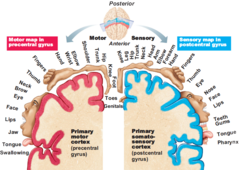
Neural prosthetics
Devices that use neural signals to help control or restore functions such as movement.

Association areas
Cortical regions supporting higher functions such as learning, memory, planning, thinking, and language.
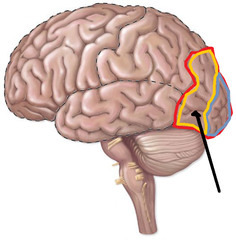
Phineas Gage
Railroad worker whose frontal-lobe injury was followed by major personality and behavior changes.

Aphasia
Impairment of language, often after damage to left-hemisphere language regions.

Broca's area
Usually in the left frontal lobe; important for producing spoken language.

Wernicke's area
Usually in the left temporal region; important for understanding language.

Plasticity (neuroplasticity)
The brain's ability to reorganize neural connections after experience or damage.
Constraint-induced movement therapy
Rehabilitation that limits use of an unaffected limb to encourage practice with an impaired limb.
Neurogenesis
Formation of new neurons.
Corpus callosum
Large band of nerve fibers connecting the left and right cerebral hemispheres.

Split-brain condition
Hemispheres are disconnected, usually after surgery cutting the corpus callosum to reduce severe seizures.
Hemispheric specialization
Some mental functions are more strongly supported by one hemisphere than the other.

Visual information from the LEFT visual field goes where?
Right cerebral hemisphere.
Visual information from the RIGHT visual field goes where?
Left cerebral hemisphere.
Language dominance in most people
The left hemisphere is more involved in speech and language production.
Consciousness
Awareness of ourselves and our environment.
Cognitive neuroscience
Study of how brain activity relates to thinking, perception, memory, and language.
Dual processing
Information can be processed simultaneously on conscious and unconscious tracks.