CHAPTER 4,5 (AP Environmental Science)
 Call Kai
 Learn
 Practice Test
 Spaced Repetition
 Match
 Flashcards
 Knowt Play
1/122

There's no tags or description
Looks like no tags are added yet.
123 Terms
Intraspecific competition
takes place between members of the same species.
Interspecific competition
takes place between
members of different species.
Competitive exclusion
If one species is a stronger competitor, it may exclude other species from the resource.
Species coexistence.
Otherwise, if no single competitor excludes others, species live side by side.
Niche
a species’ role in an ecosystem, including
resource use, habitat use, food consumption, and other
attributes.
Fundamental niche
The full potential niche of a species
Realized niche
An individual that only plays part of its role due to competition or other interactions
resource partitioning
where individuals use shared resources in different ways over many generations, in which natural selection may favor
character displacement
where competing species diverge and develop
different characteristics from resource partitionning
Parasitism
is a relationship where one organism depends on the other for nourishment.
• Parasites live with their hosts in many ways:
– Inside the host, such as tapeworms
– On the host’s exterior, such as sea lampreys
– Free living, such as cuckoos, who lay their eggs in the nests of other species
Pathogens
Parasites that cause disease
Coevolution
Parasites and hosts adapt and counter-adapt to each other
Herbivory
animals feed on the tissues of plants.
– Insects are the most common type of herbivore.
Mutualism
is a relationship where two or more species benefit each other.
Symbiosis (mutualistic relationship)
a close physical association between species.
Pollination
only require free-living organisms to encounter each other once.
▪ Birds or insects transfer pollen from flower to flower, causing fertilization.
Community
is an assemblage of populations of organisms living in the same area at the same time.
Community ecologists
study which species coexist, how they interact, how communities change over time, and why these patterns occur.
trophic level.
Species in a community are given a rank within the feeding hierarchy
Producers
use photosynthesis or chemosynthesis to make
their own sugars.
Primary consumers
consume producers.
Secondary consumers
prey on primary consumers.
Tertiary consumers
prey on secondary consumers.
Detritivores
scavenge waste and dead bodies.
Decomposers
break down nonliving matter into smaller molecules
that cycle back into soil.
Energy at each trophic level
• At each trophic level, most of the energy input is either used for maintenance or lost as heat.
– Trophic levels will only have about 10% of the energy content, organisms, and biomass compared to the one below them.
Biomass
is the collective mass of living matter in a given place and time.
Food chain
The flow of energy and feeding relationships from lower to higher trophic levels is depicted in a
Food webs
incorporate all of the interlinking food chains within an entire community, showing the map of energy flow.
Keystone Species
A species that has an impact far greater than its
abundance.
Include the following:
– Decomposers, which recycle nutrients and replenish
the soil
– “Ecosystem engineers,” such as beavers and prairie
dogs, which physically alter ecosystems
– Top predators, which control populations of lower
trophic level consumers
Trophic cascade
If top predators are lost, primary
consumers will over consume producers and alter the entire ecosystem.
Disturbance
any event that has rapid and drastic
effects on the community and ecosystem.
– can be small and localized, such as a tree falling and creating a gap in the forest canopy.
– can be large, like hurricanes.
– may also recur regularly, such as prairie fires or insect outbreaks.
Resistance
A community that resists change and remains stable
shows ______ to the disturbance.
Resilience
A community that is changed by a disturbance but returns to its original state
Succession
Severe disturbances may eliminate all or most of the
species in a community, initiating a series of changes
Pioneer Species
Succession begins with the colonization of ______ ________.
spread over long distances easily and are adapted for growing quickly.
Climax community species
Over time, pioneers are overtaken by longer-living ___________, such as hardwood trees.
Primary succession
occurs when a disturbance removes all plant or soil life.
– Lichens secrete acids that break down rock, beginning the process of soil
formation.
Secondary succession
begins with a disturbance that alters the community but leaves the soil life intact.
– Farming, fires, storms, and landslides are examples.
Regime Shift
meaning that the entire character of the community changes due to the disturbance.
– This can occur from climate change, loss of a keystone
species, or introduction of an invasive species.
No-analog communities
Caused by human disturbances in some cases, which are mixtures of species that have not previously occurred on Earth.
Introduced species
Introduced species brought by people.
Invasive Species
Most fail to establish populations, but the ones that thrive
Eradication
the total elimination of a population, is very difficult and expensive.
– Managers instead aim to control populations with trapping, poisoning, and other techniques.
Restoration Ecology
devise ways to restore altered areas to their condition before industrialized civilization
Ecological restoration 2 aims
– Restore the functionality of an ecosystem.
– Return a community to its “pre-settlement” condition.
Biome
A regional complex of similar communities
– are classified primarily by dominant plant type and vegetation structure, which in turn is the result of climate.
Rainshadow effect
Mountains also affect climate through the _________
– When moist air moves up a steep slope, it cools and
condenses, releasing precipitation.
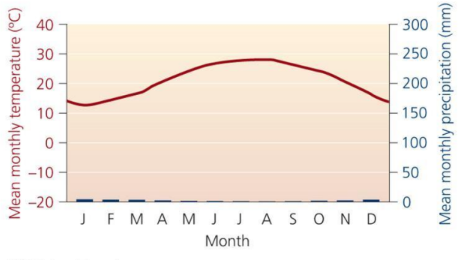
Climate diagrams, also called climatographs
depict seasonal changes in temperature and precipitation and help to tell the story of a biome.
Temperate deciduous forests
are found at midlatitudes and have relatively even precipitation throughout the year.
– Winters are frozen, causing the trees to drop their leaves.

Temperate grasslands
Temperature differences between winter and summer are more extreme and rainfall diminishes
– These biomes are also known as prairie or steppe.

Temperate rainforests
are rich in rainfall, but still found in midlatitudes.
– Mostly contain coniferous trees.
– Soils are fertile, but susceptible to erosion if the forests are
cleared.

Tropical rainforests
have dark, damp interiors, lush vegetation, and highly diverse communities.
– High numbers of tree species intermixed at low densities
– Acidic soils that are low in organic matter

Tropical dry forests
have wet and dry seasons that each occupy about half of the year.
– Temperature is consistently warm.
– Leaves are shed

Savannas
are tropical grasslands interspersed with acacias or other
trees.
– Found in dry tropical areas, including parts of Africa, Australia, and India
– Distinct wet and dry seasons

Deserts
are the driest biome, receiving less than 25 cm of rain per year.
– Soils have high mineral and low organic matter content.
– Animals and plants must adapt
Tundras
are also very dry but are consistently cold all year.
are unoccupied by humans but are the most directly impacted by air pollution and climate change.

Boreal forests
also called taiga, are also cold, but receive more precipitation than tundras.
– They are dominated by few species of evergreen trees.
– Soils are acidic and nutrient-poor.

Chaparral
is found in only a few small patches throughout the world.
– Covered by a dense thicket of evergreen shrubs
– Mild, wet winters and warm, dry summers
– Fires are frequent.
– Climate is influenced by nearby oceans.

Watershed
an area of land that drains into a body of water through rivers, delivers nutrients that sustained fields of underwater grasses.
– The grasses provided a habitat for fish and shellfish.
– Oysters kept the water clear by filtering nutrients and
phytoplankton.
Hypoxia
When decomposition of dead plankton has depletes the water
Lithosphere
is the rock and sediment in the upper mantle and crust.
Atmosphere
Air surrounding the planet
Hydrosphere
includes all surface, underground, and atmospheric water
Biosphere
consists of all the planets organisms and the abiotic portions they interact with
Abiotic
Non-living / not alive
Emergent properties
Systems with characteristics that are not evident from their components alone
(ex: studying the cell and tissue organization of a tree would not predict its importance as a habitat or food source.)
Feedback Loop
A system’s output may serve as input back into the same system, a
process
Negative Feedback loop
results when a system moving in one direction acts as an input that causes the system to move in the opposite direction.
– enhances stability in a system.
Positive Feedback Loops
occur when increased output in a system leads to increased input, which further stimulates output.
(ex: The accelerating melting of glaciers and sea ice in the Arctic is an example.)
Dynamic equilibrium
Negative feedback systems with processes that move in opposing directions at equivalent rates
Homeostatsis
the tendency of a system to maintain stable internal conditions.
Runoff
precipitation that flows over land and into waterways
Airshed
the geographic area that produces pollutants likely to end up in a waterway
Eutrophication
occurs as bacteria deplete oxygen, suffocating other organisms.
Ecosystem
consists of all organisms and nonliving entities that occur and interact in a particular area at the same time.
– Ecological communities include only living organisms.
Estuary
is an ecosystem where rivers flow into the ocean, mixing salt and fresh water.
– Organisms are affected by the flow of water, nutrients, and sediment from the rivers.
– The chemical and physical conditions of the bay’s waters are affected by the photosynthesis, respiration, and decomposition of its life.
Primary production
The conversion of solar energy into chemical bonds in sugars
Gross Primary production
The total chemical energy produced by autotrophs
Net primary production
The energy that remains after respiration is used to generate biomass
-Freshwater wetlands, tropical forests, coral reefs, and algal beds
Secondary production
Energy used by consumers to generate their own biomass
Productivity
The rate at which solar energy is converted to biomass
Nutrients
elements and compounds that organisms require for survival.
Macronutrients
Elements and compounds (nitrogen, carbon, phosphorus) needed in large amounts
Micronutrients
Nutrients needed in smaller amounts (zinc, copper, iron)
Ecotones
Areas where ecosystems meet in a transitional zone
Landscape ecology
Due to the intermixing of ecosystems, ecologists may view systems on a larger geographic scale that includes multiple ecosystems.
Patches
A landscape is made of a spatial array _____ which may be specific ecosystems or areas of habitat of an organism.
Traveling between _____ is dangerous and energy-intensive
If far enough apart, a population may be divided to subpopulations
If highly isolated individuals may not be able to move between them at all → creates extinction risk within subpopulations
Mosaic
Patches are spread out spatially over a landscape in a _______.
Metapopulation
A network of subpopulations, with limited movement between patches
Conservation biologists
study the loss, protection, and restoration of biodiversity, for ex: when patches isolation
Geographic information system (GIS).
Research tool that takes multiple types of data (geology, topography,
vegetation, etc.) and combines them into layers on a set of geographic coordinates.
Model
a simplified representation of a complex natural process.
Ecological modeling
involves constructing and testing models to explain and predict ecological
systems.
Nutrient cycles / Biogeochemical cycles
Nutrients move through ecosystems in ______ cycles
– Elements or molecules travel through the atmosphere, hydrosphere, lithosphere, and biosphere in dynamic equilibrium.
Reservoir / pool
Where nutrients move from one to the other in varying amounts of time, called the residence time
Source
When a reservoir releases more materials than it accepts
Sink
When a reservoir accepts more materials than it releases
Flux
the rate at which materials move between reservoirs.

Water in biochemical reactions
Water is the medium for all biochemical reactions, and it plays key roles in nearly every environmental system.
– Carries nutrients, sediments, and pollution
– Returns atmospheric pollutants to the surface through rain or snow