Chapter 16 - Sensory, Motor, and Integrative Systems (Part 1)
 Call Kai
 Learn
Learn Practice Test
 Spaced Repetition
 Match
Match Flashcards
 Knowt Play
1/43

There's no tags or description
Looks like no tags are added yet.
Name | Mastery | Learn | Test | Matching | Spaced | Call with Kai | Chat |
|---|
No analytics yet
Send a link to your students to track their progress
44 Terms
Somatic senses
touch, temperature, pain, proprioception
Visceral senses
sensations of our internal organs (ex. pressure, stretch, hunger)
Special senses
smell, taste, vision, hearing, balance
Free nerve endings
bare dendrites
Encapsculated nerve endings
dendrites enclosed in a connective tissue capsule
Sensory cells
specialized cells that respond to stimuli by releasing a neurotransmitter
Exteroceptors
sensory receptors located near surface of body (for external stimuli)
Interoceptors
sensory receptors located in blood vessels, organs, muscles, and nervous system (for internal stimuli)
Proprioceptors
sensory receptors located in muscles, tendons, joints, and inner ear (for body position, movement, and equilibirum)
Mechanoreceptors
detects mechanical stimuli
Thermoreceptors
detects temperature
Nociceptors
free nerve endings that detects pain (located in nearly every body tissue)
Photoreceptors
detects light in retina
Chemoreceptors
detects chemical stimuli (taste and smell)
Osmoreceptors
detects osmotic pressure in fluids
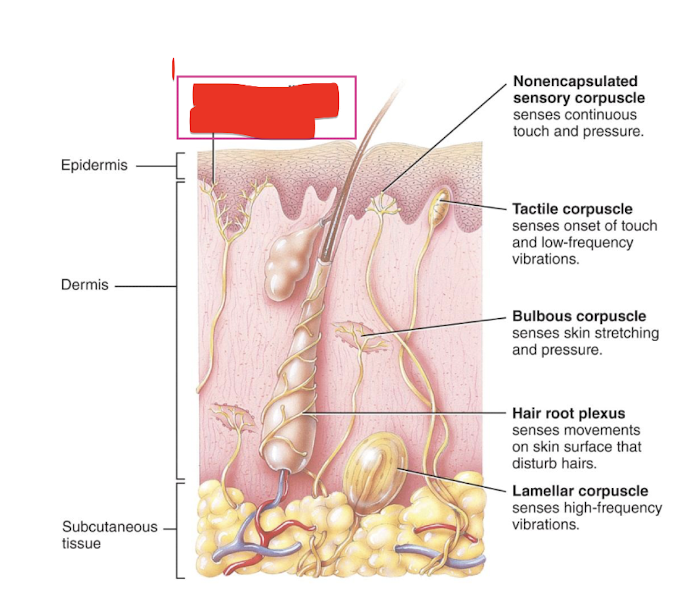
Tactile corpuscles
detects low-frequency vibrations (found in hairless skin)

Hair root plexuses
senses movements on skin surface hairs (found in hairy skin)

Nonencapsulated sensory corpuscles
senses continuous touch and pressure (found touching stratum basale)

Bulbous corpuscles
senses skin stretching and pressure (found in dermis)

Lamellar corpuscles
detects high-frequency vibrations (found in dermis, subcutaneous tissue)

Pressure
sustained tactile sensation that is felt over a larger area than touch
Vibration
tactile sensations that result from rapidly repetitive sensory signals
Itch sensation
a sensation resulting from stimulation of free nerve endings by various substances

Tickle sensation
a sensation resulting from stimulation of free nerve endings

Thermal sensation
a sensation resulting from stimulation of thermoreceptors
Fast pain
sharp acute pain that travels through medium-diameter, myelinated nerve fibers (superficial)
Slow pain
chronic aching pain that travels through small, unmyelinated nerve fibers (superficial, deeper tissues)
Superficial somatic pain
stimulation of pain receptors in skin
Deep somatic pain
stimulation of receptors in skeletal muscles, joints and tendons
Visceral pain
stimulation of pain receptors in visceral organs
Proprioception
the awareness of body position and movement
Muscle spindles
proprioceptors that monitor changes in the length of skeletal muscle

Tendon organs
proprioceptors that protect muscles from excessive tension (junction of a tendon and muscle

Joint kinesthetic receptors
proprioceptors that respond to changes of movement in joints (articular capsules of synovial joints)
First-order neurons
neurons that carry impulses from somatic receptors to brainstem/spinal cord
Second-order neurons
neurons that carry impulses from brainstem/spinal cord to thalamus
Third-order neurons
neurons that carry impulses from thalamus to primary somatosensory