OS 206 Renal Exam Voucher
 Call Kai
 Learn
Learn Practice Test
 Spaced Repetition
 Match
Match Flashcards
 Knowt Play
1/37

There's no tags or description
Looks like no tags are added yet.
38 Terms
C. Segmental renal infarction
Occlusion or injury to a segmental renal artery will cause:
A. No pathological conditions
B. Opening at the collateral circulation
C. Segmental renal infarction
D. an effect that depends on the availability of collaterals
E. Renal atrophy
C. No physiological effect
Occlusion to segmental renal vein results in:
A. Renal segmental congestion
B. Renal segmental atrophy
C. No physiological effect
D. Depends on collateral circulation
E. Gross hematuria
C. A and B
If the small ureteral arteries that form anastomoses within the ureteral adventitia are disrupted, this will result in:
A. Ureteral ischemia
B. Ureteral stricture
C. A and B
D. No physiological effect
E. Gross hematuria
D. Frequent urinary tract infections from reflux of urine back to the ureters
Patients with whom the Waldeyer sheath did not develop fully will most likely experience the following:
A. Urine will get stuck (urinary stasis) and will not continue drainage to the bladder
Weakness in the bladder floor causing incontinence
C. Retrograde ejaculation from inadequate innervation from the
pelvic plexus
D. Frequent urinary tract infections from reflux of urine back to
the ureters
A. Respiratory Acidosis
Respiratory acidosis is identified by increased pCO2 levels and HCO3-levels. Increased pCO2 levels would indicate that more carbonic acids are made, making the body more acidic. As a compensatory mechanism, the body reabsorbs more bicarbonate and produces more of it resulting in increased bicarbonate levels like in the case. Thus, A is the CORRECT ANSWER.
The patient has a pH of 7.21. The normal body pH is 7.35-7.45 which indicates that the patient is acidotic, therefore choices B and D are NOT CORRECT.
The normal bicarbonate level is 22 to 28 mEq/L. However, the patient’s ABG is 52 mEq/L which indicates increased levels. In metabolic acidosis, the values of bicarbonate should be DECREASED
A patient is brought to the ER after experiencing increased shortness of breath. The patient has the following ABG values: pH = 7.21; pO2 = 40 mmHg; pCO2 = 70 mmHg; HCO3- = 52 mEq/L. What is the patient’s condition?
A. Respiratory Acidosis
B. Respiratory Alkalosis
C. Metabolic Acidosis
D. Metabolic Alkalosis
A. Superior pole; Hilum
The transpyloric plane passes through the of the right kidney and the of the left kidney.
A. Superior pole; Hilum
B. Hilum; Superior pole
C. Hilum; Inferior pole
D. Inferior pole; Hilum
E. Superior pole; Inferior pole
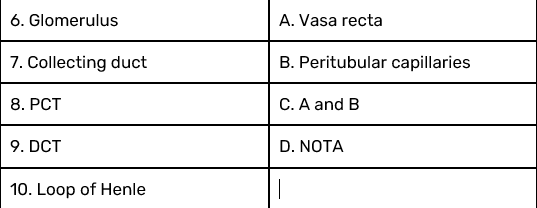
D, C, B, B, D
Matching type (answers can repeat)
A. Renal vein, renal artery, renal pelvis
he structures encountered in the renal hilum; anterior to posterior?
A. Renal vein, renal artery, renal pelvis
B. Renal artery, renal pelvis, renal vein
C. Renal pelvis, renal artery, renal vein
D. Renal artery, renal vein, renal pelvis
B. Minor calyx
The renal papilla drains directly into:
A. Infundibulum
B. Minor calyx
C. Major calyx
D. Renal pyramid
C. Proximal Convoluted Tubule
10. In which nephron segment does water exhibit the highest reabsorption?
A. Ascending limb of loop of Henle
B. Descending limb of loop of Henle
C. Proximal Convoluted Tubule
D. Distal Convoluted Tubule
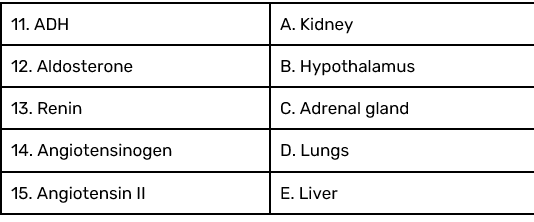
B, C, A, E, D
Matching type
D. Superior phrenic vein
Which vein does not commonly drain into the left renal vein?
A. Gonadal vein
B. Testicular vein
C. Uterine vein
D. Superior phrenic vein
E. All of the above commonly drain into the left renal vein
B. Anteriorly
A horseshoe kidney is a descent and rotation anomaly. The kidney is located caudally and the renal pelvis appears _.
A. Medially
B. Anteriorly
C. Posteriorly
D. Superiorly
D. Both B and C
The seminal vesicles aid in sperm movement so it produces secretions that are rich in?
A. Testosterone
B. Fructose
C. Prostaglandins
D. Both B and C
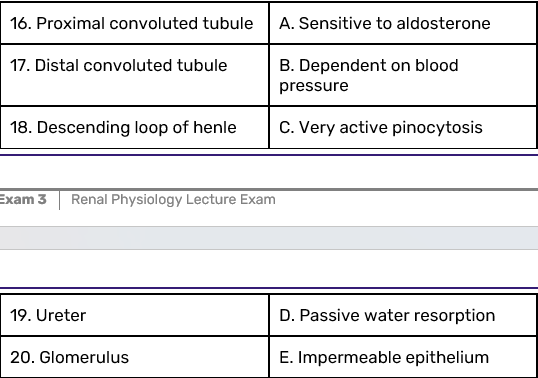
C, A, D, E, B
Matching type
D. Intramural ureter
The inferiormost end of the ureters, within the urinary bladder, acts as a collapsable flap valve when the bladder is full, is called:
A. Renal pelvis
B. Distal ureter
C. Abdominal ureter
D. Intramural ureter
C. Increased glomerular capillary hydrostatic pressure
What increases GFR?
A. Increased hydrostatic pressure in Bowman’s capsule
B. Increased afferent arteriole constriction
C. Increased glomerular capillary hydrostatic pressure
D. Increased plasma oncotic pressure
B. Reabsorbing water into the interstitium
How does the thin descending limb of the Loop of Henle contribute to the countercurrent mechanism?
A. Excreting NaCl into the luminal space
B. Reabsorbing water into the interstitium
C. It is impermeable to water
D. Reabsorbing potassium into the interstitium
D. Urea
Which solute contributes significantly to the medullary interstitial hyperosmolarity along with sodium chloride?
A. Bicarbonate
B. Glucose
C. Potassium
D. Urea
A dapat eh
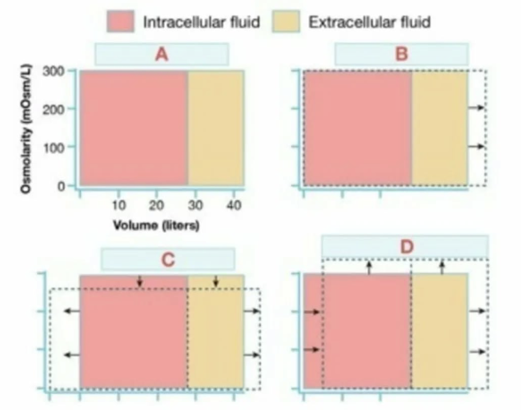
A gym enthusiast sweats profusely and decides to drink only plain water. What is the Darrow-Yannet diagram representing his change in osmolarity and volume? The healthy state is drawn in solid lines and the new steady-state in dashed lines.
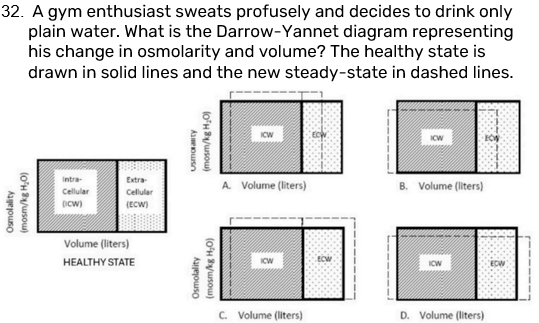
B. Anteriorly
33. Horseshoe kidney is a decent and rotation anomaly. The kidney is located caudally and the renal pelvis appears.
A. Medially
B. Anteriorly
C. Posteriorly
D. Superiorly
E. Laterally
A. Passive diffusion
Concentrated fluid from the descending limb flows countercurrent up the thin ascending limb where NaCl is passively reabsorbed.
The reabsorption of NaCl in the thin ascending loop of Henle is via the process of:
A. Passive diffusion
B. Facilitated diffusion
C. Primary active transport
D. Secondary active transport
A. Females have a lower water body composition than males due to higher fat
What statement correctly compares the water body composition of males, females and newborns?
A. Females have a lower water body composition than males due to higher fat
B. Males have a lower water body composition than females due to higher fat
C. Newborns have the same body water composition as adults, but most of it are stored in fat
D. D. Newborns have the lowest extracellular fluid compared to adults
C. Ischial spine
The arcus tendineus fascia pelvis attaches to what bony structure in the lateral pelvis:
A. Superior pubic ramus
B. Inferior pubic ramus
C. Ischial spine
D. Anterior superior iliac spine
E. Posterior superior iliac spine
C. The kidney cannot excrete potassium because of lack of ROMK channels
What is the physiologic explanation for potassium supplementation needing to be delayed in neonates?
A. High levels of aldosterone secretion suppresses potassium secretion
B. Low tubular flow leads to low potassium excretion
C. The kidney cannot excrete potassium because of lack of ROMK channels
D. The kidney cannot excrete potassium because of the lack of sodium-potassium ATPase pumps in the proximal convoluted tubule
C. Functioning thick ascending limb of loop of henle
39. Which of the following is a requirement for neonates to achieve adequate urine concentration?
A. Decreased medullary blood flow to vasa recta
B. Increased urea recycling during the 1st week of life
C. Functioning thick ascending limb of loop of henle
D. Increased responsiveness to antidiuretic hormone
B. 2 years of age
At what age do most kidney functions, including glomerular filtration rate, acid-base balance, urine concentration, and other renal parameters reach the levels comparable to those of adults?
A. 6 months of age
B. 2 years of age
C. 7 years of age
D. 18 years of age
C. Loss of negative charge on glomerular filtration barrier
A 45-year old patient presents with symptoms of nephrotic syndrome and proteinuria. A biopsy shows podocyte effacement. What is the most likely mechanism for proteinuria in this condition?
A. Increased glomerular capillary hydrostatic pressure
B. Increased renal vascular resistance
C. Loss of negative charge on glomerular filtration barrier
D. Decreased renal blood flow
C. Hydrostatic Pressure in Bowman’s Capsule
Which force primarily opposes Glomerular Filtration?
A. Oncotic Pressure in Bowman’s Capsule
B. Oncotic Pressure in Glomerular Capillary
C. Hydrostatic Pressure in Bowman’s Capsule
D. Hydrostatic Pressure Glomerular Capillary
C. Trypsin
43. What is the first pancreatic enzyme activated?
A. Proelastase
B. Chymotrypsin
C. Trypsin
D. Enterokinase
D. Preferentially constricting the efferent arteriole
During mild volume depletion, how does Angiotensin II help maintain GFR?
A. Constricting the afferent arteriole
B. Increasing the Bowman’s capsule pressure
C. Increasing renal plasma flow
D. Preferentially constricting the efferent arteriole
A. Proximal
Which nephron segment does most organic ion secretion occur?
A. Proximal
B. Loop
C. Distal
D. Collecting
B. Enhances water reabsorption but does not directly affect secretion
What is the effect of vasopressin on tubular secretion?
A. Increases potassium secretion
B. Enhances water reabsorption but does not directly affect secretion
C. Inhibits aldosterone-mediated sodium reabsorption
D. Increases organic anion secretion in the proximal tubule
C. Vitamin B12
A patient’s stomach was surgically removed due to stomach cancer. You would expect him/her to be deficient in what vitamin?
A. Intrinsic Factor
B. Vitamin B2
C. Vitamin B12
D. Vitamin B1
A. ECL - Histamine
Enterochromaffin-like (ECL) cells release histamine, which stimulates parietal cells to secrete HCl. The other pairs are incorrect: parietal cells produce HCl and intrinsic factor, chief cells secrete pepsinogen (not HCl), and mucous neck cells produce mucus (not intrinsic factor).
Which is the correctly paired cell and secretion?
A. ECL - Histamine
B. Parietal cell - Pepsin
C. Chief Cell - HCL
D. Mucous Neck Cell - Intrinsic Factor
C. Na+-H+
50. Which is not a co-transporter involving sodium reabsorption in the proximal convoluted tubule?
A. Na+-glucose
B. Na+-amino acid
C. Na+-H+
D. Na+-bicarbonate
B. Increased lymphatic flow
Which is a major safety factor that prevents severe edema?
A. High compliance of interstitial tissues
B. Increased lymphatic flow
C. Increased plasma colloid osmotic pressure
D. Decreased capillary hydrostatic pressure.