BOC Interactions and Complement
 Call Kai
 Learn
 Practice Test
 Spaced Repetition
 Match
 Flashcards
 Knowt Play
1/45

There's no tags or description
Looks like no tags are added yet.
46 Terms
Avidity may be defined as the:
a. degree of hemolysis
b. titer of an antigen
c. dilution of an antibody
d. strength of a reacting antibody
D
The strength of a visible reaction is known as:
a. prozone reaction
b. absorption
c. avidity
d. elution
C
What describes an antigen antibody precipitation reaction of non-identity
a. precipitin lines cross, forming double spurs
b. precipitin lines fuse, forming a single spur
c. no preciptin lines are formed
d. precipitin lines fuse, forming a single arc
A
What test has the greatest sensitivity for antigen detection
a. precipitin
b. agglutination
c. ELISA
d. complement fixation
C
Excess antigen in precipitation gel reactions will
a. have no effect on the precipitate reaction
b. not dissolve precipitate after formation
c. enhance the precipitate reaction
d. dissolve the precipitate after formation
D
Soluble immune complexes are formed under the condition of
a. antigen deficiency
b. antigen excess
c. antibody excess
d. complement
B
The visible serological reaction between soluble antigen and its specific antibody is
a. sensitization
b. precipitation
c. agglutination
d. opsonization
B
The curve below was obtained by adding increasing amounts of a soluble antigen to fixed volumes of monospecific antiserum: The area on the curve for equivalence precipitate is:
a. a
b. b
c. c
d. d
C

The curve below was obtained by adding increasing amounts of a soluble antigen to fixed volumes of monospecific antiserum: The area on the curve where no precipitate formed due to antigen excess is:
a. a
b. b
c. c
d. d
B

The curve below was obtained by adding increasing amounts of a soluble antigen to fixed volumes of monospecific antiserum: The area on the curve for prozone is:
a. a
b. b
c. c
d. d
A

The curve below was obtained by adding increasing amounts of a soluble antigen to fixed volumes of monospecific antiserum: The are on the curve where soluble antigen-antibody complexes have begun to form is:
a. a
b. b
c. c
d. d
D

The curve below was obtained by adding increasing amounts of a soluble antigen to fixed volumes of monospecific antiserum: The area in which the addition of more antibody would result in the formation of additional precipitate is:
a. a
b. b
c. c
d. d
B

Refer to the following illustration: Which of the above figures demonstrates a reaction pattern of identity?
a. figure 1
b. figure 2
c. figure 3
d. figure 4
A

Refer to the following illustration: Which of the above figures demonstrates a reaction pattern of non-identity?
a. figure 1
b. figure 2
c. figure 3
d. figure 4
B
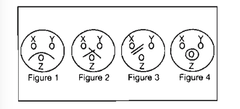
Refer to the following illustration: Which of the above figures demonstrates a reaction pattern showing 2 different antigenic molecular species?
a. figure 1
b. figure 2
c. figure 3
d. figure 4
C

Refer to the following illustration: A nonspecific precipitin reaction is demonstrated in:
a. figure 1
b. figure 2
c. figure 3
d. figure 4
D

A series of eight tubes are set up with 0.79 mL of a diluent in each. A serial dilution is performed by adding 10 µL of serum to the first tube and then transferring 10 µL through each remaining tube. What is the serum dilution of tube 7
a. 1:2.431 x 10^11
b. 1:2.621 x 10^11
c. 1:1.920 x 10^13
d. 1:2.097 x 10^13
D
The enzyme control tube in an ASO hemolytic essay exhibits no cell lysis. What is the most likely explanation for this
a. incorrect pH of buffer
b. low ionic strength buffer
c. oxidation of the enzyme
d. reduction of the enzyme
D
The following pattern of agglutination was observed in an antibody titration
Tube # 1 2 3 4 5 6 7 8 9 10 111+ 2+ 4+ 4+ 3+ 3+ 2+ 1+ 1+ 0 0
This set of reactions most likely resulted from
a. faulty pipetting technique
b. postzoning
c. prozoning
d. the presence of a high-titer, low-avidity antibody
C
In a positive antistreptolysin "O" enzyme inhibition test, the patients
a. streptolysin "O" enzyme in the patient serum neutralizes the anti-streptolysin "O" reagent, resulting in no hemolysis
b. red blood cells are hemolyzed by the streptolysin "O" enzyme in the reagent
c. anti-streptolysin "O" neutralizes the streptolysin "O" reagent, resulting in hemolysis
d. anti-streptolysin "O" inhibits the reagent streptolysin "O"s, resulting in no hemolysis
C
Blood is drawn from a patient for serological test for a viral disease shortly after the time of onset and again four weeks later. The results of the tests are considered diagnostic if the
a. first antibody titer is 2x the second
b. first and second antibody titers are equal
c. first antibody titer is 4x the second
d. second antibody titer is at least 4x the first
D
The best method to detect infections due to rubella, Epstein-Barr and human immunodeficiency viruses is:
a. antigen detection by EIA
b. cell culture
c. antigen detection by the Western blot
d. antibody detection by EIA
D (ab = Epstein/rubella)
Immunoassay are based on the principle of
a. separation of bound and free analyte
b. antibody recognition of homologous antigen
c. protein binding to isotopes
d. production of antibodies against drugs
B
What kind of antigen antibody reaction would be expected if soluble antigen is added to homologous antibody
a. precipitation
b. agglutination
c. complement fixation
d. hemagglutination
A
The following cold agglutinin titer results are observed: The best interpretation is:
a. positive, 1:128
b. negative
c. invalid because 37C reading is negative
d. repeat the 4C readings
A

In an indirect ELISA Method designed to detect antibody to the rubella virus in patient serum, the conjugate used should be
A. anti-human IgG conjugated to an enzyme
b. anti-rubella antibody conjugated to an enzyme
c. rubella antigen conjugated to an enzyme
d. anti-rubella antibody conjugated to a substrate
A
In immunofixation electrophoresis
a. the antibody reacts with the antigen and then the complex is electrophoresed
b. the antigen is electrophoresed into an antibody containing gel
c. the antigen is electrophoresed and then monospecific antisera is reacted with it
d. the antigen is electrophoresed, transferred to nitrocellulose and then antibody reacts with it and an EIA is performed
C
A single, reliable screening test for detecting neonatal infection in the absence of clinical signs is
a. serum immunoelectrophoresis
b. differential leukocyte count
c. CD4 cell counts
d. quantitative serum IgM determination
D
The serological test that can be modified to selectively detect only specific IgM antibody and untreated serum is
a. Ouchterolony
b. enzyme immunoassay
c. hemagglutination inhibition
d. passive hemagglutination
B
What is the immunologic method utilized in the flow cytometer
a. latex agglutination
b. enzyme linked immunoassay
c. immunofluorescence
d. radioimmunoassay
C
The assembly of the complement "membrane attack unit" is initiated with the binding of
a. C1
b. C3
c. C4
d. C5
D
Which of the following is most likely to activate the alternative pathway of complement activation
a. lipopolysaccharides
b. glycoproteins
c. haptens
d. IgG complexed with antigen
A
Which of the following is the largest residual split portion of C3
a. C3a
b. C3b
c. C4
d. CIq
B
Which of the following activities is associated with C3b?
a. opsonization
b. anaphylaxis
c. vasoconstriction
d. chemotaxis
A
Which of the following is the recognition unit in the classical complement pathway
a. C1q
b. C3a
c. C4
d. C5
A
Which of the following is the "membrane attack complex" of complement activation
a. C1
b. C3
c. C4, C2, C3
d. C5b, C6, C7, C8, C9
D
Which of the following releases histamine and other mediators from basophils
a. C3a
b. properdin factor B
c. C1q
d. C4
A
Which of the following is not a mechanism involved in the complement cascade
a. apoptosis
b. opsonization
c. inflammation
d. cytolysis
A
Initiation of the activation mechanism of the alternative complement pathway differs from that of the classical pathway in that
a. antigen-antibody complexes containing IgM or IgG are required
b. endotoxin alone cannot initiate activation
c. C1 component of complement is involved
d. antigen-antibody complexes containing IgA or IgE may initiate activation
D
Which of the following is cleaved as a result of activation of the classical complement pathway
a. properdin factor B
b. C1q
c. C4
d. C3b
C
The component associated only with the alternative pathway of complement activation is
a. C4
b. C1q
c. properdin factor B
d. C3a
C
Which of the following complement component is a strong chemotactic factor as well as a strong anaphylatoxin
a. C3a
b. C3b
c. C5a
d. C4a
C
The C3b component of complement:
a. is undetectable in pathological sera
b. is a component of the C3 cleaving enzyme of the classical pathway
c. is cleaved by C3 inactivator into C3c and C3d
d. is not part of the alternative pathway
C
Components of the complement system most likely to coat a cell are
a. C1 and C2
b. C3 and C4
c. C6 and C7
d. C8 and C9
B
Potent chemotactic activity is associated with which of the following components of the complement system
a. C1q
b. C5a
c. C3b
d. IgG
B
Hereditary angioedema is characterized by:
a. decreased activity of C3
b. decreased activity of C1 esterase inhibitor
c. increased activity of C1 esterase inhibitor
d. increased activity of C2
B